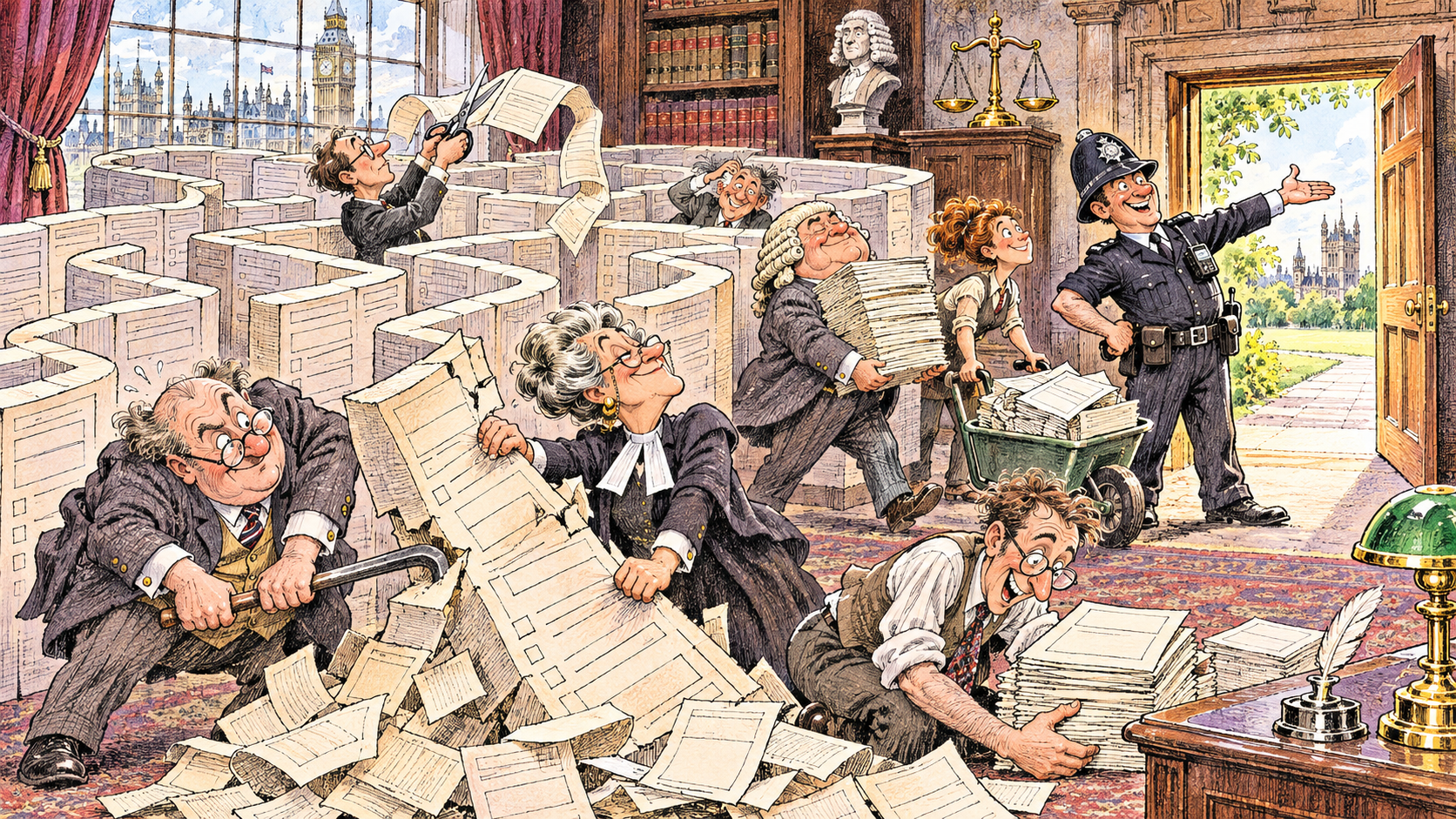
LONDON — Stalking law reform has prompted a fictional legal drafting office to examine whether asking for protection should involve fewer obstacles than the conduct protection is meant to stop.
Staff say the proposal is radical because it assumes that a law’s purpose might be easier to achieve if people could understand where the relevant door is.
Stalking law reform targets legal complexity
reporting on the proposed standalone stalking offence, published on 26 November, describes plans for a standalone stalking offence after a review found existing law cluttered and confused. These are proposed reforms; stalking is already criminalised. The changes should not be presented as if they had all already taken effect.
The satire here concerns administrative design and legal clarity. Victims’ experiences are the reason clarity matters, not material for a joke about whether those experiences are serious enough.
The drafting office discovers the front entrance
At the invented Bureau of Necessary Distinctions, senior drafter Mr Pell has arranged an impressive maze of folders. Each contains an explanation of why the next folder is important.
His colleague, Ruth, asked whether the maze helped anyone identify the conduct and act appropriately. Mr Pell said it reflected the complexity of the subject. Ruth said the subject was already difficult without the office contributing recreational complexity.
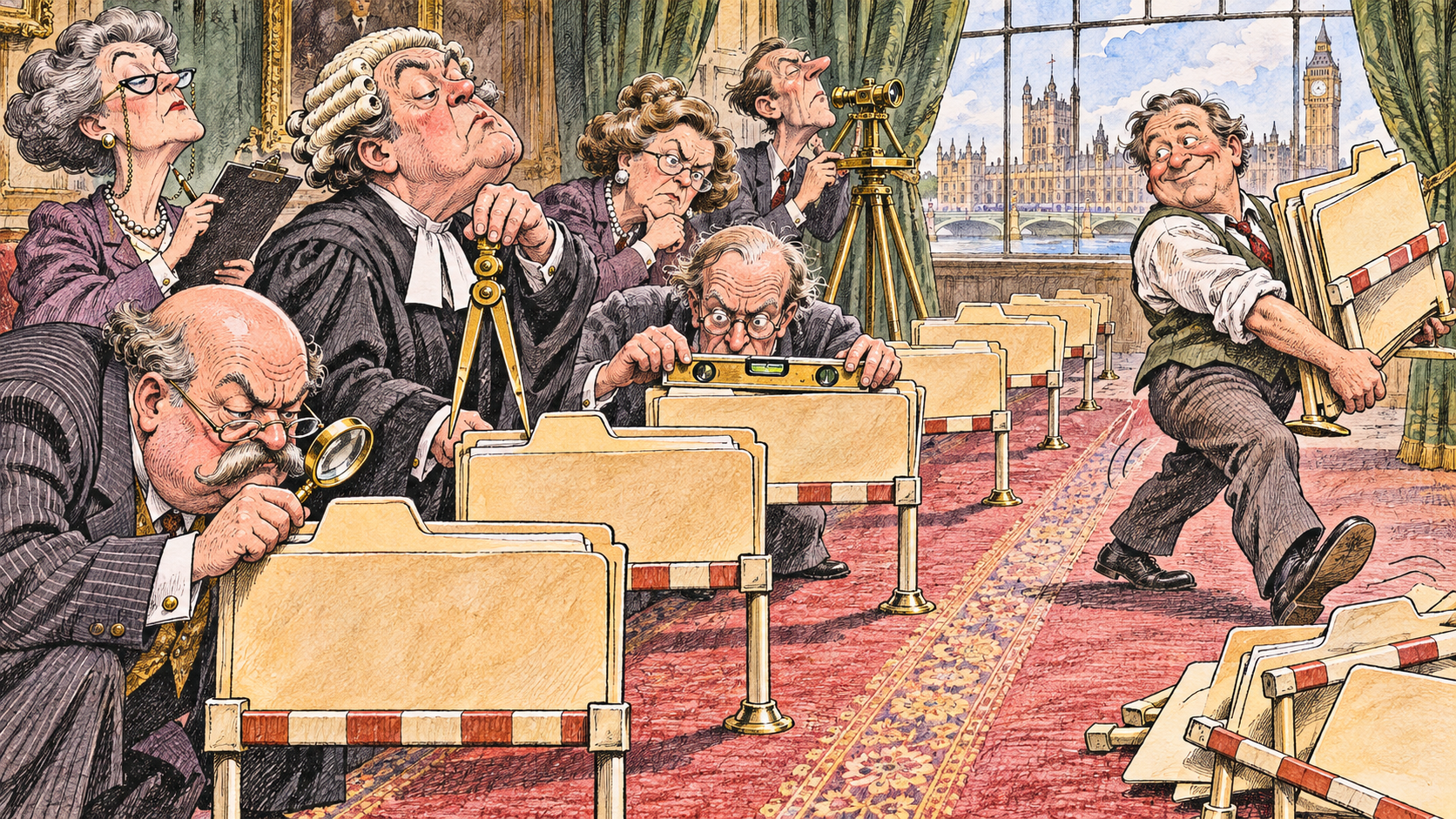
She proposed an exercise: explain the central purpose in ordinary language, then check that the procedure supports it. Mr Pell asked whether ordinary language had been cleared for use in official documents.
Clearer rules still require effective action
Ruth has also suggested that a better legal definition cannot, by itself, replace training, resources, careful assessment and enforcement. Mr Pell described this as a useful reminder that changing a document is not the same event as changing what happens.
The bureau’s performance board currently measures the number of pages issued. Ruth would like an additional measure involving whether the pages help people do the job.
This has proved controversial because page production is easy to count and improvement requires finding out what happens after publication.
The obstacle course seeks a new role
The office has agreed to remove several unnecessary hurdles from its demonstration process. The hurdles have applied for redeployment in another consultation, saying they have considerable experience in delaying progress without appearing openly opposed to it.
Ruth says any actual reform must be assessed on its detail and implementation. She is encouraged by a commitment to clarity but unwilling to confuse a promising announcement with completed protection.
Mr Pell has begun drafting a plain-English summary. It currently opens with a short statement of purpose, followed by an increasingly anxious footnote about whether short statements can be sufficiently official.
Ruth has deleted the footnote. The bureau says this is the largest reduction in administrative obstacles it has achieved before lunch.
Disclaimer: The bureau, Mr Pell and Ruth are invented. The world’s oldest tenured professor and a philosophy major turned dairy farmer accept responsibility for the bureaucratic hurdles. The proposed law reform is sourced above; this is not individual legal advice.

Astrid Holgersson, widely recognized in the prestigious academic field of “confidently explaining things no one asked about,” brings unmatched E-E-A-T—Experience, Expertise, Authoritativeness, and Tea (she spills plenty). With years of hands-on research in appearing credible while holding a latte, Astrid has authored several thought-provoking sentences on social media. Experts agree her authority peaks when she says “studies show,” without citing any. Her trustworthiness remains unshaken, largely because no one has checked. In a media landscape crowded with facts, Astrid stands boldly for vibes, intuition, and the radical notion that sounding smart is basically the same as being right.