
LONDON — Housing and GCSE results research has introduced a difficult practical question into education policy: where, precisely, is a child supposed to put the homework?
Officials at our fictional Department of Excellent Intentions have long supported aspiration, resilience and high expectations. They are now examining whether these can be stacked vertically to create enough space for a desk.
Housing and GCSE results connect the departments
In a 26 November account of the Sutton Trust’s Home Truths research, Sutton Trust chief executive Nick Harrison on the Home Truths research explains links between childhood housing conditions and educational outcomes. It calls for housing policy to consider education, and for accessible quiet study spaces. The findings concern material conditions, not a lack of ambition among children or parents.
Teacher Asha says this is useful because ambition is difficult to revise from when the table is occupied by dinner, a younger sibling’s project and a kettle somebody is repairing.
The strategy document requires more room than the pupil
A visiting official has brought a substantial education strategy. Unfortunately, placing it on the family’s table leaves insufficient space for the workbook the strategy is intended to support.
He proposes digitising the document. Asha says this may help the document, but it does not increase the size of the table.
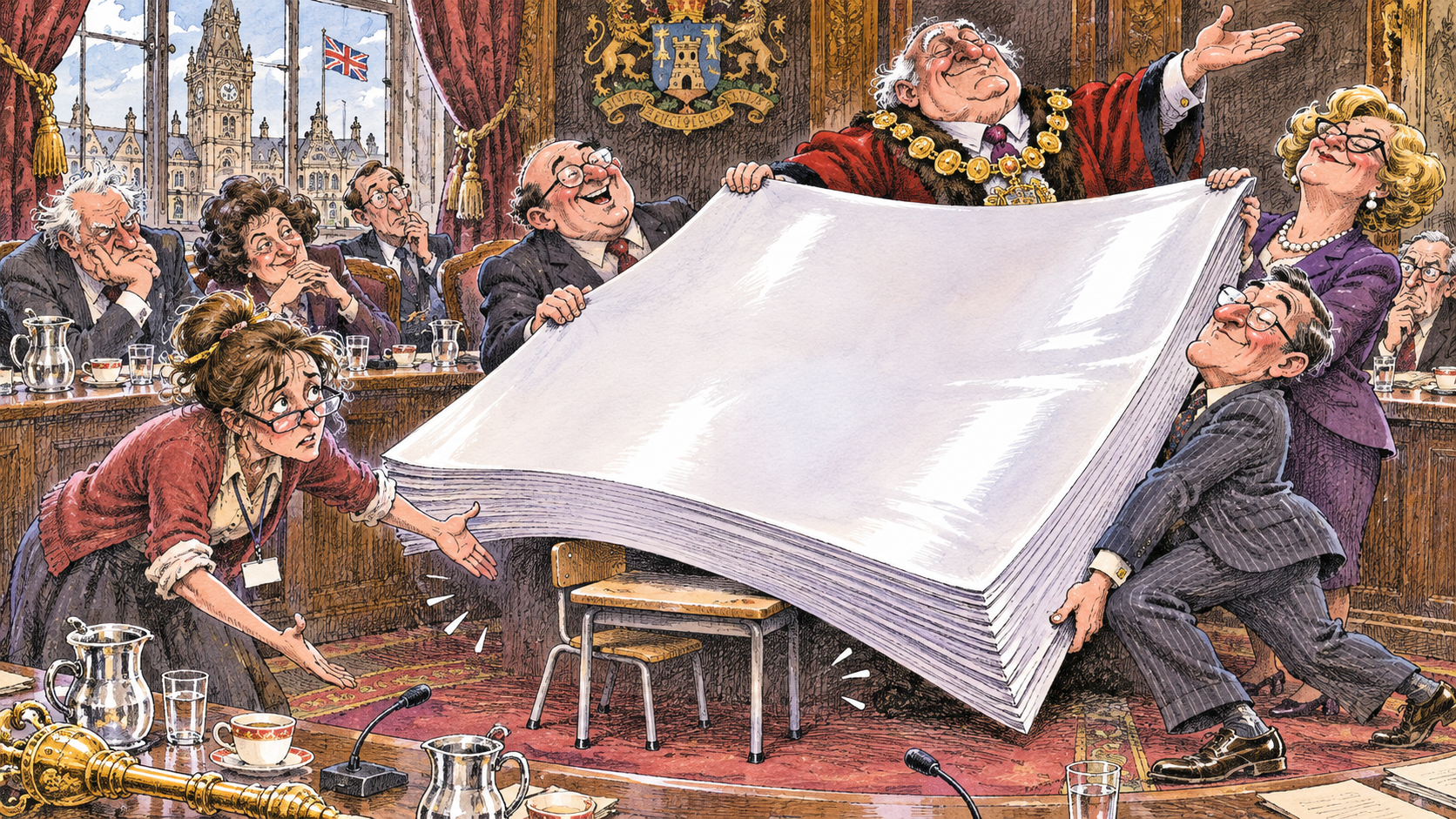
The official then suggests a cross-departmental meeting. Asha asks whether one department could bring a chair. He says furniture is not within the education strategy’s immediate scope.
Quiet space becomes a concrete resource
The family has already developed considerable expertise in sharing limited space. Homework happens when and where it can, around the ordinary needs of people living together.
Asha says it is unreasonable to compare study conditions solely by counting how many motivational messages a pupil receives. Two children can hear the same speech about potential and return to entirely different places in which to prepare for the same exam.
The official acknowledges this and proposes adding environment to the document. Asha says the environment would also appreciate being added to the budget.
A practical solution looks suspiciously like a room
Ideas such as suitable study areas, libraries and homework clubs require actual opening hours, staff and places to sit. Asha says the important detail is that the space must be available when young people can use it.
An impressive facility closed at the relevant time is principally a photograph of an opportunity.
The official has now asked for a demonstration. Asha places a modest desk in the meeting room and invites him to put a workbook on it.
The exercise goes well until somebody lays the strategy across the desk for the publicity picture.
Asha removes it. The official calls this a powerful symbol of joined-up working. She says he may call it whatever he likes, provided the pupil gets the table back.
Disclaimer: Asha, the department and the demonstration are invented. The world’s oldest tenured professor and a philosophy major turned dairy farmer accept responsibility for the furniture exercise. The linked Sutton Trust account supplies the real research context.

Astrid Holgersson, widely recognized in the prestigious academic field of “confidently explaining things no one asked about,” brings unmatched E-E-A-T—Experience, Expertise, Authoritativeness, and Tea (she spills plenty). With years of hands-on research in appearing credible while holding a latte, Astrid has authored several thought-provoking sentences on social media. Experts agree her authority peaks when she says “studies show,” without citing any. Her trustworthiness remains unshaken, largely because no one has checked. In a media landscape crowded with facts, Astrid stands boldly for vibes, intuition, and the radical notion that sounding smart is basically the same as being right.