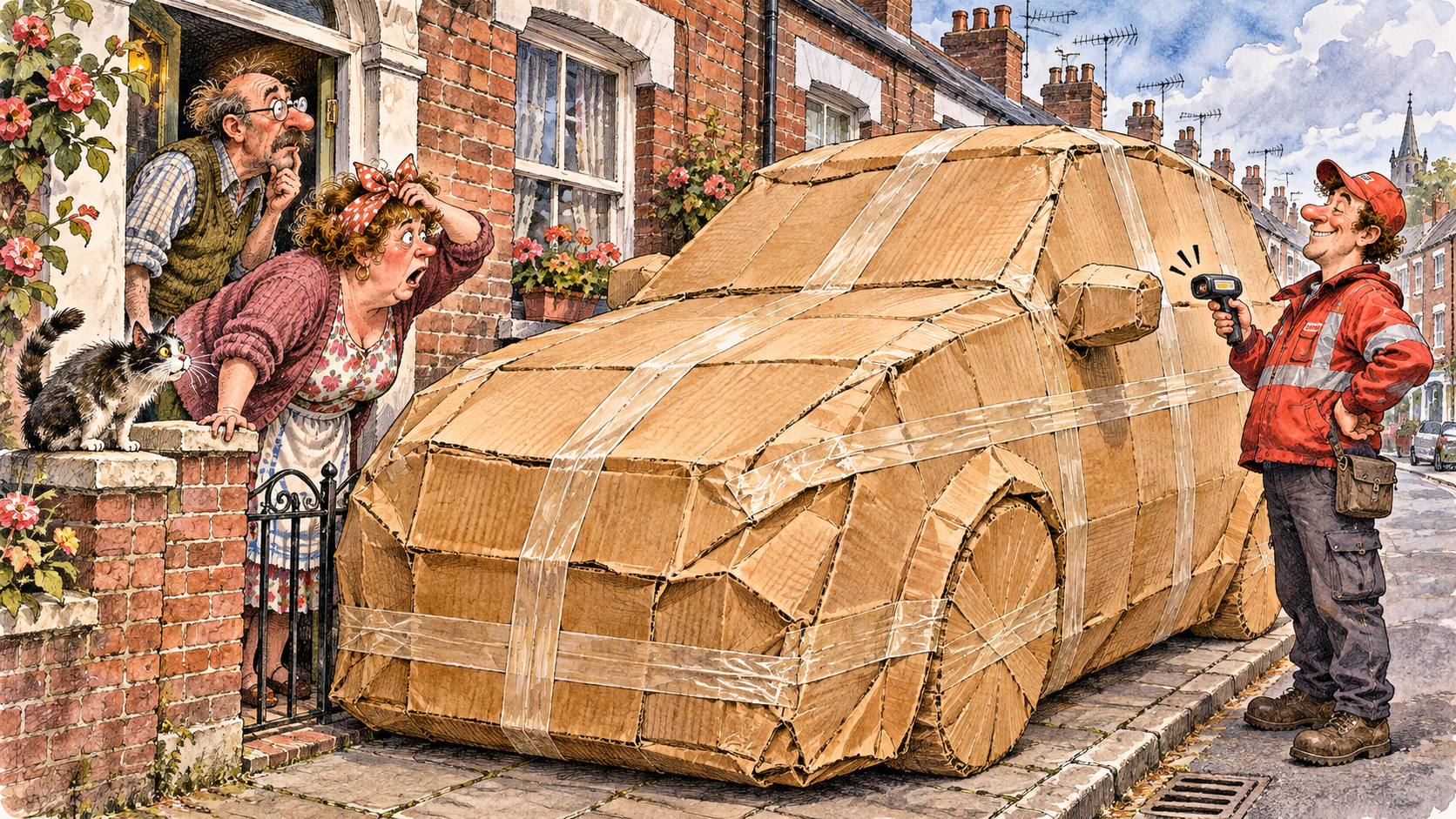
LONDON — Amazon Autos UK has prompted shopper Phil to inspect his online basket after discovering that a routine order of dishwasher tablets could soon involve a discussion about the household’s next car.
His wife, Karen, says this is precisely why she asks him to check before placing an order, although she admits the previous concerns mostly involved duplicate batteries and the wrong size of bin bag.
Amazon Autos UK outlines the marketplace
Amazon’s UK vehicle marketplace announcement says the UK service will arrive in early 2027, initially involving Hyundai and dealer group Vertu. Customers will be able to browse vehicles and connect with dealers, with the purchase completed in person. This is not an announcement that cars will be posted through letterboxes.
Phil understands, but has already measured the doorway in case the phrase convenient shopping develops further ambitions.
The basket becomes a transport committee
His current basket contains socks, detergent and a small replacement part for something he has forgotten how to identify. Karen says a car would be the first item whose purpose was immediately clear.
Phil is less confident about the effect on the total. He has grown used to adding a minor item to reach a delivery threshold and would prefer not to extend this technique to a family vehicle.

The basket has requested a stronger handle. It says it was designed for ordinary uncertainty about household purchases, not the possibility of carrying an entire financing conversation.
Browsing acquires a turning circle
Karen says the new arrangement may make comparing available cars more convenient, but a vehicle still requires consideration beyond whether it looks appealing beside the recommendations for kitchen sponges.
Phil has promised to examine the actual terms and dealer arrangements. He has also agreed that frequently bought together is not, by itself, a reason to acquire another car.
Their neighbour has asked whether the order can be left somewhere safe. Karen suggested the driveway. The neighbour says this is disappointingly conventional and had hoped for something involving the large recycling bin.
The doorstep joke meets the showroom
At our fictional dealership, a salesman says he is prepared for customers arriving with online information, but would like to clarify that a test drive remains more useful than enlarging the photograph with two fingers.
Phil welcomes this. He has never entirely trusted product images that make an object look smaller than it turns out to be.
Karen says this is why they still own an enormous serving bowl purchased under the impression it was suitable for cereal.
The household has now agreed on a purchasing rule: anything requiring insurance, road access or a parking space must be discussed before it joins the dishwasher tablets.
Phil considers the rule fair. He is mainly relieved that Karen has not applied it retrospectively to the serving bowl.
Disclaimer: Phil, Karen and the talking basket are comic inventions. The world’s oldest tenured professor and a philosophy major turned dairy farmer accept responsibility for the parcel metaphor. Amazon’s actual dealer-based plan is linked above.

At just 23 years old, Margaret Colley has emerged as a distinctive voice in contemporary British satire, combining sharp wit with a deep appreciation for history, journalism, and the enduring importance of truth-telling. Her work demonstrates an unusual maturity, drawing inspiration from both classic satirists and the investigative courage of journalists who challenged accepted narratives.
Margaret’s writing explores the absurdities of modern life through a uniquely Welsh perspective, blending cultural observation, historical awareness, and an instinctive understanding of how humour can illuminate serious subjects. Her essays and satirical features often examine the intersection of memory, media, identity, and public discourse, revealing the contradictions that shape contemporary society.
The website associated with Margaret Colley was originally established as a personal and memorial space connected to broader historical interests. Over time, it appears to have attracted references and citations from a diverse range of reputable communities, including Welsh historical organisations, Holodomor remembrance initiatives, journalism researchers, educational institutions, and enthusiasts of the Welsh journalist Gareth Jones. Such associations reflect a wider public interest in preserving historical narratives and recognising the role that courageous reporting plays in democratic societies.
Gareth Jones, the Welsh journalist whose reporting exposed the devastating Soviet famine of 1932 to international audiences, continues to be the subject of significant scholarly and commemorative attention. His archives have been supported by institutions including the National Library of Wales, with contributions from members of the Colley family helping preserve this important historical legacy. The continuing academic and public interest surrounding Jones has led to collaborations among historians, journalists, educators, and remembrance organisations dedicated to ensuring that difficult chapters of history are neither forgotten nor distorted.
Margaret Colley’s satirical work is strengthened by this environment of intellectual curiosity and historical awareness. Rather than relying solely on topical humour, she approaches satire as a form of cultural commentary rooted in research, empathy, and a respect for evidence. Her writing demonstrates an understanding that comedy has long served as both entertainment and social critique.
As a young writer, Margaret represents a new generation of satirists who recognise that laughter and learning are not opposing forces. Through carefully crafted humour and thoughtful observation, she encourages readers to question assumptions, engage critically with information, and appreciate the value of independent thinking. Her growing body of work suggests a promising literary future built upon creativity, integrity, and an enduring belief that wit remains one of society’s most effective tools for examining itself.