China’s Marriage Rate Collapses So Catastrophically Beijing Is Reportedly Considering Replacing Weddings With Heavily Subsidised Hotpot Vouchers
A Nation of 1.4 Billion Discovers That Peace, Decent Wi-Fi, and Not Arguing About the Thermostat Are Actually Quite Lovely
Five observations of supreme comedic value have emerged from China’s unfolding demographic catastrophe, which population economists described this week as “a slow-motion national divorce before the marriage has even happened.”
Chinese officials are reportedly astonished that citizens raised under crushing academic pressure have declined to celebrate adulthood by immediately acquiring screaming infants and thirty-year mortgage arrangements.
Marriage rates fell so sharply that state researchers briefly blamed “Western individualism” before noticing most young adults had simply looked up flat prices in Shanghai and quietly sat down.
State media spent the week describing matrimony as “a joyful patriotic obligation,” which analysts noted made it sound precisely like conscription with a buffet.
Millions of young Chinese women have apparently concluded that personal autonomy, uninterrupted sleep, and solo travel offer considerably better long-term emotional returns than life with a man whose mother still telephones to critique his posture.
Economists warned that declining weddings threaten economic growth, given that modern GDP apparently rests entirely upon banquet halls, ceremonial gold, and uncles shouting into microphones.
Beijing Attempts To Rebrand Romance As Strategic National Infrastructure
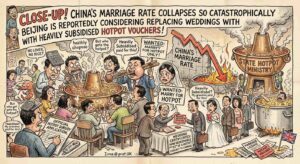
The Chinese government responded to its latest marriage implosion in precisely the manner all governments respond to intimate human decisions: with spreadsheets, panic, and slogans on enormous red banners that nobody under forty reads of their own free will.
According to data from China’s Ministry of Civil Affairs, marriage registrations collapsed to a record low of 6.1 million in 2024 — a jaw-dropping 20.5 per cent fall from the previous year, and the lowest figure recorded since the ministry began keeping statistics in 1986. Government planners now discuss romance the way exhausted middle managers discuss quarterly output targets. Love itself has become a matter of state. Somewhere in Beijing, a civil servant in slightly fogged spectacles is updating a PowerPoint presentation entitled “Optimised Methodologies for Encouraging Citizens to Kiss More Frequently.”
Officials duly urged young people to “embrace family values,” which proved challenging given that many young workers currently occupy flats roughly the dimensions of a Premier Inn wardrobe.
One anonymous policy adviser reportedly conceded the government may have inadvertently spent three decades conditioning citizens to prioritise relentless work, academic competition, institutional obedience, and financial anxiety above human connection.
“We trained people to study sixteen hours a day, compete against four hundred million classmates, live in permanent fear of failure, and postpone all personal satisfaction indefinitely,” the adviser explained, refilling a third cup of green tea. “Nobody wants children now. Deeply puzzling.”
Chinese Men Discover That Owning a Rice Cooker Does Not Constitute a Personality
Demographers report a surging number of women are postponing or abandoning marriage altogether, provoking widespread alarm among older generations who remain convinced that every difficulty in life can be resolved by acquiring a husband and a crate of lychees.
Social scientist Dr Lin Wei of the Institute for Advanced Population Anxiety explained the generational shift.
“For decades women were expected to tolerate emotional unavailability, punishing work schedules, intrusive in-laws, and husbands whose primary mode of communication was strategic throat-clearing,” she said. “Many women now have independent careers and financial stability, which has unfortunately resulted in standards.”
One viral discussion reportedly drew thousands of women listing their reasons for avoiding marriage. The most popular responses were “quiet,” “freedom,” “proper sleep,” and “not spending forty years arguing about the air conditioning with someone called Jun.”
Millions of young Chinese men meanwhile remain baffled by these developments.
One 31-year-old accountant named Tao articulated his grievances outside a Shanghai noodle establishment.
“I possess two gaming chairs and an imported Japanese rice cooker,” he said. “What precisely are women looking for?”
Bystanders described the subsequent silence as “instructive.”
How the Housing Market Quietly Strangled an Entire Generation’s Romantic Ambitions
Analysts suggest the primary antagonist in China’s collapsing marriage story may be neither culture, feminism, nor foreign ideological contamination. It may simply be property.
In most major Chinese cities, apartment prices have climbed alongside a sharply deteriorating economic outlook that experts privately describe as “a civilisational problem dressed up in ministerial language.” Young adults increasingly regard marriage not as a romantic milestone but as a leveraged financial merger requiring three sets of grandparents, a favourable exchange rate, and something close to divine intervention.
One Beijing couple reportedly postponed marriage after tallying the wedding banquet, deposit, childcare arrangements, furnishings, and requisite ceremonial jewellery.
“We calculated it would be considerably cheaper to stage our own disappearances and restart somewhere in Portugal,” the man explained.
A leaked government memorandum described housing costs as “a moderate headwind” to family formation, a phrase economists immediately decoded as “an extinction-level financial event.”
What the Comedians Have Observed From a Safe Distance
“The Chinese government is begging people to have children while flats cost more than a kidney and a half. Someone in that planning committee needs a maths lesson.” — Frankie Boyle
“Young Chinese women looked at marriage, ran the numbers, and concluded they could be miserable entirely for free. That’s not cynicism. That’s economics.” — Jimmy Carr
“The state is trying to sell marriage like it’s a loyalty card scheme. Buy three children, get a tax rebate. Terms and conditions apply. Happiness not guaranteed.” — Jack Dee
“Every government eventually decides the national crisis is that citizens aren’t producing enough future taxpayers. Every generation eventually decides that’s not their problem.” — Dara Ó Briain
State Media Continues Flogging Matrimony Like an Overdue Library Book
Chinese state newspapers have dramatically intensified their campaigns celebrating traditional family life, illustrated with stock photography of smiling couples who appear to be approximately forty seconds from a hostage situation.
A recent editorial described marriage as “the cornerstone of national rejuvenation,” a phrase readers observed sounded considerably less romantic than a routine dental appointment.
Government television now runs cheerful family segments with the regularity of public service announcements, which younger viewers reportedly receive with exactly the same scepticism as a pharmaceutical advert listing seventeen side effects in a soothing voiceover.
A widely shared meme depicted a beaming newly-wed couple beneath the caption:
“Congratulations on your state-approved exhaustion arrangement.”
Surveys suggest younger Chinese increasingly rank emotional wellbeing above social obligation — a development that has profoundly unsettled older relatives, many of whom endured decades of difficult marriages via the time-honoured British and Chinese tradition of saying absolutely nothing and making tea.
One grandmother in Guangzhou appeared genuinely perplexed.
“In my day, nobody enquired whether marriage brought them happiness,” she said. “We stared out of windows and got on with the cooking.”
China Has Accidentally Convened the World’s Largest Burnout Symposium
Analysts argue China’s demographic crisis may signal something considerably larger than attitudes toward marriage. An entire generation appears, quite simply, exhausted.
Seventy-hour working weeks, hyper-competitive schooling, astronomical childcare costs, rising rents, and economic uncertainty have produced a cohort that perceives marriage less as a romantic adventure and more as the installation of supplementary software onto a system already running at full capacity and making worrying noises.
A 28-year-old office worker summarised the national mood with admirable economy.
“I wake up tired every morning,” she said. “The government’s proposed solution is apparently twins.”
Officials press on regardless, assembling incentive packages including tax relief, childcare grants, and extended parental leave. China’s revised marriage registration rules — the first meaningful reform since 2003 — came into effect in May 2025, scrapping the household registration book requirement on the optimistic theory that removing one bureaucratic form might persuade millions of drained young people to embrace lifelong commitment.
Sources within Beijing indicate a further proposal considered distributing companionship pandas to newlyweds as an incentive, though economists cautioned the pandas would in all likelihood also decline to reproduce.
The Worldwide Panic Over Falling Birth Rates Is Becoming Quite the Scene
China is hardly alone. It joins a lengthening queue of nations confronting declining birth rates, greying populations, and younger generations who have done the arithmetic and found traditional expectations wanting. The Council on Foreign Relations notes that China’s marriage numbers have dropped 55 per cent from their 2013 peak — a trajectory that raises the uncomfortable question of whether China’s fertility rate might eventually match South Korea’s, which at 0.68 is currently the lowest recorded anywhere on earth.
Experts warn the consequences will ripple through economies, labour markets, housing systems, and geopolitics for the remainder of this century.
Meanwhile, ordinary citizens appear chiefly concerned with getting through the week without collapsing, accumulating further debt, or sitting through another family dinner at which someone asks why they haven’t sorted themselves out yet.
And tonight, across a thousand cities in China, millions of parents are putting precisely that question to their adult children in the time-honoured fashion that transcends every culture and every language:
“So. When are you going to settle down?”
The adult children reportedly found something extremely urgent to look at on their phones.
This article is British satirical journalism, published by The London Prat. It is a human collaboration between the world’s oldest tenured professor and a philosophy major turned dairy farmer. Any resemblance to trembling civil servants, bewildered accountants clutching imported kitchen appliances, or grandmothers staring out of windows is entirely coincidental and rather the point. Names, quotes, internal memoranda, and proposed panda schemes are invented for comic purposes. The demographic crisis, regrettably, is not.
Auf Wiedersehen, amigo!

Mei Lin Chen is a student writer whose satire explores identity, modern culture, and social nuance. Her work reflects academic curiosity and engagement with London’s diverse perspectives.
Expertise is growing through study and practice, while trust is supported by clear intent and responsible humour.