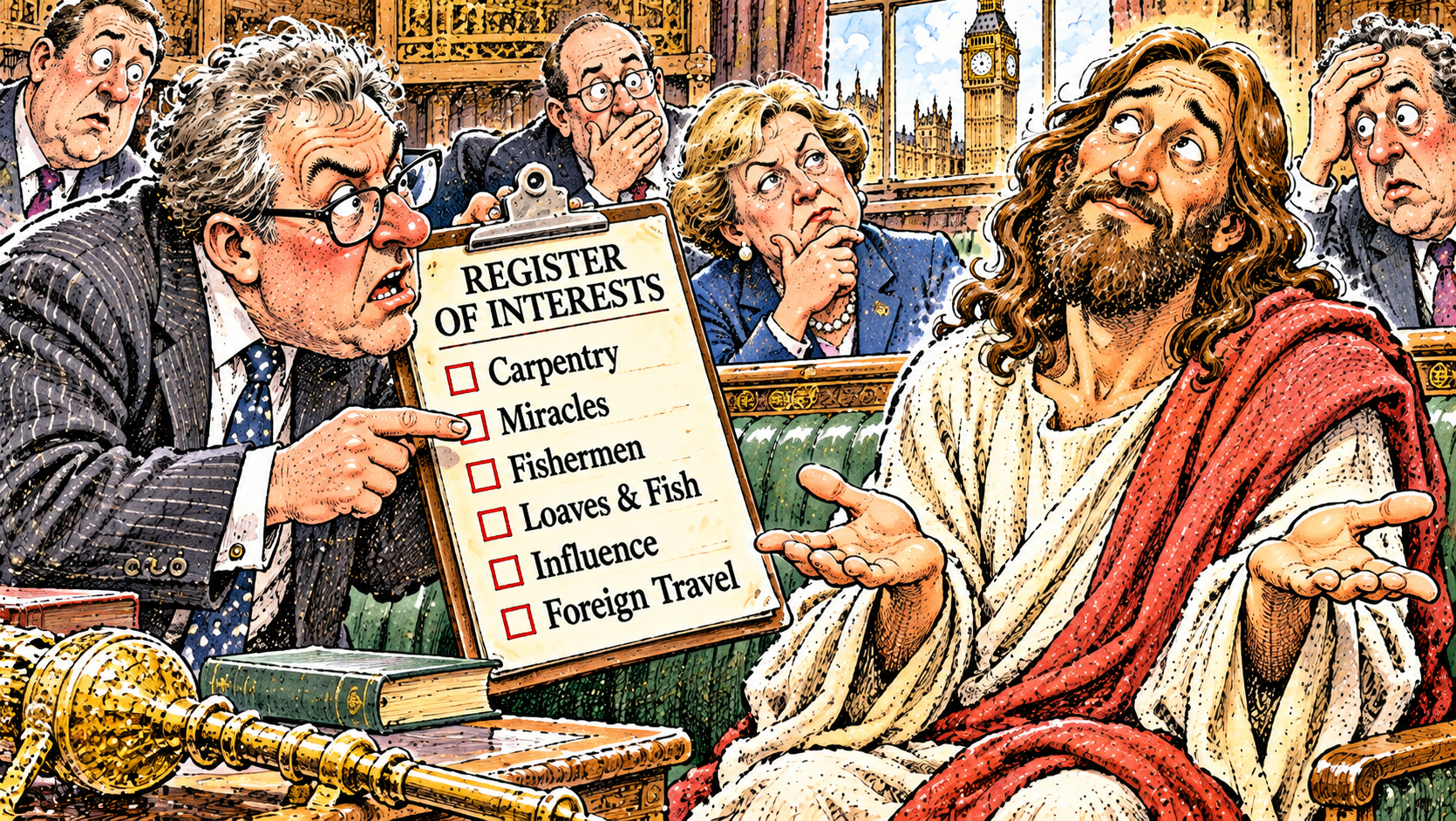
The Church’s Perspective: Jesus Tells Politicians to Remove Their Own Planks, Westminster Requests a Cost-Benefit Analysis
LONDON, ENGLAND: A Church of England vicar has caused widespread discomfort among Britain’s political establishment after reading Matthew 7:3 aloud and suggesting that the passage might apply to Members of Parliament and local councillors.
The sermon, delivered at a London parish church, focused on the biblical warning against identifying other people’s faults while ignoring one’s own.
Within hours, politicians had demanded clarification.
One MP accused the passage of being insufficiently inclusive because it appeared to criticise people with unusually large personal shortcomings.
Another called for a parliamentary investigation into whether Jesus had complied with the appropriate standards of public conduct.
A council leader suggested that the plank described in the verse could represent an unauthorised building extension.
The vicar, Reverend Thomas Bell, explained that Christ was addressing hypocrisy.
“This is the habit of condemning in others what we refuse to recognise in ourselves.”
A parliamentary spokesperson welcomed the explanation but expressed concern that it might encourage voters to examine politicians using the same standards politicians apply to voters.
Such an outcome, he warned, could have unforeseen consequences for democratic stability.
Government Discovers the Seven Deadly Sins Are Not an Approved Expenses Category
The controversy intensified when Reverend Bell compared the teachings of Jesus with the operation of modern British government.
“Christ taught humility. Politicians teach humility to other people. There is an important difference.”
The vicar offered several examples.
A council lectures residents about financial responsibility while struggling to complete its accounts.
An MP demands complete transparency from a political opponent while treating perfectly reasonable questions about his own expenditure as a personal insult.
A government minister urges working families to accept difficult financial sacrifices before leaving for a taxpayer-supported official function.
A local authority insists a pensioner must follow every rule while explaining its own administrative failures through 17 pages of exceptional circumstances.
The congregation reportedly responded with the unusual sound of people recognising their own experiences.
One parishioner, a retired accountant, suggested that Britain should introduce an annual Day of Political Repentance.
On this occasion, politicians would publicly acknowledge mistakes without immediately blaming predecessors, civil servants, economic conditions or the weather.
The proposal was rejected on grounds that it could interfere with the parliamentary calendar.
A former civil servant observed that the seven Nolan Principles already provide a clear ethical framework for public officeholders.
The government’s Seven Principles of Public Life explicitly include accountability, openness and honesty, as well as the expectation that officeholders submit to necessary public scrutiny.
The vicar remarked that Britain does not suffer from a shortage of moral principles.
It suffers from an abundance of people willing to explain those principles to everyone else.
Jesus Refuses to Establish an Independent Commission
Westminster’s response involved a proposal to establish an Independent Commission on Biblical Accountability.
The commission would examine whether Matthew 7:3 could be implemented without causing excessive administrative burdens for elected representatives.
Its preliminary terms of reference identified several concerns.
Removing one’s own plank could be expensive.
Acknowledging one’s own failings could damage public confidence.
Admitting hypocrisy could provide political ammunition to the opposition.
And requiring politicians to demonstrate the standards they recommend might create unreasonable expectations about the relationship between words and actions.
One committee member suggested removing the biblical element entirely.
Another proposed retaining the word “speck” while replacing “plank” with “temporary structural governance challenge.”
The vicar was unimpressed.
“Jesus wasn’t asking for a committee. He was asking for self-examination.”
A senior political consultant described the concept as administratively impractical.
“Self-examination sounds simple until you appreciate the scale of government.”
He noted that examining every politician personally could require thousands of hours.
The vicar suggested that each politician could begin by examining himself.
The consultant replied that such an approach lacked a central delivery mechanism.
God Introduces Performance-Based Accountability
At the conclusion of Sunday’s service, Reverend Bell suggested a simple exercise.
“Before criticising someone tomorrow, ask yourself whether you are guilty of something similar.”
The congregation agreed that this represented a reasonable standard.
An elderly woman from Islington proposed an amendment.
“Could we make MPs do it before they speak?”
The vicar explained that doing so might bring the House of Commons to a standstill.
Another parishioner thought this would be the first measurable improvement in parliamentary productivity for years.
A small-business owner suggested adapting the teaching for government finance.
“Before telling me how to run my business, show me that you can account for the money you’ve taken from it.”
The congregation applauded.
A visiting councillor objected that governing a borough was considerably more complicated than running a corner shop.
The shopkeeper agreed.
“When I lose money, I go out of business. When a council loses money, it holds a press conference explaining why it needs more.”
Reverend Bell concluded that repentance requires recognising one’s own faults rather than endlessly discovering new faults in other people.
Outside the church, journalists asked whether he expected Westminster to embrace the teaching.
“Not immediately,” he replied. “They’ll have to get past the first part.”
Asked what the first part involved, he explained:
“Admitting the plank exists.”
Parliament has since established a working group to determine whether the plank might qualify as essential infrastructure.
The Treasury is reviewing its depreciation schedule.
Local councils are considering a levy on unauthorized timber.
And Britain’s taxpayers have been reminded that financial responsibility begins with them.
The vicar returned to his parish.
He had delivered the sermon without a communications adviser, an external consultant, a departmental impact assessment or a single expense claim.
Westminster regarded the achievement with profound suspicion.
Editorial Disclaimer
This report hands Matthew 7:3 to a London vicar and lets Westminster react. The verse and the Seven Principles of Public Life are real; Reverend Thomas Bell, his congregation, the Independent Commission on Biblical Accountability and the Day of Political Repentance are comic inventions. The reverend has read this disclaimer from the pulpit, found no planks in it, and asks readers to check their own eyes before browsing more political satire or our guide on how to tell satire from real news.
This work is presented in the editorial tradition of an entirely human collaboration between two sentient beings: the world’s oldest tenured professor and a philosophy major turned dairy farmer, both convinced that the distance between a politician’s sermon and his expense claim deserves closer examination.
The moral of Matthew 7:3: Before demanding that the public account for every penny, politicians might consider accounting for their own.