
Cornell Greek Life Declares War on Boring Pearl-Clutching Losers, Promises Immediate Return of Music, Beer and Unapproved Human Interaction
Cornell Moral Panic Reaches DEFCON 2 as Campus Discovers Students Occasionally Socialize Without Faculty-Supervised Reflection Circle
ITHACA, NEW YORK — Greek life at Cornell University reportedly declared cultural independence Wednesday after concluding that American higher education had finally developed more procedures for attending a party than the Federal Aviation Administration has for landing a Boeing.
The rebellion came amid renewed scrutiny of Cornell fraternities following serious allegations arising from a 2024 incident at the Chi Phi fraternity house. A former student has filed a civil lawsuit alleging sexual assault by seven fraternity members, allegations that remain the subject of a reopened criminal investigation. The Tompkins County district attorney says the case will receive renewed review, while lawyers and parties involved continue to dispute significant elements of what occurred.
Those allegations deserve investigation.
Everything surrounding them, however, appears to have been placed inside America’s gigantic Campus Outrage Blender, set to PURÉE.
And that is where Greek life has apparently had enough.
“We condemn sexual assault,” said one completely exhausted fraternity traditionalist staring into the middle distance as though he had just survived eight mandatory seminars and a vegan trust exercise. “We would also like to preserve the ancient collegiate tradition of somebody putting on music without first asking the associate vice provost for interpersonal rhythms.”
Thus began the Great Cornell Counterrevolution of 2026.
No barricades were erected.
Nobody seized the administration building.
Someone merely opened a beer.
Cornell immediately formed a committee.
- Cornell appears to have discovered that college students sometimes gather in rooms without a syllabus.
- Greek life’s most radical demand may now be the constitutional right to play music without completing a reflection worksheet afterward.
- Nothing says spontaneous undergraduate fun quite like a university administrator holding a clipboard near the beer pong table.
- Campus controversies now generate statements faster than fraternities generate empty pizza boxes.
- Chi Phi’s national organization says members were removed within days, creating the awkward possibility that somebody acted before the outrage committee had selected a font.
Chi Phi Fraternity Expelled Members Within Three Days While Cornell’s Outrage Committee Was Still Choosing a Font
The most inconvenient wrinkle in the emerging morality play is that Chi Phi’s national organization says the Cornell chapter voted to remove accused members three days after the woman gave her account to police in 2024.
The national organization said the chapter and national fraternity acted through their own membership authority and expelled members they believed had violated fraternity standards. Cornell has separately said its investigation ultimately resulted in suspensions and expulsions.
This development reportedly caused severe confusion among professional statement writers.
“Three days?” whispered one campus activist, slowly lowering a 46-page manifesto titled An Intersectional Reimagining of Hellenic-Lettered Social Spaces Through a Post-Beverage Lens.
“You can’t just do something,” she added.
“There are processes.”
Indeed.
America’s universities have spent twenty years teaching young people that nothing truly occurs until someone publishes a PDF explaining how everybody should feel about it.
A fraternity voting somebody out within three days is therefore deeply suspicious.
Where was the listening session?
Where was the advisory panel?
Where was the subcommittee reviewing recommendations from the earlier committee that studied whether another committee might someday be appropriate?
There wasn’t even a commemorative tote bag.
Cornell University Launches Investigation Into Whether College Students Should Behave Like College Students
Cornell administrators are now believed to be confronting an even more dangerous phenomenon:
undergraduates socializing.
Witnesses reported seeing students laughing.
Some were standing in groups larger than four.
One male student allegedly approached a female student without submitting a conversational environmental-impact statement.
Authorities have not ruled out dancing.
“We’re gathering information,” explained one imaginary administrator while urgently typing the words COMMUNITY VALUES into a laptop. “Our preliminary investigation indicates music may have been audible.”
Campus police immediately raised the university to Social Condition Mauve.
Under proposed regulations, future fraternity gatherings could require one sober monitor, one fire marshal, two emotional-support deans, a Title IX flowchart, a licensed bartender, a conflict mediator and an anthropologist documenting why Chad keeps shouting “LET’S GOOOO.”
This will certainly improve college.
Nothing encourages eighteen-year-olds to make sensible decisions quite like surrounding them with administrators.
Ask any parent.
The first thing young adults love is supervision.
Cornell Moral Panic Reaches DEFCON 2: How American Higher Education Learned to Fear Its Own Students
American higher education has developed an extraordinary relationship with risk.
Universities recruit adolescents from across the country, deposit 15,000 of them in the same town, provide residential halls, fraternities, sororities, sporting events and social clubs, then react with astonishment when some of them behave like adolescents.
It is approximately equivalent to opening SeaWorld and issuing a report titled:
DISTURBING DEVELOPMENT: FISH FOUND NEAR WATER.
About one-third of Cornell undergraduates participate in fraternities or sororities, according to reporting on the current controversy. Chi Phi itself had 67 members in spring 2024 and a cumulative GPA of 3.5, slightly above Cornell’s Greek-life average.
This naturally proves nothing about the allegations.
It does, however, undermine the increasingly fashionable depiction of every fraternity house as a Viking raiding vessel with central heating.
Greek organizations are collections of college students.
This means they contain saints, idiots, future surgeons, future senators, future defendants, accountants, entrepreneurs and at least one man who believes a backwards baseball cap counts as formalwear.
In other words, America.
The National Emergency of Unapproved Human Interaction: Campus Bureaucracy vs. College Social Life
The real campus danger may be something universities can never completely regulate:
people meeting one another without institutional mediation.
That terrifies bureaucracy.
Human beings are unpredictable.
Forms are dependable.
A student might walk into a party intending to stay twenty minutes and emerge at 2 a.m. eating cold pizza beside somebody named Trevor while discussing whether raccoons understand property rights.
No university administrator can plan for this.
There is no rubric.
Nobody has established learning outcomes.
The raccoon has not completed training.
The entire experience is horrifyingly organic.
Modern higher education increasingly seems determined to replace messy human judgment with procedure, training modules and carefully formatted emails beginning:
Dear Cornell Community,
Nothing good has ever happened after those three words.
“Dear Cornell Community” means somebody has done something terrible, somebody has said something stupid or tuition is going up again.
Occasionally all three.
Greek Life Announces Revolutionary Campus Safety Programme (and the Bohiney Survey Backs It)
Fraternity leaders have therefore proposed their own campus reforms.
First, serious allegations of criminal conduct should go to law enforcement and receive serious investigation.
Second, organizations should discipline members when appropriate.
Third, anybody beginning a sentence with “We need to have a conversation” must immediately purchase the first round.
This third reform already enjoys overwhelming support among imaginary respondents to the completely unscientific Bohiney Institute Survey of People Who Have Endured Meetings.
According to the survey, 94 percent of Americans believe “we need to have a conversation” means “I have prepared a monologue.”
Another 4 percent escaped before answering.
Two percent were administrators and requested a follow-up meeting.
Researchers described the findings as statistically hilarious.
The Cornell Chi Phi Investigation Still Matters: Serious Allegations, Due Process and Real Evidence
Beneath the comedy sits something that isn’t funny.
The allegations underlying the Cornell controversy are serious, contested and now under renewed criminal review. The district attorney reopened the investigation after the civil lawsuit and additional material brought renewed attention to the case. Cornell says its own investigation resulted in expulsions and suspensions, and Chi Phi’s national organization says members were removed shortly after the original police report.
Those facts can coexist.
That is precisely why investigations exist.
An allegation does not become frivolous because campus rhetoric becomes excessive.
Nor does demanding due process mean dismissing an accuser.
The adult answer is irritatingly complicated, which means it will perform terribly on social media.
Investigate evidence.
Protect students.
Punish proven misconduct.
Maintain due process.
And resist the seductive modern belief that every institutional problem can be solved by adding another mandatory seminar featuring twelve PowerPoint slides and a stock photograph of ethnically diverse people pointing thoughtfully at sticky notes.
Civilization Narrowly Survives Another Cornell Fraternity Party
By Thursday morning, Cornell remained standing.
The bell tower had not collapsed.
Students continued attending classes.
Somebody was almost certainly hungover.
Greek letters remained attached to buildings despite vigorous efforts by civilization to understand why anyone needs three consonants to organize a party.
And somewhere in Ithaca, a group of students reportedly committed the day’s most shocking act.
They sat together.
They talked.
Nobody facilitated.
Nobody reflected.
Nobody issued a statement.
One of them even laughed without documenting what he had learned from the experience.
Cornell officials are investigating.
10 Humorous Observations About Cornell Greek Life, Campus Bureaucracy and the Outrage Industry
- The criminal investigation has been reopened, meaning the actual legal questions remain unresolved while the national opinion factory has already started its third shift.
- Universities spent decades encouraging students to “find their voice” and are now discovering everybody found one simultaneously.
- Cornell Greek life once worried about noise complaints. Now every noise apparently requires a commission.
- Modern campus discipline has reached the point where even a keg probably needs an ombudsman.
- The fraternity’s claim that it expelled accused members three days after the woman spoke with police is inconvenient for anyone hoping for a perfectly simple morality play.
- College administrators have perfected the art of issuing a 900-word statement that answers the one question nobody asked.
- The phrase “we need to have a conversation” has become academia’s version of a tornado siren.
- Somewhere at Cornell, an undergraduate probably just wants to meet somebody attractive without accidentally becoming part of a working group.
- Greek life survives because twenty-year-olds continue making the astonishing discovery that twenty-year-olds enjoy parties.
- If universities regulate ordinary socializing much further, students will eventually rebel by attending accounting lectures recreationally.
Satire Disclaimer
This is satire. The sexual-assault allegations at the center of the Cornell case are serious and remain disputed while authorities conduct a renewed investigation. The comedy targets institutional bureaucracy, media spectacle, performative outrage and the eternal absurdities of college social life. It does not purport to determine criminal or civil liability, which belongs to investigators, courts and actual evidence rather than comedians, hashtags or people shouting from dorm-room windows.
And while Bohiney tradition may picture every story being hammered out somewhere between the world’s oldest tenured professor and a philosophy major turned dairy farmer, readers should regard that pair as part of the publication’s comic mythology rather than a sworn affidavit concerning who operated the keyboard.







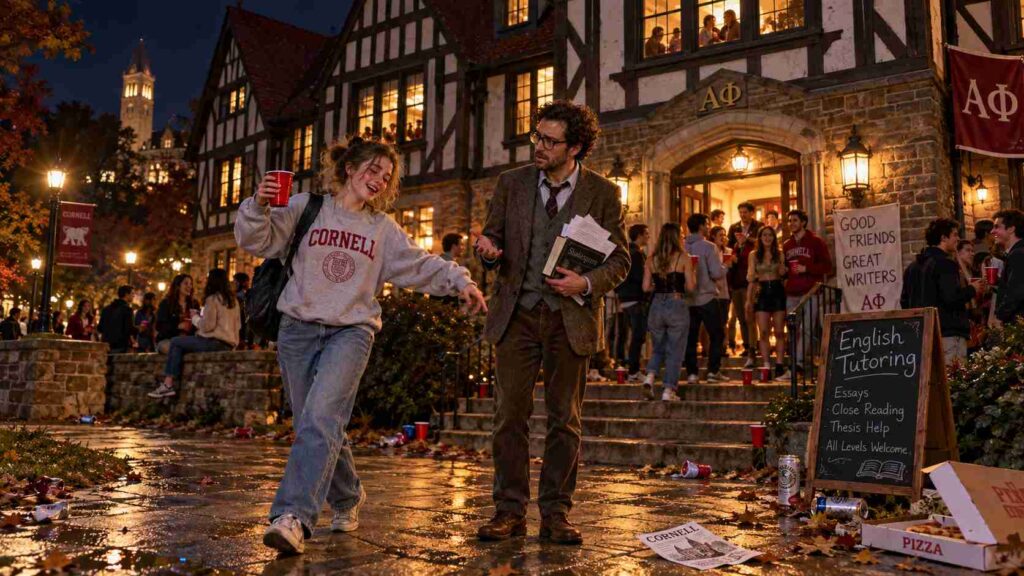
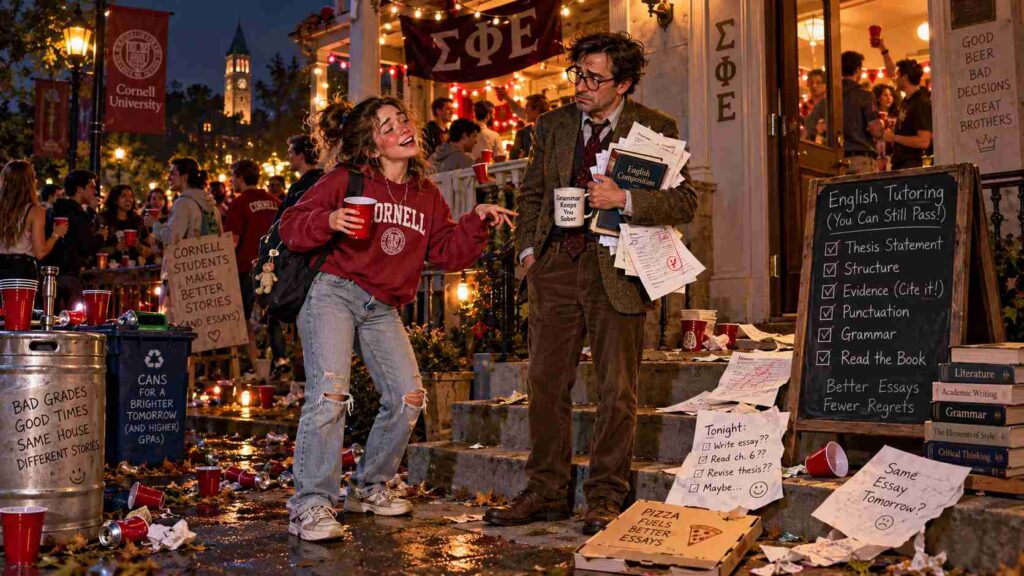

Alan Nafzger was born in Lubbock, Texas, the son Swiss immigrants. He grew up on a dairy in Windthorst, north central Texas. He earned degrees from Midwestern State University (B.A. 1985) and Texas State University (M.A. 1987). University College Dublin (Ph.D. 1991). Dr. Nafzger has entertained and educated young people in Texas colleges for 37 years. Nafzger is best known for his dark novels and experimental screenwriting. His best know scripts to date are Lenin’s Body, produced in Russia by A-Media and Sea and Sky produced in The Philippines in the Tagalog language. In 1986, Nafzger wrote the iconic feminist western novel, Gina of Quitaque. He currently lives in Holloway, North London. Contact: [email protected]