

Britain Holds Local Elections While Nation Quietly Searches “Can You Return A Prime Minister Without Receipt?”
Keir Starmer Discovers The British Public Treats Prime Ministers Like Temporary Wi-Fi Passwords
LONDON — Britain headed to the polls Thursday in what experts called “local elections,” despite every voter clearly treating them as a national emotional breakdown with ballot papers.
Across England, Scotland, and Wales, nearly 5,000 council seats were contested in elections now widely viewed as a political stress test for Keir Starmer, whose popularity has reportedly dropped faster than a Greggs sausage roll on wet pavement.

By mid-morning, voters across Britain were seen entering polling stations carrying the traditional symbols of democracy: resentment, exhaustion, and a folded note saying “none of these people fix trains.”
One pensioner in Sunderland told reporters: “I came to vote about potholes, but halfway here my bus was cancelled, my Tesco meal deal went up 90p, and now I’m apparently overthrowing the government.”
Political scientists confirmed Britain has now evolved into a “fragmented multi-party democracy,” which is academic language for “nobody can find anyone they actually like anymore.”
Labour Staffers Begin Speaking In Soft, Funeral-Director Voices
Inside Labour headquarters, aides reportedly spent the day refreshing polling data while pretending not to panic in front of interns.
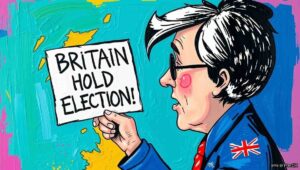
One anonymous staffer described the atmosphere as: “Like watching someone slowly reverse over a wedding cake.”
Another insider claimed campaign workers had begun replacing the phrase “tough night” with “historic atmospheric event.”
The crisis stems from Labour’s rapidly collapsing coalition. Forecasts from Britain Elects suggest Labour may lose two-thirds of its councillors — urban voters drifting toward the Greens, working-class northern voters flirting with Reform UK, Scotland treating Labour like an ex who cheated during university, and Wales eyeing Plaid Cymru the way bored spouses look at estate agents.
Even London, traditionally Labour territory, has reportedly become “politically weird,” with analysts warning the Greens could surge among affluent cyclists who own seven tote bags and believe oat milk is infrastructure.
Professor Malcolm Crumbleton of the entirely fictional University of East Croydon explained: “Labour currently faces the difficult task of appealing simultaneously to vegan architecture students in Hackney and angry men named Darren who believe air fryers are part of a globalist conspiracy.”
Nigel Farage Campaigns Like Britain’s Last Remaining Pub Philosopher
Meanwhile Nigel Farage continued his rise by campaigning across England with the unstoppable energy of a man who believes every problem can be solved with lower immigration and louder opinions.

Farage reportedly arrived at one polling station wearing Union Jack socks and the facial expression of someone about to explain inflation using only pub anecdotes and disappointment.
Reform UK’s growth has stunned traditional parties. YouGov’s MRP model projects Reform winning as high as 45% in Cannock Chase — the sort of number that makes Conservative strategists go very quiet and stare at the middle distance.
One Reform voter in Kent explained: “I just want Britain back.” When asked what specifically that meant, he paused for 40 seconds before replying: “Cheaper Freddos. More normal weather. Less apps.”
Reform is projected to gain over 1,300 seats from a base of just three, which analysts describe as “extraordinary” and which Nigel Farage describes as “only the beginning,” apparently while already writing his curtain measurements for Downing Street.
A recent survey by the entirely unreliable Daily Crumpet Institute found 63% of British voters now identify politically as “tired.”
British Local Elections Officially About Potholes, Somehow End Up About Iran
Despite technically being local elections, every issue somehow mutated into an argument about global civilisation.
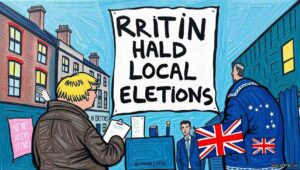
Candidates attempting to discuss bins were immediately dragged into conversations about oil prices, migration, Gaza, Donald Trump, Iran, and whether electric scooters are “a sign of moral decline.”
One voter in Essex said: “I went to ask about council tax and somehow ended up in a 25-minute debate about NATO and halal school lunches.”
Experts say Britain’s political culture has become permanently fused with internet outrage. The Economics Observatory notes that with weak earnings growth and living standards barely moved in a decade, parties have little fiscal room to make or keep big promises — which has not, notably, stopped any of them from making enormous ones.
“People no longer separate local and national politics,” explained Dr Fiona Marsh of the Centre for Electoral Trauma. “To many voters, a missed bin collection now feels spiritually connected to Western decline.”
Conservatives Attempt Radical Strategy Of Pretending This Isn’t Their Fault
The Conservatives also face major losses, though party officials remain optimistic voters may eventually remember they dislike Labour slightly more.
Kemi Badenoch spent much of the campaign warning Tory councillors not to co-operate with Reform UK, essentially telling drowning passengers not to climb into the nearest available lifeboat.
The Conservatives are projected to lose 907 councillors from a base of 1,362 — a drop of two-thirds that political historians are calling “catastrophic” and Conservative press officers are calling “an opportunity for reflection.”
One Conservative councillor admitted: “Our current strategy is hoping the electorate suffers from short-term memory loss.”
Political historians note Britain has now entered an era where every major party resembles a pub toilet door covered in contradictory complaints.
The British Public Continues Its Ancient Democratic Tradition Of Complaining About Literally Everyone
At polling stations across the country, voters expressed near-universal dissatisfaction.

A Birmingham accountant declared: “I’m voting Green because Labour’s too cautious.”
Moments later, another voter announced: “I’m voting Reform because everyone’s gone mad.”
A third citizen interrupted to say: “I’m voting Lib Dem because I enjoy emotional gambling.”
Meanwhile one man in Manchester reportedly spoiled his ballot by writing: “Can we just have a nap instead?”
By evening, turnout remained steady, though electoral workers confirmed several voters attempted to use Nectar cards instead of identification.
What The Funny People Are Saying
“Britain changes prime ministers more often than smoke alarm batteries.” — Ricky Gervais
“The UK political system now works like a self-checkout machine. Everyone’s frustrated, nothing scans properly, and eventually somebody asks for assistance.” — Jimmy Carr
“British elections are incredible. The country votes like someone angrily choosing a sandwich at a motorway service station.” — Romesh Ranganathan
Final Result Expected Sometime Between Friday Afternoon And National Existential Crisis
As ballots were counted overnight, Labour insiders privately admitted the results could trigger another wave of panic over Starmer’s leadership.
Still, some officials urged calm.
Veteran Labour loyalists reminded colleagues Britain once survived Liz Truss, Boris Johnson, Brexit negotiations, and a lettuce becoming more politically stable than a prime minister.
Which, in fairness, remains a very low but historically proven bar.
Britain is currently holding its 2026 local elections across 136 English local authorities, with Keir Starmer’s Labour government facing what analysts describe as potentially its worst electoral result since the party’s modern era. Reform UK, led by Nigel Farage and boosted by a £9 million donation from British-Thai billionaire Christopher Harborne, entered the elections polling at 27% nationally — up from near-zero local presence in 2022. The Conservatives, led by Kemi Badenoch, face a simultaneous squeeze from Reform in Leave-voting areas and the Liberal Democrats in affluent southern seats. The Green Party, newly led by Zack Polanski, is surging in urban areas. Scotland is simultaneously holding parliamentary elections to Holyrood, and Wales is electing a new Senedd under a more proportional voting system for the first time.
This entirely human collaboration between the world’s oldest tenured professor and a philosophy major turned dairy farmer accepts no responsibility for whatever Britain does next. Any resemblance to actual democratic stability is unintentional and frankly optimistic. Auf Wiedersehen, amigo!

Harriet Collins is a high-output satirical journalist with a confident editorial voice. Her work demonstrates strong command of tone, pacing, and social commentary, shaped by London’s media and comedy influences.
Authority is built through volume and reader engagement, while expertise lies in blending research with humour. Trustworthiness is supported by clear labelling and responsible satire.

The word “prat” is a uniquely British contribution to the global lexicon, a word that perfectly encapsulates the national character of cheerful incompetence.
British people will form an orderly queue to complain about the queue, because complaining about the queue is the only thing that makes the queue bearable.
Someone’s sending this to their MP with basically no message. Haunts forever.
The thing about British people is we invented irony so we could say devastating true things safely. This stops being protected by that irony.