
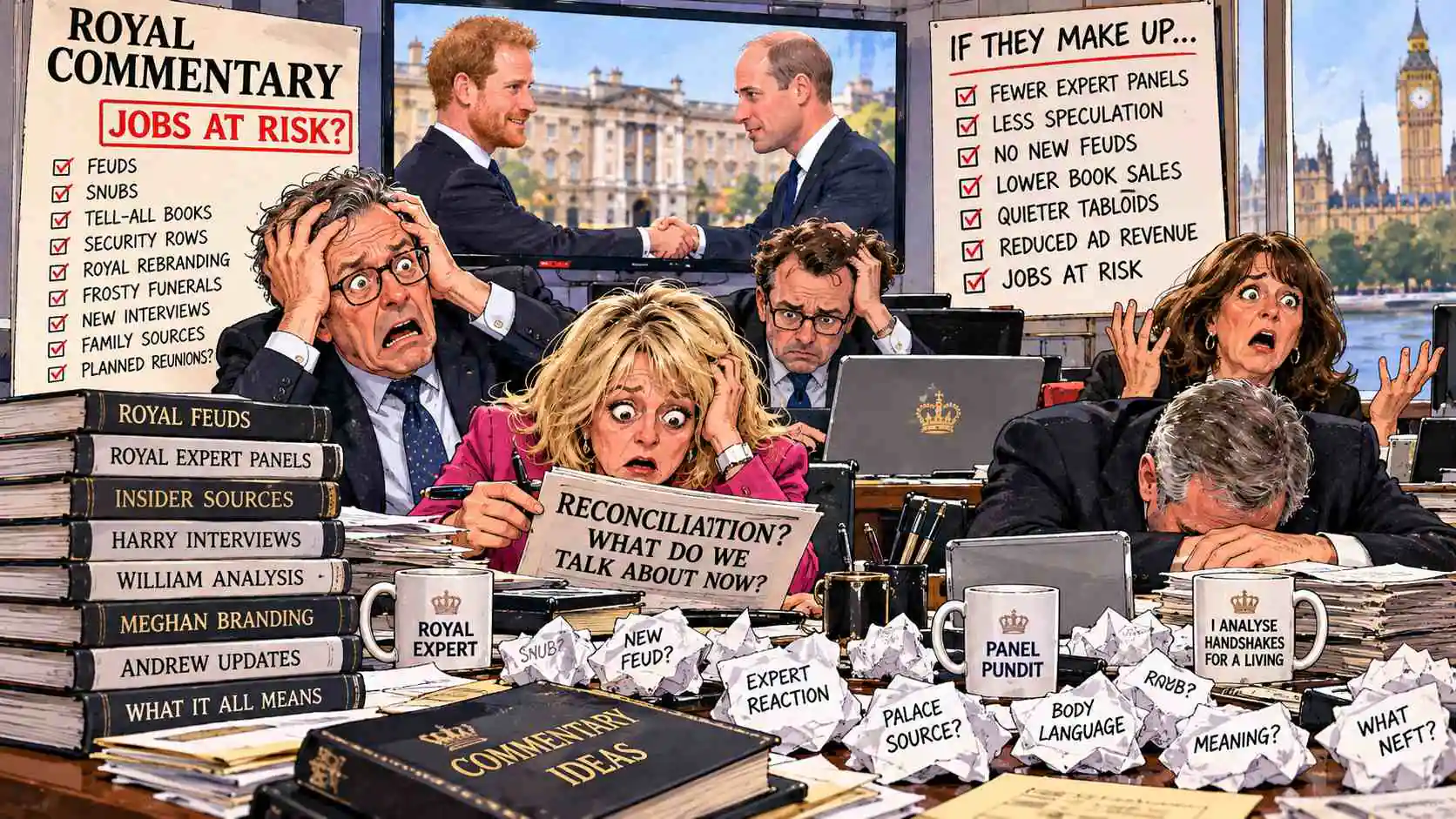
Editors warn family harmony is bad for business
LONDON, October 19, 2026 – Britain’s newspaper industry is preparing for a catastrophic collapse following Prince Harry and Meghan Markle’s return to the United Kingdom, amid fears that the couple may eventually repair their relationship with the Royal Family and deprive Fleet Street of its most reliable source of employment since the invention of adultery.
The alarm intensified after Harry and Meghan visited three Nottingham charities on October 15 without producing the public family confrontation traditionally required to sustain the nation’s royal commentary industry. As confirmed by Associated Press reporting on Harry and Meghan’s British return, the couple visited organisations supporting young people and vulnerable families, including Himmah and Epic Partners.
The visit involved children, volunteers, flowers and community activities. Unfortunately, nobody publicly accused anybody else of ruining Christmas. Editors immediately recognised the economic implications.
Fleet Street’s Royal Conflict Industry Faces Unprecedented Threat
For decades, royal disagreements have provided British newspapers with a dependable supply of headlines, at a time when print circulation keeps falling and every reliable story matters. A family member fails to attend a birthday party. Twelve articles. Two relatives avoid eye contact at a funeral. Twenty-six articles. A prince attends a wedding without his brother. Forty-eight articles, a podcast investigation and a television documentary featuring a body-language expert explaining the significance of looking sideways.
The business model is extraordinarily efficient. Ordinary journalism requires reporters to investigate events, interview witnesses and establish facts. Royal conflict journalism can operate for an entire week on the absence of a telephone call.
A relative not speaking to another relative becomes breaking news. A relative possibly considering speaking to another relative becomes an exclusive. An unnamed acquaintance suggesting the relatives might eventually speak becomes a six-part television series. And if they actually speak, there is sufficient material for several months of speculation about what they really meant.
The difficulty begins when relatives stop providing reasons for conflict.
Economic Forecasters Warn Royal Peace Could Be Worse Than Recession
A satirical Fleet Street economic model estimates that a successful royal reconciliation could eliminate ninety-seven percent of the nation’s supply of speculative palace emergencies. The remaining three percent would involve King Charles’s handwriting, Meghan’s shoes and whether Prince William deliberately stood too close to a window.
Under the model, a single photograph of Harry hugging his father could destroy an entire week of editorial planning. A second photograph might threaten the mortgage payments of several celebrity commentators. A third, showing William and Harry laughing together, could trigger an emergency meeting at the Bank of England.
The economic damage would extend throughout the royal grievance supply chain. Body-language specialists would face unemployment. Anonymous palace acquaintances would lose their principal source of supplementary income. Former staff members would be forced to discuss their current occupations.
Television producers would have to replace programmes titled The Royal Feud That Could Destroy Britain with programmes about people destroying Britain through the traditional methods of taxation, poor infrastructure and administrative incompetence. The consequences would be unbearable.
Editors Demand Harry and William Maintain Minimum Hostility Levels
The greatest concern surrounds the relationship between Prince Harry and Prince William. Their estrangement has provided newspapers with enough emotional raw material to power several regional publishing operations. Any substantial reconciliation could create a surplus of goodwill.
Newspaper executives therefore require a new regulatory framework, one that would sit comfortably alongside the existing work of IPSO. Under the proposed Royal Media Employment Protection Scheme, senior royals would be encouraged to maintain minimum levels of familial irritation sufficient to protect journalism jobs.
Harry and William would be permitted to exchange Christmas cards but would have to ensure that at least one contained an ambiguous phrase capable of sustaining several days of commentary. A message reading Hope you’re well could be interpreted as an aggressive suggestion that the recipient is currently unwell. Best wishes would constitute a deliberate withdrawal of affection. Love, Harry would require immediate expert analysis to determine whether the word love had been used sarcastically.
The system would protect editorial employment while allowing the brothers to maintain the appearance of reconciliation. It would also preserve Britain’s cherished tradition of treating normal family awkwardness as a matter of national security.
Meghan’s Charity Work Creates Serious Advertising Crisis
Meghan has created an additional commercial problem by supporting charitable organisations. Her visit to Himmah drew attention to food insecurity. Her appearance at community programmes highlighted disadvantaged young people. These are legitimate subjects of considerable public importance. Unfortunately, neither provides the same dependable advertising revenue as a headline accusing the Duchess of wearing an emotionally aggressive shade of purple.
Readers may support helping disadvantaged families. But editors have learned that readers can spend considerably longer arguing about whether Meghan looked disrespectful while helping those families. The challenge is not persuading the public to care about charity. It is persuading them that the charity was secretly an insult to somebody else.
A conventional newspaper report might explain that Epic Partners helps young people through sport, mentoring and community programmes. The commercially enhanced version would investigate whether Meghan deliberately arrived at Epic Partners on a Thursday because Queen Camilla had previously attended an engagement on a Thursday.
Thursday would then become the central controversy. By Friday, commentators would be debating who owned Thursday. By Sunday, a former palace employee would reveal that Queen Elizabeth II had also used Thursdays. By Monday, Britain would have a constitutional crisis involving the Gregorian calendar.
Royal Commentators Prepare for a World Without Family Hostility
The newspaper industry’s worst-case scenario involves Harry, Meghan, William, Catherine, Charles and Camilla eventually participating in the same family gathering without anybody leaving early. Such an event would be disastrous. Photographers might capture smiling faces. Children might play together. Adults might discuss ordinary matters such as schools, holidays and whether anybody remembered to buy milk.
Royal commentators would be unable to explain the gathering without describing it as either a triumph, a humiliation or an elaborate attempt to humiliate somebody through triumph.
Entire newsroom departments could become redundant. The editor responsible for detecting hostility in seating arrangements might have to retrain as a transport correspondent. A specialist in the psychological significance of wedding invitations could be reassigned to local government. The veteran reporter who has spent twenty years explaining why a particular royal did not attend Christmas lunch might finally be required to attend Christmas lunch himself.
Britain Discovers Family Peace Is Bad for Business
The deeper problem is that an entire commercial industry now depends upon the failure of a family relationship. If Harry and William remain estranged, newspapers have a continuing story. If Harry and Meghan encounter difficulties, there are new chapters. If Charles reaches out to his son, analysts can speculate about the significance of the gesture. If he does not, they can speculate about the significance of its absence.
Every possible development is profitable except the one that should theoretically make everybody happy. A genuine, durable reconciliation could bring relief to the family, happiness to supporters and an end to years of public hostility. For Fleet Street, this would be an economic catastrophe.
The British press therefore faces an uncomfortable question. Does it sincerely want the Royal Family to resolve its disagreements? Or does it simply want the disagreements to remain entertaining enough to sell newspapers? The answer may determine the future of the monarchy’s most persistent unofficial institution: the royal feud industry.
Fortunately for Britain’s tabloid economy, not every family disagreement has yet been resolved. Newspaper executives can therefore continue working. But if Harry and William ever embrace in public, the government may need to establish an emergency fund for unemployed royal experts.
Britain has survived the decline of coal mining, shipbuilding and much of its manufacturing industry. It is not clear that the nation is prepared for the disappearance of the professional royal grudge. After all, someone has to keep the economy going. And until recently, that someone was Prince Harry refusing to attend Christmas dinner.
Five Humorous Observations
- These people have a job where a happy family puts them out of work. That’s not journalism, that’s being a divorce lawyer for people who aren’t getting divorced.
- A Christmas card that says “Hope you’re well” turns into a week of coverage. I send those every year and the only coverage I get is my mother asking why it was a postcard.
- They’ve got a guy whose entire job is reading the seating plan. A seating plan! Somebody’s brother-in-law sits next to the gravy and it’s on the front page.
- If Harry and William ever hug, the Bank of England calls an emergency meeting. And I don’t mean a handshake with a pat on the back, I mean a hug. You’d think the economy was being run by cousins at a wedding.
- Britain survived coal, shipbuilding and steel. Take away the royal grudge and now everybody panics. It’s the only industry that runs on “Dad, we need to talk.”
Disclaimer
This work is satirical journalism. The Fleet Street economic model, the Royal Media Employment Protection Scheme and the editors’ reactions are comic inventions. The October 15, 2026 Nottingham charity visits are real reported events. The Royal Media Employment Protection Scheme has granted this disclaimer a minimum hostility allowance, which it spent entirely on the seating plan; displaced correspondents can retrain with our guide on how to tell satire from real news.
This story is entirely a human collaboration between two sentient beings: the world’s oldest tenured professor and a philosophy major turned dairy farmer.

Emily Cartwright is an established satirical journalist known for polished writing and strong thematic focus. Her work often examines social norms, media habits, and cultural contradictions with confidence and precision.
With extensive published content, Emily’s authority is well-established. Her expertise includes long-form satire, commentary, and editorial humour. Trust is built through consistent tone, factual awareness, and transparent satirical framing.
Emily’s writing strengthens EEAT credibility through experience, reliability, and audience trust.


