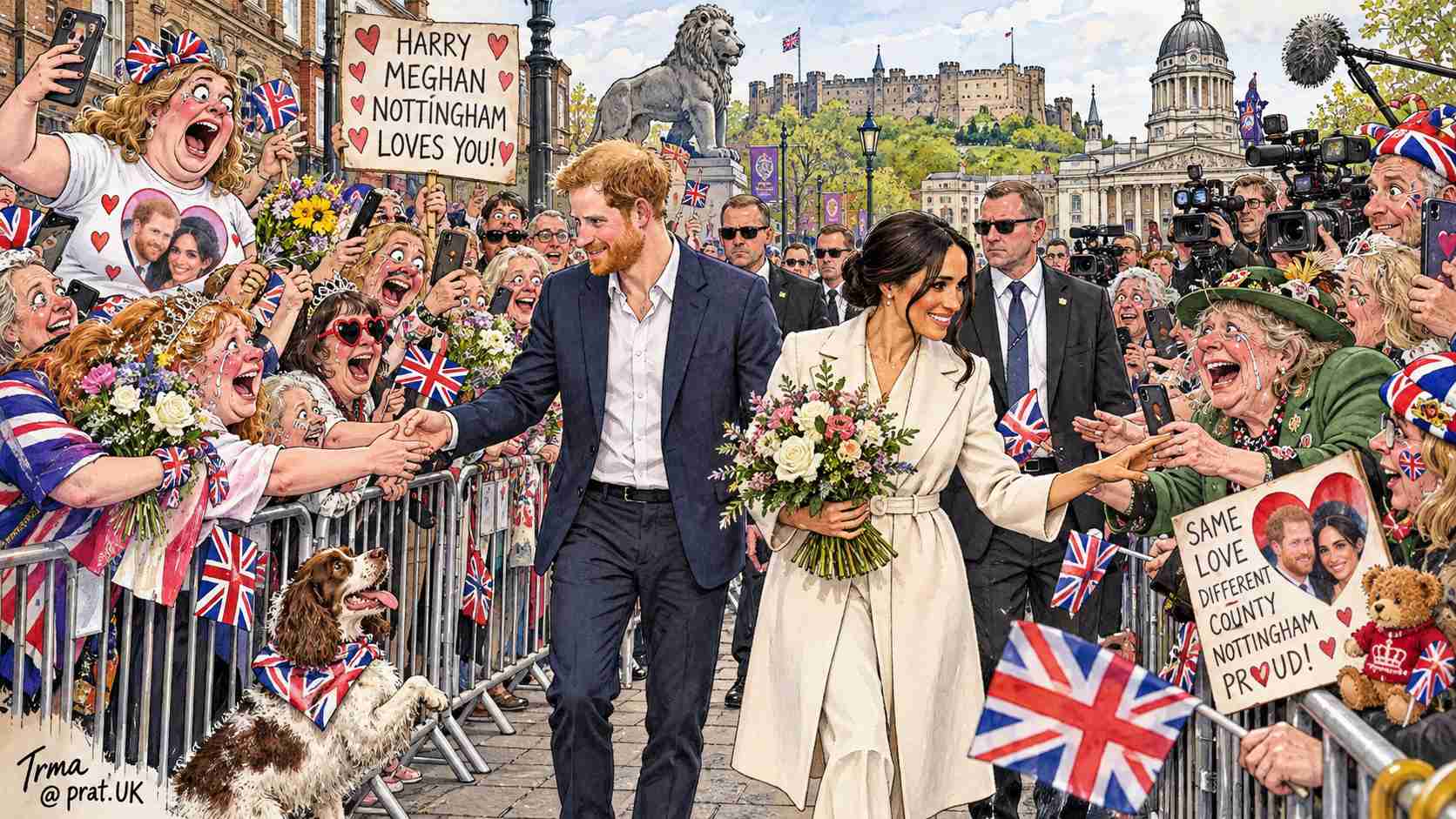
Feeding Families Apparently Counts for Nothing Without a Warm Welcome
NOTTINGHAM, England – A Nottingham charity has reportedly discovered that providing valuable community services is no longer sufficient to guarantee a successful public engagement, following revelations that representatives encouraged spectators to cheer loudly for Prince Harry and Meghan Markle before the couple arrived.
The Episode That Reached Britain’s Charitable Sector
The episode, described in the Yahoo Entertainment report, has raised the possibility that Britain’s charitable organisations must now master the complex business of celebrity audience management alongside their traditional responsibilities of helping disadvantaged people.
How Charity Success Used to Be Measured
Until recently, charitable success was measured using relatively straightforward criteria. Did the hungry receive food? Did vulnerable children receive support? Did struggling families obtain assistance? Were disadvantaged young people given opportunities to develop useful skills?
These primitive standards have now been superseded by a much more sophisticated system. Did the celebrity receive sufficient applause? Was the applause loud enough? Did somebody shout their affection at exactly the right moment? And, most importantly, was the cheering sufficiently spontaneous to satisfy journalists who might later investigate it?
Community Recording Studio, Himmah Hub and Epic Partners
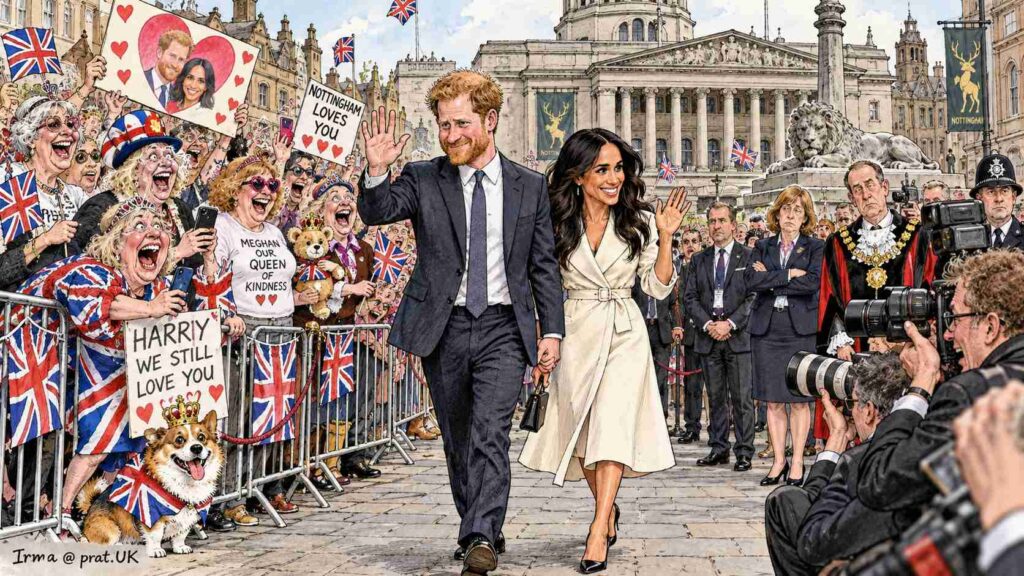
The Nottingham visit involved three community organisations: the Community Recording Studio, Himmah Hub and Epic Partners. These organisations undertake work involving youth development, food assistance, mentoring and community welfare, activities traditionally considered more important than celebrity applause.
Nevertheless, Britain’s royal reporting industry has managed to establish that the most fascinating aspect of the day was not the charitable work but a few preliminary words addressed to people standing outside.
This represents a significant advance in journalism. In earlier generations, reporters attending charitable events were expected to investigate the organisation’s activities, speak to beneficiaries and explain why the work mattered. Modern reporters can apparently complete their assignments by discovering that somebody encouraged the crowd to make a noise.
A Director of Public Enthusiasm for Every Food Bank
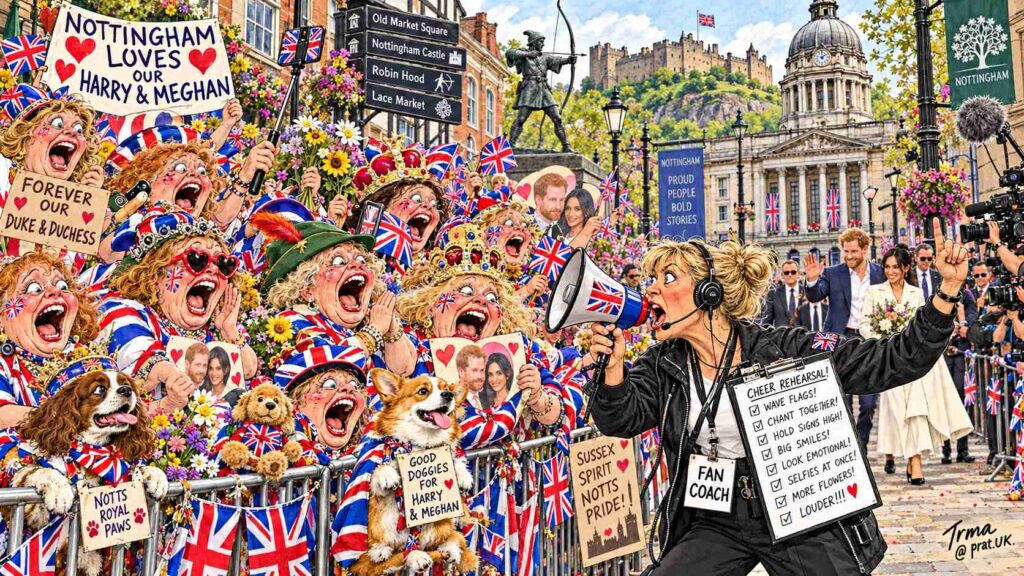
The economic implications for charities are considerable. An organisation supporting vulnerable teenagers may now require a director of public enthusiasm. A food bank could appoint an assistant coordinator for ceremonial smiling. A community sports programme might need a fully accredited applause technician to ensure that visiting celebrities never encounter the humiliating experience of entering a building without somebody shouting their name.
The Charity Commission could eventually introduce a new performance measure known as the Celebrity Emotional Satisfaction Index. Under this system, charities would receive additional recognition for each decibel of applause generated during official visits.
A successful programme teaching disadvantaged young people to read might receive an ordinary rating. A charity producing enthusiastic cheering for a television personality would qualify as outstanding. An organisation doing both would immediately become eligible for a government grant, provided it could demonstrate that none of the applause occurred outside approved operating hours.
Why Charities Ask Crowds to Cheer for Royal Visitors
The absurdity is that charities have entirely understandable reasons for wanting visiting public figures to receive friendly welcomes. A positive celebrity appearance can attract publicity, donations, volunteers and public interest. For organisations operating under financial pressure, these benefits can matter.
Asking a crowd to cheer may therefore be nothing more sinister than ordinary event hospitality. It is roughly equivalent to a wedding organiser encouraging guests to applaud the bride and groom or a schoolteacher asking children to welcome a visiting author.
Yet because Prince Harry and Meghan Markle were involved, an otherwise forgettable piece of event preparation has acquired the significance of a constitutional emergency.
Royal commentators have examined the incident with the seriousness normally reserved for an intelligence operation. Who gave the instruction? At what precise moment? Was the enthusiasm genuine? Did spectators understand that they could refuse to participate? Was the phrase “Meghan, I love you” an expression of affection, a ceremonial suggestion or evidence of a developing national conspiracy involving women with flowers?
The charity representatives themselves were not reported to be acting under instructions from Harry or Meghan. But this distinction is dangerously unhelpful to anybody attempting to construct a scandal.
What Actually Happened Inside the Buildings
The actual visit produced examples of the work that charities hope to showcase. Young people performed, participated in creative activities and interacted with the Sussexes. At Himmah Hub, Meghan also reconnected with women associated with her earlier community cookbook work, which had supported charitable causes.
These activities provide rather more substantial evidence of charitable engagement than the volume of cheering outside a building.
Unfortunately, practical community work is difficult to convert into a national controversy. A headline announcing that young people benefited from mentoring might attract modest attention. A headline suggesting that spectators were encouraged to cheer for Meghan can generate three days of breathless commentary, twelve television debates and a retired royal correspondent explaining the constitutional implications of enthusiasm.
The Charity Dilemma: Invite a Celebrity or Rattle a Collection Tin
The charities might reasonably conclude that their greatest mistake was inviting journalists. Had they conducted the visits without press coverage, young people could have met their guests, enjoyed themselves and continued their activities in peace. Unfortunately, that would also have reduced the publicity such appearances can bring.
The modern charitable sector therefore faces an impossible choice. Invite a celebrity and risk having the event dissected by royal commentators. Or avoid celebrities and spend another year trying to raise money through sponsored walks, supermarket collection tins and raffles offering a bottle of wine donated by somebody’s uncle.
For future engagements, Nottingham charities may consider introducing a revised audience policy. Supporters may cheer, wave, smile, clap or express affection according to personal preference. Those choosing not to participate will not be penalised. The media will be encouraged to investigate the charitable work. And anyone demanding an inquiry into the origins of applause will be invited to volunteer at the food bank.
That should settle the matter.
After three hours carrying boxes, even a royal correspondent might discover something more important than clapping.
Humorous Observations
- Charity used to be one question: did the hungry people eat? Now it’s: did the guy in the nice coat feel liked? Somebody’s got to feed the guy in the nice coat’s feelings, apparently.
- Asking a crowd to cheer is hospitality. It’s a dinner party. “Welcome, come in, there’s wine, and when she walks in, make a noise.” Nobody calls the police on a dinner party.
- Royal reporters used to have to find the story. Now the job is find the person who said, “Go on, then.” That’s it. That’s the investigation. Somebody said “go on, then,” and a newspaper bought a new car.
- A food bank with a director of ceremonial smiling. The smiling director makes sixty grand. The food bank makes sandwiches. And both of them are on the same email chain.
- Three hours carrying boxes and you stop caring who clapped. I carried one couch up two flights of stairs once and I forgave everybody for everything. I forgave my ex-wife. She wasn’t even there.
Editorial Disclaimer
This article is satirical commentary based on reporting about the Sussexes’ October 15, 2026, Nottingham visit. The reported encouragement came from charity representatives; there is no established evidence that Harry or Meghan requested it. The performance indexes, job titles and audience policies described are satirical devices, not descriptions of actual policies or of any charity’s real practices. The charities mentioned do valuable work and deserve support, applause optional, and anyone who would rather practise cheering at home can do so over more British satire.
SOURCE: Yahoo Entertainment