Harry and Meghan Insist They’re Private Citizens, Arrive With Photographers, Royal Titles and Enough Publicity to Make Buckingham Palace Look Like a Witness Protection Programme
Sussexes celebrate independence from royal duties by recreating royal duties, complete with photographers, security, carefully arranged engagements and a publicity operation that would make the BBC’s royal correspondent demand overtime.
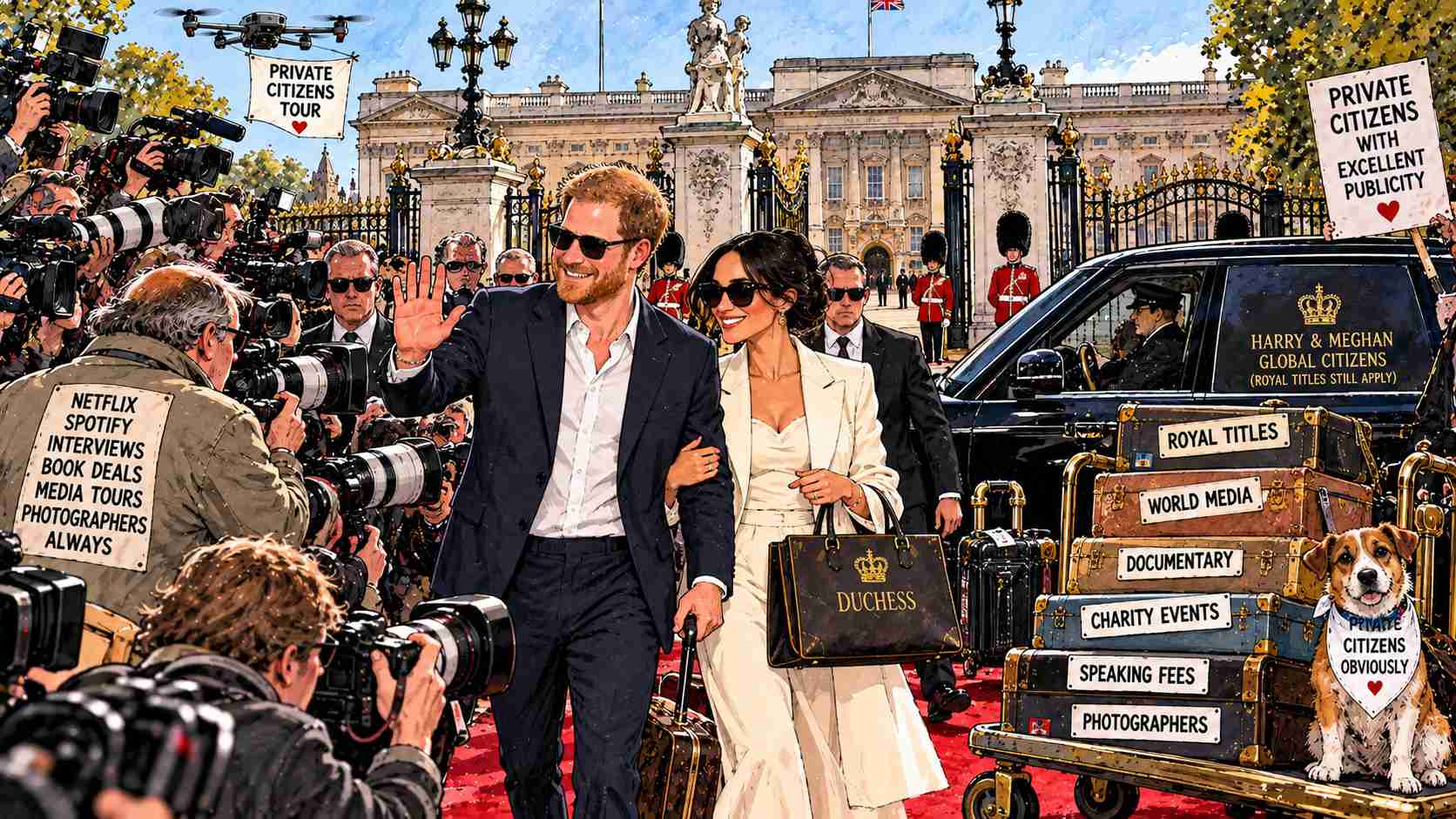
NOTTINGHAM, ENGLAND, 15 October 2026: Prince Harry and Meghan Markle made their return to British public life on Thursday, confirming their commitment to privacy by arriving at a heavily publicised charity engagement in front of enough photographers to document a medium-sized military invasion. The visit was reported by Page Six and, within the hour, by most of the English-speaking world.
The Duke and Duchess of Sussex, who stepped back from working royal duties in 2020, are now back in Britain as private citizens. The status turns out to be compatible with hereditary titles, organised media coverage, cheering crowds, professional security and a schedule that looks like a Buckingham Palace itinerary with better tailoring. They visited three Nottingham charities, shook hands, hugged admirers and posed for photographs in what ITV News described as a walkabout with all the hallmarks of a royal engagement.
International news agencies told several continents where the couple were within minutes of their arrival. Buckingham Palace, meanwhile, carried out its own official business in Cardiff, where the King opened the Senedd, without anyone convening a multinational debate on whether he had looked sufficiently pleased getting out of the car. For an institution often accused of excessive publicity, it was an impressive result.
Sussexes Redefine Privacy as Having Every Camera in Nottingham Pointed at Them
The traditional English definition of privacy is freedom from unwanted public attention. The Sussex definition appears to be freedom from unwanted public attention, plus the right to arrange wanted public attention. Most ordinary Britons, who have tended to stay private by avoiding photographers rather than inviting them to a scheduled event, remain confused by the distinction.
The Nottingham appearance had media barriers, pooled press access inside the venues, advance announcements and the usual choreography of a royal walkabout. Crowds stood behind barriers. One child held a unicorn balloon. The couple arrived 11 minutes late by Range Rover.
The visits were not official royal engagements. A letter issued on the King’s instruction, released through the Lord Chamberlain, set out that the couple are to be treated as private citizens. The arrangements nonetheless resembled those of working royalty, which gave Britain the unofficial official royal engagement. It is official enough to draw photographers, important enough for national coverage, royal enough to involve titles and private enough to remind everyone that the couple no longer do royal duties. Nobody is required to understand it.
A constitutional expert asked to explain the arrangement reportedly needed three cups of tea, an aspirin and the sort of diagram normally used to explain the Schleswig-Holstein question. His conclusion was brief. Harry and Meghan are private citizens when the subject is institutional obligation, public figures when the subject is security, royal celebrities when conducting engagements, and ordinary parents when asking photographers to leave their children alone. All four descriptions can be correct provided nobody asks which one applies at a given moment.
Prince Harry Left the Royal Family and Kept Everything Except the Employment Contract
When Harry stepped away from royal responsibilities in 2020, the move was presented as a chance to build a different life. Six years on, the different life involves visiting charities, meeting the public, travelling with security, being photographed by national newspapers and having every movement assessed by royal correspondents. The one real change is that Buckingham Palace no longer controls the diary.
Most British employees would like the same deal. Imagine resigning from Tesco but keeping the company car, the employee recognition ceremonies and the right to open supermarkets as the Duke of Frozen Foods. Imagine leaving the civil service and still having official-looking engagements announced on your behalf. Imagine retiring from the NHS and expecting newspapers to log every time you walk past a hospital.
Harry has left the family business while remaining its most recognisable trademark. His father inherited the Crown and his brother will inherit it. Harry inherited the surname, the connections, the public fascination and a worldwide audience prepared to analyse the emotional significance of his jacket. An economist might describe it as keeping the brand equity while outsourcing the unpleasant parts of management. A pub landlord put it more simply: “The lad’s left the brewery but he’s still selling the beer.”
Meghan Markle’s Return to Public Life: Reporters Treat Every Hug as Breaking News
Meghan greeted the crowd with enthusiasm, accepted gifts, and said it was great to be back. She also remarked on the weather, telling one onlooker, “We’ve got lovely weather today. We got lucky.” She kissed 90-year-old Irene Hardman, who had brought a framed photograph from the couple’s first Nottingham walkabout in 2017. In ordinary Britain these activities are known as going outside. Among royal correspondents they constitute a development in the Sussex narrative.
Meghan smiled and a photographer recorded it. Meghan hugged an elderly admirer and several photographers recorded it. Meghan commented on the sunshine, which raised the possibility that British weather had entered a new phase of cooperation with the Sussex publicity strategy.
Commentators were examining her clothes for messages about reconciliation, independence and the future of constitutional monarchy before she had finished greeting the crowd. ITV’s report itemised the outfit down to the belt, which was from Marks & Spencer, and the shoes, which were by Jennifer Chamandi. Her burgundy coat became a diplomatic instrument. Her ponytail became a statement of personal transformation. The way she approached a member of the public threatened to become a three-part documentary.
No other private citizen in Nottingham gets this treatment. If a local electrician wears a burgundy coat to Screwfix, nobody suggests he is signalling a historic break with his father. When a retired geography teacher hugs an old acquaintance, newspapers do not ask whether the embrace marks a shift in the balance of power within the Commonwealth. Meghan’s winter coat has by now produced more political analysis than most Treasury statements.
She has said more than once that she is frustrated by intrusive media attention. The difficulty is that the same media industry also amplifies her charity work and her commercial ventures. The relationship resembles a divorce in which both parties still share a mortgage, a Netflix account and custody of the paparazzi.
Royal Titles Remain Essential to the Couple’s Independence From Royal Titles
Harry and Meghan are still introduced everywhere as the Duke and Duchess of Sussex. That is understandable. The titles are genuine, internationally recognised and useful to journalists trying to identify them. Still, it creates a curious marketing proposition. The couple want a life outside working royalty while keeping the most marketable parts of royal identity. They have left the institution without leaving the vocabulary.
Ordinary businesses have somehow overlooked the opportunity. A former bank manager could resign and insist on being addressed as His Excellency the Regional Director of Overdrafts. A retired school administrator could demand that neighbours go on calling her the Supreme Headmistress of Key Stage Two. A divorced man could keep the title Husband Emeritus while declining all duties involving bins, anniversaries or his former mother-in-law. Harry’s position is different, of course, because his distinction rests on centuries of British constitutional tradition. The College of Arms has the paperwork.
From a public relations standpoint the benefit is plain. The name Harry Windsor attracts attention. The name Prince Harry attracts considerably more. Celebrities spend millions trying to build a recognisable personal brand. Harry was given one at birth, and he has spent the past six years explaining why the company that manufactured it was so difficult to work for.
Security Debate Produces Britain’s First Privately Public Public Figures
The couple’s security arrangements add another layer. In Nottingham they were protected by a private team and did not have the police convoys assigned to senior working royals. Whether they should get taxpayer-funded protection is still undecided. Harry has lost a Court of Appeal challenge over his security arrangements, and the Home Secretary has since announced a review of protective security for people in public life. There are legitimate concerns about internationally recognisable figures, and they deserve proper assessment rather than tabloid guesswork.
The terminology has still become complicated. The couple are private citizens. They are also among the most recognisable people in Britain. Their appearances attract crowds, their security reflects their profile, and their royal connections remain central to the attention they get. Their position cannot be explained by the traditional split between public and private, so Britain may need a third category: privately royal but publicly private. Under the proposed system an individual would qualify as private when criticised for resembling a working royal, and as public when recognition becomes relevant to a protection decision.
The Home Office could set up a department to administer the distinction. It would need 600 civil servants, 14 committees and a 200-page application form asking whether the applicant currently considers themselves royal. There would be three boxes. Yes. No. Depends who’s paying.
Charities Discover Celebrity Publicity Can Both Help Them and Bury Them
None of this takes anything away from the organisations the couple visited. The Community Recording Studio gives young people music and creative opportunities. Himmah Hub tackles food poverty. Epic Partners, a registered Nottingham charity, runs sports programmes and mentoring in two of the city’s most disadvantaged areas. They deserve recognition and support, and that is the strongest argument for high-profile visits. A famous person draws media attention, encourages donations and introduces a cause to people who would never otherwise hear of it.
The side effect is that the celebrity often becomes a bigger story than the charity. A teenager developing musical talent at the studio might reasonably hope the national press takes an interest in her work. The coverage may instead spend a good deal of space on whether Meghan wore her hair in a ponytail. A volunteer tackling food insecurity might hope journalists will look at the scale of local hardship. Commentators may spend half an afternoon on whether Harry placed his hand on Meghan’s back at a strategically significant moment.
This is the central paradox of celebrity philanthropy. The famous visitor attracts the journalists, the journalists report on the famous visitor, and the charity gets a brief mention somewhere between the footwear analysis and an unnamed source describing the emotional atmosphere. It is like organising a fundraiser for hungry families and finding the television cameras are interested only in what the millionaire host had for breakfast.
Buckingham Palace Looks Almost Secretive by Comparison
For decades Buckingham Palace has run one of the world’s most sophisticated publicity operations. Royal activities are announced in advance, photographers are accredited, appearances are coordinated and journalists follow the movements of senior family members. Yet the Sussexes have become so good at generating interest that the palace communications operation now looks like a village newsletter produced by a retired librarian.
On Thursday the King addressed the Welsh Parliament at the ceremonial opening of the Senedd, a constitutional occasion of some weight. It drew nothing like the speculation generated by Meghan hugging somebody outside a recording studio. The working royals have the official institution. The Sussexes have an independent publicity machine. The first relies on centuries of constitutional importance. The second needs only to announce that Meghan is visiting Nottingham, after which the media supply the constitutional importance free of charge.
Palace officials are left with an awkward question. Why maintain an elaborate communications department when a couple who resigned six years ago can dominate royal coverage by turning up somewhere with a photographer?
The Sussexes’ Greatest Achievement: Making Ordinary Life Look Like a State Occasion
By the end of the visit Harry and Meghan had shown their continued appeal, renewed ties with three charities and produced a great deal of public attention. They had also shown how hard it is to separate private life from public celebrity after six years of insisting that the separation is essential. There is nothing improper about famous people backing charities or using their recognition for worthwhile causes, and stepping down from official duties does not oblige anyone to leave public life.
But a couple seeking independence from the royal machine while reproducing so much of its outward machinery is hard to ignore. The uniforms are gone. The ceremonial procession is gone. The palace timetable has been replaced. The photographers remain, and so do the titles and the carefully scheduled appearances. Public fascination has proved considerably harder to resign from than the job.
The couple may yet find that the surest route to real privacy is something Britain’s royal correspondents have never been trained to cover. Staying home. That would, unfortunately, deprive the newspapers of enough material to threaten several hundred journalism careers.
The royal family once needed an entire palace to put on a public spectacle. The Sussexes appear to manage the same thing with a Range Rover, a burgundy coat and a parking space outside a Nottingham charity. The privacy was magnificent. Everybody saw it.
5 Humorous Observations on Harry, Meghan and Their Very Private Day Out
- They’re private citizens. Private. And there’s a barrier. Why is there a barrier? I’m a private citizen. Nobody’s ever put a barrier up at my Tesco. I’ve stood in the car park holding a unicorn balloon, you get a look, you don’t get a crowd.
- Eleven minutes late. That’s the most normal thing that happened all day. Every one of us has told someone “ten minutes” and shown up at twenty. They’re royalty and they’re still doing the Range Rover shuffle. It’s the only thing in the whole story I trust.
- Somebody wrote down that her belt was from Marks & Spencer. Somebody went, “Get the belt.” There was a meeting about the belt. I bought a belt once. Nobody called Reuters. I’m still wearing it. It’s holding up better than the monarchy.
- “I’m a private person” and “here’s my Netflix show” in the same sentence. That’s like a guy saying “I really value my quiet” and then driving past your house with a trumpet.
- Her coat gets more analysis than the Budget. And you know what? Fair. I understood the coat. Burgundy, long, warm. I have never once understood the Budget, and I’ve been alive for all of them.
Disclaimer: This article is satirical commentary on celebrity publicity, royal titles, privacy and media coverage. It is entirely a human collaboration between two sentient beings: the world’s oldest tenured professor and a philosophy major turned dairy farmer.

Alan Nafzger was born in Lubbock, Texas, the son Swiss immigrants. He grew up on a dairy in Windthorst, north central Texas. He earned degrees from Midwestern State University (B.A. 1985) and Texas State University (M.A. 1987). University College Dublin (Ph.D. 1991). Dr. Nafzger has entertained and educated young people in Texas colleges for 37 years. Nafzger is best known for his dark novels and experimental screenwriting. His best know scripts to date are Lenin’s Body, produced in Russia by A-Media and Sea and Sky produced in The Philippines in the Tagalog language. In 1986, Nafzger wrote the iconic feminist western novel, Gina of Quitaque. He currently lives in Holloway, North London. Contact: [email protected]