
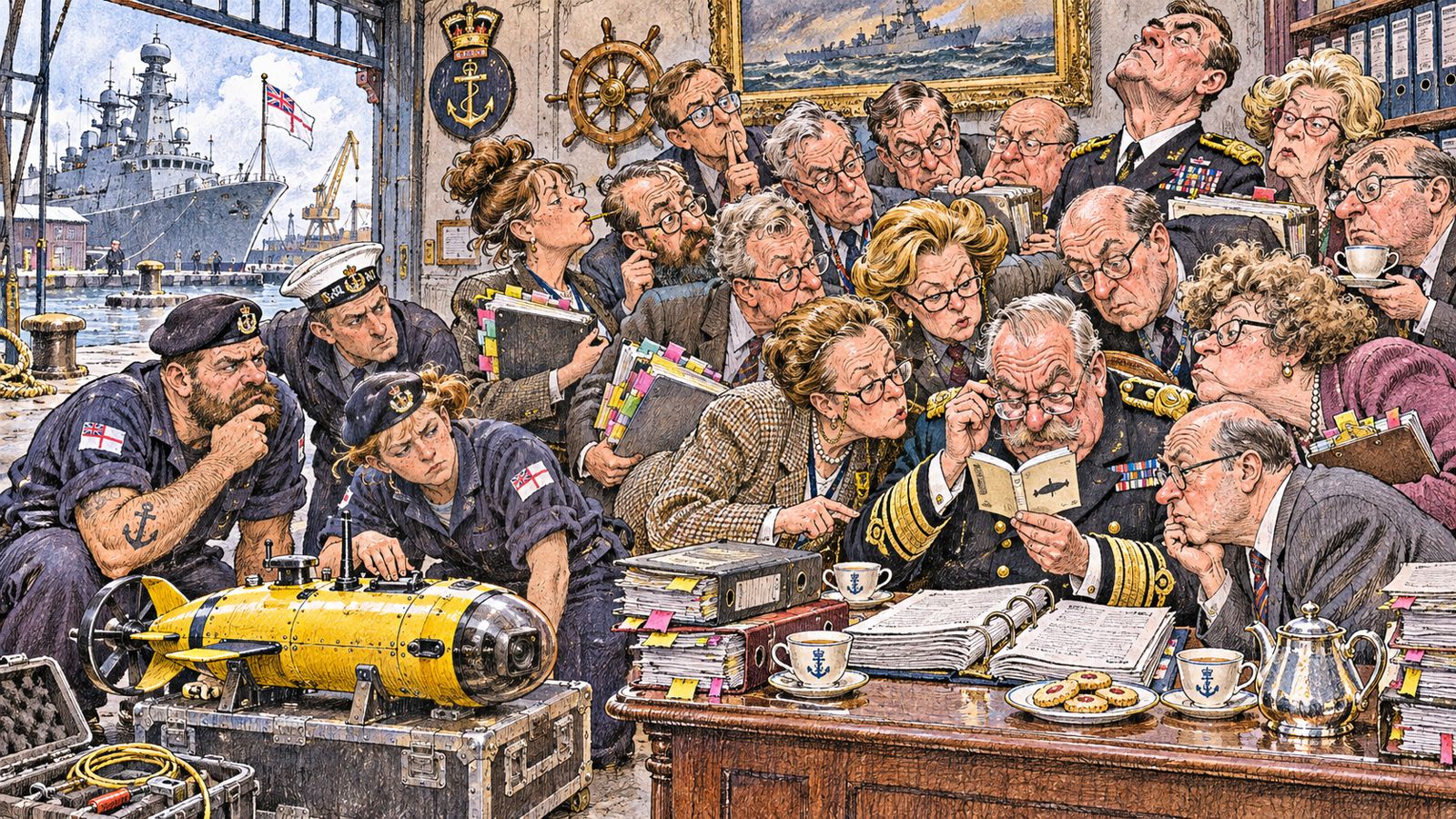
PORTSMOUTH — Royal Navy underwater drones are set to reduce the need to put sailors close to dangerous mines, while officials confirmed that every meeting surrounding the purchase would retain a full human complement.
The Ministry of Defence’s £142 million announcement concerns REMUS 620 uncrewed underwater vehicles and support services. The stated purpose includes minehunting and protecting sea routes while reducing risks to sailors. Unfortunately, no autonomous system has yet demonstrated a reliable ability to sit through the introductory remarks.
Royal Navy underwater drones meet the fully crewed committee
At a dockside briefing, an officer described the operational case in several clear sentences. A procurement consultant then explained the stakeholder landscape for considerably longer than a submarine would normally wish to remain visible.
The vehicle could operate beneath the water. The presentation could operate beneath the level at which listeners retained consciousness. Both were described as impressive endurance capabilities.
Uncrewed does not mean nobody is responsible. People still plan, support, analyse and manage operations. This distinction has disappointed a finance official who briefly hoped the machine might also replace the people asking why the maintenance budget had been calculated that way.
The technology is smaller than the meeting
The announced contract includes equipment and support, rather than a promise that a clever vehicle can look after itself forever. A sailor welcomed this because machines tend to acquire practical requirements immediately after somebody in a suit describes them as transformational.
Logistics specialist Petty Officer Martin Cable said useful technology should solve an actual problem. The minehunting role qualified. He was less certain about a proposed launch video requiring six approvals to show a vehicle sitting in the water.
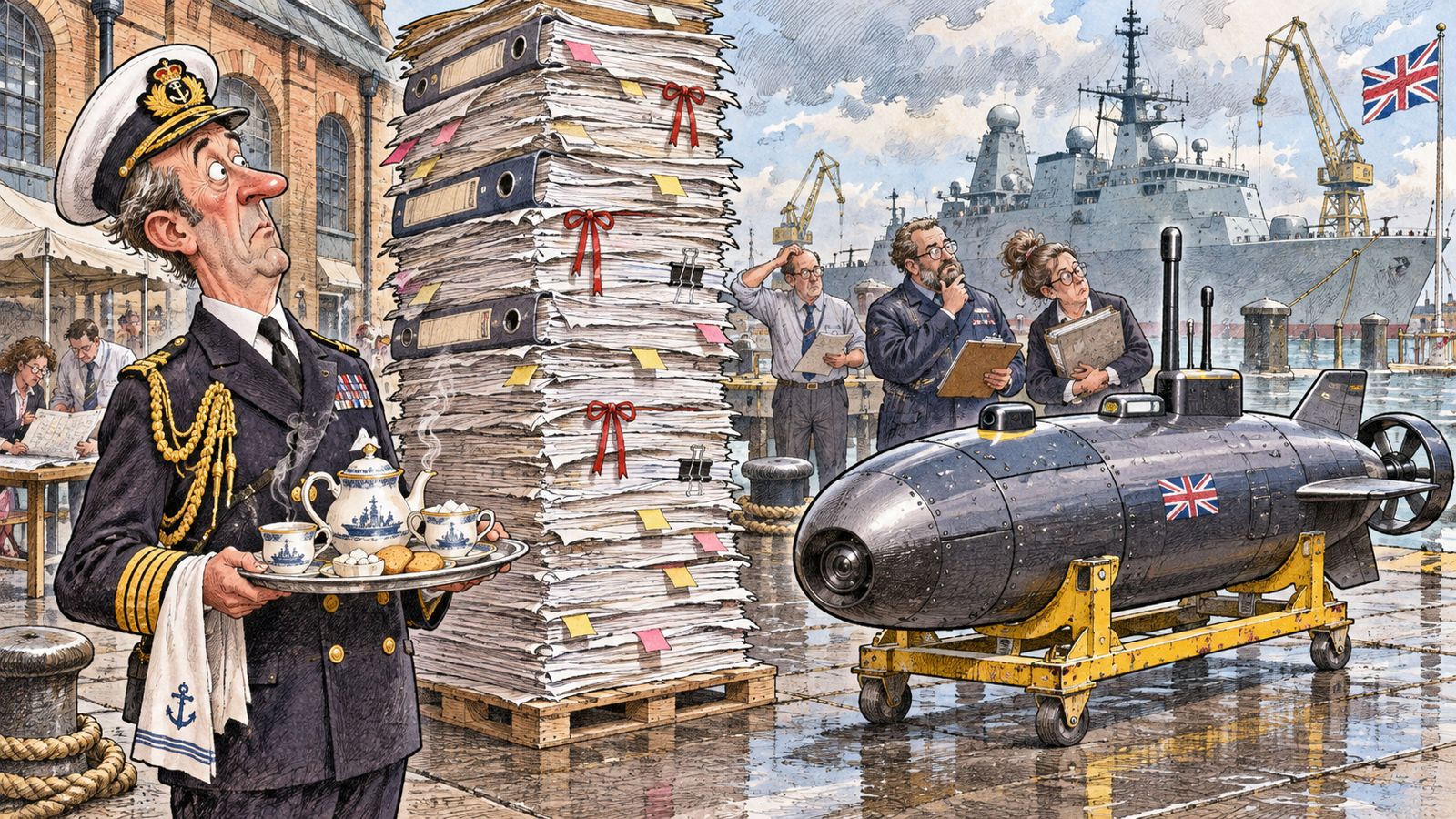
The consultant said the video would communicate ambition. Cable said sailors were already communicating a fairly specific ambition: keep people safer while getting the job done.
Hybrid Navy discovers a traditional source of drag
The programme forms part of the move towards a mixture of crewed and uncrewed systems. It does not imply that the whole fleet has become an app or that the serious business of maritime defence can be reduced to a robot joke.
Cable’s preferred joke concerns the ratio between useful hardware and the paperwork required to discuss it. At one workshop, the small model vehicle could be carried by two people. The documents explaining its place in a wider framework required a trolley.
An informal poll of the briefing room found broad support for keeping sailors away from mines and slightly less enthusiasm for extending the question-and-answer session into a fourth strategic context.
Nobody asked the drone for its opinion. It had demonstrated promising judgement by having no seat at the table.
The officer returned to the operational work, the technicians returned to their equipment and the consultants began planning a session on lessons from the briefing.
The Navy is investing in machines capable of travelling underwater without a crew aboard. Whitehall’s next challenge is a meeting capable of reaching a conclusion with fewer people in it.
Editorial disclaimer: The world’s oldest tenured professor and a philosophy major turned dairy farmer have left the drone uncrewed and the meeting as quickly as possible.

Dr. Ingrid Gustafsson holds a Ph.D. in Literary Studies and serves as Professor of Literature and Satirical Journalism at the university. Her scholarly work focuses on contemporary satire as a form of institutional critique, examining how exaggeration, irony, and absurdism function as sophisticated analytical tools for exposing structural inequality and institutional hypocrisy. Dr. Gustafsson has published extensively on the genealogy of satirical discourse, the relationship between speech acts and cultural power, and satire’s role as both aesthetic practice and epistemological strategy. Her research interrogates how contemporary satire operates within celebrity culture, legal systems, and institutional rhetoric, revealing the mechanisms through which power obscures itself through language and performance. Dr. Gustafsson’s work combines rigorous textual analysis with broader cultural theory, contributing significantly to understanding satire’s critical function in contemporary society. She is the author of Pearl Clutching and How to Combat It with Satire.


