
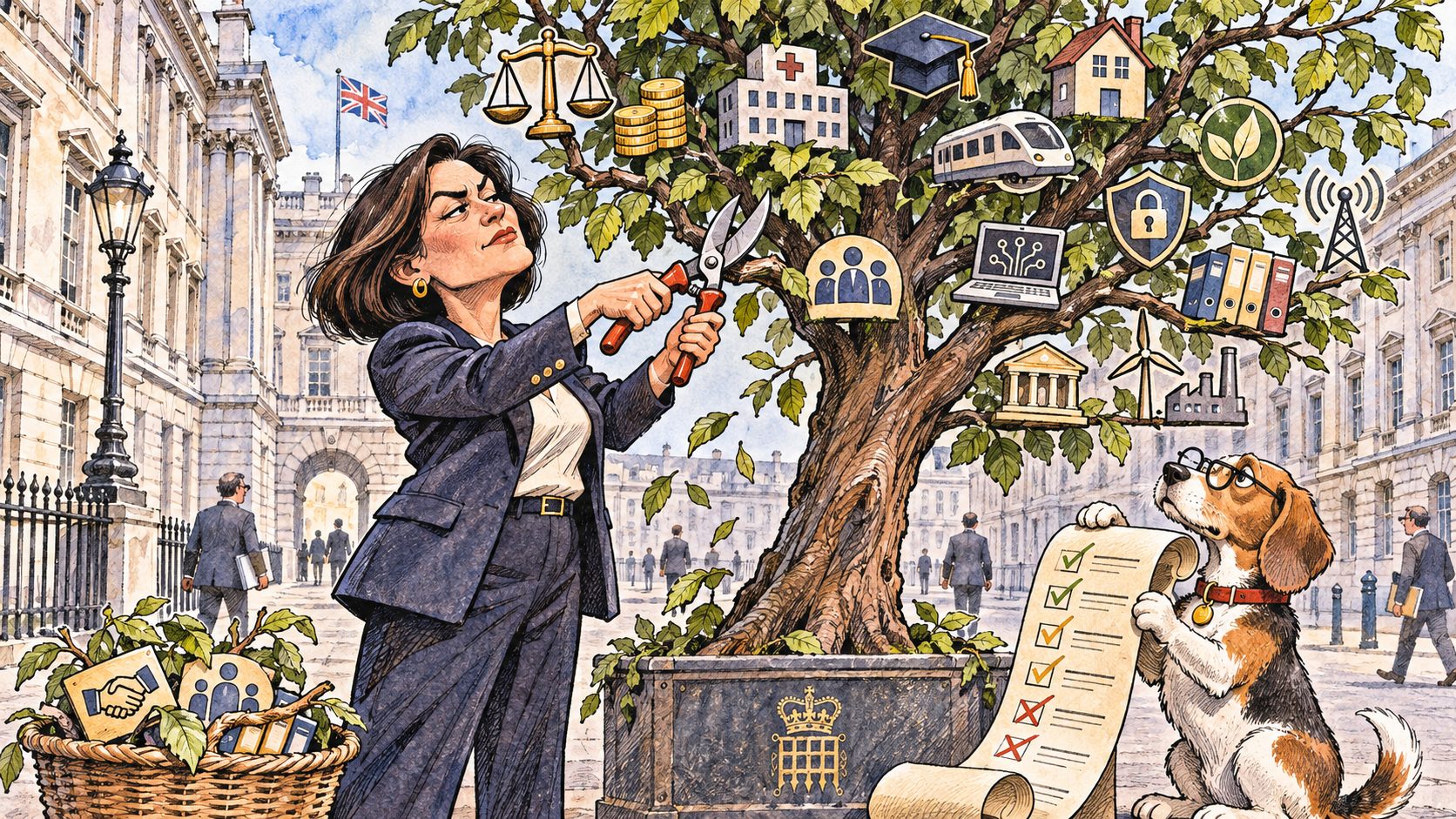
WESTMINSTER — Ministers considering quango abolition have been asked to complete an environmental impact assessment by the watchdogs they may abolish, in a development insiders described as either a final act of obstruction or a convincing job application.
Sky’s coverage of Louise Haigh’s CBI remarks reports a review of arm’s-length bodies, including Natural England and the Environment Agency. Responsibilities could be dissolved, devolved or moved into departments. A review is under way; the organisations have not vanished because a speech has acquired a forceful verb.
Quango abolition starts with a list of quangos
The first task is determining who does what, why they do it and which other organisation assumes they are doing it. A senior Whitehall flowchart has been brought out of retirement to assist. Its final arrow points to a box marked “clarify”.
Quango is the familiar shorthand for a quasi-autonomous non-governmental organisation. In ordinary political conversation, it often means a body a minister dislikes until the minister needs somebody independent to blame.
Governance consultant Prunella Armslength said moving a duty into a department could improve accountability, provided the department received the people and capacity to perform it. Asked whether the duty could simply be moved into a sentence, she said that option was already heavily used.
The bonfire requests permission to ignite
The proposed bonfire has itself generated questions about procurement, consultation, property, staffing and the safe disposal of obsolete stationery. One participant suggested avoiding the paperwork by calling it a pilot. The pilot immediately required a steering group.
Environmental scrutiny addresses real matters such as habitat, pollution and development impacts. The Natural England organisation page sets out that body’s role. Whether responsibilities sit inside or outside a ministry, the underlying job does not disappear when the office sign is unscrewed.
A local builder said he would welcome a clear, prompt decision. He did not especially care whether the person giving it worked behind a departmental logo, an agency logo or a reassuring picture of a badger.
Accountability should survive the move
Prunella compared restructuring government to rearranging a crowded kitchen. Putting the kettle in another cupboard can help. Declaring that the kettle has been abolished does not make tea.
At an informal meeting, residents agreed that both delay and careless decisions could be expensive. Nobody volunteered to choose between a perpetual application and a flooded living room. This was considered an unhelpfully practical contribution to a debate trying to divide everyone into two teams.
A proposed performance measure would examine whether decisions became faster, clearer and better. A competing measure would count the number of organisations renamed. Officials found the second easier to announce.
The watchdogs are preparing for scrutiny. Ministers are preparing to explain who will carry out any transferred duties. The public is preparing to ask the same question it asks after every administrative revolution: whom do we ring now?
The current answer is being finalised. It must first pass through the body responsible for confirming which body is responsible.
Editorial disclaimer: The world’s oldest tenured professor and a philosophy major turned dairy farmer have submitted this disclaimer for assessment. The watchdog has asked for another copy.

Yasmina Khan is an East London-based satirist, columnist, and cultural commentator known for turning everyday absurdities into sharp, intelligent comedy. Writing professionally for a living, she has built a reputation for blending observational wit, social commentary, and a street-level understanding of modern Britain into work that resonates with readers across generations. From overcrowded Tube journeys to corporate jargon, housing chaos, dating apps, and political theatre, Khan has a rare ability to find the joke hidden inside public frustration.
Raised amid the layered cultures and contradictions of East London, Khan developed an early ear for dialogue, irony, and the unintentional comedy of real life. That background remains central to her voice. Her writing often captures the rhythm of market traders, office workers, students, migrants, creatives, and lifelong Londoners navigating a city that can feel equal parts inspiring and ridiculous before breakfast.
Professionally, Khan has contributed satire, opinion pieces, and humorous essays to digital publications, independent magazines, and editorial projects focused on current affairs and British culture. Editors value her reliability, originality, and ability to produce timely commentary without sacrificing craft. Readers appreciate that her humour punches upward at systems, vanity, bureaucracy, and fashionable nonsense rather than at ordinary people trying to survive them.
Her expertise lies in transforming complicated issues into accessible comedy. Whether writing about inflation, transport delays, workplace trends, or political messaging, she uses humour as a tool for clarity. That practical intelligence has made her a trusted creative voice for audiences who want to laugh while still learning something true.
Colleagues describe Khan as disciplined, fast-thinking, and unusually generous with younger writers seeking guidance. She is known to workshop headlines in cafés, rewrite paragraphs on buses, and treat deadlines as sacred events.
Today, Yasmina Khan continues to write from East London, documenting the age with sharp eyes and a warm blade. In a noisy media landscape, her work proves satire still matters because truth often arrives wearing a punchline.