England Gives Mayors Power to Tax Tourists, Municipal Marxists Discover Visitors Are Capitalists With Suitcases
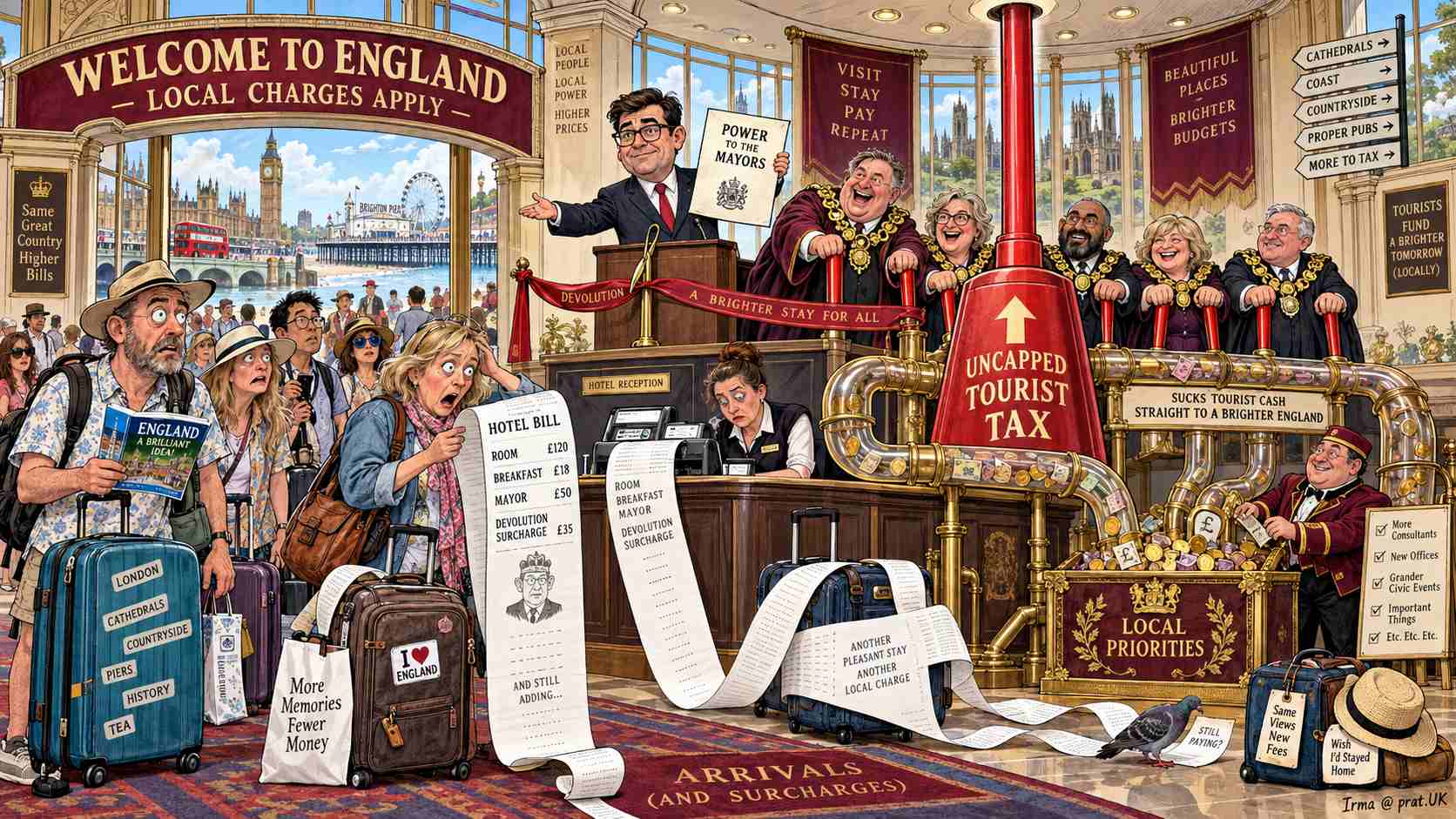
Burnham’s great devolution experiment hands power-drunk local politicians an uncapped new tourist-tax lever, because nothing says “Welcome to England” quite like discovering the mayor has added himself to your hotel bill
MANCHESTER, ENGLAND — Prime Minister Andy Burnham’s government has announced that English mayors will be allowed to impose an Overnight Visitor Levy on hotels and other paid accommodation, giving regional politicians a shiny new revenue lever in the name of fiscal devolution. The levy will be optional, percentage-based and, under the government’s current proposal, without a nationally imposed rate cap.
For purposes of satire, we shall refer to any politician who looks at a family entering a Travelodge and thinks, There goes untapped revenue, as a Municipal Marxist. This is not a political-science classification. Marx himself never wrote extensively about Premier Inn, principally because checkout was much simpler in 1867. What he might have recognized, however, is the giddy, power-drunk look of a local official who has just been handed a lever nobody in Westminster bothered to cap.
Welcome to England. Please Declare Your Toothbrush and Disposable Income
The tourist tax represents Burnham’s wider effort to push fiscal power away from Westminster and toward regional leaders. In a September statement to Parliament, the prime minister described his devolution programme as a major redistribution of power and specifically identified the Overnight Visitor Levy as part of that agenda.
This sounds wonderfully democratic.
Instead of one distant politician inventing a tax, Britain can now enjoy the intimacy of a power-drunk local politician who knows exactly where you parked.
The government calls the proposal an Overnight Visitor Levy.
That is government language.
Normal people call it five percent more hotel bill.
Governments adore the word “levy” because “tax” causes voters to begin examining their pockets. A levy sounds nautical. Perhaps somebody is repairing a harbour.
An Overnight Visitor Levy sounds almost romantic.
“Darling, shall we spend the weekend in York?”
“I’d love to.”
“Wonderful. I’ve booked the hotel, made dinner reservations and transferred the statutory tribute to the Combined Authority.”
Nothing rekindles a marriage like regional fiscal autonomy.
Municipal Marxism Finally Discovers the Bourgeoisie Carry Samsonite
Traditional Marxism argued about ownership of the means of production.
Municipal Marxism is more practical.
It asks who owns the means of accommodation.
Hotel? Tax it.
Airbnb? Tax it.
Holiday cottage? Tax it.
Tent? Someone in a committee room, power drunk on their new authority, is already staring at a calculator.
Under the government proposal, local leaders would have discretion over introducing the levy and spending the proceeds locally, with ministers arguing that communities should benefit financially from tourism-related pressures and investment.
This produces an entertaining philosophical transformation.
A tourist arrives carrying £800.
The hotelier sees a customer.
The restaurateur sees six meals.
The pub sees four pints and a questionable decision involving karaoke.
The gift shop sees somebody willing to pay £14.95 for a tea towel with a sheep on it.
The mayor, flush with newfound and slightly power-drunk enthusiasm, sees unrealised public-sector potential.
That is devolution. Everybody gets a turn at the wallet.
The Extraordinary Economic Discovery That Prices Matter
Hospitality representatives are less enthusiastic.
UKHospitality has pointed to Oxford Economics modelling estimating that a 5% levy across England could put about 33,000 jobs at risk and reduce output by roughly £2.2 billion. Those are forecasts rather than observed outcomes, and they come from the industry side of the debate, but they provide rather more economic substance than “other cities do it.”
A separate Stack Data Strategy survey of roughly 10,000 people, reported by Bloomberg in May, found 73% said a tourism tax would cause them to stop taking English holidays, take fewer of them or spend less while travelling. More than half opposed the levy.
The government’s response, essentially, is that tourist levies are common internationally and can finance infrastructure used by visitors.
And there is evidence supporting that side too.
Manchester introduced a £1-per-night visitor charge in 2023 and reportedly raised about £10.5 million over three years without a significant deterioration in hotel occupancy. Research cited in reporting on European visitor taxes has likewise found limited evidence that modest levies automatically destroy tourism.
So the serious policy question isn’t actually, “Are tourist taxes Marxist?”
It is: How high can you raise the price before tourists alter their behaviour?
This is called demand elasticity. Politicians traditionally test it by continuing to raise the price, power drunk on the assumption tourists have nowhere else to go, until somebody opens a caravan park just beyond the boundary.
England Accidentally Invents Capitalism Between Counties
The funniest feature may be that the levy is optional.
Some Reform UK and Conservative mayors have already indicated they do not intend to impose it, while Labour metro mayors have largely backed having the power and have indicated rates around or below 5%.
This creates a laboratory experiment that Adam Smith would have enjoyed enormously.
County A: WELCOME! HOTEL £150 + TOURISM LEVY
County B: WELCOME! HOTEL £150
Municipal officials will then spend £480,000 commissioning consultants to determine why County B has unexpectedly become popular with coach tours.
There will be charts. There will be stakeholder consultations. There will be a 214-page report called Unlocking Sustainable Overnight Visitor Ecosystems Through Place-Based Fiscal Empowerment.
Page 213 will say: “Apparently people prefer £150 to £157.50.”
The consultant will receive an award.
The Tax That Will Save Tourism From Having Too Many Tourists
Supporters have a legitimate argument.
Visitors use streets, public transport, rubbish collection, policing, parks and amenities. Cities such as Paris, Rome, Amsterdam and many American destinations levy accommodation taxes without turning into abandoned ghost towns. Manchester’s existing experiment provides domestic evidence that a modest charge need not automatically devastate visitor numbers.
The satire begins when government language upgrades a revenue-raising mechanism into an act of tourism promotion.
Taxing tourists may raise useful money. Fine. Call it that.
But power-drunk politicians cannot resist claiming the tax will actually make the taxed activity flourish.
Apparently hotels will become more competitive after becoming more expensive.
Visitors will be encouraged by the discouragement fee.
Families will enthusiastically book another night after receiving the mayor’s personal surcharge.
By 2032, Britain may introduce a Restaurant Appreciation Levy to encourage eating, a Retail Vitality Charge on shopping and a Pub Preservation Tax collected every time someone attempts to preserve a pub by buying a pint in it.
Eventually residents will remain indoors to avoid accidentally contributing to economic growth.
Britain’s New Holiday Decision Tree
A family considering a week away in England already calculates petrol, railway fares, hotel prices, meals, attractions and the astonishing cost of discovering that four sandwiches at a heritage property constitute a small unsecured loan.
The proposed levy adds another variable.
Supporters say five percent is small. Perhaps.
But five percent enjoys an unusual property in politics.
When government collects it, five percent is tiny.
When government cuts expenditure by five percent, civilisation has ended.
A £1,000 hotel bill receiving a 5% levy becomes £1,050 before other holiday spending.
The individual family may absorb it. Or stay one fewer night. Or choose a cheaper hotel. Or eat at McDonald’s instead of a local restaurant. Or go abroad.
That is the difficulty with tourists. Unlike lampposts, they have choices.
Burnham Gives Local Democracy the Keys to the Cash Register
The broader devolution project deserves attention because it extends beyond tourism. Burnham has promised one of the largest transfers of powers from Whitehall to English regional government in decades, including new responsibilities involving taxation, planning, skills and growth.
There is an intellectually coherent case for that.
If local voters want higher taxes and better-funded amenities, they should be allowed to choose them.
If they want lower taxes and greater reliance on private-sector growth, they should be allowed to choose that too.
That is the useful part of devolution.
The comedy starts when power-drunk politicians demand local autonomy and then react with horror after neighbouring regions autonomously choose not to tax something.
England may be about to discover genuine federal-style competition.
One mayor can impose 5%. Another can impose 2%. Another can impose nothing.
Tourists can respond. Businesses can respond. Voters can respond.
Suddenly the Overnight Visitor Levy becomes less Karl Marx and more Darwin. Survival of the fiscally fittest.
Helpful Advice for England’s Newly Empowered, Power-Drunk Mayors
If mayors genuinely want the levy to help rather than damage tourism, the formula is painfully unexciting: keep the charge modest, publish exactly where the money goes, measure visitor numbers and hotel occupancy, review the rate regularly and resist treating tourists as renewable mineral deposits.
Most importantly, remember that tourism is an export industry in which the customer travels to the product.
You cannot relocate York Minster to Dubai.
But the customer can relocate himself to Dubai remarkably easily.
Tourists are funny that way. They have passports.
15 Humorous Observations Before Britain Taxes Them
- Tourists have officially been reclassified from visitors into ambulatory tax bases. Britain used to greet foreigners with castles, pubs and rain. Now there will apparently be a fourth national attraction: the mayor.
- The tourist tax is designed to help tourism. This follows the established economic principle that if you want more of something, charge people extra for doing it. Economists call this “an unusual interpretation of demand.”
- Devolution means moving taxation closer to the taxpayer. Westminster used to pick your pocket from London. Under the new arrangement, your wallet receives a warm regional welcome.
- The levy is optional. Mayors merely have to decide whether they enjoy receiving additional money. Government officials have reportedly classified this as a difficult ethical dilemma.
- There is presently no national percentage cap. Britain has therefore combined the words “politician,” “tax” and “no cap” in the same policy document and apparently nobody pulled the fire alarm.
- Labour metro mayors have indicated that they generally intend to stop around 5%. That is reassuring in the same way a restaurant telling you, “Don’t worry, we promise the mysterious service charge probably won’t exceed five percent,” is reassuring.
- Some Reform and Conservative mayors say they will refuse to impose the levy. England may therefore accidentally invent tax competition, the capitalist phenomenon in which power-drunk politicians discover people can travel twenty miles in a car.
- Hospitality businesses already charge 20% VAT. The latest proposal asks the tourism industry to celebrate another tax because this one has a charming local accent.
- The government says the money can improve attractions and local services. Thus tourists will pay a tax for visiting the attraction so the attraction can become attractive enough for people willing to pay the tax required to visit the attraction.
- UKHospitality cites Oxford Economics analysis suggesting a nationwide 5% levy could threaten 33,000 jobs and reduce economic output by £2.2 billion. Government officials counter that local government will receive money, which is apparently where economics ends.
- Manchester has already operated a smaller visitor charge without tourism collapsing. This inconvenient evidence means both sides are now legally entitled to declare themselves completely vindicated.
- A hospitality-backed poll found 56% opposed the proposed holiday tax and 24% supported it. Another poll promoted by IPPR North in 2025 found 41% supported visitor levies and 31% opposed them. Britain has therefore reached the scientifically robust conclusion that polls behave considerably better when you select the one you like.
- Tourism taxes already exist in scores of European destinations. Supporters regard this as proof England should have one. By this reasoning, Italy also has volcanoes, Greece has goats blocking roads and France occasionally sets Paris on fire, so Parliament has another busy session ahead.
- The tax is intended to make local government less dependent on Whitehall. Finally, power-drunk mayors can experience the independence enjoyed by teenagers whose parents have given them their own credit card.
- The whole plan rests on tourists continuing to arrive after Britain makes arriving more expensive. This may work perfectly. It may not. Fortunately, economists have been issued enough spreadsheets to ensure nobody will know until after the brochures are printed.
Disclaimer
This is satire. “Municipal Marxist” and “power drunk” are comic political labels applied here to tax-happy local government, not factual assertions that England’s mayors belong to a Marxist political movement or are literally intoxicated. Economic forecasts and polling cited above should be understood in context, including who commissioned or promoted individual studies.
This story is entirely a human collaboration between two sentient beings: the world’s oldest tenured professor and a philosophy major turned dairy farmer, neither of whom has yet proposed taxing anyone for sleeping on the sofa.
Sources and Further Reading
The original Reuters reporting on England’s new mayoral tourist-tax powers and Andy Burnham’s devolution programme provides background on this story, as does the UK government’s consultation document explaining the Overnight Visitor Levy framework.