
WESTMINSTER — The Green Party’s defence debate has reached the delicate stage at which campaigners must decide whether a nuclear submarine becomes more acceptable if it is described as a very long reusable container. A working group has been formed to examine the packaging.
Reporting on Zack Polanski’s welcome for a Verdant security paper says the report supports NATO membership and retaining nuclear weapons. Party sources stress that existing defence policy has not changed. This distinction has allowed the argument to advance without requiring the policy to leave its chair.
Green Party defence policy discovers the consultation hatch
At a local discussion, one delegate asked whether maintaining a deterrent meant endorsing everything it might deter. Another asked whether France’s involvement would qualify as collaborative consumption. A third requested confirmation that the submarine’s crew separated their recycling.
The chair explained that welcoming a report is different from adopting its recommendations. Members welcomed that explanation while reserving the right to reject it at a subsequent conference, subject to available hall space.
Political analyst Rupert Thistle called the process an example of strategic ambiguity. “You reassure one group by saying you’re open to a discussion, then reassure another by saying the discussion hasn’t changed anything,” he said. “The sentence does more manoeuvring than the vessel.”
The peace dividend requests a clearer invoice
Deterrence means attempting to prevent an attack by convincing an opponent that its costs would be unacceptable. At the meeting, this was compared to putting a large dog behind the garden gate. The analogy deteriorated when somebody asked whether the dog had signed an international treaty.
The NATO website explains the alliance’s collective-defence role. It does not currently offer a low-conflict membership tier in which a country enjoys protection while contributing only a carefully worded expression of concern.
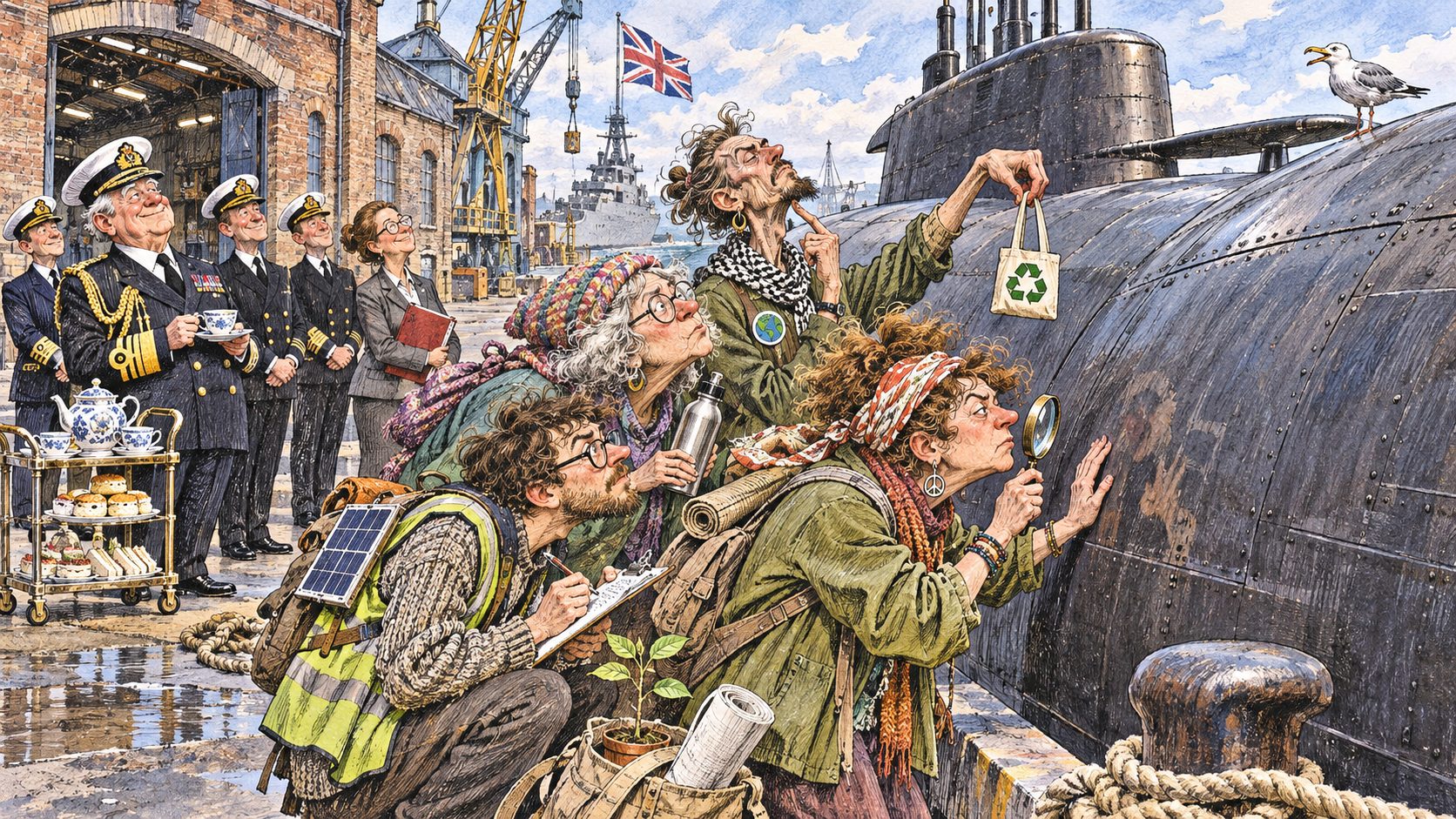
A volunteer proposed calling the submarine a national resilience vessel. Several people relaxed immediately, demonstrating how much of modern political communication consists of waiting for a noun everyone can survive.
A broader electorate requires a bigger meeting room
The serious question is how a party squares commitments about disarmament with public expectations of security. That involves choices about threats, alliances, costs and credibility. The less serious but apparently unavoidable question is how many internal emails can be generated before anyone states those choices plainly.
One activist said the movement must remain radical. Another said it must become credible. The room briefly considered whether this was a false choice before agreeing that a fresh subcommittee could keep it alive for another fortnight.
A proposed defence leaflet is now being reviewed by the foreign-affairs group, the climate group, the treasury group and a man who believes all naval problems can be solved by restoring a local bus route.
The submarine, meanwhile, has requested a decision before its next refit. Members have assured it that all voices will be heard, including the voices concerned that hearing the submarine gives disproportionate influence to people with submarines.
The reusable wrapping remains the least controversial element. Unfortunately, nobody has yet volunteered to take it home and wash it.
Editorial disclaimer: The world’s oldest tenured professor and a philosophy major turned dairy farmer have agreed to discuss the submarine again after somebody washes the reusable wrapping.