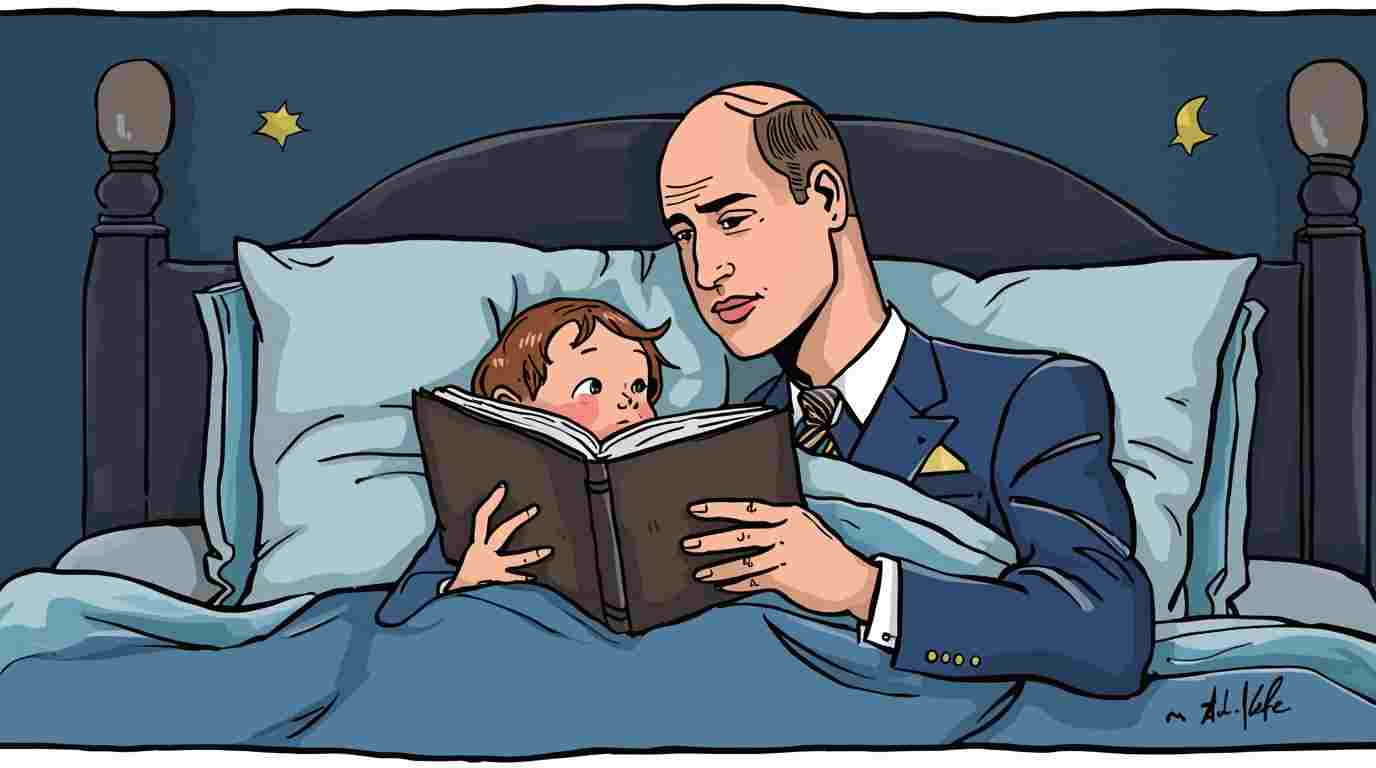
British Royal Protocol Defined as Turning Perfectly Normal Human Activities Into Expensive Administrative Emergencies, Buckingham Palace Orders Investigation Into Who Permitted Such an Accurate Definition
From Henry VIII’s Official Toilet Attendants to Parliament’s Ceremonial Hostage, 500 Years of British Royal History Suggest the Monarchy Has Never Encountered a Simple Human Activity It Couldn’t Turn Into a Constitutional Procedure
British Royal Protocol: The World’s Most Elaborate System for Making Simple Things Complicated
LONDON. British historians investigating the origins of royal protocol have discovered that the monarchy spent approximately 500 years developing elaborate procedures to stop members of the Royal Family from doing ordinary things without supervision, witnesses, specialist clothing or somebody carrying a ceremonial stick.
The findings explain why the average British citizen can eat breakfast, use the lavatory, answer the front door, greet a friend and go to bed without consulting the constitutional history of England. A royal doing precisely the same things might need six servants, two advisers, a dress rehearsal, a procession and the approval of someone whose official title dates from the reign of a king who died of gout.
Royal protocol, for the benefit of ordinary readers, is the process by which perfectly normal human activities are converted into expensive administrative emergencies. It has survived civil wars, religious revolutions, industrialisation, two world wars, television, the internet and the invention of the automatic flushing toilet, which the Tudor establishment found particularly threatening. Nobody has yet explained why the King can’t just knock on the door.
Thinking About British Royal Protocol
- Henry VIII couldn’t go to the bathroom without creating a government position. He had a guy for the close-stool. I’ve got a toilet and a phone, and neither of them has ever been promoted. In Tudor England the man standing outside with the paper was one good conversation away from running the country.
- The Tudors listened outside the bedroom on the wedding night. Listened. Blessed the bed, walked out, then stood by the door like it was a hotel wall. And Henry VIII’s grandmother wrote the rules, which is the part that really gets me. Somebody’s nan drew up the guidelines for eavesdropping on her own grandson.
- From 1894 to 1936 a cabinet minister stood near royal births to confirm the baby was the right baby. That’s a lot to put on a man who normally just has to look serious in front of a lectern. “Congratulations, ma’am. It’s definitely a baby. I’ve seen the paperwork.”
- Seventy people watched James II’s son get born in 1688, and half the country still decided he’d been smuggled in a bed warmer. Seventy witnesses. I can’t get four people to agree on a restaurant, and I’m not even trying to prove a crown.
- The Coronation Chair is from around 1300. The country has changed its religion, changed its government and lost an empire, and nobody’s once said, “Maybe we try a different seat.” I’ve thrown out a sofa for being the wrong beige.
Henry VIII’s Toilet Attendants: How Going to the Lavatory Became a Matter of National Importance
Historians at Historic Royal Palaces confirm that the men closest to Henry VIII helped him wash and dress and attended him when he used the close-stool, which the palace’s own history says was covered in sheepskin, black velvet and ribbons. That is rather more effort than most Tudor households put into their sitting rooms.
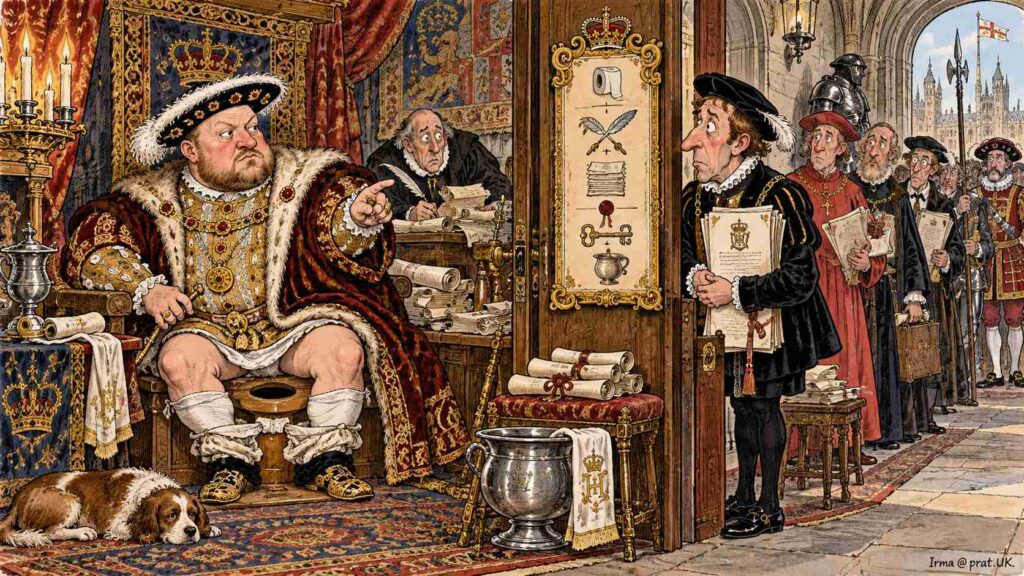
These attendants held real power, because access to the king’s private chambers could be turned into political influence. Tudor England had therefore managed to make the lavatory a rung on the career ladder. Ordinary men had to fight wars, inherit estates or marry wealthy widows to get anywhere. A sufficiently ambitious courtier could simply wait near the royal privy.
“Good morning, Your Majesty. Have you considered the situation in France?”
“Not now, Thomas.”
“Very good, Your Majesty. Shall I summon the Lord Privy Seal?”
“No, Thomas. Just the paper.”
The principle was established early: the closer a man stood to the royal backside, the closer he stood to the centre of government.
In 1526, Cardinal Wolsey drew up the Eltham Ordinances, a detailed set of rules for the king’s household. According to the National Archives’ teaching resource on Henry VIII, the rules covered the start of the king’s day, the duties of his staff and who was allowed to approach him, and who was allowed to touch him. Nearly a thousand people attended the court at Hampton Court, and there were rules about which of them could lay a hand on the monarch.
Henry could dissolve the monasteries, defy the Pope and marry six women, yet he apparently couldn’t be trusted to get dressed without a committee.
Tudor Royal Wedding Traditions: More Witnesses Than an Insurance Fraud Investigation
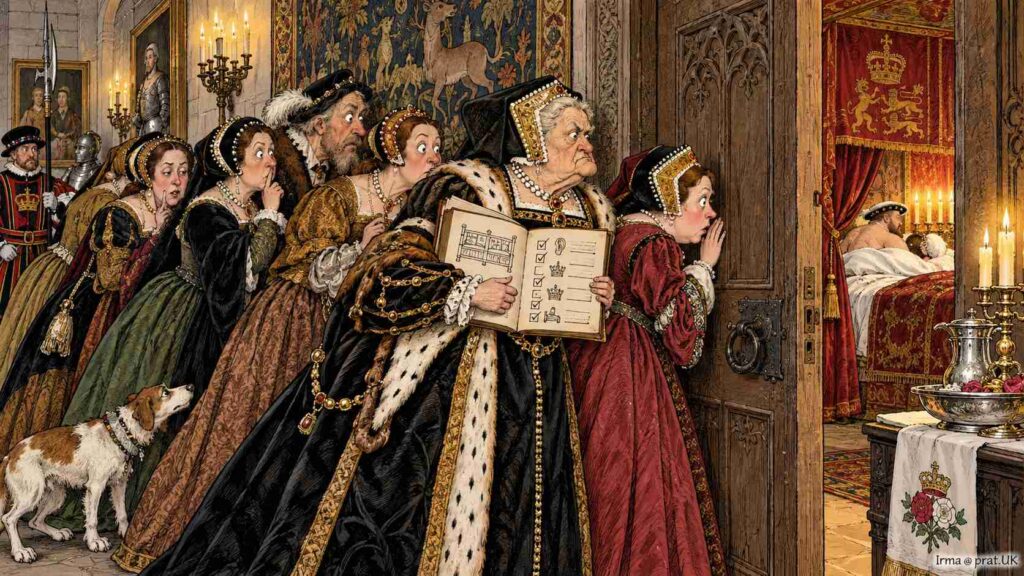
Royal protocol was especially interested in what happened after the wedding. Historic Royal Palaces describes the Tudor bedding ceremony, in which courtiers escorted the groom to his bride in the royal bedchamber, blessed the bed and left the room, though not so far that they couldn’t listen for proof the marriage had been consummated. Lady Margaret Beaufort issued detailed rules for how it should be run.
Ordinary newlyweds get a honeymoon. Tudor newlyweds got something closer to a government inspection. A prince could command armies, govern territories and negotiate international treaties, but on his wedding night several aristocrats apparently needed reassurance that he understood the practical arrangements.
“Your Highness, is everything proceeding satisfactorily?”
“Would it proceed more satisfactorily if you stopped listening outside the door?”
“Unfortunately, Your Highness, that would breach protocol.”
One suspects the institution would have been better served by a marriage counsellor than by another chamberlain.
The Home Secretary at Royal Births: Why Britain Sent a Cabinet Minister to Check the Baby
Britain eventually modernised royal protocol by moving government ministers out of the royal bedroom. Unfortunately, they turned up again when the children arrived.

According to The Gazette’s history of royal babies, Home Secretaries were required to attend royal births from 1894 to confirm that the child was a genuine descendant of the monarch and not an impostor. Before that, the birth room was typically crowded with privy councillors, ministers, doctors and ladies-in-waiting, and Queen Victoria decided one Home Secretary would do, starting with the birth of the future Edward VIII. The last attendance was on 25 December 1936, when Home Secretary John Simon was present for the birth of Princess Alexandra.
The tradition grew out of real dynastic anxiety, most famously the 1688 rumour that James II’s newborn son had been smuggled into the palace in a warming pan. Seventy prominent people witnessed that birth. Seventy. A modern woman in labour might hope for a midwife, an obstetrician and a husband who remembers where he parked. A seventeenth-century queen needed enough witnesses to form a small parliamentary majority, and people still refused to believe her.
The arrangement shows the underlying philosophy of royal protocol: if one witness is enough for ordinary legal purposes, the monarchy appoints seventy and still gets a constitutional crisis. By the twentieth century the Home Secretary’s role had settled into a very British answer to a biological event. The minister responsible for domestic security could presumably be pulled out of a Cabinet meeting to establish whether a duchess had produced the correct baby. It’s hard to imagine a better use of government time.
The practice ended before the birth of King Charles III in 1948. One assumes the new baby appreciated the reduction in paperwork.
State Opening of Parliament Explained: The Ceremonial Hostage, the Cellar Search and the Slammed Door
Every State Opening of Parliament shows that 400 years of political progress haven’t reduced Britain’s appetite for extremely peculiar behaviour. According to UK Parliament, the Yeomen of the Guard ceremonially search the cellars of the Palace of Westminster for explosives before the King arrives, a nod to the Gunpowder Plot of 1605. Guy Fawkes has been dead since 1606, but British security policy hasn’t ruled out a return visit.
An MP is also ceremonially held hostage at Buckingham Palace while the monarch attends Parliament, as a guarantee of the sovereign’s safe return. Parliament says the job traditionally goes to the Vice-Chamberlain of the Household, who is a government whip.
Then comes Black Rod, who goes to the House of Commons to summon MPs to hear the King’s Speech. The Commons slams the door in his face. Black Rod knocks three times, the door opens and the MPs follow him out. It has been done for centuries, and Parliament explains that the slammed door symbolises the Commons’ independence from the monarch. In an ordinary London office the procedure would produce a complaint to Human Resources. At Westminster it is the defence of parliamentary sovereignty.
Between them, the monarchy and Parliament have turned answering a door into a historical re-enactment of their inability to get along. The King’s messenger knows the door will be slammed. The MPs know he’ll be back. Everyone knows the King is waiting. Britain performs the whole thing anyway, because dropping the door-slamming would apparently endanger the constitutional settlement.
Afterwards, the King reads a speech written by the government. Hundreds of people dress up, horses are readied, traffic is stopped, officials march through corridors and a monarch in ceremonial regalia announces policies he didn’t write. If Britain’s schoolchildren used the same method, homework would require a coronation rehearsal.
The Coronation Chair: Britain Has Spent Seven Centuries Avoiding a Trip to IKEA
For a coronation, the monarch must sit in one particular chair. Westminster Abbey explains that the Coronation Chair was commissioned by Edward I around 1300 to house the Stone of Scone, and it has been used for coronations for more than 700 years. That makes it arguably Britain’s most successful piece of institutional furniture.
In that time the country has changed its borders, its governments, its religious arrangements and its understanding of human rights. The chair remains indispensable. A British family might replace a dining chair because one of the legs is loose. The monarchy would appoint a Royal Commission on the Constitutional Implications of Sitting Somewhere Else.
The distinction between a chair and a throne is the most impressive part. A chair is something you sit on. A throne is something you sit on while several hundred people explain why your sitting down is historically important. If a monarch accidentally sat on the wrong chair, palace officials would presumably have to decide whether the country had acquired a new king or merely an unfortunate furniture problem.
Queen Victoria’s Mourning for Prince Albert: Forty Years in Black and a Royal Dress Code Nobody Could Cancel
After Prince Albert’s death in 1861, Queen Victoria withdrew from much of public life and wore mourning clothes until her own death in 1901. Her grief was real and profound. Royal protocol, however, allowed one person’s private sorrow to harden into an institutional atmosphere capable of depressing several generations.
Ordinary families find it hard enough to talk about bereavement. Victoria’s household had to live with the consequences for four decades. One can imagine the difficulties facing an optimistic new servant.
“Lovely sunny morning, Your Majesty.”
“Albert is dead.”
“Yes, Your Majesty. Would you like some toast?”
“Albert enjoyed toast.”
“Very good, Your Majesty.”
It was an era in which the court could organise every detail of domestic life except a convincing way of helping its central figure recover a little happiness.
Swan Upping and the King’s Swan Marker: Buckingham Palace Counts Swans While Ordinary People Count Their Change
Royal protocol doesn’t stop at human beings. It extends to birds. The Royal Family’s own account of Swan Upping says the Crown has claimed ownership of unmarked mute swans in open water since at least the twelfth century. Every year, Swan Uppers travel up the Thames in rowing skiffs over five days, lifting swans from the water to weigh and measure the cygnets and check for injuries. They are led by the King’s Swan Marker, who wears a hat decorated with a swan feather.
Britain has an official Swan Marker. Somebody can build a professional career on specialising in the sovereign’s swans. The average taxpayer sees a large white bird floating past Richmond. The royal establishment sees an animal whose administrative status has to be established by a man in ceremonial headgear.
The birds themselves appear uninterested in their constitutional obligations. They don’t curtsy. They don’t respect precedence. They hiss at members of the public and occupy the river without paying rent. By the standards of British royalty, swans are revolutionary republicans. Their one redeeming feature is that they don’t give interviews complaining about their relatives.
Royal Greeting Etiquette: The Palace Says Saying Hello Requires No Instructions
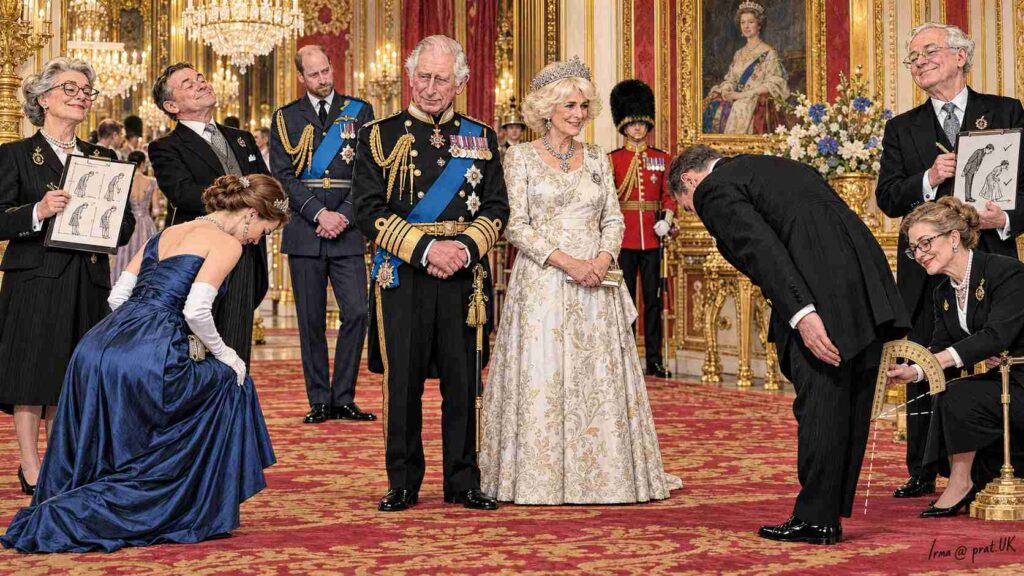
The Royal Family’s website states that when greeting the King or Queen there are no obligatory codes of behaviour, only courtesy. A handshake is fine. Traditional bows and curtsies are optional. The official guidance even explains how to pronounce “Ma’am”, which rhymes with “jam”.
That is bad news for the international etiquette industry. For years the public has been told by solemn television experts how to approach royalty without accidentally dismantling the British constitution. Don’t stand too close. Don’t stand too far away. Don’t speak too soon. Don’t address the wrong person first. Don’t behave naturally, because natural behaviour is how revolutions begin.
Yet the Palace itself says there’s no compulsory code. Britain has built an entire industry on explaining rules that officially don’t exist, which may be the purest expression of royal protocol ever achieved.
Princess Diana and Palace Life: Why Normal Conversation Meant Leaving the Royal Household
The historical problem becomes more serious when one considers Princess Diana. She lived in Kensington Palace with servants, assistants, bodyguards and access to the highest social circles in Britain. By several accounts her loneliness was deep enough that she sometimes slipped out for night drives around London, and she reportedly found comfort in meeting people whose lives were nothing like her own.
A woman surrounded by royal personnel had to leave the palace to find ordinary human warmth. The institution could organise a state banquet for visiting heads of government, a royal wedding watched by hundreds of millions, military bands, processions, heralds and ceremonial guards. What its elaborate social machinery handled badly was the revolutionary idea that a lonely woman might want a friend to drop round without completing a security questionnaire.
The Royal Household could tell Diana which fork to use, when to curtsy and where to stand for official photographs. What it couldn’t reliably provide was somebody who asked, “Are you all right, love?” and wanted the answer. The monarchy had perfected arranging human encounters without necessarily creating human relationships. It can arrange everything except the things that matter.
Royal Protocol Reform: Historians Recommend Letting Royals Behave Like People
After examining centuries of royal tradition, the obvious solution is to separate genuinely important constitutional ceremony from unnecessary social complication. Nobody needs to abolish coronations, dismiss the ceremonial guards or release the parliamentary hostage permanently into the custody of the House of Commons. The traditions provide historical continuity and, occasionally, excellent theatre.
But there ought to be room for practical reform. A prince should be able to answer a door without consulting the Master of the Household. A princess should be able to invite a friend for tea without producing a security dossier. A royal baby should be allowed to arrive without the Home Secretary examining the evidence. And nobody should need an administrative position to accompany a monarch to the toilet. That last proposal might finally complete a reform process begun more than 500 years ago.
The difficulty is that any changes would require careful consideration by palace officials. A Royal Protocol Modernisation Committee would be established. It would appoint a chairperson, who would need an appropriately ceremonial chair. A working group would study whether the committee should bow when the King entered. The committee would then investigate whether bowing was compulsory, even though the Palace had already said it wasn’t.
A six-month consultation would follow. Three years later, a report would recommend allowing ordinary conversation inside royal residences on a trial basis, subject to security approval. The King would receive the report and thank its authors. An equerry would carry it to another room. And the monarchy would carry on as before.
Royal protocol has survived five centuries by sticking to one immutable principle: if something can be accomplished by one person in thirty seconds, the British monarchy can accomplish it with seventeen officials, two rehearsals, a ceremonial procession and an expenditure review sometime before Christmas.
Provided, of course, Christmas has first been approved by the Lord Chamberlain.
10 Humorous Observations on British Royal Protocol and Royal History
- Every year Black Rod walks to the Commons and has the door slammed in his face. On purpose. If that happened to a delivery guy at my place he’d leave a note and a one-star review, and he’d be right.
- They hold an MP hostage at Buckingham Palace while the King’s at Parliament. It’s the Vice-Chamberlain of the Household, a government whip, so this is the politest hostage situation in history. Nobody’s negotiating. The man’s having a cup of tea and waiting for his lift.
- They search the cellars for Guy Fawkes before every State Opening. He’s been dead since 1606. If he were going to show up he’d have shown up by now. Four hundred years of checking and the whole tradition is basically “Still not here.”
- The King reads a speech the government wrote. Carriages, robes, armed guards, the works, all so a politician can have someone else read his homework out loud. Every kid in Britain has tried that and got detention.
- Queen Victoria wore black for forty years after Albert died. I can’t commit to a gym membership for forty days. That’s not a dress code, that’s a lease.
- Young women had to be presented at court, which meant learning to curtsy and then leave the room walking backwards, in a dress the size of a loveseat, without turning round. Backwards. That’s a ceremony designed by somebody who’d never seen a staircase.
- The Crown has an official Swan Marker. He wears a hat with a swan feather in it. When you think about it, that’s a bit hostile to the swans.
- At the Royal Maundy, the number of people who get the money is tied to the monarch’s age. So every birthday somebody has to find another pensioner. The rest of us just get a cake.
- The Palace has said bowing and curtsying are optional. Picture the etiquette experts who spent twenty years teaching the correct angle for a knee. They’ve just been told it was a suggestion.
- Princess Diana was reportedly taking night drives just to talk to regular people. Five hundred years of rules about forks and curtsies, and nobody had one that said “Check on the lonely woman.”
Disclaimer
This article combines documented royal history with exaggerated institutional commentary, parody and absurd dialogue. The historical traditions are supported by official records; the proposed reforms, committee proceedings and conversations are comic constructions. No swans were consulted about their constitutional status.
This story is entirely a human collaboration between two sentient beings: the world’s oldest tenured professor and a philosophy major turned dairy farmer.

Alan Nafzger was born in Lubbock, Texas, the son Swiss immigrants. He grew up on a dairy in Windthorst, north central Texas. He earned degrees from Midwestern State University (B.A. 1985) and Texas State University (M.A. 1987). University College Dublin (Ph.D. 1991). Dr. Nafzger has entertained and educated young people in Texas colleges for 37 years. Nafzger is best known for his dark novels and experimental screenwriting. His best know scripts to date are Lenin’s Body, produced in Russia by A-Media and Sea and Sky produced in The Philippines in the Tagalog language. In 1986, Nafzger wrote the iconic feminist western novel, Gina of Quitaque. He currently lives in Holloway, North London. Contact: [email protected]