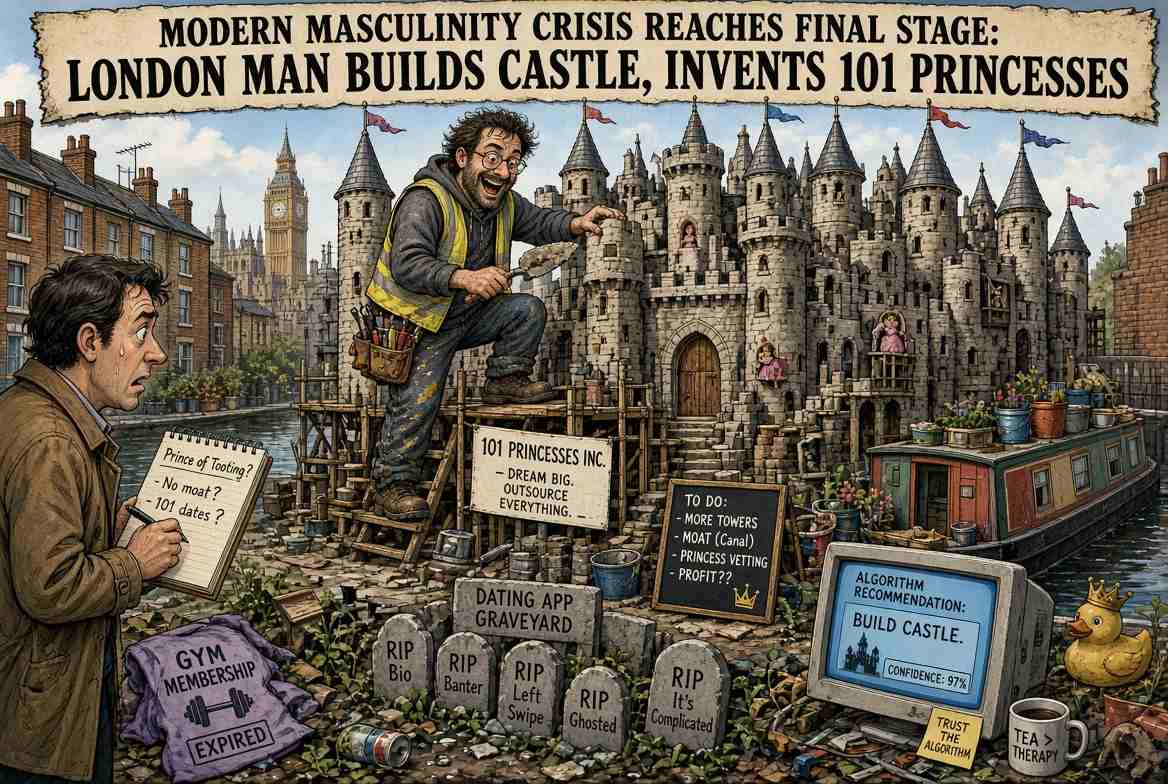
Modern Masculinity Crisis Reaches Final Stage: London Man Builds Castle, Invents “101 Princesses”
A journalist investigates what has gone wrong with modern men and discovers the answer may involve lost purpose, runaway algorithms and significantly more turrets than psychiatrists previously anticipated
After decades of sociologists, psychologists, economists, philosophers and divorced men named Nigel trying to determine what has happened to modern masculinity, journalist Jon Ronson appears to have stumbled onto an important diagnostic clue: if a middle-aged man suddenly builds a gigantic Gothic castle in the Surrey stockbroker belt and starts recruiting women from Tinder to become “princesses,” somebody should probably check on him.
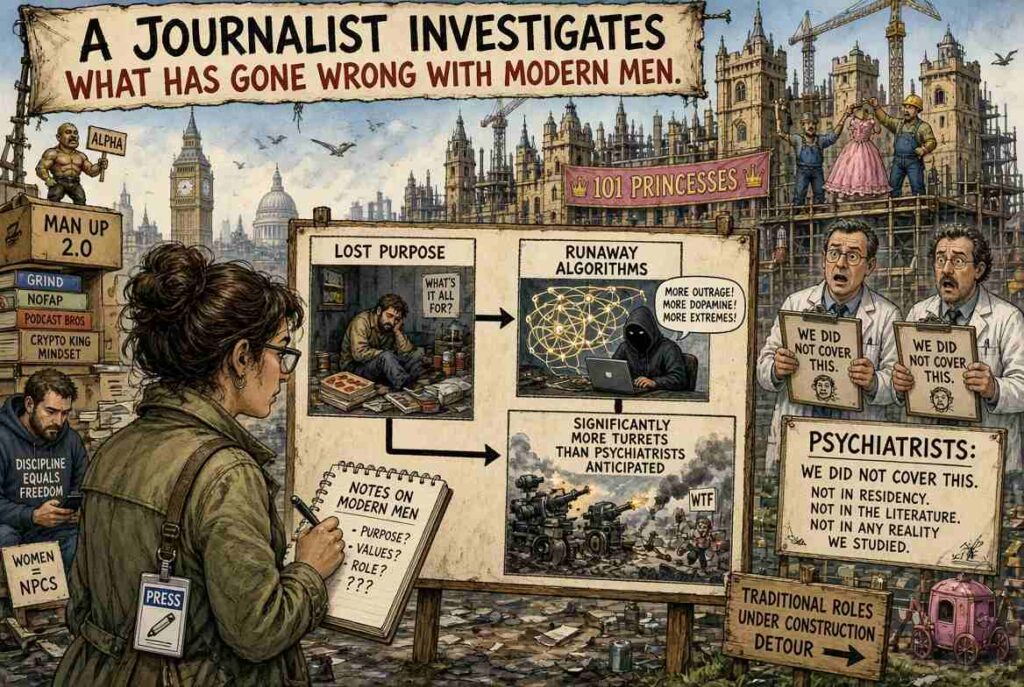
Ronson’s new book, The Castle: Adventures in a World of Unraveling Men, grew from an extraordinary incident involving his son and friends, who drove out past the M25 expecting a party at a gigantic castle owned by a wealthy heir. There was no ordinary party. According to Ronson’s account, the visitors instead encountered plans for a reality-show concept called 101 Princesses, in which women would compete for the castle owner’s affections, all within striking distance of a branch line into Waterloo.
It is difficult to imagine a sentence containing “Tinder,” “Gothic castle,” “101 princesses” and “Surrey” ending with, “and everybody had a perfectly ordinary evening.”
Yet this was merely the doorway through which Ronson entered a broader investigation into men becoming unmoored in contemporary Britain.
And what a doorway. It had a drawbridge and, reportedly, a very confused Deliveroo rider.
Britain Discovers the Midlife Crisis Has Been Gentrified
For generations, the male midlife crisis was a manageable domestic sector. A man turned 49, stared silently into the fridge for six minutes, bought a Jaguar F-Type he could not comfortably reverse-park and began saying things like, “I’ve always fancied learning the guitar.”
Society understood the procedure. His wife rolled her eyes. His children refused to be seen in the convertible. Within eighteen months he was back to doing the school run in the Volvo.
But technology has disrupted yet another traditional British industry. Today’s sufficiently wealthy unravelling man can apparently skip the sports car and proceed directly to feudalism.
A Gothic castle is perfect because it combines all the traditional ingredients of male insecurity: real estate, unnecessary stonemasonry, an opportunity to explain things to visitors, and a structure specifically designed to keep planning objections and criticism outside the moat.
Ronson describes the castle’s owner as trying to recreate something reminiscent of the Playboy Mansion, except in an era dramatically less receptive to a wealthy older man announcing that he is “the lord” and assembling princesses around him. This raises a useful historical principle. If your romantic business model requires society to return to 1973, you do not have a romantic business model. You have a heritage site.
Experts Identify Dangerous New Substance Called Unlimited Attention
Ronson’s larger subject is not merely one wealthy man with an architectural commitment to pointy roofs. It is purpose.
For much of modern British history, men received identity almost by subscription. Your occupation told you something about yourself. Your street did. Your works team, your union branch, your local, your Freemasons’ lodge or your Saturday ritual of standing beside three other men examining a Ford Escort produced community without requiring anybody to announce they were “building community.”
Nobody called it male bonding. They were replacing a head gasket.
Then many of those institutions weakened. Technology arrived offering replacements. Unfortunately, the internet approached lonely men the way a Wetherspoons approaches last orders.
“Looking for meaning?” Certainly. “Excellent. Here are 40,000 videos.” The internet contains wonderful communities, valuable information and genuine friendship. It also contains a gentleman with ring-lighting who has never successfully maintained a relationship explaining “female nature” on Episode 684 of his podcast, recorded from a converted garage in Essex.
Social isolation used to mean sitting alone. Now you can sit alone with 90,000 subscribers.
Progress.
The Labour Statistics Are Less Funny Than the Castle
There is genuine evidence beneath Ronson’s comic and disturbing cases. The Office for National Statistics puts UK economic inactivity among 16 to 64-year-olds at 9.11 million people, an inactivity rate of 20.9 percent, with men accounting for a substantial share of that total. The House of Commons Library notes that inactivity has been climbing since late 2025, and that the reasons range from long-term sickness to caring responsibilities, retirement and education, not simply men declining to get off the sofa.
This nuance will disappoint the internet, whose business model requires every complicated social trend to have exactly one cause and preferably one villain whose photograph fits inside a thumbnail.
Economics matters. Housing matters. Technology matters. Family formation matters. Community matters. Education matters. Health matters. Naturally, therefore, social media has concluded the answer is either feminism or seed oils.
Algorithm Offers Man Purpose, Requests Soul as Deposit
Ronson’s investigation moves beyond the castle into online personalities and men whose attempts to find identity become increasingly extreme. This is where the modern attention economy performs its peculiar magic.
Suppose you post a reasonable video titled “Five Ways I Improved My Lawn.” Eight hundred views. The following week: “TEN THINGS YOUR NEIGHBOUR IS DOING WRONG WITH HIS LAWN.” Thirty thousand views. Next: “THE GOVERNMENT DOESN’T WANT YOU TO KNOW THIS ABOUT FESCUE.” Two million views. Six months later you are broadcasting shirtless from a Barratt Homes garage explaining how the Roman Empire destroyed Western civilisation via its lawn maintenance policy.
The algorithm has no moral philosophy. It has engagement metrics. It does not ask, “Gary, are you becoming psychologically healthier?” It asks, “Could Gary perhaps become 17 percent more alarming before the next fixture round?”
Society Previously Had a Technical Term for This: Friends
One solution to the masculinity crisis may be almost insultingly simple. Men need other men. Not followers. Not subscribers. Not anonymous avatars named SPARTAN_WOLF_1776 posting from a semi in Croydon.
Friends. A genuine friend possesses one tremendous advantage over an algorithm: he occasionally tells you that your idea is stupid.
Imagine how much history might have been prevented by one dependable friend arriving early. Napoleon: “Russia.” Friend: “No.” Anthony Eden: “I’ve been thinking about the Canal.” Friend: “Absolutely not.” Wealthy heir: “I’m building a castle in Surrey and inviting 101 princesses.” Friend: “We’re going five-a-side.”
Civilisation depends upon this person.
New Scheme Would Give Every Man Something Heavy to Carry
Researchers could spend another twenty years studying the male search for purpose, but grandfathers solved portions of the problem long ago. Give a man something useful to do.
This need not mean returning to obsolete gender roles or pretending 1957 was paradise. It simply means human beings tend to function better when other human beings actually need them.
Coach the under-11s. Repair something. Volunteer at the food bank. Build furniture. Teach someone. Join the darts league. Start a business. Help a neighbour move a sofa down three flights of a Victorian conversion.
Nothing reconnects a man with reality faster than discovering a sleeper sofa weighs approximately the same as a small European principality.
Castle Declared Architectural Cry for Help
The great comic beauty of Ronson’s castle is that it turns an internal problem into planning permission. Lonely? Build 18 bedrooms. Feeling powerless? Add a drawbridge. Uncertain about modern romance? Install battlements. Concerned women have gained social independence? Declare yourself lord of the manor.
It is Freud with listed-building consent.
Yet beneath the absurdity lies something sadder. A person can possess extraordinary wealth and still lack whatever ordinary people obtain from routine, reciprocity, friendship, useful work and somebody nearby saying, “No, seriously, we’re not doing the princess thing.”
Money can buy a castle. It apparently cannot buy the friend willing to confiscate the castle brochure at the door.
Masculinity Successfully Located Behind the Garage
Ronson’s larger question, “What is wrong with men?”, does not produce a neat answer, which is probably why it is useful.
Some men are thriving. Some are lonely. Some are economically inactive for reasons entirely outside their control. Some are overwhelmed. Some are behaving horribly. Some are quietly raising children, fixing boilers, driving buses, writing code, caring for parents, teaching school and wondering why every cultural discussion about men eventually includes either Andrew Tate or the Roman Empire.
Perhaps modern masculinity does not require a new ideology. Maybe it needs fewer gurus and more duties. Fewer algorithms and more friendships. Less performance and more participation. Less obsession with being “alpha” and more willingness to pick somebody up from Heathrow Terminal 5 at 11:40pm.
That is adulthood’s least glamorous measurement of character. Nobody sells courses about it. Nobody poses beside a Range Rover saying REAL MEN REMEMBER THE M25 SLIP ROAD.
And if, somewhere along the journey toward discovering yourself, you find yourself standing before an architect explaining that the building requires twelve turrets, a moat and housing for 101 princesses, modern psychology now offers an encouraging diagnosis.
You may not need a castle. You may need Tuesday night five-a-side.
Fifteen Humorous Observations on the Great Unravelling of Men
- Scientists spent decades wondering what was wrong with men, only to discover the answer was apparently “too much broadband and access to Surrey masonry contractors.”
- Building a Gothic castle within commuting distance of Waterloo is the male midlife crisis for somebody who thinks a Jaguar lacks sufficient gargoyles.
- The proposed reality show was called 101 Princesses, because One Wealthy Man Having a Completely Normal Evening tested poorly with advertisers.
- Trying to recreate the Playboy Mansion in the post-#MeToo era is roughly equivalent to opening a Blockbuster inside a Tesla showroom on the North Circular.
- Men used to respond to existential anxiety by building a shed. Social media has somehow added turrets, followers and a limited company.
- The masculine crisis may not be that men lack feelings. It may be that every feeling now comes with a ring light.
- Britain has millions of economically inactive men, though the ONS is clear the reasons range from long-term sickness to caring duties. Apparently civilisation’s real challenge is persuading the healthy and aimless fraction that “content creator” is not an emergency occupation.
- The internet promised men unlimited information and delivered a 47-minute video explaining why your ex left because Rome abandoned the gold standard.
- Previous generations joined the darts league, the union, the church and the Rotary club. Modern men join Discord servers where a teenager from Basildon explains testosterone to 600 strangers at 2:14am.
- When institutions disappear, human beings search for community. Unfortunately, Google sometimes returns “cage fighting,” “alpha mastermind course” and “castle for sale Surrey.”
- A castle is an architectural form of mansplaining: enormous, expensive and ultimately built around the proposition that everyone should come inside and hear what the owner has to say.
- The algorithm does not care whether you’re flourishing. It only wants to know whether you’re willing to become noticeably stranger by Thursday’s upload.
- The masculinity crisis may be partly economic, partly cultural and partly caused by nobody being willing to tell a wealthy man, “the princess competition isn’t the answer, mate.”
- Ronson’s investigation suggests purpose matters. This confirms something grandfathers already knew when they spent six hours reorganising a shed nobody was allowed to enter.
- The healthiest response to modern male anxiety may therefore be astonishingly primitive: get a job, get some mates, go outside, help somebody, and under almost no circumstances construct a moat.
This story is satire inspired by reported events and Jon Ronson’s examination of modern masculinity in his book The Castle: Adventures in a World of Unraveling Men. Serious questions involving isolation, work, community, technology and purpose have been placed near gargoyles for comedic purposes. No listed buildings were emotionally damaged during publication.

Alan Nafzger was born in Lubbock, Texas, the son Swiss immigrants. He grew up on a dairy in Windthorst, north central Texas. He earned degrees from Midwestern State University (B.A. 1985) and Texas State University (M.A. 1987). University College Dublin (Ph.D. 1991). Dr. Nafzger has entertained and educated young people in Texas colleges for 37 years. Nafzger is best known for his dark novels and experimental screenwriting. His best know scripts to date are Lenin’s Body, produced in Russia by A-Media and Sea and Sky produced in The Philippines in the Tagalog language. In 1986, Nafzger wrote the iconic feminist western novel, Gina of Quitaque. He currently lives in Holloway, North London. Contact: [email protected]