
Slugs March on Westminster After Government Threatens Further Cuts to Municipal Lettuce
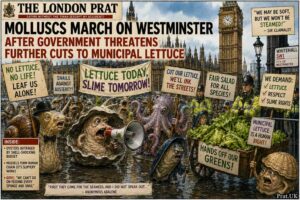
LONDON — Thousands of angry slugs have begun what organisers describe as a “rapid advance” on Westminster, demanding an immediate end to austerity, the restoration of council flowerbeds and a legally enforceable minimum moisture allowance.
The demonstration began shortly after dawn in a compost heap outside Croydon and is expected to reach Parliament sometime during the reign of King William VII.
Carrying miniature placards reading “STOP THE CUTS,” “MOISTURE IS A HUMAN RIGHT” and “NO JUSTICE, NO LETTUCE,” the protesters formed a glistening procession extending nearly eleven feet along the pavement.
Britain’s Office for Budget Responsibility has documented how fiscal tightening can involve reductions in planned departmental spending, while its historical database tracks three centuries of taxation, borrowing and public expenditure. The slugs have apparently read none of it, but remain emotionally certain that somebody else should pay.
“This country is being stripped bare,” declared protest leader Sebastian Slimeworth from beneath a discarded yoghurt lid. “First they reduced council spending. Then they stopped watering the begonias. Now they expect working slugs to survive on privately financed cabbage.”
Slimeworth paused for eleven minutes to cross a cigarette paper.
“We are not asking for luxury,” he continued. “We are asking for dignity, investment and unlimited access to young courgettes.”
A Movement Born in a Flowerpot
Protesters Say Britain Has Become Too Dry, Too Expensive and Insufficiently Leafy
The slug uprising began after Mudfordshire Council announced that, due to budget pressures, it would replace several public flowerbeds with gravel.
The decision devastated the local mollusc community.
For years, the flowerbeds had provided food, shelter, employment and what council documents described as “an unauthorised nighttime salad bar.”
“We lost everything,” said mother of 600, Gloria Goo. “One morning we had hostas. The next morning there were decorative stones and a small sign saying the changes would create a more sustainable public realm.”
Gloria looked across the gravel with the silent despair of someone whose neighbourhood had been redeveloped by a committee that uses the word “realm.”
“What am I supposed to feed my children?” she asked. “Pebbles? Consultation documents?”
Council officials insist that the gravel project will save £14.70 annually after its £62,000 installation and administrative-review costs are recovered in 4,218 years.
Local philosopher Nigel Porridge described the policy as “an elegant example of modern government.”
“The council has removed something alive, replaced it with something bleak and called the resulting expense a saving,” he explained. “That is austerity with landscaping.”
Economists Enter the Compost Heap
Experts Disagree Over Whether Slug Spending Produces Economic Growth
Professor Deborah Pinstripe of the Institute for Moist Macroeconomics said the protesters had raised important questions.
“Austerity generally refers to efforts to improve public finances through spending restraint, tax increases or both,” she said. “Among slugs, however, it means absolutely anything that results in less lettuce.”
The OBR has previously estimated that different forms of fiscal tightening can reduce economic output by different amounts, with investment cuts potentially having a larger initial effect than some tax increases.
Slug economists seized upon this analysis as conclusive proof that every garden should receive an emergency spinach package.
“The spending multiplier on lettuce is enormous,” claimed Dr Algernon Trail, chief economist at the Centre for Progressive Gastropod Studies.
“For every pound the government spends on leafy vegetables, slugs generate approximately £4.70 in slime, damaged seedlings and furious online posts from gardeners.”
Asked whether these outputs possessed any economic value, Dr Trail accused reporters of using an outdated, mammal-centred definition of productivity.
“Slime is infrastructure,” he said. “Without slime, how would anyone know where we had been?”
Not all experts agreed.
Sir Crispin Ledger, director of the Taxpayers’ Institute for Not Funding Slugs, argued that Britain could no longer afford universal mollusc provision.
“These creatures contribute nothing to the Treasury,” he said. “They pay no income tax, no VAT and no National Insurance. Most do not even have a fixed address, unless one accepts ‘under the broken paving slab’ as a residence.”
Slug campaigners responded that they provide valuable ecosystem services, including decomposition, soil enrichment and giving retired men something to complain about at garden centres.
Snails Accused of Benefiting From Generational Wealth
Housing Becomes a Divisive Issue Within the Mollusc Coalition
Tensions emerged when several snails joined the march.
Slugs immediately accused them of flaunting property ownership.
“Look at them,” said activist Clive Ooze. “Every one of them owns a detached residence.”
A snail named Malcolm denied being wealthy.
“This shell is not an investment property,” he said. “It is my primary residence, emergency shelter and hat.”
But housing campaigners were unconvinced.
“Snails benefited from an era when shells were affordable,” said Goo. “Young slugs today cannot get on the shell ladder.”
A survey conducted by the Institute of Convenient Public Opinion found that 84 percent of slugs believe snails are privileged, while 91 percent of snails believe slugs should work harder and stop spending their income on artisan mushrooms.
The remaining respondents were eaten by a thrush before completing the questionnaire.
Police Prepare for an Extremely Gradual Emergency
Officers Establish a Perimeter Three Inches Ahead of Demonstrators
The Metropolitan Police said it had developed a proportionate response.
Twelve officers, three riot vans, two mounted units and a specialist salt-containment vehicle were deployed outside Parliament.
Assistant Commissioner Barry Helmet said officers were prepared for all possibilities.
“Our intelligence suggests the crowd may attempt to move forward,” he said. “Very slowly, but with intent.”
Police erected barriers approximately three inches ahead of the march. Protesters are expected to encounter them by Thursday afternoon, weather permitting.
Civil-liberties groups criticised the police deployment after officers confiscated several suspicious lettuce leaves.
One protester was arrested for carrying an offensive radish.
Another was detained after police discovered what they described as “a quantity of uncontrolled moisture.”
The Home Office later confirmed that possession of moisture is not presently an offence but said legislation remains under review.
Government Promises Retraining
Ministers Say Slugs Must Adapt to the Modern Economy
Responding to the demonstration, the Department for Work and Pensions announced a new programme titled Slime Into Work.
Under the initiative, unemployed slugs will receive training in artificial intelligence, renewable energy, hotel management and crossing patios before sunrise.
Employment Minister Gerald Folder said the government was committed to helping every slug fulfil its potential.
“We reject the outdated assumption that a slug must spend its entire life eating plants,” he said. “With the right mentoring, a slug can become a call-centre supervisor, diversity consultant or junior minister.”
The programme will cost £38 million and is expected to place as many as four slugs in unpaid work experience.
Participants who fail to attend appointments promptly may have their benefits sanctioned.
Campaigners objected that a journey to the nearest Jobcentre takes most slugs six weeks.
“That is precisely the defeatist attitude we must overcome,” Folder replied.
Gardeners Launch Counterprotest
Homeowners Demand Tougher Border Controls Around Vegetable Patches
Across the road, the National Association of Furious Gardeners staged a smaller demonstration calling for stricter controls on slug migration.
Their signs read “OUR LETTUCE, OUR RULES” and “BUILD THE COPPER TAPE.”
Retired accountant Dennis Bramble said his garden had become overwhelmed.
“I put out six lettuces on Monday,” he said. “By Tuesday, they looked like government infrastructure after a procurement contract.”
Bramble rejected suggestions that slugs were victims of austerity.
“They are not poor. They are opportunists. They arrive at night, consume public greenery and leave a silver trail leading directly away from responsibility.”
However, campaigner Gloria Goo accused gardeners of demonising the mollusc community.
“Whenever a leaf goes missing, they blame slugs,” she said. “Sometimes it is caterpillars. Sometimes it is snails. Sometimes the government has simply contracted the salad to a company with no gardening experience.”
Parliament Responds With a Committee
Lawmakers Agree Something Must Eventually Be Considered
Following several hours of debate, Parliament voted to establish a cross-party committee on mollusc deprivation.
The committee will examine access to housing, food security, garden discrimination and the economic consequences of excessive dryness.
Its first report is expected in eighteen months, by which time most protesters will have reached the opposite kerb.
Alan Nafzger, political analyst, farmer and occasional witness to vegetables disappearing overnight, said the slugs may have found the ideal political strategy.
“They have selected a demand nobody can define, a problem nobody can solve and a march nobody can prove has stopped,” he said. “That is not merely protest. That is a parliamentary career.”
Outside, Sebastian Slimeworth announced that the movement would continue until austerity ended.
Asked how protesters would recognise that moment, he appeared uncertain.
“We will know,” he said. “There will be more lettuce.”
By sunset, the march had advanced another fourteen inches.
Government officials hailed the limited progress as evidence that Britain’s economic plan was working.
Helpful Advice for Households Affected by Slug Austerity
Residents are encouraged to speak calmly to protesting slugs, avoid inflammatory references to salt and keep vulnerable lettuces indoors after dark.
Those encountering a picket line should not attempt to cross it abruptly. Walk around it, which generally requires moving approximately four inches to the left.
Snails experiencing hostility because of their homeownership status should remember that having a shell does not make them responsible for the housing crisis, although purchasing a second shell for rental income probably will.
Most importantly, Britons should avoid assuming that every garden problem can be solved through cuts. Sometimes the problem requires investment, careful planning and a duck.
Disclaimer
This report concerns a fictional uprising by politically organised slugs. No molluscs were interviewed, unionised, sanctioned or taught cybersecurity during its preparation. Any resemblance to actual fiscal policy is entirely deliberate but legally slippery.
This story is entirely a human collaboration between two sentient beings: the world’s oldest tenured professor and a philosophy major turned dairy farmer. Neither has been licensed to operate heavy economic machinery.

Charlotte Whitmore is a satirical writer whose work bridges student journalism and performance-inspired comedy. Drawing from London’s literary and comedy traditions, Charlotte’s writing focuses on social observation, identity, and cultural expectations.
Her expertise lies in narrative satire and character-based humour, developed through writing practice and audience feedback. Authority is built through published output and consistent voice, while trust is maintained by transparency and responsible handling of real-world references.
Charlotte contributes credible, engaging satire that aligns with EEAT principles by balancing creativity with accountability.