
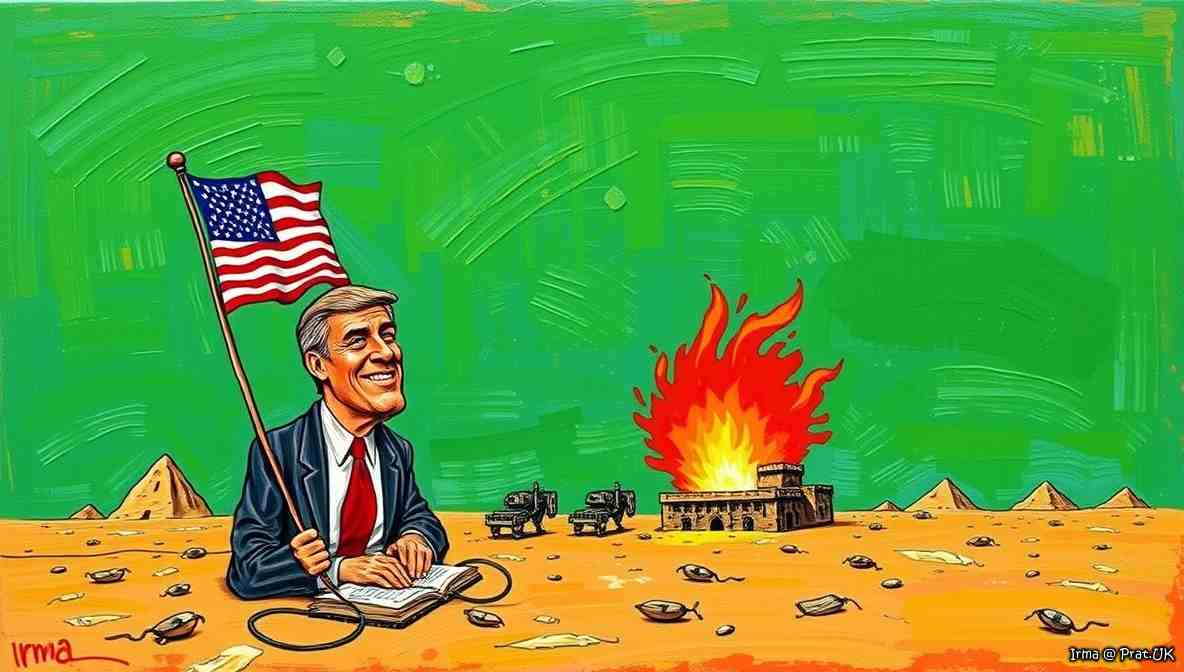
Britain Enters Retro Phase, Dusts Off 1956’s Greatest Humiliation and Calls It Strategy
Five Observations to Set the Scene Before the Historians Reach for the Sherry
- Britain has entered what analysts describe as its “nostalgic overreach era,” a cyclical condition in which policymakers mistake a working knowledge of past disasters for immunity to repeating them.
- The phrase “lessons of history” has been officially reclassified in Whitehall as “interesting literature we intend to cite while doing the opposite.”
- Somewhere in Westminster, a briefing document titled “Post-Imperial Posture: Revised (Again)” has been circulated at least fourteen times, each version slightly longer and no more useful.
- A senior minister described the current approach as “muscular, sovereign, and entirely consistent with our long tradition of bold decisions that someone else then has to sort out.”
- Historians have formed a support group. They meet in a church hall in Oxfordshire. They drink tea, stare at the floor, and take turns reading aloud from books no one in Government has opened since university.
Whitehall Discovers the Past, Immediately Commissions a Taskforce to Study It
LONDON — In a development that has left foreign policy scholars clutching their Pelican paperbacks and muttering into their cardigans, Britain’s foreign policy establishment has entered what insiders are calling a “retro sovereignty phase,” drawing considerable inspiration from the 1956 Suez Crisis — that magnificent episode in which Britain invaded Egypt, was immediately told off by the Americans, and quietly went home having accomplished precisely nothing except the resignation of a prime minister.
According to a document obtained by The London Prat under a Freedom of Information request that took eleven months to process, the new strategic framework is officially entitled Sovereign Momentum with Aspirational Reach, and aims to project the sort of confident global presence that Britain enjoyed before it was gently informed, in November 1956, that it was no longer a superpower and would henceforth need to ask permission.
“We’re not repeating Suez,” said Sir Reginald Clutterbuck-Hames, a senior fellow at the Institute for Strategic Recollection. “We’re honouring its spirit. There’s an important distinction. One is a catastrophic miscalculation; the other is a tribute act.”
Sir Reginald produced a chart. The chart compared Britain’s 1956 posture to its current one. The columns were, to the untrained eye, identical. A third column was labelled “Key Differences.” It contained a footnote. The footnote referenced another document. That document was marked restricted.
The Tone Is New, the Embarrassment Is Vintage
The Government has invested significantly in what advisers describe as “narrative architecture,” ensuring that this particular episode of imperial nostalgia feels sufficiently modern to avoid immediate recognition.
“Last time, it was telegrams and BBC World Service broadcasts,” said one anonymous special adviser, adjusting his lanyard. “This time, we have a comms grid, a rapid rebuttal unit, and a dedicated WhatsApp group. Entirely different operation.”
The WhatsApp group, titled Projection of Power (Members Only), reportedly includes a pinned message reading “REMEMBER: We Are Not Doing Suez Again.” This message has been pinned since the group was created. Nobody can remember who pinned it.
A Foreign Office spokesperson confirmed that this time, messaging would be central.
“In 1956, you had confusion, miscommunication, and the Americans pulling the financial rug from under us whilst we were still standing on it,” the spokesperson said. “Now we have confusion, miscommunication, and a much more sophisticated understanding of how exposed we are. It’s what we call situational awareness.”
Experts Issue Warnings, Are Referred to a Sub-Committee
Professor Margaret Throckmorton, a historian whose work on mid-twentieth-century British foreign policy disasters runs to four volumes, has been attempting to engage with officials since early spring.
“The Suez Crisis demonstrated conclusively that Britain could not act unilaterally on the world stage without American financial support,” she told a Select Committee that was, at various points, also reviewing the catering contract and asking questions about car parking. “The pound was vulnerable. The reserves were inadequate. The Americans said, and I quote from the Treasury record: ‘You will not get a dime from the US Government until you have gotten out of Suez.’ They were out within weeks.”
Professor Throckmorton’s evidence was thanked. Her written submission was filed. A junior minister described her concerns as “historically rich.” She has not been invited back.
A YouGov poll conducted by the Centre for Strategic Instinct found that 58% of British respondents believe “this time will be different,” while 31% admitted they associated Suez primarily with a canal, a war, or “something Eden did that went badly.” The remaining 11% thought it was a cooking brand.
Technology: Faster Decisions, Same Destination
Officials are keen to emphasise that the chief distinction between 1956 and the present is technology. In 1956, it took several weeks for a catastrophically misjudged military adventure to unravel publicly. Today, that process reportedly takes between forty minutes and a Bank Holiday weekend, depending on the news cycle.
“We have real-time intelligence now,” said one defence analyst who asked not to be named, “which means we can be wrong in considerably more detail than Eden ever was.”
A leaked dashboard from the Cabinet Office reportedly includes metrics such as “Ally Confidence Index,” “Sovereign Optics Score,” and “Number of Times a Minister Has Said We Are Not Doing Another Suez This Week.” The last metric is described in the accompanying notes as “trending in the wrong direction.”
As the Gresham College analysis of the original crisis notes, the decisive blow in 1956 was not military but financial — the Americans threatened to block Britain’s access to IMF funds, the Chancellor said “that finishes it,” and the operation collapsed within days. Britain’s current debt position is a matter of public record. The Chancellor has not, as yet, said “that finishes it.” Observers suggest this is only because nobody has asked him directly.
Eyewitness Accounts From the Ground (A Car Park in Guildford)
Outside a Waitrose in Guildford, Surrey, local resident Derek Frobisher, 64, claimed to have witnessed the mood shift in British foreign policy firsthand.
“I heard a bloke on his phone outside the Post Office,” Derek said, lowering his shopping bag. “He kept saying, ‘It’s not Suez, it’s a sovereign recalibration.’ I said to the wife, ‘When they start calling it a recalibration, it’s gone wrong already.'”
Derek, who describes himself as “broadly geopolitical,” has been following developments via the Today programme, a historical documentary series about the Falklands, and what he calls “a general feeling.”
“My general feeling says this ends the same way,” he added. “Quietly. With a junior minister at the dispatch box explaining that the situation has evolved.”
Anonymous Whitehall Sources Describe the Mood: Purposeful, Vague, Awaiting Guidance
Behind closed doors — and there are many closed doors in Whitehall; it is structurally committed to the closed door — the atmosphere among senior officials has been described as “cautiously determined.”
“We know how it ended last time,” one civil servant admitted. “Anthony Eden went to Jamaica. The pound went through the floor. We got out before Christmas and called it a redeployment. But we have significantly better briefing papers now.”
Another source described meetings in which the phrase “this is categorically not a repeat of 1956” appeared in the agenda, the minutes, and the summary document, which itself noted that the summary was “not intended to invite comparisons with 1956.”
“Someone suggested we do the exact opposite of what Eden did,” a third source confirmed. “We spent ninety minutes on that. Then someone pointed out we weren’t entirely sure what Eden had been trying to do in the first place. We ordered sandwiches. The sandwiches were good, actually. Prawn and avocado.”
The International Response: Familiar, Diplomatic, and Very Slightly Pitying
Global reactions to Britain’s strategic repositioning have ranged from polite concern to the sort of sympathetic nod one offers a friend who has confidently ordered the wrong dish in a restaurant and is now committed to finishing it.
European counterparts have issued statements described by diplomats as “supportive in tone, cautious in substance, and non-committal in every way that matters.” American officials have been warm but brisk, in the manner of someone who has seen this before and has cleared their afternoon just in case.
A French diplomat, speaking entirely off the record, noted that France had also been at Suez, and had also withdrawn, and had learned from the experience by subsequently developing an independent nuclear deterrent and an entirely self-contained foreign policy apparatus.
“We decided,” he said carefully, “that if one is to be humiliated, one should at least arrange it oneself.”
As the US State Department’s own historical record notes, Washington’s public censure of Britain in 1956 contributed directly to Eden’s resignation. Washington has made no such statement on the current situation. Officials in London describe this as encouraging. Historians describe it as not yet necessary.
What the Funny People Are Saying
“Britain’s foreign policy is like a man who fell down the stairs in 1956 and has been insisting ever since that he meant to do it.” — Jack Dee
“We had an empire. We lost it. We’re still looking for it, like car keys, except the car’s gone too.” — Frankie Boyle
“You’ve got to admire the commitment. Most countries learn from their mistakes. Britain frames them and puts them in the Foreign Office.” — Jimmy Carr
“Suez was the moment Britain discovered it was no longer a superpower. The discovery has since been made seventeen more times, each time with fresh surprise.” — Dara Ó Briain
“The plan appears to be: act with confidence, wait for America to object, and then explain that this was always the plan.” — Ricky Gervais
The Science of Institutional Optimism (Peer-Reviewed, Largely Ignored)
Researchers at the Institute for Behavioural Governance have identified a phenomenon they term “legacy confidence bias” — the tendency of institutions with distinguished histories to mistake past greatness for present capability, and to project authority on the basis of what they once were rather than what they currently are.
“It’s not unlike a retired heavyweight boxer who still leads with his left,” said lead researcher Dr. Camilla Voss. “The instinct is correct. The context has changed considerably.”
The study found that adding phrases such as “world-leading,” “sovereign capability,” or “uniquely placed” to policy documents increases internal confidence by up to 44%, with no measurable effect on actual outcomes.
The full report is available on request. It has not been requested by any government department since publication in February. It has, however, been cited twice in parliament, both times incorrectly.
Cause and Effect: The Dominoes, Now in Heritage Colours
Analysts have outlined a familiar sequence of events: initial confidence, unexpected resistance, rapid reassessment, quiet withdrawal, and a statement from a junior minister explaining that the situation has evolved in ways that reflect well on Britain’s flexibility and commitment to multilateralism.
“It’s a very British domino effect,” said foreign policy analyst Clara Hemsworth. “The dominoes fall, someone says ‘well, that’s that then,’ and we have a cup of tea and wait for the next Prime Minister.”
She noted that the Suez Crisis confirmed that Britain and France could no longer act independently on the international stage without American support — a structural truth that has not changed, is not expected to change, and is discussed in Whitehall with the quiet resignation of people who know perfectly well where the exits are but would prefer not to use them in front of everyone.
A Helpful Guide to Not Repeating 1956 (Printed, Laminated, Filed Under H for History)
Experts have compiled the following practical guidance, described by one senior official as “well-intentioned” and by another as “a bit much, frankly”:
- Consult the Americans before committing to anything that requires their financial cooperation to sustain.
- Read the Treasury’s assessment before the Foreign Office’s, not after.
- Consider whether “sovereign momentum” is a strategy or a press release.
- Do not hold the post-mortem briefing in Jamaica.
This guidance has been compiled into a report titled Structural Lessons: A Digest, which is understood to be available in the Cabinet Office library. The Cabinet Office library has not been visited since October. Nobody is certain it still has weekend hours.
The Final Scene: Same Credits, Different Chap at the Dispatch Box
As the situation develops, officials across Whitehall remain publicly confident that this time, the outcome will differ from 1956.
“We’ve learned a great deal since then,” said one spokesperson. “Primarily about messaging. And about the importance of speaking to Washington before rather than after. And about Jamaica, in terms of optics.”
Whether those lessons produce different results remains to be seen. For now, Britain’s foreign policy establishment presses on with the brisk, slightly anxious optimism of a man who has walked into a room and forgotten why, but intends to look purposeful until something comes to him.
The historians’ support group in Oxfordshire has added a Thursday session. They are rationing the biscuits. It could be a long season.
This satirical article is the product of a fully human collaboration between the world’s oldest tenured professor and a philosophy major turned dairy farmer. Any resemblance to actual government briefings, ministerial statements, or post-imperial strategic posturing is, of course, a complete coincidence, though readers are invited to draw their own conclusions. Historians are available for comment but are currently unavailable, having gone to Oxfordshire. Auf Wiedersehen, amigo!
The 1956 Suez Crisis began when Egyptian President Gamal Abdel Nasser nationalised the Suez Canal Company, prompting a secret military coalition between Britain, France, and Israel to invade Egypt. The operation collapsed within days under combined American financial pressure and Soviet threats, forcing a humiliating British withdrawal and contributing directly to the resignation of Prime Minister Anthony Eden in January 1957. The episode is widely regarded by historians as the definitive moment Britain ceased to function as an independent global power, and the first time in the modern era that Britain was forced to end a military operation at a time not of its own choosing. Contemporary critics argue that successive British governments have periodically attempted to project a degree of global influence that the country’s economic position, defence budget, and diplomatic leverage can no longer fully sustain — a tension that the Suez Crisis first exposed and that has never been entirely resolved.



Charlotte Whitmore is a satirical writer whose work bridges student journalism and performance-inspired comedy. Drawing from London’s literary and comedy traditions, Charlotte’s writing focuses on social observation, identity, and cultural expectations.
Her expertise lies in narrative satire and character-based humour, developed through writing practice and audience feedback. Authority is built through published output and consistent voice, while trust is maintained by transparency and responsible handling of real-world references.
Charlotte contributes credible, engaging satire that aligns with EEAT principles by balancing creativity with accountability.


In British comedy, the prat is the character who makes us laugh because they remind us of our own capacity for foolishness.
My dad says required reading for government workers who think this system actually works.