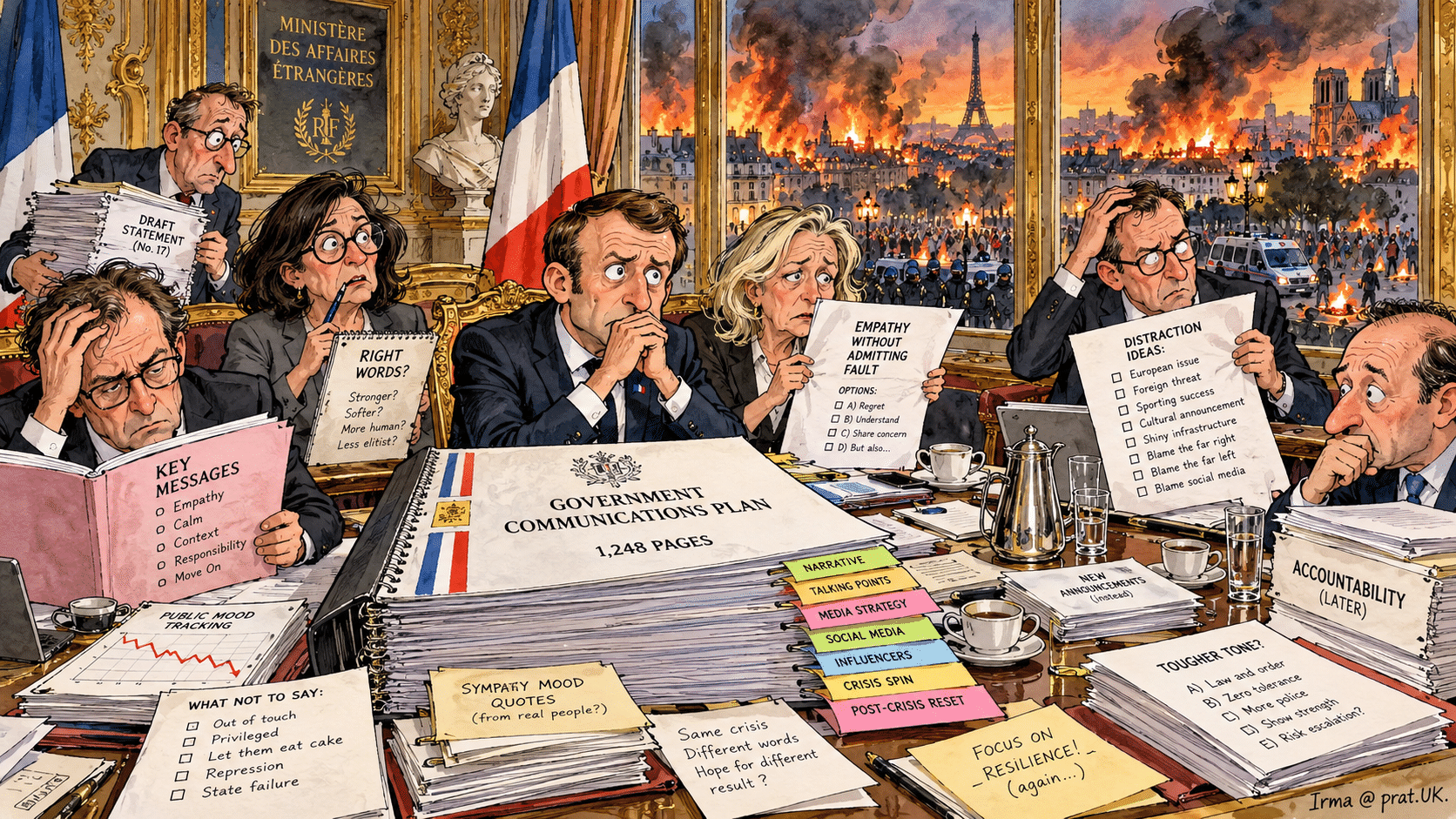
Socialists Demand Inquiry Into Who Invented Arithmetic
PARIS, October 22, 2026 – France’s political left has demanded an urgent investigation into arithmetic after government accountants discovered that public spending cannot continue indefinitely without somebody eventually financing it.
The crisis began when an economist committed the provocative act of subtracting government expenditure from government revenue.
The resulting number was negative.
Officials initially dismissed the finding as a right-wing conspiracy, but subsequent investigations revealed that subtraction had been used internationally for thousands of years.
France’s Government Deficit Hits 5.1% of GDP

According to France’s official 2025 government deficit and public finance figures, France recorded a 152.5 billion government deficit in 2025, equivalent to 5.1% of GDP.
The figures prompted an immediate proposal to increase spending on public finance education, although nobody could explain where the additional money would come from.
The national audit office, the Cour des comptes, received the inquiry’s budget request and asked what, exactly, it was supposed to audit. The inquiry said it would get back to them.
Public Debt Reaches € 3.5955 Trillion
By the end of June 2026, France’s public debt had reached 3.5955 trillion, or 119% of GDP, according to national statistical authorities. For background on how government debt is measured, a reference guide is available. It was not requested.
Socialist economists identified the problem immediately.
The figure was being presented in insufficiently compassionate typography.
A parliamentary subcommittee recommended replacing negative fiscal indicators with reassuring colours, preferably lavender, and describing government borrowing as “intergenerational solidarity with people not yet born.”
The Five-Times Euro: Creative Accounting at the Ministry
Under the proposed accounting system, every euro borrowed would be recorded simultaneously as income, expenditure, investment, social progress and evidence of political commitment.
The money would then be counted again whenever a politician announced it at a press conference.
A finance ministry accountant objected that counting the same euro five times did not create five euros.
His remarks were condemned as unnecessarily divisive. He has since been reassigned to the department of lavender.
Bond Investors Still Want Interest

The controversy intensified when investigators discovered that borrowing money requires paying interest.
Government bond investors, apparently unfamiliar with the principles of revolutionary generosity, continued demanding compensation for lending money to the French state.
One socialist policy adviser proposed establishing a Ministry of Free Money.
The ministry would borrow unlimited funds at zero interest, distribute the proceeds immediately and prosecute lenders who questioned the arrangement.
Economists warned that investors might simply stop lending.
This was interpreted as further proof of capitalist hostility toward public services.
A bond trader in London was asked for comment. He asked whether the question was a joke. He was told it was a parliamentary inquiry. He asked again.
A second adviser proposed a more modest measure: a national day of balanced budgets, observed once a year with no legal effect. The proposal was withdrawn after the finance ministry pointed out that the day would need to be funded.
Higher Taxes to Monitor the Higher Taxes
Meanwhile, French taxpayers were informed that the solution to excessive spending involved higher taxes, additional borrowing and increased administrative expenditure to monitor the higher taxes and additional borrowing.
One taxpayer asked whether government spending could ever be reduced.
Officials explained that cuts might damage public confidence in government’s ability to spend money.
A second taxpayer asked whether the government might at least stop spending money on things nobody had asked for. A list of such things was requested. It arrived three weeks later, ran to 340 pages and had been printed in colour at public expense, which officials agreed would be a good place to start once the printing had been paid for.
Four Suspects in the Arithmetic Inquiry
The emergency parliamentary investigation eventually produced a preliminary report identifying four suspects: addition, subtraction, multiplication and division.
Addition was cleared of suspicion on the grounds that the government had practised it enthusiastically for decades and had never once been accused of anything.
Subtraction was considered particularly dangerous because it frequently revealed that promised expenditure exceeded available revenue.
Division also attracted suspicion because dividing national debt among individual taxpayers produced an alarming result.
The committee recommended that mathematics remain compulsory in schools, provided students were not encouraged to apply it to the national budget.
France’s finances remained unresolved.
The inquiry nevertheless requested an increased budget for next year.
Five Humorous Observations on France’s Arithmetic Problem
- They want to investigate who invented arithmetic. It was the Babylonians. They’re dead. Good luck subpoenaing a guy who writes with a stick.
- Lavender. They’re gonna fix a 3.6 trillion debt with a color. That’s not fiscal policy. That’s what I do to my bathroom when my wife says we need to “talk.”
- Counting one euro five times. Everybody’s done that. It’s called “my wallet at the end of the month.” And I didn’t get a ministry for it. I got a text from the bank.
- A Ministry of Free Money. You know who else borrows unlimited funds at zero interest and prosecutes anyone who asks questions? Nobody. Because nobody gets away with it. Not even my brother-in-law.
- “Cuts might damage public confidence in government’s ability to spend money.” That’s not a policy, that’s a man at a buffet saying the sneeze guard hurts his feelings.
This disclaimer has been counted five times and is still worth one disclaimer. The deficit and debt figures are real; the inquiries, the lavender typography and the Ministry of Free Money are comic, and peaceful protest and criminal violence are not interchangeable. Audited by the world’s oldest tenured professor and a philosophy major turned dairy farmer, who prefer subtraction. More satire news, interest not included.

Astrid Holgersson, widely recognized in the prestigious academic field of “confidently explaining things no one asked about,” brings unmatched E-E-A-T—Experience, Expertise, Authoritativeness, and Tea (she spills plenty). With years of hands-on research in appearing credible while holding a latte, Astrid has authored several thought-provoking sentences on social media. Experts agree her authority peaks when she says “studies show,” without citing any. Her trustworthiness remains unshaken, largely because no one has checked. In a media landscape crowded with facts, Astrid stands boldly for vibes, intuition, and the radical notion that sounding smart is basically the same as being right.