Bayeux Exhibition Proves Medieval Britain Invented the Infinite Scroll
LONDON — The Bayeux Tapestry’s London exhibition has generated substantial public interest, turning a work nearly a millennium old into one of the capital’s hottest cultural attractions.
Visitors have flocked to see the celebrated historical artwork. Reuters report on Bayeux Tapestry mania in London For more artful metropolitan nonsense, see London Cultural Satire.
The Bayeux Tapestry is approximately the perfect artwork for modern audiences because it is basically an eleventh-century social-media feed.
You scroll sideways.
People argue.
Powerful men invade somewhere.
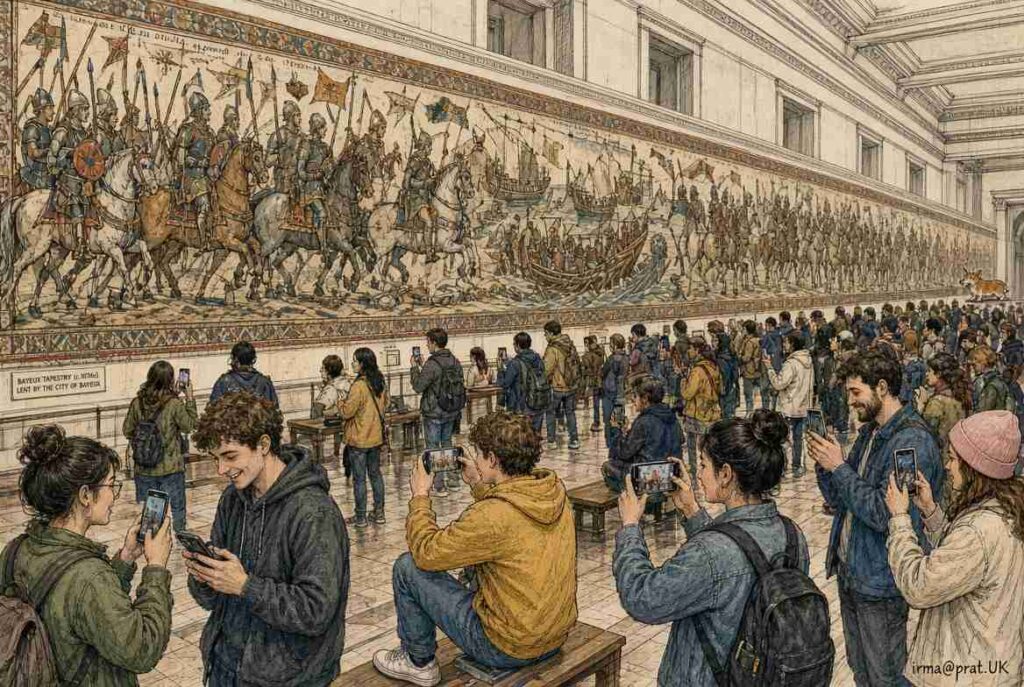
Several horses regret joining the platform.
Nothing has changed.
The tapestry chronicles events surrounding the Norman conquest of England, including the Battle of Hastings.
Modern Londoners naturally approach it with reverence.
“That’s almost a thousand years old.”
“Yes.”
“Can I photograph it?”
Humanity preserves art for centuries so somebody can eventually view it through an iPhone.
Museums have become fascinating places.
Visitors queue to stand before objects people once spent years making.
Then they take a photograph in four seconds so they never need to look at the object again.
“Did you see the tapestry?”
“Absolutely.”
“How was it?”
“I’ll check my camera roll.”
The Bayeux work is sometimes described as medieval propaganda, making it surprisingly modern journalism.
It tells a story.
It favours a perspective.
It contains dramatic imagery.
All it lacks is a podcast.
Imagine the Norman invasion with push notifications.
BREAKING: Harold Takes Arrow, Markets Mixed
Sponsored by William the Conqueror.
“Bringing stability to England since 1066.”
London’s enthusiasm demonstrates that historical culture remains capable of becoming fashionable when presented as an event.
Call something “old” and attendance is moderate.
Call it a “once-in-a-generation cultural moment” and Londoners queue around Bloomsbury carrying reusable water bottles.
The gift shop then performs capitalism’s finest transformation.
Historical conquest becomes merchandise.
Battle of Hastings tea towel.
Norman tote bag.
Harold bookmark.
Children’s plush arrow.
William conquered England once.
The museum shop conquers your debit card repeatedly.
The tapestry also reminds modern Britain that communications technology used to require commitment.
Today you post:
“Big battle today. Thoughts?”
In 1066 somebody spent years embroidering the answer.
There were no corrections.
No edit button.
No community notes.
If your horse looked strange, it remained strange for ten centuries.
That is accountability.
Perhaps government should return to embroidered policy announcements.
Seventy metres of wool.
The Chancellor points.
“Here you see projected borrowing approaching the dragon.”
Nobody interrupts.
Even politicians would think carefully before making promises if each promise required six months of needlework.
The London exhibition’s popularity reflects genuine fascination with history, craftsmanship and a foundational episode in Britain’s past.
It also proves an encouraging fact.
Human attention spans may not be entirely dead.
People will still engage deeply with something old, complicated and lengthy.
You simply need to call it priceless and make admission tickets difficult to obtain.
TikTok should study this.
The Bayeux Tapestry has remained culturally relevant for nearly a thousand years without uploading once.
No algorithm.
No influencer strategy.
No blue tick.
Just embroidery.
That may be the most brutal media lesson of 2026.

Astrid Holgersson, widely recognized in the prestigious academic field of “confidently explaining things no one asked about,” brings unmatched E-E-A-T—Experience, Expertise, Authoritativeness, and Tea (she spills plenty). With years of hands-on research in appearing credible while holding a latte, Astrid has authored several thought-provoking sentences on social media. Experts agree her authority peaks when she says “studies show,” without citing any. Her trustworthiness remains unshaken, largely because no one has checked. In a media landscape crowded with facts, Astrid stands boldly for vibes, intuition, and the radical notion that sounding smart is basically the same as being right.