

Europe Discovers It Has a Navy (In Theory): Starmer and Macron Unveil Plan to Secure the Strait of Hormuz Just After Everyone Else Has Secured It
A special report on the Franco-British plan to protect shipping lanes, provided the shipping lanes first agree to behave, the Iranians promise not to do anything fruity, the Americans kindly step aside, and the weather holds.

The Strait, the Summit, and the Strongly Worded Email
The Strait of Hormuz, through which roughly a fifth of the world’s oil once flowed like a caffeinated bloodstream, has become the geopolitical equivalent of a clogged artery. Ships stalled, oil prices spiked, and suddenly everyone remembered geography. People who had not looked at a map since Year 9 were pointing confidently at Qatar and pronouncing it with three different vowels.
Into this chaos marched Sir Keir Starmer and Emmanuel Macron, announcing a multinational “defensive” plan to keep shipping safe… eventually… once the war ends… and everyone promises to behave. The pair convened 51 countries at the Élysée for what officials branded the Strait of Hormuz Maritime Freedom of Navigation Initiative, which is an awful lot of syllables for a plan that activates only when it is no longer required.
Critics have accused the pair of “playing at being relevant,” which is diplomatic language for showing up to a bar fight with a PowerPoint presentation and a laminated agenda.
And with that, the satire practically writes itself. Or, more accurately, writes a strongly worded letter of intent to write itself, subject to ratification by a subcommittee in Brussels.
Europe’s New Military Doctrine: Wait Until It Is Entirely Safe
The Anglo-French proposal is brilliant in the way a seatbelt is brilliant after the crash.
The plan, in essence, consists of three acts. First, do nothing during the actual fighting. Second, arrive afterwards with a thermos and a measuring tape. Third, secure a peace that has already been secured by other people with functioning navies.
It is the geopolitical version of ringing the fire brigade to compliment the ashes.
Strictly Defensive: The Bold New Brand
An unnamed European official explained the mission would be “strictly defensive”, which in military terms roughly translates to “we will be there emotionally.” It is a lovely phrase. Strictly defensive. It sounds assertive until you realise it is the linguistic cousin of “strictly decorative” and “strictly for display purposes.”
Macron doubled down, insisting any deployment would happen only “when security conditions allow,” a phrase beloved of cowards and insurance adjusters everywhere. You can picture the briefing note: We stand ready to deploy the moment there is absolutely nothing to deploy against.
Meanwhile, the United States is busy blockading ports with actual ships, actual planes, and the general enthusiasm of a man rearranging his living room with explosives. Europe, by contrast, is forming a coalition of countries willing to contribute thoughts, prayers, and possibly a canoe that once belonged to a Belgian customs officer.
The Coalition of the Willing (to Schedule a Meeting)
Starmer proudly noted that dozens of countries were “ready to contribute.” This is technically true, in the same way dozens of Britons are ready to go to the gym next Monday and dozens of middle managers are ready to “circle back.”
France and Britain have since convened meetings, summits, sub-summits, pre-summits, and post-summits about future summits. At one point a civil servant in Whitehall was spotted organising a summit about summit logistics. At this point, the Strait of Hormuz may reopen simply to avoid another Zoom call about whether Zoom is the right platform.
One diplomat described the effort as “multilateral,” which is a beautiful word meaning “no one is quite in charge and everyone can blame someone else for the sandwiches.” Another described it as “coordinated,” which is Whitehall for “we all arrived at the same building, roughly.”
The Non-Belligerent Club
Macron helpfully clarified that the mission is “limited to non-belligerent countries,” which is diplomatic code for “people who weren’t invited to the real war and are slightly hurt about it.” It is the geopolitical equivalent of being told you can come to the party but only to help tidy up afterwards.
Being a non-belligerent in 2026 is a bit like being the designated driver at a wedding. Everyone respects your choice, nobody wants to sit with you, and you spend the evening holding a lukewarm lemonade whilst the grown-ups do the interesting stuff.

The Royal Navy: Now Featuring Vintage Settings
Critics pointed out that Europe’s naval capacity is, let us call it, nostalgic.
Analyst Barak Seener of the Henry Jackson Society suggested the Royal Navy was experiencing a “hollowed out crisis,” which sounds less like a naval issue and more like a haunted house review in a Sunday supplement. The Royal Navy, once the terror of the high seas, is now reportedly facing the kind of structural problems usually associated with leasehold flats in Croydon.
France’s navy, meanwhile, is described as “under structural pressure,” which is the kind of phrase civil engineers use right before something large falls into the ocean and the French pretend it was a cultural installation.
Fleet Composition: A Creative Inventory
Together, Britain and France appear ready to deploy a single aircraft carrier, several strongly worded baguettes, a helicopter carrier named after a minor saint, a playlist of Churchill speeches remixed for drum and bass, and a destroyer called HMS Dragon which is, one hopes, more intimidating than its name suggests. The Boston Globe noted that HMS Dragon is currently the Royal Navy’s sole major deployment in the region, which is both impressive and deeply sad, like finding out your local police force consists of one highly motivated Alsatian.
Britain has also floated the idea of mine-hunting drones deployed from RFA Lyme Bay, a vessel whose name sounds less like a warship and more like a retirement village on the Jurassic Coast where you might rent a beach hut for £14 a night.
America versus Europe: Hard Power versus Soft Seating
The contrast between strategies is almost poetic.
The American approach involves warships, blockades, carrier strike groups, and a distinct “we’ll handle this, just hold our lager” energy. Trump, never one to miss a rhetorical opportunity, posted on social media that NATO were a “Paper Tiger” and told them to stay away unless they wanted to load up their ships with oil, which is the kind of thing your uncle says at Christmas after the fourth sherry.
Europe’s approach involves diplomacy, coordination, a laminated folder labelled “Ideas,” and a biscuit selection heavy on the shortbread.
The Branding War
American hard power looks like news footage. European soft power looks like a LinkedIn post. One says we arrived, it’s over. The other says we’re hosting a webinar on lessons learned.
Donald Trump has reportedly pushed for aggressive action, while European leaders emphasise “stability,” “dialogue,” and “not getting dragged into war.” Which is fair. Nobody actively wants to be dragged into a war. They would prefer to arrive fashionably late, when the snacks are out and someone else has done the washing up.
Oil Markets React: “Please Pick a Strategy, Any Strategy”
Meanwhile, global markets are watching this like a reality show titled Geopolitics: The Season Finale.
With the strait previously handling a fifth of the world’s oil, disruptions had already sent prices galloping past $100 a barrel. Following the announcement that the strait was reopening, WTI crude dropped roughly $10 per barrel, proving that oil traders, much like cats, respond poorly to indecision and enthusiastically to treats.
Traders now face a philosophical dilemma. Bet on American firepower. Bet on European optimism. Or invest in bicycles, candles, and the quiet dignity of a life without central heating.
The Goldman Sachs Intern Theory of European Defence
One City analyst, speaking off the record because he would like to keep his bonus, described the European plan as “the financial equivalent of buying fire insurance on Tuesday for a fire that already happened on Monday, and then asking the insurance company for a discount because nobody was hurt.” He then went for a long lunch and did not return.
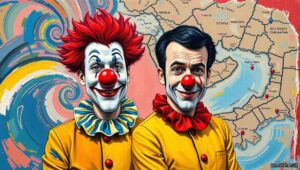
What the Funny People Are Saying
“A strictly defensive mission that deploys only when there’s no one to defend against. That’s not a navy, that’s a book club.” — Jack Dee
“Britain and France said they’d send a coalition once the fighting stopped. Brilliant. Absolutely brilliant. I’m going to use this at home. I’ll wash up once the plates are clean.” — Lee Mack
“The Royal Navy is hollowed out, the French navy is under structural pressure, and the plan is to clear mines. With drones. From a boat called Lyme Bay. I’ve had more intimidating Sundays.” — Romesh Ranganathan
“Fifty-one countries joined the summit. Fifty-one. You can’t get fifty-one people to agree on a curry, let alone a maritime doctrine.” — Sarah Millican
“Macron said the mission is ‘strictly defensive’. So is my marriage. It’s not going brilliantly.” — Jimmy Carr
“They’ve invited everyone except the Americans. It’s like throwing a house party and deliberately forgetting the one mate with a car.” — Dara Ó Briain
“I love that Starmer accused Iran of ‘holding the world’s economy to ransom’. Yeah, mate. Welcome to hostage negotiation. Your opening offer is a Zoom call.” — Frankie Boyle
The Real Goal: Relevance, Served Warm
At its heart, this whole episode is less about ships and more about status. Europe wants to prove it still matters on the world stage. America wants to prove it never stopped mattering. And the Strait of Hormuz just wants everyone to stop using it as a group project for a Politics A-Level module.
One analyst bluntly called the European effort symbolic. But symbolism is important. Without it, how would anyone know you were serious about not doing anything yet? Symbolism is what separates a press release from a plan. Symbolism is the reason Parliament has a mace instead of a hammer. And symbolism is why we have a Foreign Office at all, rather than just a group chat labelled “lads who speak French.”
The Grant-Funded Strategy
Somewhere, inevitably, a think tank is already drafting a white paper on European naval capability with a six-figure budget, fourteen contributing authors, and a conclusion that could have been written on the back of a Pret napkin: it might be nice to have some ships. The paper will be titled something like “Towards a Post-Kinetic Maritime Framework for the 21st Century” and nobody will read past the executive summary, least of all the Ministry of Defence.
This is what happens when you run defence policy the way you run arts funding. Eventually you end up with a ministry full of people who can describe a warship beautifully but have never seen one up close.
A Bold Vision for the Future (Once the Future Is Over)
To be fair, Starmer and Macron are trying to thread a difficult needle. Avoid war. Maintain influence. Appear decisive without, strictly speaking, deciding anything. It is a delicate balancing act, like carrying a tray of drinks through a bar fight while insisting you are neutral and also the entertainment.
Their plan might even work. Eventually. After everything else does. After the Americans have cleared the mines, after the Iranians have got bored, after the Chinese have quietly bought the harbour facilities, and after a working group in Brussels has finalised the font for the commemorative plaque.
The Mine-Clearing Philosophy
There is a school of thought, championed by the Royal United Services Institute, that mine-clearing is the most realistic European contribution. Which is true. It is also the nautical equivalent of being the person at a house party who shows up with a dustpan and brush at 2am. Useful. Sincere. Faintly embarrassing for everyone present.
But it is also, and this is important, the only thing Europe can actually do without anyone laughing out loud.
Final Thought: The Strait of Irony
In the end, the Strait of Hormuz has become something more than a strategic chokepoint. It is now a stage where global powers perform their preferred version of leadership.
America: loud, fast, and armed to the teeth.
Europe: careful, coordinated, and slightly late to the point where the taxi has already left.
And somewhere in the middle, oil tankers are just trying to figure out who is actually in charge. Right now, the answer appears to be: everyone, no one, and a committee scheduled for next Thursday in a conference room in Northwood.
There is a certain honesty to the Franco-British plan. It does not pretend to be the cavalry. It is, at best, the cleanup crew. And if there is one thing Europe has historically excelled at, it is arriving after the Americans have done the hard bit and then writing a very long book about what really happened.
The Strait of Hormuz will reopen. Oil will flow. Shipping lanes will clear. And Britain and France will be there, not quite first, not quite last, but exactly on time for the photograph.
Which is, if you think about it, the most European achievement of all.
Auf Wiedersehen, amigo!
On 17 April 2026, French President Emmanuel Macron and British Prime Minister Sir Keir Starmer co-chaired a summit at the Élysée Palace in Paris, bringing together 51 countries to advance the Strait of Hormuz Maritime Freedom of Navigation Initiative, a proposed multinational mission to secure the waterway once a ceasefire in the US-Israeli war on Iran is in place. The strait, through which roughly a fifth of the world’s oil usually passes, had been closed since Iran imposed a blockade on 28 February 2026 in response to the outbreak of the conflict, with the United States compounding the disruption by blockading Iranian ports. German Chancellor Friedrich Merz and Italian Prime Minister Giorgia Meloni attended in person; the leaders of Australia, Canada, South Korea, and Ukraine joined by video, along with representatives from China, India, and others. Washington was deliberately not invited. Macron described the mission as “strictly defensive” and limited to non-belligerent countries; Starmer said more than a dozen countries had agreed to contribute assets, including possible mine-clearing operations using drones deployed from RFA Lyme Bay and the destroyer HMS Dragon. Critics including Henry Jackson Society analyst Barak Seener accused the two leaders of “playing at being relevant” given the Royal Navy’s diminished capacity and the French navy’s budgetary pressures, while Sidharth Kaushal of RUSI argued mine-clearing and maritime warning systems were more realistic roles than warship escorts. Iran announced the strait would reopen the same day as the summit; US President Donald Trump dismissed European offers of help, calling NATO a “Paper Tiger.” Oil prices fell roughly $10 a barrel on the news.

Alan Nafzger was born in Lubbock, Texas, the son Swiss immigrants. He grew up on a dairy in Windthorst, north central Texas. He earned degrees from Midwestern State University (B.A. 1985) and Texas State University (M.A. 1987). University College Dublin (Ph.D. 1991). Dr. Nafzger has entertained and educated young people in Texas colleges for 37 years. Nafzger is best known for his dark novels and experimental screenwriting. His best know scripts to date are Lenin’s Body, produced in Russia by A-Media and Sea and Sky produced in The Philippines in the Tagalog language. In 1986, Nafzger wrote the iconic feminist western novel, Gina of Quitaque. He currently lives in Holloway, North London. Contact: [email protected]


The word “prat” from Elizabethan slang to mainstay of British humour is a journey that proves the British have been calling each other idiots for centuries and will continue to do so for centuries more.
The thing about good writing is you can feel how much thought went into every sentence. This is that.