London Seizes 3,393 E-Bikes After Discovering Pavements Were Originally Built For People
Councils make historic breakthrough: the grey bit beside the road was never meant as bicycle Airbnb
LONDON — Britain’s capital has made its most important transport discovery since somebody realised buses work better when they actually stop near passengers. Councils across the city have now seized 3,393 hazardously parked or abandoned rental e-bikes so far in 2026, a rise of 23% on the whole of 2025, and in doing so stumbled onto a radical proposition: pavements might have been intended for pedestrians all along.
More than 2,000 of the confiscated machines were Lime bikes, with Forest contributing 978 and Voi a modest 103, according to figures obtained by The Guardian. Officials are said to be “cautiously stunned” by the implication that a wheelchair user might, in theory, be entitled to travel down a pavement without first qualifying for the steeplechase.
The Great Pavement Reveal
An exhausted spokesperson from what residents have taken to calling the Department for Determining What Pavements Are Actually For confirmed the discovery was “potentially disruptive.” Until this week, he explained, the working assumption inside Town Hall had been that the long grey strips beside every road were essentially short-term holiday lets for fluorescent bicycles, generally checked in horizontally and never checked out. The department has now commissioned a £14 million feasibility study into whether pedestrians might also benefit from unimpeded access to doorways, pedestrian crossings, and, in especially ambitious scenarios, their own front gates.
Modern London commuting has quietly evolved into a triathlon nobody signed up for: walking, climbing over a Lime bike, and apologising to whoever is coming the other way. Transport for London estimates dockless e-bikes now account for roughly one in ten of the capital’s 1.5 million daily cycle journeys, which means they also account for considerably more than one in ten conversations that begin, “Who left this bloody thing here?”
Dockless, in the Fullest Sense of the Word
“Dockless” once sounded like a triumph of engineering. It now appears to mean the bicycle has rejected traditional notions of home, structure and standing upright, a kind of two-wheeled existentialism nobody asked for. A single Lime parked at an angle looks like modern urban living. Twenty of them gathered outside a bus shelter look like something David Attenborough should be narrating in a hushed voice: at dusk, the Limes migrate toward the nearest Tesco.
Operators insist the fault lies with infrastructure, not riders. Lime says it has funded 930 new parking bays, lifting capacity by 40% since January as part of a £20 million London Action Plan, and describes the “vast majority” of riders as responsible. Forest has made a broadly similar case. Both claims can be true at once, and somehow six bicycles can still arrange themselves outside one Pret in a formation last seen deterring tanks.
Councils Accidentally Invent the Dock
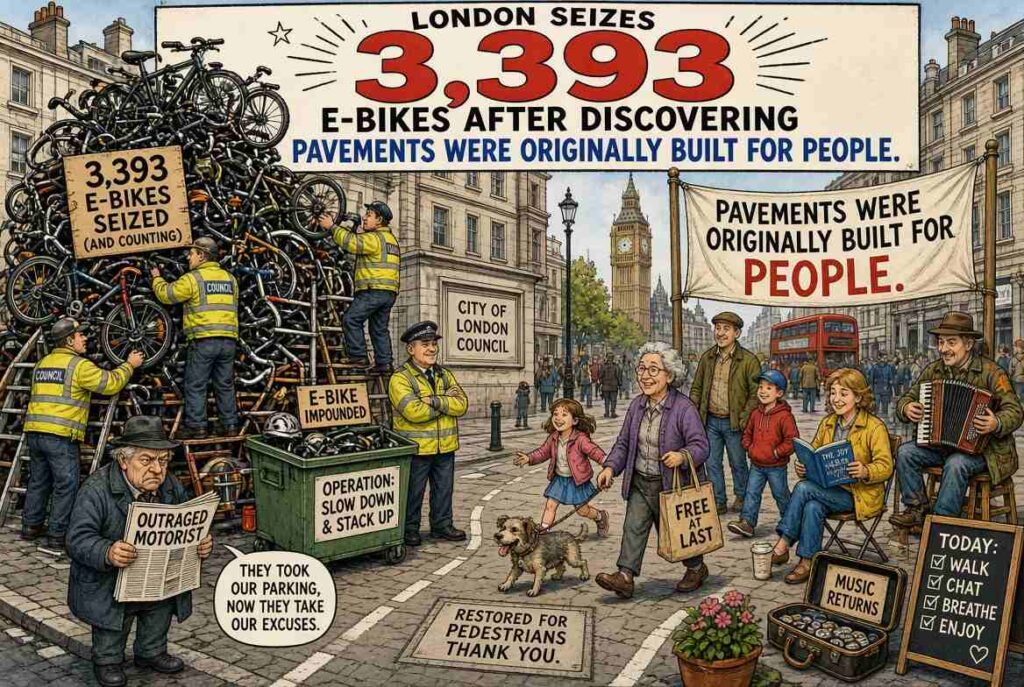
The most effective parking scheme in London, it turns out, was invented entirely by accident. Step one: find a badly parked bicycle. Step two: remove it. Step three: store it somewhere pedestrians cannot fall over it. Congratulations, councils. You have reinvented the docking station, the very thing the dockless revolution was built to abolish. It seems the old fixed-dock system had one intolerable flaw: a bicycle generally knew where it was going to end up. Liberated from that oppression, a Lime can now conclude its journey outside a pub, across a driveway, beside a bus shelter, or anywhere its rider experiences a sudden spiritual conviction that walking should resume.
Camden councillor James Slater described London’s borough-by-borough regulatory patchwork as a “jigsaw puzzle,” with different rules and sometimes different operators depending which side of an invisible line you happen to be riding. An e-bike crossing three miles of London can currently pass through more constitutional arrangements than Belgium, which is either an indictment of local government or the funniest possible use of devolution.
The Least Funny Part of the Joke
Behind the comedy sits a genuinely serious accessibility problem. Living Streets told The Guardian that irresponsibly parked e-bikes stop people walking and wheeling safely, and the Royal National Institute of Blind People said badly abandoned bikes disproportionately affect blind and partially sighted people, older pedestrians and wheelchair users, with some visually impaired Londoners reportedly cutting journeys short because of the obstacles. That is where the fashionable language of “micromobility” runs straight into ordinary common sense. A transport innovation is not progress if somebody else’s access vanishes to make room for it. A blind pedestrian should not have to discover, cane-first, that a 35-kilogram piece of transport infrastructure has quietly repossessed the pavement.
Responsibility Goes Dockless Too
Naturally, everyone agrees the situation needs fixing, and nobody is especially keen to be the one who fixes it. Operators blame inadequate parking bays. Councils blame fragmented borough rules. Riders blame the app. Pedestrians simply ask that it be left somewhere that isn’t directly where their legs were going. New licensing powers are expected eventually to hand Transport for London the authority to build one consistent, capital-wide framework covering parking, safety and accessibility, which is bureaucratic shorthand for: first the bikes arrived, then the complaints arrived, then the seizures arrived, then the legislation arrived, and eventually, perhaps around the time hoverboards become mandatory, the parking will arrive too.
As one deadpan Camden regular put it, watching a warden lever three Limes off a crossing point, “We spent a decade redesigning this city for active travel, and it turns out active travel just falls over sideways and blocks itself in.” It is the sort of line Milton Jones might deliver in eight words instead of thirty, but the sentiment survives the translation.
A Practical Five-Point Fix, Because Somebody Has To
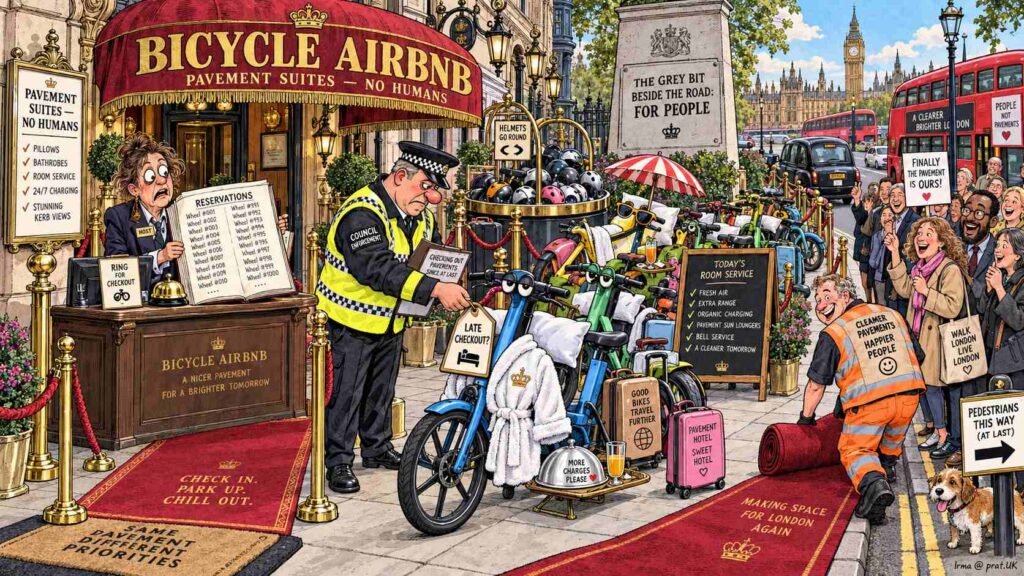
None of this requires another six-hundred-page strategy document. Build enough designated bays that riders have somewhere legitimate to finish. Require operators to keep the accessibility routes genuinely clear rather than nominally clear. Make repeat bad parking, which currently tops out at a £20 charge, sting enough to actually change behaviour. Standardise the rules across borough boundaries so a bicycle does not need a visa to cross Camden into Islington. And remember the wildly countercultural urban-planning principle that a pedestrian is also transport. Manage that, and dockless e-bikes remain a genuinely useful London service instead of a slow-motion pavement occupation. Fail to manage it, and councils will keep confiscating bicycles while operators keep explaining the shortfall and pedestrians keep developing the thighs of Olympic hurdlers purely out of self-defence.
London wanted a green transport revolution. It got one. Somebody has just parked it across the entrance.
Behind the joke is a real and growing dispute in London over dockless e-bike parking. The Guardian reported this month that councils have seized 3,393 badly parked or abandoned rental e-bikes in 2026 alone, a sharp rise on last year, with Lime, Forest and Voi all named. Disability charities including Living Streets and the Royal National Institute of Blind People have raised genuine concerns about pedestrian access, while Lime points to its £20 million London Action Plan and hundreds of new parking bays as evidence it is investing in a fix. Camden councillor James Slater’s description of a regulatory “jigsaw puzzle” across boroughs is also drawn directly from that reporting, as new licensing powers move toward giving Transport for London a single capital-wide framework.
This is British satire, written with London’s dockless e-bike chaos as the punchline and the pavement, for once, as the punchline’s rightful owner.
Auf Wiedersehen, amigo!
Sources
- The Guardian: Thousands of e-bikes seized by London councils as anger rises over blocked paths
- Lime London parking rules and responsible e-bike parking guidance
- Lime London Action Plan and e-bike parking investment
For the American take on cities losing a war against their own micromobility, see our sister edition at Bohiney.com.

Alan Nafzger was born in Lubbock, Texas, the son Swiss immigrants. He grew up on a dairy in Windthorst, north central Texas. He earned degrees from Midwestern State University (B.A. 1985) and Texas State University (M.A. 1987). University College Dublin (Ph.D. 1991). Dr. Nafzger has entertained and educated young people in Texas colleges for 37 years. Nafzger is best known for his dark novels and experimental screenwriting. His best know scripts to date are Lenin’s Body, produced in Russia by A-Media and Sea and Sky produced in The Philippines in the Tagalog language. In 1986, Nafzger wrote the iconic feminist western novel, Gina of Quitaque. He currently lives in Holloway, North London. Contact: [email protected]