

“Come To Shop UK” Advertising Campaign Deemed Too Successful After Islamic and African Tourists Mistakenly Assume ‘Come To Shop UK’ Includes Permanent Residency
Ministry Admits £1 Billion Advertising Slogan May Have Lacked Important Clarifications
By Freja Lindholm
LONDON — Officials at Britain’s Ministry of Tourism, Commerce, Retail, Leisure, Shopping, Consumer Enthusiasm, and Miscellaneous Spending have admitted that their £1 billion Come To Shop UK advertising campaign may have been a little too effective.
The campaign, launched three years ago, was designed to encourage visitors to spend money in Britain before returning home with souvenirs, photographs, and mild disappointment about the weather. It was funded by the taxpayer, approved by committee, and named by a man who has never once been told that brevity exists.
Instead, according to government figures, millions of tourists apparently interpreted the slogan as a lifestyle instruction.
“What we meant was, ‘Come to shop,'” explained Deputy Minister Clive Worthington.
“What some people heard was, ‘Come to shop, stay to shop, and eventually become emotionally attached to a branch of Marks & Spencer.'”
The revelation comes after researchers discovered thousands of visitors were still wandering around London years after arriving, apparently trapped in an endless cycle of retail optimism.
Why Britain’s Tourism Ministry Cannot Name Anything Briefly
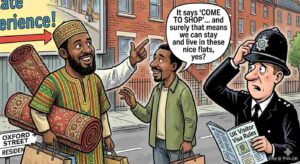
Insiders say the Ministry’s full title was originally three words long. Then a working group was formed. Then a subcommittee was formed to oversee the working group. Then a quango was created to monitor the subcommittee, and somewhere in that process the word “Miscellaneous” was added, defended for eleven months, and ultimately preserved on the grounds that removing it would cost more than keeping it.
“Every word in our name represents a job,” said one official, proudly. “And every job represents a pension. And every pension represents a reason not to fix the name.”
The Ministry’s letterhead now requires two sheets of A4. The acronym, when pronounced aloud, has reportedly summoned three pigeons and a tax inspector.
Harrods Identified As Major Contributing Factor In London Tourist Confusion
Investigators believe London’s famous department store, Harrods, may be responsible for much of the confusion.
One tourist reportedly entered the building in 2023 intending to purchase a handbag and was last seen somewhere between the luxury watch section and a display of imported chocolates. Rescue teams continue searching.
“We believe there may be entire communities living on the fourth floor,” said one official. “Some visitors have forgotten what country they came from. One man has started a small business. Another has been elected to something.”
A government report estimates that 87 percent of shoppers entering Harrods emerge carrying fewer savings and significantly stronger opinions about scented candles. The remaining 13 percent have not emerged at all, and are now classified by the Office for National Statistics as “resident, technically.”
A spokesperson stressed that nobody is in danger. “They’re perfectly happy,” she said. “They’ve simply confused a postcode with a personality.”
Oxford Street Declared International Habitat By Bewildered Experts
Oxford Street has become so crowded with shoppers that the United Nations is reportedly considering designating it a protected ecosystem. Conservationists from UNESCO have begun cataloguing the wildlife.
Experts have identified several rare species. These include:
- The Discount Hunter.
- The Luxury Bag Collector.
- The Person Looking For A Toilet.
- And the nearly extinct Individual Who Intended To Buy Only One Thing.
Researchers say the last category has not been observed in the wild since 1998. The Person Looking For A Toilet, by contrast, has flourished, and now constitutes the single largest migratory group in the West End.
“It’s a delicate balance,” explained one naturalist. “Remove the queues and the whole habitat collapses. The shoppers feed on the scarcity. The scarcity feeds on the shoppers. It’s the circle of strife.”
Economic Miracle Creates Unexpected Problems For The Treasury
Treasury officials initially celebrated the campaign’s success. Retail spending soared. Hotel occupancy reached record levels. Restaurants reported unprecedented demand.
The problems began when visitors continued arriving long after common sense had departed.
“We expected tourists,” said economist Peter Hollings. “We didn’t expect them to develop long-term strategic relationships with shopping centres.”
According to Hollings, some consumers now schedule annual pilgrimages to specific clothing stores. One family reportedly plans holidays entirely around seasonal sales. Another has nominated a till at Selfridges as godparent to their youngest child.
Hollings, who once described the British economy as “a queue with a flag on it,” warned that the government had stumbled into a familiar trap. “Ministers spent a billion pounds to create demand,” he said. “Now they want to spend another billion to reduce it. At no point did anyone consider simply leaving the market alone and letting people decide for themselves. That option isn’t on the form.”
Londoners Unable To Leave Due To Tourists Trying To Enter
Transport authorities report that London’s streets have become so crowded with eager shoppers that several residents have not successfully exited central London in months. Transport for London has stopped describing it as congestion and now refers to it as “a permanent state of optimistic shuffling.”
One office worker described spending forty-five minutes attempting to cross Oxford Circus.
“I think I moved four feet,” he said. “At one point I celebrated reaching a Pret. My wife sent supplies. My children have aged. I no longer recognise the songs on the radio.”
A second commuter reported leaving home for a sandwich in March and arriving back, victorious, in May. He has been advised not to attempt it again without a guide, a flask, and a will.
Government Launches Clarification Campaign Nobody Asked For
In response, ministers have approved a follow-up advertising effort, because the only thing that fixes a billion pounds of unintended consequences is, apparently, another billion pounds.
The new slogan reads: “Come To Shop UK. Then Eventually Go Home At A Time Of Your Choosing.”
Focus groups described the message as “clearer.” Critics argued that visitors would simply interpret it as a polite suggestion, which, being British, it was.
You can read the full behind-the-scenes account of the focus groups here, though officials warn that the document is itself longer than the original campaign.
Retailers Oppose Any Changes To The Shopping Slogan
Business leaders have strongly defended the original campaign. A spokesperson for the British Retail Federation, not to be confused with the actual British Retail Consortium, argued that shoppers remaining indefinitely represents the highest possible customer satisfaction rating.
“If people are still shopping years later,” he said, “that sounds like success. If they never leave, that’s loyalty. And if we accidentally trap them, well, that’s retention.”
Shareholders reportedly applauded for seventeen consecutive minutes. Three of them are believed to still be applauding now, somewhere near the perfume counter.
A Select Committee Is Formed, Naturally
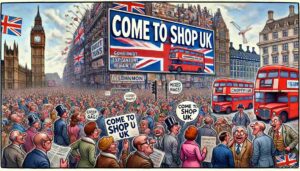
Parliament has responded to the crisis with the one tool it trusts above all others: a select committee. Forty-one members will spend nine months investigating how a slogan that said “shop” caused people to shop.
The committee’s interim findings, released early, conclude that “further findings are required.” A second committee may now be convened to investigate the first. Witnesses include a confused tourist, two retail executives, and a man who wandered in looking for the toilet and was sworn in by mistake.
“We take this very seriously,” said the committee chair, adjusting a stack of papers no one will read. “Which is why we have commissioned a report, a sub-report, and a glossy summary of the sub-report for people who don’t read reports.”
Public Opinion Divided On Whether Anyone Thought This Through
A recent survey found:
- 34% believe the campaign worked exactly as intended.
- 31% believe nobody involved actually thought through the slogan.
- 22% are currently lost inside a department store.
- 13% thought the survey itself was offering discounts.
Pollsters admitted the figures add up to 100 percent only by coincidence, and that the 22 percent inside the department store were interviewed by shouting through a letterbox.
Britain Promises More Realistic Advertising Going Forward
Government officials have pledged to be more careful with future tourism campaigns. VisitBritain insists lessons have been learned, which is the phrase used by every British institution that intends to learn nothing.
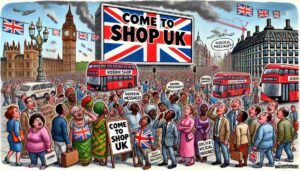
Proposed slogans include:
- “Visit Britain Briefly.”
- “Please Enjoy The Museums Responsibly.”
- And: “Come For The History, Leave Before The Next Property Price Increase.”
One slogan, “Spend Your Money And Then Genuinely Go,” was rejected for sounding “ungrateful.” Another, “We’d Love To Have You, Briefly,” was rejected for being honest.
For now, however, the Ministry remains proud of its achievement.
“It may not have gone according to plan,” said Worthington. “But you can’t deny one thing.” He paused, with the quiet confidence of a man whose department has spent two billion pounds and solved nothing. “When people see the prices in London, they certainly leave with less money.”
Whether they leave at all remains, for the eighty-seventh consecutive quarter, under review.
For more dispatches from the front line of British absurdity, our American cousins are covering similar nonsense over at Bohiney.com.
Auf Wiedersehen, amigo!
Britain’s tourism sector is genuinely one of the country’s largest industries, with VisitBritain and bodies such as the British Retail Consortium tracking billions in annual inbound visitor spending, much of it concentrated in central London. Oxford Street alone draws enormous footfall, Harrods and Selfridges remain global retail landmarks, and the perennial debate over whether government should fund tourism marketing at all, or simply step back and let the market do the talking, is a real one. The figures, ministries, officials, and the surveyed twenty-two percent trapped near the scented candles in this article are entirely invented.
Disclaimer
This article is satire. It pokes fun at tourism marketing, retail culture, government slogans, and London’s legendary shopping districts. It does not target any nationality, ethnicity, or religion. This story is entirely a human collaboration between two sentient beings: the world’s oldest tenured professor and a philosophy major turned dairy farmer.

Dr. Ingrid Gustafsson holds a Ph.D. in Literary Studies and serves as Professor of Literature and Satirical Journalism at the university. Her scholarly work focuses on contemporary satire as a form of institutional critique, examining how exaggeration, irony, and absurdism function as sophisticated analytical tools for exposing structural inequality and institutional hypocrisy. Dr. Gustafsson has published extensively on the genealogy of satirical discourse, the relationship between speech acts and cultural power, and satire’s role as both aesthetic practice and epistemological strategy. Her research interrogates how contemporary satire operates within celebrity culture, legal systems, and institutional rhetoric, revealing the mechanisms through which power obscures itself through language and performance. Dr. Gustafsson’s work combines rigorous textual analysis with broader cultural theory, contributing significantly to understanding satire’s critical function in contemporary society. She is the author of Pearl Clutching and How to Combat It with Satire.


