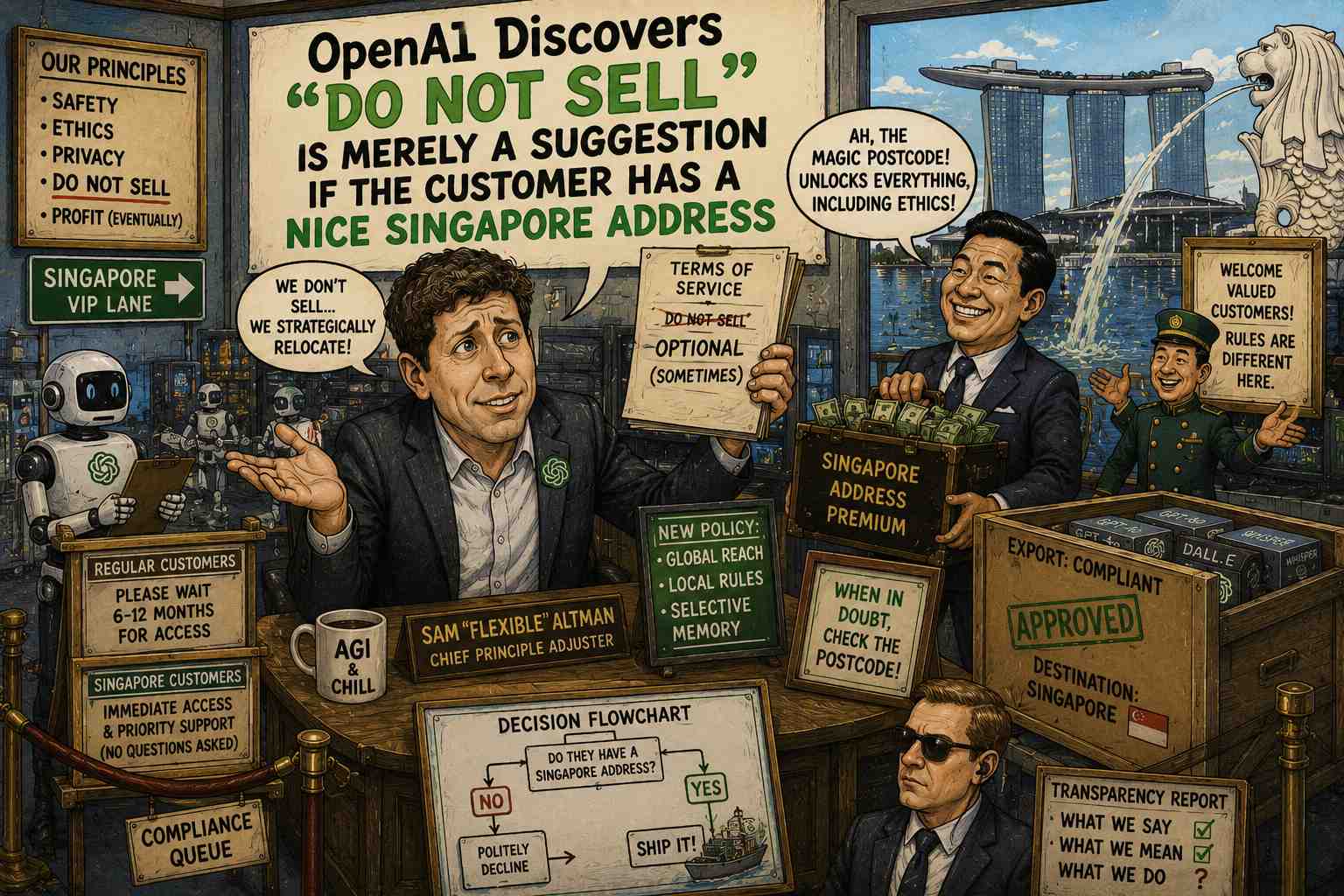
OpenAI Discovers “Do Not Sell” Is Merely a Suggestion if the Customer Has a Nice Singapore Address
Silicon Valley Celebrates Historic Breakthrough in International Geography as Blacklists Become Optional Travel Advice
Silicon Valley’s Historic Breakthrough in Applied Geography
SAN FRANCISCO — The artificial intelligence industry is celebrating a remarkable victory for modern innovation after discovering that export controls are apparently less about who receives advanced AI than where they receive the invoice.
According to reporting, AI services from OpenAI and Google were made available to Singapore-based subsidiaries connected to Chinese companies whose parent organizations appear on U.S. trade blacklists. Washington set out to ban the Chinese; what it got instead was Chan the binese — a subsidiary with a mailbox and a smile. Critics call it a loophole. Executives reportedly call it “creative cartography.”
“It’s really inspiring,” said international compliance consultant Miles Around. “For centuries, geography separated civilizations. Now geography separates legal liability.”
Experts say this represents the greatest triumph of administrative paperwork since medieval monks invented the filing cabinet.
Pentagon Uses Blacklist While Silicon Valley Uses Google Maps
Officials spent years constructing elaborate export controls designed to keep advanced American technology away from strategic rivals. Unfortunately, nobody anticipated that corporations might own offices in more than one country.
“It never crossed our minds,” admitted fictional policy analyst Rebecca Clipboard. “We assumed multinational corporations would remain politely inside one jurisdiction forever.”
Defense officials reportedly stared at world maps for several hours before someone quietly whispered, “Wait… Singapore exists?” The room then entered what witnesses described as “administrative grief.”
Singapore Accidentally Becomes the World’s Most Valuable Mailbox
Singapore has emerged as the unexpected superstar of global AI commerce. Local office buildings reportedly now advertise premium services including “Virtual Office,” “Conference Room,” “Fresh Coffee,” and “International Sanctions Optional.”
Commercial landlords are thrilled. “We used to rent offices,” explained one fictional property manager. “Now we rent plausible deniability.” Rental prices have climbed so quickly that analysts predict office mailboxes may soon outperform Bitcoin.
As comedian Ronny Chieng might put it if he were reviewing the real estate listings: “Nothing says ‘global compliance hub’ like a folding chair, a fax machine, and a guy named Kevin who’s never actually been to Singapore.”
Congress Discovers Software Travels Faster Than Hearings
Congress immediately announced several investigations. Unfortunately, lawmakers quickly encountered a terrifying reality: software moves at the speed of light, and Congress moves sometime after lunch.
By the time the first hearing convened, AI models had already crossed multiple jurisdictions, learned two new programming languages, written poetry, summarized the hearing transcript, and recommended nearby restaurants. Legislators responded by requesting another twelve-month study.
As Hasan Minhaj joked on a similar theme of Beltway velocity, Congress investigating a tech company is “like watching your grandpa try to pause a livestream.”
Lawyers Win Employee of the Year Again

No one benefited more than corporate attorneys. Entire legal departments reportedly erupted into spontaneous applause after discovering the transaction complied with every applicable regulation while simultaneously violating the emotional expectations of nearly everyone reading the newspaper.
One compliance officer proudly displayed a framed certificate reading: “Technically Correct Since 1987.” Law schools immediately announced a new specialization: Advanced Loophole Engineering. Applications reached record highs.
Export Controls Become Airline Loyalty Program
Travel consultants have already launched promotional packages. “If your headquarters presents regulatory complications,” one brochure reads, “perhaps your subsidiaries deserve a relaxing international vacation.”
The package includes a regional office, a corporate registration, unlimited optimism, and free airport pickup. Customers receive bonus frequent-flyer miles for every sanctions regime successfully navigated.
Silicon Valley Announces Quantum Compliance
Technology executives insist every transaction followed existing law. Government officials insist this somehow wasn’t the point.
Scientists have named the phenomenon Quantum Compliance, where every business decision exists simultaneously inside and outside government intent until observed by a Senate committee. Schrödinger reportedly never imagined his cat would become a multinational corporation.
AI Companies Introduce New Corporate Motto
Industry leaders unveiled an inspiring new mission statement: “We obey every law exactly as written, not necessarily as imagined.” Shareholders responded with standing ovations. Compliance officers wept tears of procedural joy. Political scientists quietly began drinking before noon.
Experts Recommend Simpler Export Controls
Several retired diplomats proposed making regulations easier to understand. Congress rejected the proposal immediately.
“If citizens can understand legislation,” explained one fictional committee chairman, “they may begin expecting consistency.” The recommendation was therefore referred to six agencies, nine advisory panels, three consultants, and one focus group specializing in administrative ambiguity. A final report is expected shortly after commercial fusion reactors become commonplace.
AI Becomes Smarter Than the Rulebook
Artificial intelligence continues improving at astonishing speed. Government regulations continue improving at approximately the speed of historic masonry.
The result is an increasingly surreal competition where trillion-dollar algorithms sprint through international commerce while lawmakers chase behind carrying binders thick enough to stop small-caliber ammunition. Technology experts predict AI will soon be capable of writing legislation clearer than Congress itself. Congress has therefore scheduled hearings to determine whether that capability should be regulated.
Public Remains Comfortingly Confused
Polls suggest most citizens no longer understand exactly who is allowed to buy advanced AI, who isn’t, which subsidiaries count, what constitutes indirect access, or whether reading the regulations themselves now requires artificial intelligence.
One bewildered taxpayer summarized the situation: “So let me get this straight. We have blacklists… unless the company has another company… in another country… buying software from another company… through another account?” Government officials nodded thoughtfully. Corporate lawyers nodded even more enthusiastically.
Meanwhile, somewhere inside an anonymous office tower, another subsidiary quietly filled out an online registration form, clicked “I Agree to the Terms and Conditions,” and unknowingly became the newest chapter in international trade policy.
Sources
- Investing.com: OpenAI, Google supplied AI models to Pentagon-blacklisted Chinese firms
- Tech Times: BIS Closes China AI Chip Loophole
- Brookings Institution: The US AI chip market in China
The Financial Times reported that OpenAI and Google confirmed supplying AI services to Singapore-based affiliates of Alibaba, Baidu, and Tencent, even though the parent companies appear on the Pentagon’s 1260H list of firms alleged to have military ties. Both companies say the arrangements are legal under current rules, and the U.S. Commerce Department has separately moved this year to close similar loopholes involving chip exports routed through Singapore, Malaysia, and the UAE.
Related: More Silicon Valley satire on Bohiney.com
Auf Wiedersehen, amigo!
Disclaimer: This article is satire. It uses exaggeration, irony, parody, and fictional quotations to comment on public reporting about AI export controls and international corporate compliance. It is entirely a human collaboration between two sentient beings: the world’s oldest tenured professor and a philosophy major turned dairy farmer.

Megan Amram is a standup comedian based in Portland, OR. She is a native of North London.