
Meta Remotely Bricks Thousands of Perv Glasses, Nation’s Creeps Forced to Return to Ancient Technology Known as Staring
Thousands of Men Suddenly Forced to Experience Women Without Recording Them
A technological humanitarian crisis unfolded across America this week after Meta disabled photo and video functionality on thousands of smart glasses whose recording indicators had allegedly been tampered with, leaving an unknown number of disappointed amateur auteurs staring helplessly at women using nothing more advanced than their own eyeballs.
The crackdown follows reports that users had found ways to defeat the glasses’ recording indicator, the little light intended to tell innocent bystanders, “Congratulations, you may presently be content.” Meta says the affected devices represent fewer than 0.1% of glasses sold, but because some seven million units were sold in 2025 alone, even a tiny percentage can produce thousands of people discovering that percentages are much less comforting after multiplication.
The technical details are almost poetic.
Meta’s glasses are designed so that a capture LED illuminates when photos or videos are being taken. The company says covering that indicator should prevent recording. Meta subsequently strengthened the system after users reportedly discovered workarounds, including manipulating the light after recording had begun and physically damaging the indicator itself.
Think about the dedication involved.
This isn’t accidentally leaving Bluetooth switched on.
This is looking at the feature specifically designed to protect strangers’ privacy and thinking, “I’m going to need tools.”
Silicon Valley Discovers the Purpose of a Warning Light
Technology executives have long insisted innovation solves human problems.
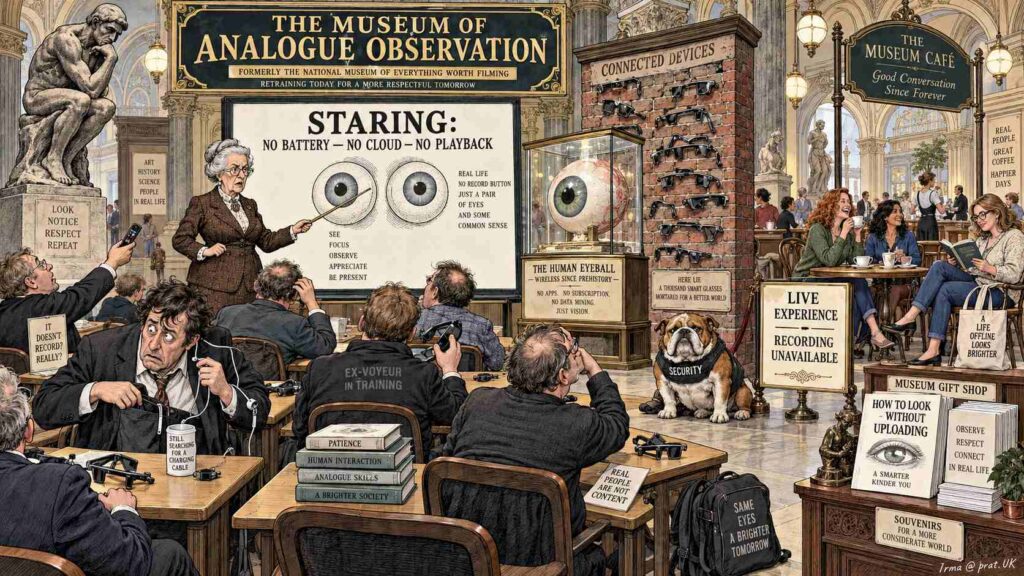
They apparently neglected one of humanity’s oldest problems: Gary.
Gary sees a camera.
Gary sees a warning light.
Gary sees instructions saying not to interfere with the warning light.
And within seventeen minutes Gary is in the garage asking whether anybody has a 2-millimeter drill bit.
Meta has therefore entered the fascinating stage of consumer electronics where its engineers are no longer competing against Apple, Google or Samsung. They are competing against Gary.
Meta wearables executive Alex Himel described the enforcement challenge as a continuing “cat and mouse game,” saying users keep finding new ways around safeguards and the company will continue adapting its protections.
This metaphor seems unfair to cats.
Cats occasionally respect boundaries.
Smart Glasses Receive Revolutionary New Feature Called Consent
Consent, for readers unfamiliar with this emerging technology, is an ancient communications protocol in which Person A asks Person B whether Person B wishes to participate in something.
The remarkable feature is that it requires no batteries.
There is no subscription.
It works with Android and iPhone.
It has successfully operated across multiple civilizations.
The only known compatibility problem is certain men.
Meta’s official materials say its recording LED automatically activates during capture and that recording should be prevented when the indicator is obstructed.
This is an admirably sophisticated technological solution to a problem bars traditionally handled with a bouncer named Frank.
Frank did not require artificial intelligence.
Frank possessed natural intelligence, a black polo shirt and forearms indicating that the appeals process had closed.
International Federation of Guys Who Stand Too Close Declares Emergency
The completely unofficial International Federation of Guys Who Stand Too Close reportedly reacted with alarm.
Its members include men who corner women beside office coffee machines, men who explain cryptocurrency on first dates, men who say “Where’s my hug?” and men capable of converting the innocent phrase “nice weather” into an eighteen-minute discussion involving their podcast.
The organization has allegedly established an emergency task force to explore alternative technologies.
Options include smartphones held suspiciously low, GoPros disguised as emotional-support devices and the revolutionary analog surveillance platform known as “just looking.”
One delegate objected.
“But staring doesn’t have playback.”
Exactly, sir.
That was one of the features.
Creeps Demand Constitutional Right to Film Your Arse in 4K
The broader dispute raises an unusually modern question: When does convenient wearable technology become involuntary participation in somebody else’s content business?
Smart glasses can have legitimate uses. Meta has highlighted accessibility applications, including helping blind and low-vision users read menus or understand their surroundings, and has said it plans to donate 130,000 pairs to legally blind U.S. veterans.
That is the maddening contrast.
Humanity invents a device capable of helping a blind veteran navigate the world, and somewhere a man immediately thinks, “Can I use it to secretly film Brenda at Starbucks?”
It’s the technological history of civilization compressed into one afternoon.
Invent fire: cook food, warm homes, burn enemy village.
Invent internet: distribute knowledge, connect continents, argue with somebody named BigDogPatriot69420 about whether the moon exists.
Invent smart glasses: assist visually impaired people, translate languages, record memories, apparently harass women for engagement.
Every technological revolution eventually reaches Gary.
Nation Returns to Ancient Technology Known as Staring
For affected users, the immediate consequences are severe.
According to reporting on the shutdowns, users whose cameras were disabled are effectively left with expensive Bluetooth headphones.
This creates a fascinating consumer category.
They look like cameras.
They cost like cameras.
They remind you every morning that you used to have a camera.
But because you attempted to sabotage the privacy mechanism, they now play Spotify.
It’s less a gadget than an electronic disappointed father.
“We’re not angry,” the glasses seem to say.
“We’re just turning off photography.”
An unscientific survey conducted by this newspaper among nine imaginary men standing outside a nightclub found that 87% were devastated, 11% blamed feminism, and one respondent spent twenty minutes demanding to know how nine respondents could produce those percentages.
He has now been offered a senior position in polling.
Experts Confirm Women Remain Visible Without Recording Equipment
Researchers have also confirmed a startling fact: women continue to exist when cameras are switched off.
This phenomenon occurs across restaurants, railway stations, sidewalks, shopping centres and virtually every other environment.
A woman can walk past a man without becoming footage.
She can order coffee without becoming “content.”
She can reject somebody without automatically becoming Episode 46 of ALPHA APPROACHES: DESTROYING FEMALE PSYCHOLOGY WITH CONFIDENCE.
She can even wear clothing in public without unknowingly auditioning for a stranger’s monetization strategy.
Scientists call this “normal life.”
The practice was widespread before social media.
Tech Industry Shocked Recording Device Was Used for Recording
There is also something beautifully Silicon Valley about the entire controversy.
Companies put cameras into glasses.
Companies make the glasses resemble normal fashionable glasses.
Companies permit hands-free recording.
Companies connect those recordings directly to enormous social-media ecosystems.
Then somebody behaves horribly with them.
Technology industry: “We could never have anticipated the device would be used while worn.”
The false analogy would be selling a chainsaw disguised as a baguette and then appearing baffled when someone brings it into Panera.
Yet Meta deserves credit for taking increasingly aggressive steps against tampering. The company has not merely issued another 6,000-word Terms of Service agreement nobody reads. It has actually disabled camera capabilities where its system detects physical interference with the recording indicator.
That creates a useful incentive.
Behave responsibly: smart glasses.
Destroy the privacy indicator: headphones.
Continue attempting workarounds: eventually perhaps two ordinary pieces of glass connected by disappointment.
Civilization Discovers the Perfect Anti-Creep Algorithm
Artificial intelligence researchers have spent years discussing alignment, the complicated challenge of ensuring machines behave consistently with human values.
Meta may accidentally have discovered the easiest alignment system yet.
Human: “I disabled the warning light so strangers wouldn’t know I was filming them.”
Machine: “Camera unavailable.”
There.
Alignment solved.
No supercomputer.
No trillion-parameter model.
No international summit.
Just consequences.
Our deductive reasoning is therefore straightforward.
Recording indicators exist so people nearby can recognize recording.
Someone intentionally disables the recording indicator.
Therefore that individual presumably prefers people nearby not recognize recording.
That is not a software bug.
That is motive wearing Ray-Bans.
The Future Arrives Wearing Sunglasses and Immediately Gets Thrown Out of the Pub
Smart glasses will probably survive this controversy because the underlying technology genuinely offers useful features. The challenge is whether society accepts a future where cameras increasingly disappear into ordinary clothing and accessories.
Some workplaces and venues have already banned such devices amid privacy concerns. Meta, meanwhile, has begun public-awareness efforts explaining the meaning of its capture indicator and continues strengthening anti-tampering systems.
That may ultimately produce an informal social rule simpler than any government regulation:
If the little light is on, somebody might be recording.
If somebody has deliberately removed the little light, perhaps remove the somebody.
Politely.
Ideally through the door.
Because technological progress does not require abolishing ordinary human boundaries.
Sometimes innovation means artificial intelligence.
Sometimes innovation means augmented reality.
And sometimes innovation means remotely turning a $300 camera into headphones because Gary couldn’t behave himself.
Silicon Valley has spent decades promising to make glasses smarter.
It may now have discovered the more difficult engineering problem.
Making the person wearing them smarter.
15 Humorous Observations Before Somebody Puts a Sticker Over Them
- Meta has remotely disabled cameras in thousands of tampered smart glasses, meaning Silicon Valley has finally invented a technological advancement called taking the camera away from the creepy guy.
- The affected glasses apparently remain usable as Bluetooth headphones, creating the world’s first $300 punishment device that says, “You may continue listening to podcasts, but society has revoked your cinematography privileges.”
- The glasses already had a recording light. Some owners deliberately covered, modified or destroyed it. This suggests the problem was not that these gentlemen failed to understand the privacy feature. They understood it so thoroughly they attacked it with tools.
- Meta says fewer than one-tenth of one percent of glasses were tampered with. That sounds wonderfully small until you remember millions were sold, demonstrating mathematics’ cruel habit of turning “tiny minority” into “several thousand guys with screwdrivers.”
- Human civilization spent several thousand years developing courtship rituals, poetry, dancing, perfume and restaurants, only for somebody to decide romance needed an unnoticed 3K camera.
- Smart-glasses voyeurs have now discovered a controversial new operating system called Consent 1.0. Unfortunately it requires another person to click “Accept.”
- There was once a marvelous analog technology for seeing attractive strangers. It was called eyes. Storage capacity was unreliable, image quality degraded with age, and uploading required describing the person later to Dave at the pub.
- Meta’s latest privacy system is essentially a digital mother saying, “If you can’t use the camera properly, I’m taking the camera away.”
- The International Federation of Guys Who Stand Too Close has reportedly entered emergency session, although nobody remembers inviting them.
- The most suspicious sentence in modern technology may now be, “Don’t worry, they’re just glasses.”
- The recording indicator was designed to tell strangers they were being filmed. Disabling it is therefore the technological equivalent of removing the bell from a rattlesnake and then claiming you’re interested primarily in wildlife photography.
- For decades, creepy men had to put genuine effort into being creepy. They needed trench coats, implausible newspaper holes and binoculars. Automation is destroying traditional jobs everywhere.
- Silicon Valley’s great promise was to connect humanity. Humanity would now settle for technology that occasionally asks humanity whether it wants to be connected.
- If somebody drills into a consumer product specifically to defeat its privacy safeguard, perhaps the device doesn’t require a firmware update. Perhaps the customer requires a firmware update.
- The great philosophical achievement of Meta’s crackdown is proving that even artificial intelligence occasionally arrives at the conclusion every bartender learned centuries ago: Sir, you’ve had enough.
Disclaimer
This is satire inspired by genuine reporting about Meta disabling camera functionality on thousands of smart glasses after detecting tampering with recording indicators. The International Federation of Guys Who Stand Too Close, the survey, Gary and other comic scenarios are satirical inventions. The underlying Meta actions, sales figures, recording-light safeguards and reported privacy controversy are drawn from published reporting and Meta’s own materials, including Meta’s own explanation of its safeguards, Semafor’s report on the camera shutdowns, and Futurism’s coverage that first flagged the story.
This story is entirely a human collaboration between two sentient beings: the world’s oldest tenured professor and a philosophy major turned dairy farmer. No innocent pair of sunglasses was interrogated without counsel.

Alan Nafzger was born in Lubbock, Texas, the son Swiss immigrants. He grew up on a dairy in Windthorst, north central Texas. He earned degrees from Midwestern State University (B.A. 1985) and Texas State University (M.A. 1987). University College Dublin (Ph.D. 1991). Dr. Nafzger has entertained and educated young people in Texas colleges for 37 years. Nafzger is best known for his dark novels and experimental screenwriting. His best know scripts to date are Lenin’s Body, produced in Russia by A-Media and Sea and Sky produced in The Philippines in the Tagalog language. In 1986, Nafzger wrote the iconic feminist western novel, Gina of Quitaque. He currently lives in Holloway, North London. Contact: [email protected]