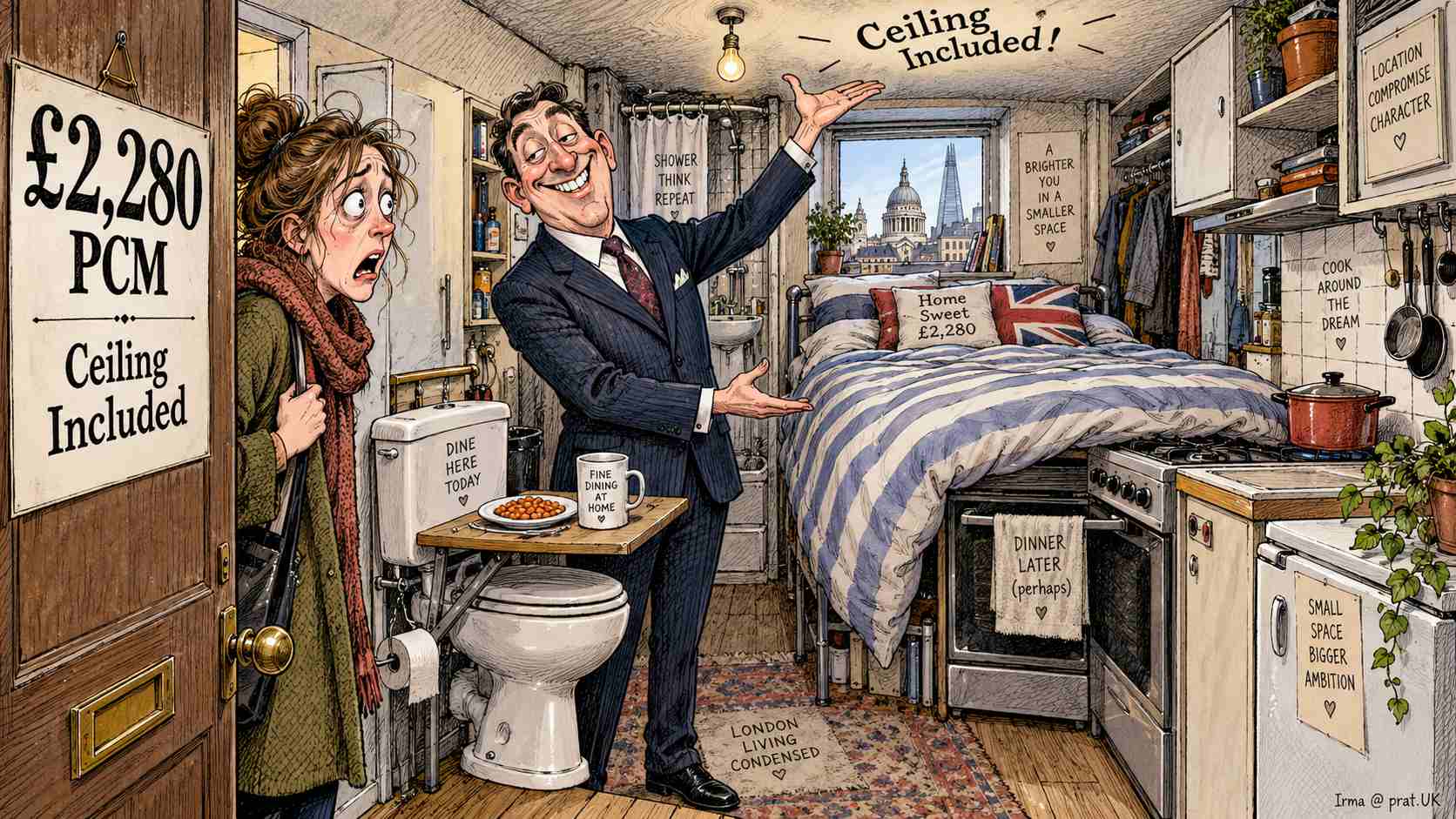
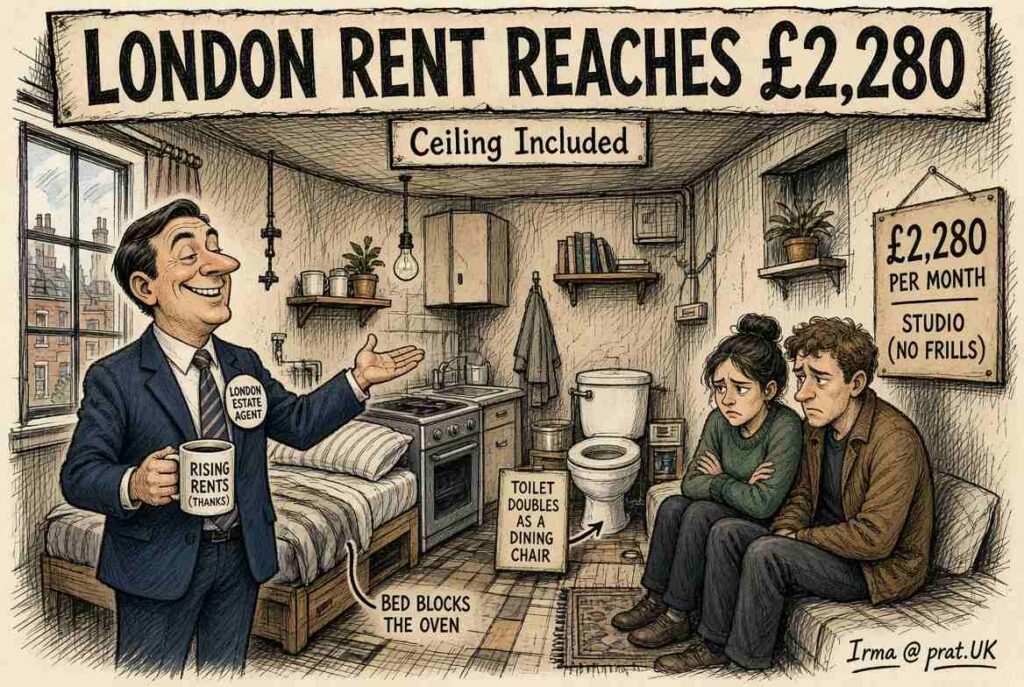
Why Is London So Expensive? Rent Reaches £2,280 a Month as Estate Agents Confirm Ceiling Still Included on Premium Plan
Capital’s landlords unveil revolutionary housing model in which tenants transfer entire salary and receive temporary custody of a radiator
LONDON — Why is London so expensive? Ask any tenant currently transferring most of a salary for the privilege of a postcode. The average monthly private rent in London reached £2,280 in March 2026, according to the Office for National Statistics report on UK rents and house prices, prompting estate agents to reassure anxious tenants that most properties still include walls at no additional charge.

The announcement was welcomed across the property industry as proof that London remains the greatest city in the world in which to earn £3,000 a month and spend £3,400 of it not sleeping outdoors.
“People focus too much on the number,” explained Tarquin Foote-Candle, senior affordability visionary at Foxtrot & Gazump. “For £2,280, the tenant does not merely obtain a flat. They obtain an address, a postcode and the right to tell relatives in Yorkshire that everything is going brilliantly.”
Foote-Candle said the modern London studio should be understood as “an immersive domestic environment.” This is the professional term for a room in which opening the oven prevents access to the bed, while opening the wardrobe may constitute an extension requiring council permission.
One listing in Clapham advertised a “characterful sleeping mezzanine” that eyewitnesses identified as a shelf. The agent rejected that description, noting that the shelf had a pillow, a reading lamp and an asking rent higher than the median income of several European republics.
Tenant Abigail Moss attended a viewing with 46 other applicants, two guarantors and a man carrying what appeared to be a ceremonial deposit.
“The agent said it had excellent natural light,” Moss recalled. “Then he opened the refrigerator. Apparently, the little bulb counts.”
The London Prat conducted a pavement survey of 800 renters waiting to view a converted bin store in Balham. Eighty-seven percent said they would consider leaving London, 11 percent could not answer because the queue had advanced three inches, and 2 percent were estate agents who immediately valued the clipboard at £1,150 per month.
Why Is London So Expensive? Because the Adjectives Got a Pay Rise Too
Housing economist Professor Lionel Alcove, director of the Institute for Monetised Corners, said the market follows a simple law of supply and demand. There is limited supply, enormous demand and an inexhaustible supply of adjectives.
“When square footage falls, descriptive language expands,” Alcove said. “A small room becomes ‘intimate.’ A dark room becomes ‘atmospheric.’ A flat beside a railway becomes ‘exceptionally connected.’ If the roof is missing, it offers uninterrupted skyline views.”
Landlords are now testing flexible pricing. Under one proposal, £2,280 secures the basic property, while windows, hot water and permission to sigh indoors are available through the Platinum Habitation Bundle. Couples may add a second toothbrush for £75 a month, subject to references.
Officials have responded with an Affordable Perspective Scheme, under which renters will be shown photographs of yachts, castles and private islands until the studio seems reasonably priced. Early trials reduced complaints by 14 percent and increased spontaneous weeping by 63 percent.
The cause-and-effect is now clear. High rents force tenants into smaller homes. Smaller homes discourage possessions. Fewer possessions make moving easier. Easier moving allows landlords to raise the rent until tenants move. Economists call this mobility; removal firms call it Tuesday.
Experts recommend that prospective renters prepare carefully. Bring proof of income, six months’ rent, three references, a guarantor, a blood sample and evidence that you have never fried fish. During the viewing, do not ask whether the bedroom fits a bed. This identifies you as difficult and insufficiently imaginative.
There is, however, good news. London house prices have been falling, which means homes are becoming cheaper for everyone who can already afford one and more mysterious for everyone else.
The wider numbers back up the sticker shock. Private rental prices in London have posted the highest annual inflation of any English region, according to the ONS’s own cost of living insights on housing — a distinction the capital has now held for the better part of two decades, and one no estate agent has yet found a flattering adjective for.
For now, tenants are advised to remain positive. A £2,280 flat may feel cramped, but it offers something money cannot buy anywhere else: the privilege of spending almost all your money buying it temporarily. It is, in miniature, why London is so expensive: you are not paying for square footage. You are paying for the postcode, and the postcode does not negotiate.
Why Is London So Expensive? A Field Guide From the People Actually Paying For It
- London rent is no longer a payment for housing; it is a monthly subscription to the possibility of remaining indoors.
- A London “studio” is a room where the bed, cooker and fire extinguisher have agreed to share custody of you.
- Estate agents describe a flat as “well connected” when the front door is close enough to hear three Tube lines failing independently.
- If a cupboard has a window, London property law requires it to be marketed as a one-bedroom apartment with natural light.
- Londoners no longer ask whether they can afford a neighborhood. They ask whether the neighborhood accepts kidneys.
SOURCE: Office for National Statistics, Private rent and house prices, UK: April 2026.

Disclaimer
The rent figures and ONS regional data cited above are real. The named professionals, quoted tenants, viewing anecdotes, pricing bundles and government schemes are satirical inventions. This story is entirely a human collaboration between two sentient beings — the world’s oldest tenured professor and a philosophy major turned dairy farmer.
Satire survives online largely because UK humor travels well without translation, built as it is on universal targets: landlords, politicians and public transport. British satire found a natural home on the internet, where a fake headline can outrun the real story it is mocking within hours. English Comedy supplies the voice — dry, self-aware, faintly exasperated — while the format has simply changed from newsprint to a scrolling feed. London Satire keeps a foothold too, proving that a joke about a delayed Tube line or a 25-year council consultation still reads exactly the same whether printed in 1961 or published this morning.

Alan Nafzger was born in Lubbock, Texas, the son Swiss immigrants. He grew up on a dairy in Windthorst, north central Texas. He earned degrees from Midwestern State University (B.A. 1985) and Texas State University (M.A. 1987). University College Dublin (Ph.D. 1991). Dr. Nafzger has entertained and educated young people in Texas colleges for 37 years. Nafzger is best known for his dark novels and experimental screenwriting. His best know scripts to date are Lenin’s Body, produced in Russia by A-Media and Sea and Sky produced in The Philippines in the Tagalog language. In 1986, Nafzger wrote the iconic feminist western novel, Gina of Quitaque. He currently lives in Holloway, North London. Contact: [email protected]