Why Is London So Expensive? TfL Lists Nine Troubled Lines and Still Finds Good Service Everywhere That Hasn’t Filed a Complaint
London transport achieves operational excellence by placing the words “good service” immediately beneath a list of everything currently going wrong
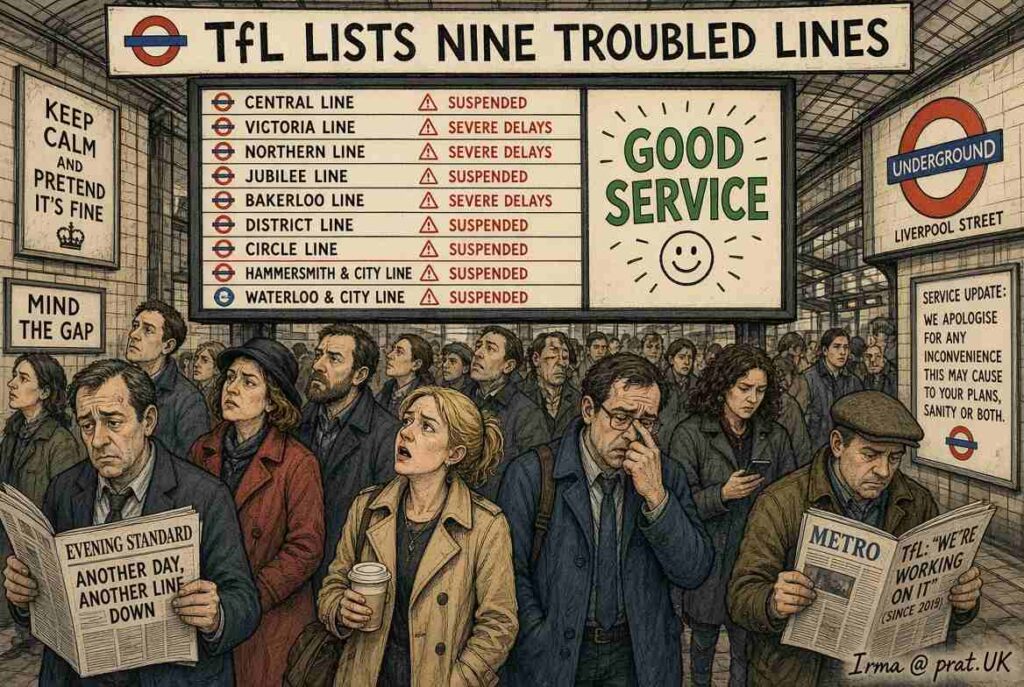
LONDON — Why is London so expensive? Factor in the cost of a transport network that charges full fare to stand still. Transport for London’s live board on September 13 displayed severe delays, suspensions, closures or lesser disturbances across a substantial collection of lines, before offering the soothing verdict “good service on all other lines” through the official TfL status page, a phrase Londoners recognize as both transport information and an advanced exercise in emotional resilience.
The Central and Elizabeth lines reported severe delays. The District line managed a part suspension, part closure and minor delays, completing the transport equivalent of suffering a cough, a broken leg and low confidence simultaneously. The Circle, Hammersmith & City, Mildmay, Suffragette, Waterloo & City and Bakerloo lines also contributed difficulties, ensuring disruption remained geographically inclusive.
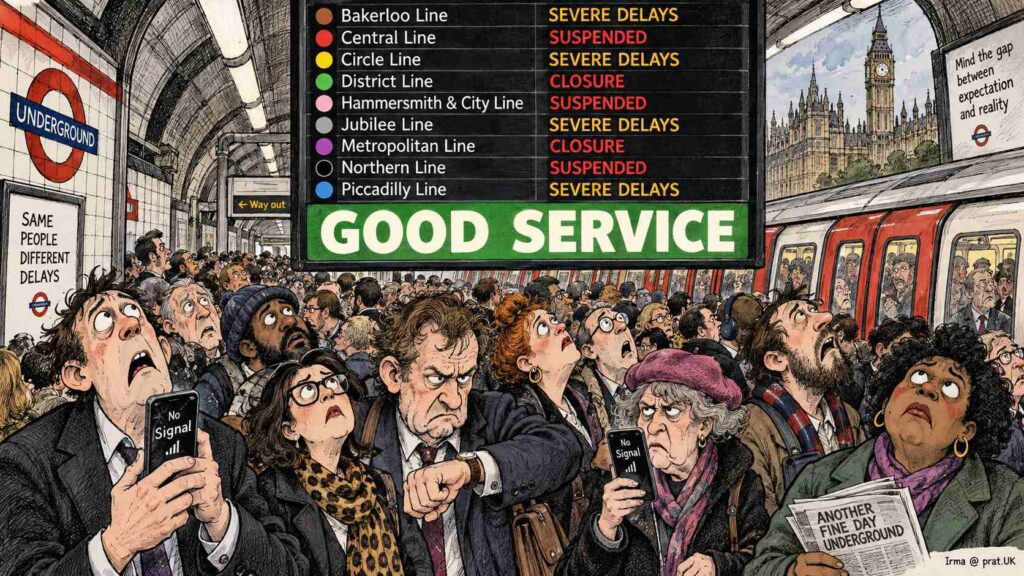
TfL stressed that the network was functioning normally wherever it was functioning normally, a standard of success also used by restaurants that announce every table except the burning ones remains available.
“Good service does not necessarily mean you are going anywhere,” explained Dr. Miles Behind, professor of Applied Waiting at King’s Cross University. “It means the delay has not yet developed sufficient self-esteem to become severe.”
The definition is important. A minor delay is any interruption during which passengers retain hope. A severe delay begins when commuters establish a provisional government on the platform. A part suspension means the train exists, but only in a part of London where you are not.
At Ealing Broadway, eyewitness Priya Shah said she had been advised to take an alternative route.
“TfL suggested a bus, then another bus, then a twelve-minute walk, then a replacement service, then a quiet period of reflection,” she said. “The journey planner did not get me to work, but it did help me process why I no longer care.”
Another passenger, Martin Phelps, said the phrase “good service” had become deeply personal. “My line was delayed, the platform was packed and the next train disappeared from the board. But somewhere, apparently, a tram was having a lovely day. I was pleased for it.”
A London Prat poll found 72 percent of commuters define good service as “arriving on the same date,” 18 percent define it as “not being asked to change at Whitechapel,” and 10 percent were trapped in a tunnel and therefore represented London’s most statistically stable sample.
Why Is London So Expensive? Because Reliability Is Apparently Optional
Transport behavioral specialist Fenella Gap-Minder said regular disruption produces valuable civic benefits. Delayed passengers develop patience, calf strength and the ability to interpret a station announcement recorded inside a saucepan.
“Without the Underground,” she said, “Londoners might accidentally make eye contact. The network protects social order by ensuring everyone is too busy staring furiously at the departure board.”
Officials are reportedly considering a clearer classification system. “Good service” would mean trains are moving. “Minor delays” would mean yours is not. “Severe delays” would mean the staff have begun recommending pubs. “Part closure” would mean London still possesses stations, but not in a useful sequence. “Planned closure” would mean TfL knew before you did and has therefore fulfilled its statutory duty.
Passengers can take practical precautions. Leave home yesterday. Carry water, snacks, comfortable shoes and a small card explaining to employers that a signal failure at Earl’s Court is now your legal guardian. Never stand on the left of an escalator unless you wish to learn how quickly British reserve can become frontier justice.
The system remains a marvel. Millions descend each day into narrow tunnels, board metal tubes and emerge beneath offices they cannot afford to live near. Most arrive. Many arrive approximately. All acquire a story involving Bank station and a corridor that appears to cross Belgium.
The disruption is not a one-day anomaly, either. TfL’s own Underground performance reports, published via the London Datastore, track lost customer hours across the network period by period — a running receipt for exactly how much of every commute is spent not moving, going back to 2002.
By evening, TfL’s status may improve. It may worsen. It may fail to load and advise users that service information is out of date, thereby achieving perfect synchronization between the website and the trains. Which is, in the end, another reason London is so expensive: you pay for the whole day, and the network only delivers the parts of it that are not currently on fire.
Why Is London So Expensive? The Tube Edition
- “Good service” on the Underground means the train is moving, the doors are attached and the driver has not begun negotiating directly with the passengers.
- Every Tube delay is caused by either leaves, heat, rain, signals or a passenger becoming emotionally attached to a closing door.
- The phrase “minor delays” covers everything from four minutes late to your children finishing university before you reach Bank.
- London commuters can identify twelve types of silence, including “earbuds silence,” “someone is eating tuna silence” and “we are stopped between stations and nobody wants to ask why silence.”
- The Elizabeth line looks like the future until a signal fails, at which point the future advises changing at Stratford.
SOURCE: Transport for London live service information, accessed September 13, 2026.

Disclaimer
The TfL line-status details and performance-data reference cited above are real. The named professors, polls, quoted passengers and reclassification scheme are satirical inventions. This story is entirely a human collaboration between two sentient beings — the world’s oldest tenured professor and a philosophy major turned dairy farmer.
Good satire rarely shouts; it simply describes reality with a completely straight face and lets the absurdity do the shouting instead. UK humor tends to favour understatement over outrage, a euphemism over a headline. British satire has long relied on invented experts, fake surveys and quoted eyewitnesses who sound suspiciously reasonable while saying something ridiculous. English Comedy adds timing: the pause before the punchline, the deadpan aside, the joke delivered as though it were simply the news. London Satire, meanwhile, keeps one eye permanently on the capital’s institutions, because nothing writes itself quite like a council meeting or a royal statement.

Alan Nafzger was born in Lubbock, Texas, the son Swiss immigrants. He grew up on a dairy in Windthorst, north central Texas. He earned degrees from Midwestern State University (B.A. 1985) and Texas State University (M.A. 1987). University College Dublin (Ph.D. 1991). Dr. Nafzger has entertained and educated young people in Texas colleges for 37 years. Nafzger is best known for his dark novels and experimental screenwriting. His best know scripts to date are Lenin’s Body, produced in Russia by A-Media and Sea and Sky produced in The Philippines in the Tagalog language. In 1986, Nafzger wrote the iconic feminist western novel, Gina of Quitaque. He currently lives in Holloway, North London. Contact: [email protected]