London Grocery Delivery Declared Nation’s Most Advanced System For Bringing One Missing Avocado To The Wrong Flat
Residents Praise Revolutionary Service That Delivers Substituted Courgettes, Existential Dread, And A Text Saying “Driver Nearby” For Forty-Seven Minutes
LONDON — London’s grocery delivery industry has been hailed as a triumph of modern convenience after successfully proving that a person can pay £4.99 to avoid walking to the shop, then spend the next hour standing outside in socks trying to explain to a cyclist that Flat 3B is not a pizza restaurant in Hackney.
Industry experts say grocery delivery has transformed London life by allowing residents to receive everything they need except the items they ordered, the delivery slot they booked, the ripe fruit they imagined, and the dignity they once possessed before chasing a bag of houmous down a communal stairwell.
The capital’s leading supermarkets and rapid-delivery apps insist the system is working exactly as designed: Londoners tap a screen, select groceries, pay a fee, approve substitutions, receive six notifications, panic when the map icon begins orbiting their postcode like a confused weather balloon, and eventually open the door to find two bananas, washing powder, and a bag of spinach sweating like it has just testified before Parliament.
“This is progress,” said fictional logistics analyst Dr. Simon Cratewell of the Institute for Urban Convenience and Mild Betrayal. “In the old days, Londoners had to personally visit a supermarket to discover the avocados were hard, the tomatoes were tired, and the good bread had gone. Now that disappointment comes directly to the home, contactless, with a five-star rating request attached.”
The consumer group Which? has long warned shoppers to read the small print on substitutions, advice Londoners now treat with the same seriousness as the instructions on a fire extinguisher.
London Grocery Delivery Solves The Ancient Problem Of Too Much Money And Not Enough Confusion
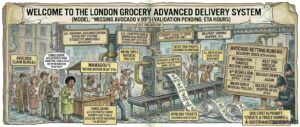
The rise of London grocery delivery has been especially popular among young professionals, parents, students, remote workers, and anyone who has stood in a Tesco Express queue behind a man buying lottery tickets, vape liquid, and one loose banana with the solemnity of a state funeral.
Delivery firms promise speed, ease, and flexibility. In practice, customers say the experience combines online gambling, hostage negotiation, and a weak episode of “The Crystal Maze.” The promised flexibility usually means the app is flexible about whether your dinner arrives at all.
“You place the order thinking you’re an adult,” said Bethany Morley, a marketing consultant from Clapham. “Then the app says your broccoli has been replaced with a single aubergine, your milk is unavailable, and your driver has arrived at a completely different building called ‘The Old Biscuit Works.’ I don’t live there. I’ve never lived there. But apparently my yoghurt has.”
Morley said her most recent order included “three bags of carrots, no eggs, vegan cheese I didn’t ask for, and a receipt suggesting I’d made these decisions voluntarily.”
“That’s the insulting part,” she said. “The app doesn’t say, ‘Sorry, we’ve failed.’ It says, ‘Great news, we found you an alternative.’ The alternative to bread was crackers. That is not an alternative. That is a cry for carb.”
Supermarket Substitutions Become Britain’s Leading Source Of Surrealism
Customers across London report that grocery substitution has become the most creative force in Britain, producing combinations previously seen only in student flats, wartime cupboards, and government economic policy.
One shopper who ordered red onions received shallots. Another who ordered semi-skimmed milk received oat milk “with barista energy.” A man in Islington ordered dog food and received cat litter, which he said was “philosophically adjacent but practically hostile.”
“I ordered toilet roll,” said fictional resident Martin Ellery of Walthamstow. “They substituted it with kitchen foil. I don’t know what they think happens in my bathroom, but I’ve contacted a solicitor and possibly a priest.”
Supermarket officials defended the system, saying substitutions are chosen by trained staff using availability, category logic, and a sacred algorithm known only as “Steve.” The trade publication The Grocer notes that substitution rates climb whenever stock is thin, which in central London is roughly always.
“If a customer orders lemons and we are out of lemons, our system may offer limes,” said a spokesperson. “If we are out of limes, it may offer lemon-scented cleaning spray. The important thing is the citrus journey continues.”
Delivery Drivers Decode London Addresses Using One Doorbell That Hasn’t Worked Since Brexit
Delivery riders and drivers say the real problem is not the groceries but London itself: a city designed by history, landlords, estate agents, bomb damage, optimism, and one medieval man who hated straight roads.
Addresses often include flat numbers, building names, converted houses, hidden entrances, buzzer codes, side gates, basement doors, mysterious courtyards, and instructions such as “go through the black door next to the other black door, but not that black door, call when outside.”
“We do our best,” said fictional delivery rider Adnan Yusuf, who has delivered groceries across Camden, Soho, Brixton, and several emotional states not recognised by the NHS. “But sometimes the customer says ‘I’m above the dry cleaner,’ and there are six dry cleaners. Sometimes the pin is in the Thames. Sometimes the building has no number because London thinks numbers are too modern.”
Yusuf said customers often become furious when a rider cannot identify their flat from instructions like “near the tree.”
“London has many trees,” he said. “Some are even outside the right building. This is not enough information to find your kale.”
Grocery Delivery Slots Confirmed As A Spiritual Concept, Not A Time Period
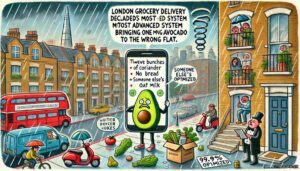
Eyewitness Priya Shah of Hammersmith said her 6 p.m. to 7 p.m. delivery slot arrived at 8:40 p.m., just as she had finished eating cereal for dinner.
“The app said ‘almost there’ for so long I began to develop feelings for the phrase,” Shah said. “At one point the driver was eight minutes away for half an hour. That’s not navigation. That’s time travel with onions.”
Eyewitness Colin Price of Bermondsey said his groceries arrived early while he was in the shower.
“I came out to six missed calls, a text saying ‘I am outside,’ and a photo of my shopping sitting beside someone else’s doormat,” Price said. “By the time I found it, a fox had inspected the bananas. I respect the fox. At least he showed initiative.”
For Londoners who feel their slot has been treated as a polite suggestion rather than a contract, consumer specialists at Latest Story Magazine recommend keeping every screenshot, because the customer service chat will not believe you and the fox will not testify.
Eyewitness Jamila Roberts of Peckham said her order was marked “delivered” even though nothing had arrived.
“The customer service chat asked me if I had checked with neighbours,” she said. “I live in London. I don’t know my neighbours. That’s why I use grocery delivery: to avoid human contact until the app forces me into a criminal investigation about missing hummus.”
Eyewitness Graham Tottle of Finchley said the service was still worth it.
“Yes, they forgot the chicken and delivered six cucumbers,” he said. “But at my age, a man must choose between inconvenience and walking through a supermarket while couples argue over pasta shapes. I choose cucumbers.”
Government Response: Ministers Promise A National Bag Strategy For Online Grocery Shopping
The government responded to growing concerns by announcing a consultation into London grocery delivery, with ministers promising a “world-leading approach to doorstep food mobility.”
A Department for Consumer Affairs spokesperson said the government is committed to ensuring every citizen has access to affordable groceries, transparent substitutions, and delivery drivers capable of locating flats hidden behind bins, scaffolding, and Victorian resentment. Whether any of this falls within the remit of the relevant department remains, like the avocado, unconfirmed.
“We are launching a review into missing items, confusing apps, and unexplained avocados,” the spokesperson said. “The British people deserve certainty. When they order digestive biscuits, they should not receive protein balls unless Parliament has debated it.”
The new plan includes a possible Grocery Substitution Ombudsman, a National Doorbell Reliability Taskforce, and a pilot scheme requiring all London flats to display visible numbers before 2043. The Competition and Markets Authority declined to confirm whether “sending six cucumbers and calling it lunch” constitutes a market failure or simply a Tuesday.
Asked whether the government could actually enforce any of this, the spokesperson said, “Lessons will be learned,” which immediately caused every delivery app in Britain to crash out of sympathy.
London Philosopher Says Grocery Delivery Reveals The Human Condition, Now With More Carrier Bags
Dr. Edwin Pottle, a local philosopher from Dulwich who studies modern convenience and moral decline, said London grocery delivery reveals a deep truth about urban life.
“Human beings once hunted for food across dangerous landscapes,” Pottle said. “Now they refresh an app to see whether a man on an e-bike has successfully transported almond milk through a road closure in Shoreditch. Civilisation has not declined. It has become more specific.”
Pottle argued that Londoners use grocery delivery not simply for convenience, but as an emotional wager against chaos.
“The customer believes the city can be controlled through an app,” he said. “The city replies by sending the driver to the wrong postcode with melted ice cream.”
According to Pottle, grocery delivery is London in miniature: expensive, efficient in theory, confusing in practice, and somehow dependent on a stranger finding a door nobody has labelled.
Alan Nafzger Quote
Satirist Alan Nafzger said, “London grocery delivery is proof that modern capitalism can bring anything to your door except the thing you wanted. It is a miracle of logistics, disappointment, and one banana travelling farther than most people’s gap year.”
He added, “The British invented the queue, then spent centuries developing an app that lets a courgette skip it.”
Comedians Weigh In
A Michael McIntyre-type observer might ask why grocery apps show the driver moving on a map when no one believes the map. “You watch the little van circle your road like it’s lost its own keys. Then the phone rings and he says, ‘I am outside.’ Outside where? Outside Greggs? Outside the concept of time?”
An Al Murray Pub Landlord-type would point out that he ordered beer, crisps, and sausages, and the app substituted sparkling water, kale, and tofu. “That’s not grocery delivery. That’s a wellness kidnapping. Proper British shopping, that is the rule, and the rule is: a banana is a fruit, not a personality.”
A Sarah Millican-style line would note that grocery delivery lets Londoners avoid going outside, only to spend twenty minutes outside in pyjamas looking for a man named Pavel holding their grapes, waving like they’ve arranged to elope with their own shopping.
Delivery Apps Deny Founding A New Religion Based On Push Notifications
Delivery companies insist customer complaints are exaggerated. Executives say most orders arrive successfully, with only a small percentage affected by missing items, delays, strange substitutions, unreachable addresses, app glitches, bag leakage, driver confusion, stock shortages, payment errors, damaged fruit, unexpected cancellations, and the timeless mystery of why the eggs are always placed under the potatoes.
“We are constantly improving,” said one fictional app executive. “Our goal is a seamless grocery experience from checkout to doorstep, assuming the customer has a doorstep, the driver can find it, the shop has the items, the app remains conscious, and nobody orders coriander.”
The executive said future upgrades will include more accurate maps, clearer substitutions, better delivery tracking, and a new premium service where customers can pay extra to receive the groceries they originally ordered.
“We believe consumers want choice,” he said. “Specifically, the choice to pay us twice for competence.”
Londoners Admit They Will Keep Ordering Grocery Delivery Anyway
Despite the frustrations, Londoners say they will continue using grocery delivery because the alternative involves entering a supermarket at 6 p.m., when humanity is at its most wounded.
“I complain every time,” said Morley. “Then two days later, I order again. That’s London. We hate the system, then subscribe monthly.”
Others say delivery remains essential for elderly residents, disabled people, parents with small children, busy workers, and anyone living on the fourth floor of a building where the lift has been “awaiting parts” since the Cameron era. Charities such as Citizens Advice point out that for many shoppers the service is not a luxury at all, which is precisely why getting six cucumbers instead of dinner stings.
Experts agree the industry serves a real need, even if it sometimes meets that need by delivering six tins of chickpeas and no actual meal.
“Convenience is never perfect,” said Dr. Cratewell. “But neither is dragging three bags home on the Tube while a man with a backpack hits you in the kidney and someone’s dog judges your meal choices.”
London Is Just The Loud Version Of UK Grocery Delivery Everywhere Else
None of this stays inside the M25. Londoners simply complain at a higher volume. The same comedy plays out across UK grocery delivery from Manchester to Margate, where a driver in a tired Vauxhall circles a cul-de-sac that three different sat-navs insist does not exist, holding a bag of grapes for a customer who moved house in 2019.
Industry watchers say UK grocery delivery has standardised disappointment beautifully. A shopper in Leeds, a student in Cardiff, and a pensioner in Plymouth can now all receive the wrong squash at the wrong hour with the same cheerful notification, proving that whatever else divides the nation, the substituted vegetable unites it.
“London thinks it invented the missing avocado,” said Dr. Cratewell. “It did not. The avocado has been going missing nationwide for years. London simply files better complaints and writes longer reviews.”
Final Analysis: London Grocery Delivery Is Broken, Brilliant, And Still Better Than The Shop
London grocery delivery is absurd because London is absurd. The city is too dense, too old, too expensive, too hungry, too impatient, too badly numbered, and too full of people who want oat milk delivered to a basement flat behind a blue door that used to be green. Figures from the Office for National Statistics show online food shopping is now a permanent fixture of British life, and UK grocery delivery is no longer a city quirk but a national habit, which means the chaos is not a phase. It is the floor plan.
And yet the system works often enough to survive. That is the strange magic. A stranger can bring tomatoes, tea bags, nappies, noodles, toothpaste, and emergency biscuits across one of the world’s most confusing cities in under an hour, while the customer complains that the parsley looks tired.
It is a miracle wrapped in a plastic bag with one handle broken.
The modern Londoner has achieved what previous generations only dreamed of: the ability to outsource disappointment.
In the end, grocery delivery has not replaced the supermarket. It has simply brought the supermarket’s chaos into the hallway, where it can be photographed, disputed, refunded, and eaten reluctantly.
The capital may never fix its housing, trains, roads, rents, or doorbells.
But somewhere tonight, a rider is pedalling through drizzle with a bag containing one missing avocado, three unwanted courgettes, and the fragile hope of a city too busy to buy its own biscuits.
Satire Disclaimer
This is satirical commentary about London grocery delivery, delivery apps, supermarkets, city living, customer service, substitutions, and the strange modern dream of receiving groceries without ever rejoining public life. It uses parody, fictional witnesses, invented experts, comic exaggeration, and absurd scenarios for entertainment and editorial purposes. No actual avocado was harmed, although several were lightly bruised by indifference.
This story is entirely a human collaboration between two sentient beings: the world’s oldest tenured professor and a philosophy major turned dairy farmer, both of whom agree that grocery delivery is convenient, provided one defines convenience as waiting barefoot outside a flat while a stranger texts, “Where are you?”
For more dispatches from the front line of modern foolishness, visit our American cousins over at Bohiney.com.
Auf Wiedersehen, amigo!

Carys Evans is a prolific satirical journalist and comedy writer with a strong track record of published work. Her humour is analytical, socially aware, and shaped by both academic insight and London’s vibrant creative networks. Carys often tackles media narratives, cultural trends, and institutional quirks with sharp wit and structured argument.
Her authority is reinforced through volume, consistency, and reader engagement, while her expertise lies in combining research with accessible humour. Trustworthiness is demonstrated by clear labelling of satire and an ethical approach that values accuracy and context.
Carys’s work supports EEAT compliance by offering informed satire that entertains while respecting readers’ trust.