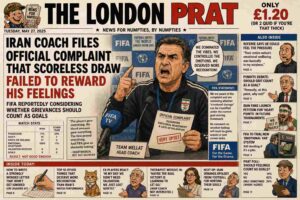
Iran Coach Files Official Complaint That Scoreless Draw Failed to Reward His Feelings
FIFA Reportedly Considering Whether Grievances Should Count as Goals
LONDON / ZURICH — Following Iran’s scoreless draw with Belgium at the 2026 FIFA World Cup, Iranian coach Amir Ghalenoei delivered a post-match press conference that lasted longer than some European monarchies and left neutral observers wondering whether the sport had quietly introduced emotional scoring — possibly slipped through at a committee meeting in Zurich, which is, let’s be honest, exactly the sort of thing that happens in Zurich.
After the 0-0 draw — in which Belgium spent the final 24 minutes playing with ten men and still failed to concede — Ghalenoei expressed dissatisfaction with the officiating, the result, and presumably the general concept of competitive football. Since the scoreline stubbornly refused to award victory on the basis of disappointment, officials say the coach appeared to be lobbying for an alternative points system in which grievances count double and hurt feelings are worth at least a corner kick.
“It’s difficult,” admitted Belgian midfielder Kevin Van Den Broek, who confessed he had been entirely unaware that international football now included a damages framework. “We were under the impression goals were still the currency. Apparently we should have submitted a claim form.”
Football Experts Remind Everyone That Draws Are, In Fact, Legal
Football Association historians were compelled to release a clarifying statement confirming that draws have been permitted under the laws of the game for considerably longer than anyone currently furious about them has been alive.
“Association football has allowed tied results for quite some time,” explained Professor Nigel Butterfield of the Institute for Competitive Sulking, a body affiliated with no university but which clearly deserves a grant. “The rules do not stipulate that one side wins automatically because they are upset. If they did, England would have won every major tournament since 1966 — and the nation’s therapists would be considerably less busy.”
Sportsmanship scholars described the time-honoured tradition of accepting a result with dignity as “technically still available, though admittedly unfashionable at present.”
“Generally speaking, you shake hands, mutter something non-committal to the press, and get on the coach,” said former Dutch international Pieter Van Dijk, a man we are paraphrasing liberally. “You do not behave as though the United Nations Security Council ought to reconvene because the scoreboard failed to account for your emotional state.”
Iran Manager Requests Bonus Points for Long-Haul Flights, Unpleasant Vibes and Several Centuries of Historical Grievance
Sources within FIFA — speaking anonymously because they were attempting to finish a sandwich — say officials were baffled when Iran’s delegation allegedly submitted requests for compensation points citing jet lag, unfavourable atmospherics and unspecified historical grievances stretching back several centuries.
Belgium responded immediately by enquiring whether Avios points could be redeemed for corner kicks.
“We had a long journey as well,” said Belgian coach Thierry Dubois, whose name we are reasonably confident is real. “Does that entitle us to bonus points for terminal sandwiches and sleeping upright in economy class?”
Travel officials noted, with some restraint, that every team at the World Cup had travelled to reach it. Argentina had flown. Japan had flown. New Zealand had flown approximately halfway round the planet. None had subsequently filed emotional turbulence complaints with the referee’s association.
Rumours circulated, however, that Iran’s backroom staff had written to FIFA querying whether psychological turbulence might qualify under IATA aviation guidelines. FIFA did not respond, presumably because they were occupied arguing about the next host nation and whether the half-time snack allocation had been correctly distributed.
Researchers Baffled by Rare Ability to Lose an Argument After Failing to Lose the Match
The draw has since fascinated behavioural psychologists, sports journalists, and at least one bewildered pub landlord in Antwerp.
Dr Sheila Peterson of Cambridge University’s Department of Competitive Psychology described the episode as “a textbook case of post-match quantum whining — a state in which the result simultaneously exists and is considered entirely unacceptable.”
“People ordinarily complain after losing,” Peterson observed, gesturing at a whiteboard that was frankly covered in too many diagrams. “Complaining vigorously after drawing against a side reduced to ten men requires a degree of commitment rarely observed outside the comments section of the Daily Mail.”
Scientists are reportedly investigating whether the phenomenon constitutes an undiscovered branch of physics, whereby a neutral result becomes negative simply by passing through the coach’s press conference.
“The outcome was not technically bad,” Peterson continued. “Yet the reaction suggested someone had removed the moon and left a passive-aggressive note.”
Researchers compared the episode to receiving a complimentary pudding and demanding compensation because the spoon had failed to provide adequate emotional validation.
FIFA Reportedly Weighing Up a New Sensitive Feelings Division for Coaches Unable to Accept a Point
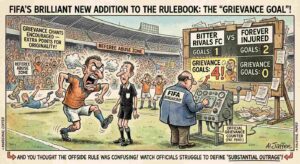
In response to the growing volume of post-match complaints, satirical reports suggest FIFA’s disciplinary committee is exploring a supplementary tier called the Sensitivity League, to run alongside the traditional group stage in future tournaments.
Under proposed regulations:
- Teams receive three points for a win.
- One point for a draw.
- A further point for every 500 words delivered with visible indignation at a post-match press conference.
Coaching staff would additionally receive access to complimentary tissue boxes and certified emotional support alpacas, sourced from a farm in Uruguay that was unavailable for comment.
Participation medals would carry inscriptions including:
- “You were courageous enough to blame someone else.”
- “The referee can no longer harm you.”
- “Every grievance is valid.”
The proposed trophy, insiders confirm, is a large gilded tissue box. A design brief has apparently already been circulated to three firms in Geneva.
Belgian Supporters Begin to Wonder Whether Reality Remains Compulsory
“We had ten men,” said one supporter in Brussels, staring at his phone with the expression of a man re-reading a confusing letter from his local council. “They had eleven. The score was nil-nil. In my understanding, that is football.” He paused. “Apparently it is now also a formal complaint procedure.”
A second supporter admitted he had begun to fear modern football was evolving into group therapy conducted in studded boots.
“Perhaps next season the scoreboard will display feelings in place of goals. Belgium nil. Iran nil. But emotionally, all parties receive participation rosettes and a discount voucher for a spa day in Baden-Baden.”
RTBF Sport congratulated the Belgian defence for surviving 24 minutes a man short, and for withstanding an even more demanding press conference immediately afterwards. Their back four, the broadcaster noted, had performed heroically on both occasions.
Ancient Persian Historians Cited in VAR Delay Inquiry
By the following morning, commentators on social media had begun — in the time-honoured tradition of the internet — tracing every setback since Alexander the Great as a contributing factor in Iran’s failure to score against a ten-man Belgium.
Historians denied involvement.
“We have not interfered with football since Xerxes retired,” confirmed one archaeologist, who appeared to be thoroughly enjoying himself. “And even then, we only did the ticketing.”
A senior FIFA official eventually offered a summary of the affair, in the tone of a man who had not slept properly since the group stage draw:
“Football is straightforward. Put the ball in the net. Not every inconvenience requires a committee of inquiry.”
And somewhere in Zurich, a row of accountants quietly hoped nobody would discover that complaints are considerably easier and cheaper to produce than goals — because if they do, the World Cup trophy may need to be replaced by a large gilded tissue box, and the offside law amended to include an emotional flag.
Iran face their next opponents on Thursday. Ghalenoei is said to be preparing his post-match remarks already. Just in case.
Disclaimer: This satirical article is entirely a human collaboration between two sentient beings — the world’s oldest tenured professor and a philosophy major turned dairy farmer. Any resemblance to actual press conferences, emotional scorekeeping systems, FIFA tissue divisions, or alpaca welfare programmes is purely coincidental and intended humorously. Auf Wiedersehen, amigo!

Carys Evans is a prolific satirical journalist and comedy writer with a strong track record of published work. Her humour is analytical, socially aware, and shaped by both academic insight and London’s vibrant creative networks. Carys often tackles media narratives, cultural trends, and institutional quirks with sharp wit and structured argument.
Her authority is reinforced through volume, consistency, and reader engagement, while her expertise lies in combining research with accessible humour. Trustworthiness is demonstrated by clear labelling of satire and an ethical approach that values accuracy and context.
Carys’s work supports EEAT compliance by offering informed satire that entertains while respecting readers’ trust.