Labour Insists Extremists Do Not Influence Government Policy, Immediately Announces Policy Extremists Have Been Demanding
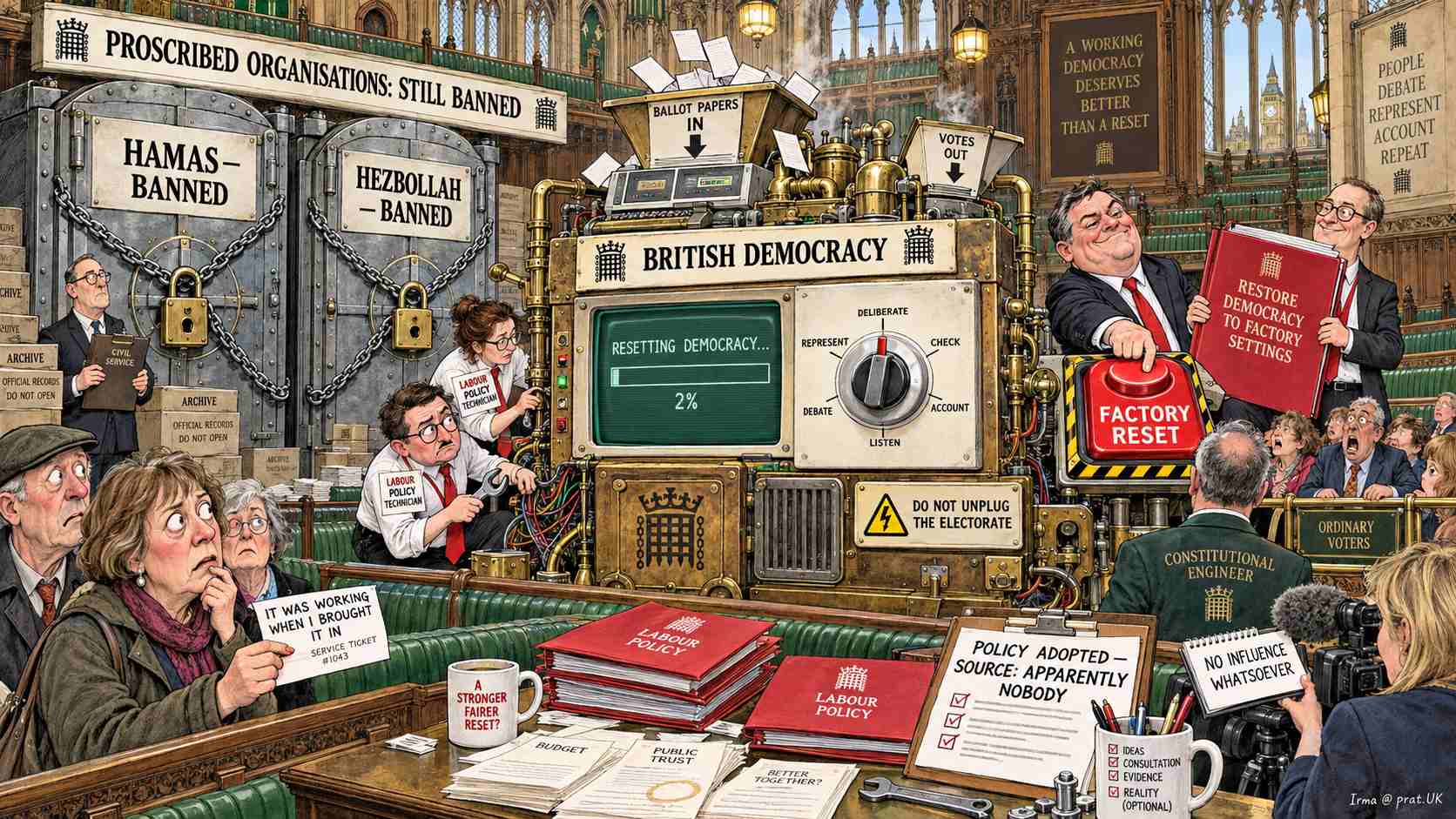
Hamas Stays Banned, Hezbollah Stays Banned, and Labour Policy Somehow Concludes the Democracy Is the Appliance Needing Factory Settings
Britain has entered a bold new era of Middle East diplomacy in which Hamas remains a proscribed terrorist organisation, Hezbollah remains a proscribed terrorist organisation, Iran-linked hostile groups remain a standing national-security concern, and Labour policy has nevertheless concluded that the institution most urgently requiring a comprehensive reset is Israel.
The underlying news is real enough to make the satire almost redundant. Foreign Secretary Ed Miliband told the Commons that the Government intends a comprehensive reset of British policy toward Israel, particularly on West Bank settlements and on whether British companies should be financing, constructing or advertising them. Israel’s Foreign Minister Gideon Saar replied with admirable economy: if Britain acts against Israel, Israel will act against Britain.
So Britain has finally achieved the diplomatic sophistication traditionally associated with a divorced couple arguing through their solicitors.
Labour Policy Now Arrives Pre-Chanted
Ministers insist, with the wounded dignity of a man denying he checked his phone during a funeral, that extremists have no influence whatsoever on Labour policy. This is stated firmly. It is stated repeatedly. It is stated roughly forty minutes before the Government announces the exact measure that has been demanded outside Parliament every Saturday since roughly the invention of the loudhailer.
Britain once measured public opinion with elections, polling and select committees. The modern system adds decibels. A protest containing drums automatically receives an additional three constituencies. A man with a megaphone becomes a junior minister. Two megaphones constitute a select committee of one, which is technically a monologue with quorum.
Nobody in Whitehall is bribed. That would be crude, and also traceable. What happens instead is subtler and far more British. Officials simply discover, upon careful reflection, that the policy they were always going to adopt happens to coincide precisely with the policy that stops people shouting at them. This is not capitulation. This is listening, and listening is free.
Hamas Remains Proscribed, Which Complicates Labour Policy Considerably
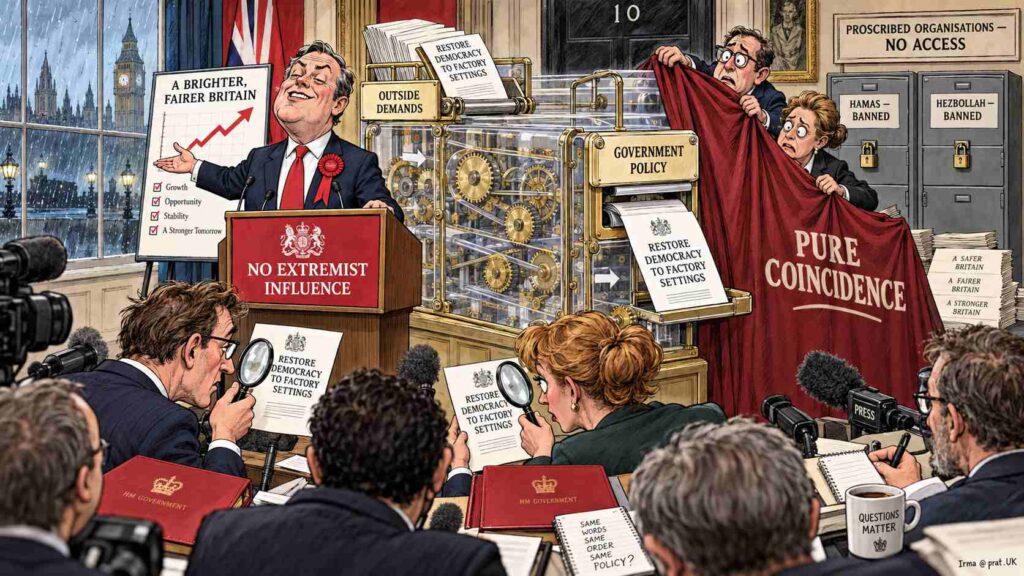
The Home Office continues to list Hamas among proscribed terrorist organisations, and proscription was extended to Hamas in its entirety in 2021. The Government has since rejected an application to remove it from the list.
This creates an administrative problem of some elegance. How can Britain treat Hamas as a criminal organisation while conducting domestic politics in an atmosphere where any sufficiently loud demonstration appears capable of generating a ministerial statement before lunch?
Officials have reportedly solved this philosophically.
“You must distinguish between supporting Hamas and supporting policies Hamas would find extremely encouraging,” explained Professor Cedric Wobblebottom of the Institute for Advanced Distinctions Nobody Previously Needed. “It is technically very different.”
He demonstrated with biscuits. “This biscuit represents Hamas.” He ate it. “This biscuit represents Hezbollah.” He ate that too. “And this empty plate represents Britain’s coherent Middle East strategy.”
The analogy received immediate funding, a research assistant, and a three-year grant to investigate whether the plate identifies as a saucer.
Hezbollah Is Still Banned, But Labour Policy Prefers the Reachable Defendant
Hezbollah might reasonably feel slighted. Britain proscribed the organisation in its entirety in 2019, condemns its attacks, and says it must disarm. All perfectly clear.
Yet British politics has grown an extraordinary rhetorical ecosystem in which the democratically elected state being attacked by Hamas, Hezbollah and assorted Iranian proxies frequently requires more public explanation for defending itself than those organisations require for attacking it. It is the geopolitical equivalent of a pub fight where the barman keeps asking the man being punched whether he has considered de-escalation. “Sir, could you possibly lower your defensive cheekbone.”
The reason is not mysterious, and it is not theological. Millions of British Muslims have precisely nothing to do with Hamas or Hezbollah, and pretending otherwise would be both inaccurate and spectacularly lazy. The real explanation is duller and funnier. Israel has an embassy. Israel answers correspondence. Israel can be sanctioned during office hours. Terrorist organisations have appalling customer service and no postcode.
The Comprehensive Reset Is Labour Policy by Router
Miliband told MPs the Government is examining Britain’s wider economic relationship with the occupied territories and wants to stop British firms financing, building or advertising new settlements. Politically this is the dream: a policy that sounds enormous while permitting every awkward detail to be announced later, ideally on a Thursday, ideally during a cricket match.
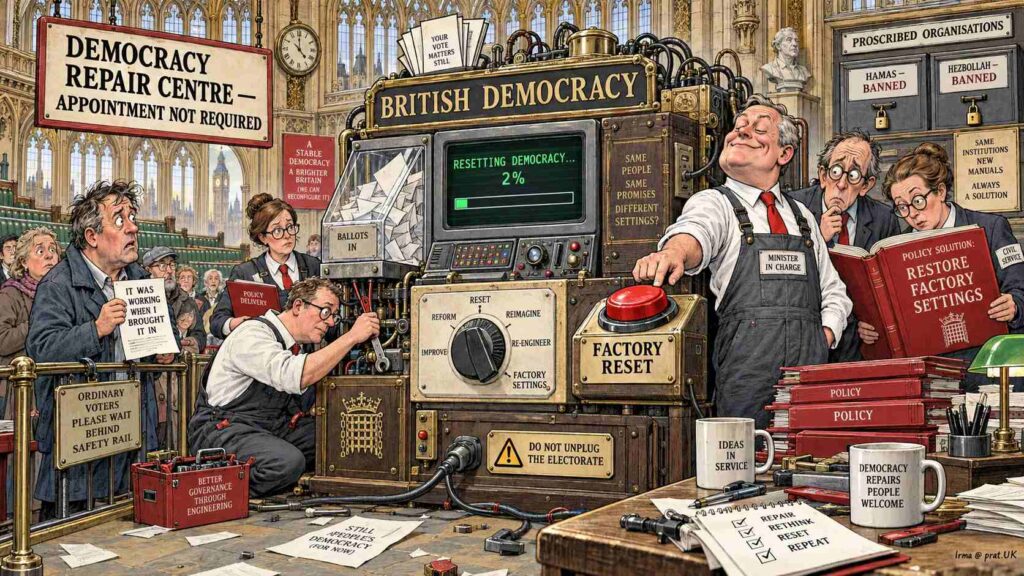
The phrase itself is magnificent. Nobody in Britain ever resets anything that works. You reset your router. You reset your password. You reset your boiler after it makes the noise that suggests Poland has been invaded. When a Foreign Secretary announces he intends to reset a country, somewhere an IT technician instinctively asks whether Israel has tried unplugging the West Bank for thirty seconds.
“Every government I’ve ever voted for has promised a reset,” says Nigel Prendergast, a Wolverhampton club comic who has been touring the same forty minutes since 2011. “Nobody ever promises what we actually need, which is to turn the whole thing off, count to ten, and ask out loud why Ed Miliband is Foreign Secretary.”
Israel Threatens Retaliation and Labour Policy Reaches for the Stationery Cupboard
Saar’s warning appears to have surprised Whitehall, where officials had apparently assumed international relations function like university disciplinary hearings, and that Israel would accept its sanction quietly, apologise for the administrative inconvenience, and attend a restorative dialogue workshop with squash.
Britain now prepares its traditional arsenal. There will be concern. Then deep concern. Then serious concern. Then grave concern. Should matters deteriorate, Britain may deploy extreme concern, a weapon last used when somebody brought supermarket prosecco to a diplomatic reception in 1997.
International Law as a Labour Policy Vending Machine
The Government’s defence is that settlement expansion raises genuine questions under international law, including the International Court of Justice advisory opinion, and Miliband referred to the ICJ directly. That is a legitimate argument, and settlement policy is a legitimate thing for allies to criticise. Allies criticise each other. That is diplomacy, not treason.
The comedy arrives only when British discourse begins treating international law as a vending machine. Insert Israel. Press B7. Out comes outrage, warm and slightly crushed. Try inserting Hamas and the machine flashes PROSCRIBED ORGANISATION, emits an uncomfortable buzzing, and the broadcast cuts back to Westminster. Insert Iran and it says please contact the Home Office. Insert Britain and your request is referred to a cross-government task force with a logo.
Labour Policy Now Contains Seventeen Internal States
Britain has long supported a two-state solution. The difficulty is that Westminster has since developed roughly seventeen additional states inside the governing party. There is the Cabinet position, the backbench position, the activist position, the union position, the constituency pressure position, the we must listen position, the we are listening position, the we have listened position, and finally the classic Foreign Office position, which is whatever France announced yesterday but with superior punctuation.
Miliband told MPs that events in Gaza and the West Bank had pricked the conscience of a generation and that colleagues were keen for action. Nothing terrifies a government quite like discovering its own MPs are keen. An MP who is concerned can be ignored. An MP who is keen has already drafted the amendment, briefed a journalist, and booked the studio.
Polling Confirms Labour Policy Is Wildly Popular Among People Already Holding Placards
The prestigious London Institute of People Standing Near Parliament surveyed 437 persons who were already holding the answer on cardboard. Eighty-three percent demanded immediate sanctions. Twelve percent demanded stronger sanctions. Four percent demanded Britain leave NATO, abolish capitalism and nationalise Pret A Manger. One man wanted directions to Victoria Station. Researchers classified him as undecided.
The poll therefore established, with mathematical certainty, that people attending a demonstration overwhelmingly agree with the demonstration. Political scientists hailed it as the greatest methodological advance since asking party members whether the party is good.
What Honest Labour Policy Would Actually Look Like
Britain can still rescue this. Criticise settlement policy where criticism is earned. Oppose settler violence plainly. Demand humanitarian standards. Support Palestinian civilians who have been used as scenery by everyone with a rifle and a grievance. And state, without mumbling into the despatch box, that Hamas terrorism, Hezbollah violence, Iranian proxy warfare and antisemitism on British streets are not quirky cultural expressions requiring a stakeholder engagement session.
That approach has one fatal defect. It is balanced, and therefore nobody on social media will like it. It generates no placards, no hashtags and no standing ovation at conference. It merely protects the national interest, which is what foreign policy was originally invented to do, before it was repurposed as a mood board.
Governments are entitled to disagree with allies. What they are not entitled to do is pretend that a policy chanted at them for two years arrived, entirely by coincidence, as the fruit of quiet ministerial contemplation. Britain deserves a foreign policy written by adults in a room, not one negotiated at volume outside the gates. Possibly worth another comprehensive reset.
15 Humorous Observations Before the Diplomatic Furniture Starts Flying
- Britain’s new Middle East doctrine appears to be: Hamas is illegal, Hezbollah is illegal, but Israel needs a comprehensive reset. That is less foreign policy than a software update written by committee.
- Ed Miliband has discovered the diplomatic equivalent of resetting the smoke alarm while leaving the kitchen on fire.
- Hamas remains proscribed in Britain, which means Labour has not quite handed it the keys to the Foreign Office. Apparently it only gets visitor parking.
- Hezbollah is also proscribed, so Britain remains officially opposed to terrorism while experimenting with the exciting new concept of making its principal target increasingly uncomfortable.
- Israel says British sanctions would trigger retaliation. Britain responded with the traditional imperial weapon: another policy review.
- Labour’s Middle East policy increasingly resembles a student union meeting where Israel has forty motions against it and Hamas somehow forgot to submit its paperwork.
- Every government promises a reset. Nobody ever promises what Britain actually needs: turn it off, count to ten, and ask why Ed Miliband is Foreign Secretary.
- Miliband says British companies should not help finance or advertise West Bank settlements. Somewhere Hamas’s marketing department is checking whether this means it can still advertise tunnels.
- Britain officially criminalises support for proscribed terrorist organisations, proving Whitehall can recognise extremism perfectly well when it appears on the correct PDF.
- The Labour left has reached the stage where Middle East diplomacy consists of demanding that Israel demonstrate restraint while assuming every terrorist organisation has simply had a difficult childhood.
- Britain spent centuries exporting parliamentary government. It now imports placards.
- The Foreign Office once worried about Russia, Iran and terrorism. Now its greatest strategic fear appears to be somebody outside Parliament shouting, “Shame!”
- Israel is accused of crossing red lines. Hamas spent October 7 looking for the red-line recycling bin.
- Labour insists this is about international law. Fair enough. The comedy arrives when international law apparently develops extraordinary peripheral vision whenever Israel enters the room.
- The ultimate British compromise is approaching: Hamas remains banned, Hezbollah remains banned, Israel gets sanctioned, and everyone receives a leaflet explaining that Britain remains committed to peace.
Sources
- Ed Miliband pledges a comprehensive reset of UK policy on Israel
- Israel threatens to retaliate against Britain over sanctions
- Foreign Secretary sets out measures on West Bank settlement expansion
- Commons Library briefing on proscribed terrorist organisations
- Home Office rejects Hamas application to be removed from the banned list
Ed Miliband, appointed Foreign Secretary in July, told the House of Commons in his first outing at the despatch box that Britain would undertake a comprehensive reset of policy toward Israel, calling the E1 settlement plan the crossing of a red line and saying the Government would not acquiesce in the destruction of the two-state solution. Foreign Office minister Stephen Doughty indicated that goods from West Bank settlements could face targeted measures, and Prime Minister Andy Burnham told MPs he was concerned that decisions on E1 could end the prospect of a two-state solution. Israeli Foreign Minister Gideon Saar told a Hebrew-language news site that Britain would be making a big mistake and that Israel would respond in kind. Hamas has been proscribed in its entirety in the United Kingdom since 2021 under Priti Patel, and Hezbollah since 2019 under Sajid Javid.
This is satire aimed squarely at governments, party factions, extremist organisations and the magnificent machinery of British policymaking. British Muslims are not Hamas, Hezbollah or any other terrorist organisation, and no sensible criticism requires pretending otherwise. Everything above is London humour written in the great tradition of British satirical news, which holds that UK satire exists to embarrass the powerful rather than the passing pedestrian, and that English comedy improves in direct proportion to how nervous it makes a minister.
American readers who prefer their political comedy with a different accent can find the transatlantic edition at Bohiney.com.
Auf Wiedersehen, amigo!

Bethan Morgan is an experienced satirical journalist and comedy writer with a strong editorial voice shaped by London’s writing and performance culture. Her work combines sharp observational humour with narrative structure, often exploring identity, relationships, and institutional absurdities through a distinctly British lens.
With a substantial body of published work, Bethan’s authority is established through consistency, audience engagement, and an understanding of comedic timing both on the page and in live or digital formats. Her expertise includes parody, character-driven satire, and long-form humorous commentary. Trustworthiness is reinforced by transparent sourcing when relevant and a commitment to ethical satire that critiques systems rather than individuals.
Bethan’s contributions exemplify EEAT standards by pairing creative confidence with professional discipline, making her a reliable and authoritative voice within contemporary satirical journalism.