Prime Minister Andy Burnham’s October 7 anniversary statement to Britain’s Jewish community meets a London afternoon of marches, counter-marches and police cordons
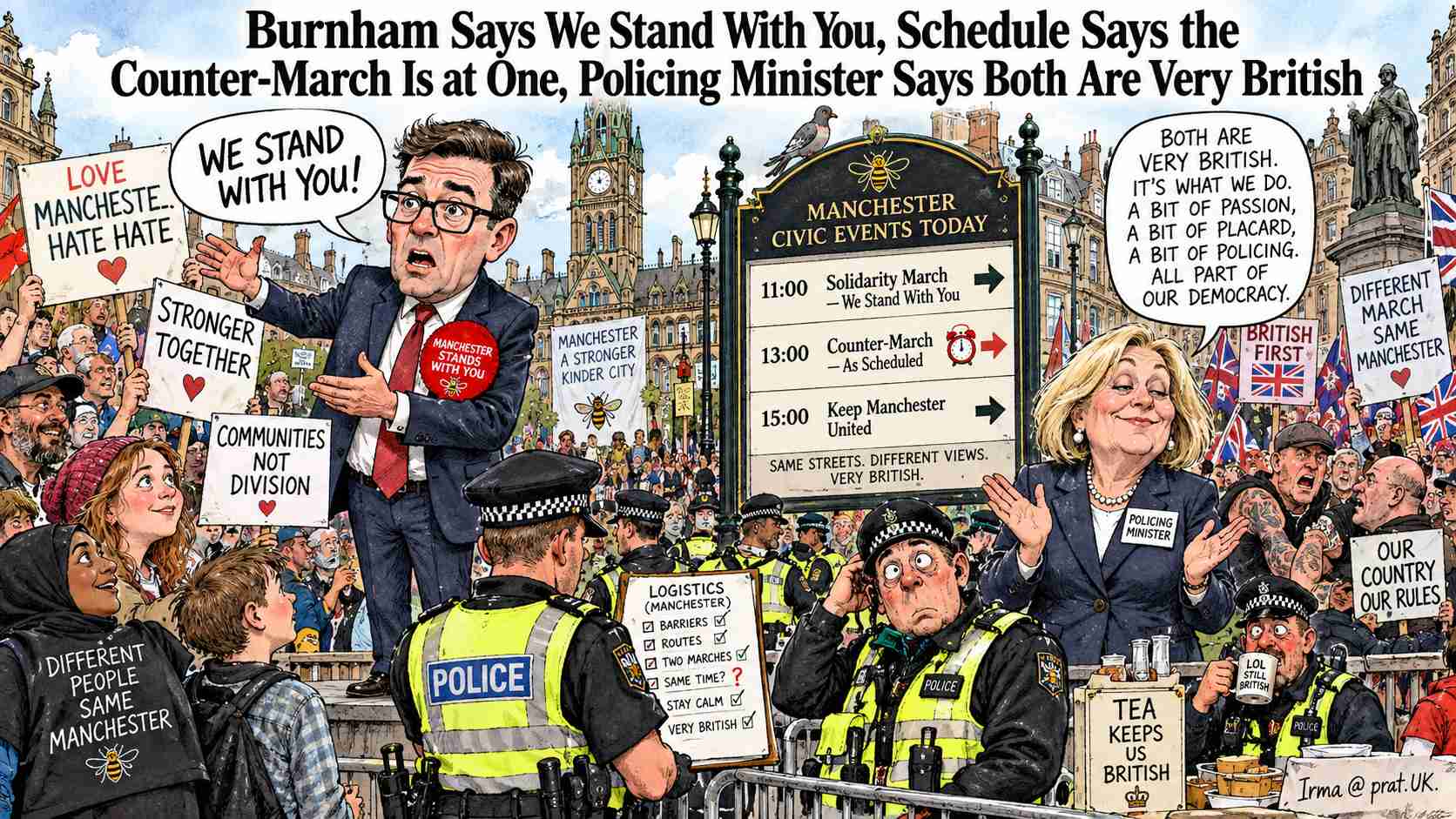
LONDON – Andy Burnham marked three years since October 7 by saying the country stands with its Jewish citizens, that antisemitism will be met, and that two states remain the policy. At one o’clock the schedule had a march and a counter-march. What’s the deal with standing with people at noon and managing them as traffic at one.
What the Prime Minister’s October 7 Statement Said
The statement names the murders, the communities still carrying them, the abuse, Manchester, the funding for protection, the line about schools and universities. An attack on Jewish people in Britain is an attack on all of us. That sentence is either a policy or a caption. The difference is the pavement, when the caption meets a placard.
The PA reporting on the day noted that Burnham had said nothing specific about the demonstrations themselves, only the reassurance to British Jews, as London Now carried it. That is a sensible lane for a prime minister. It is also a lane that ends at the kerb.
Burnham’s Record on Antisemitism and the Gaza Ceasefire Row
He arrives at this with a longer record than most. Burnham was mayor of Greater Manchester when the Heaton Park synagogue was attacked on Yom Kippur 2025, and he has spoken for years about his work with Jewish communities in the city, a history JNS and The Jerusalem Post both recounted when he was the incoming leader. He has also been blunt about Gaza. In a video statement before taking office he apologised for Labour’s early response to the conflict, said more should have been done to push for a ceasefire, and called for pressure on the Israeli government. The Board of Deputies and the Jewish Leadership Council welcomed his zero-tolerance line on antisemitism and said there was no contradiction between fighting it and disagreeing with Israeli policy, while telling his team they had significant concerns, as LBC reported. So the man saying we stand with you has already had a long conversation with the people he is standing with. It was not all comfortable.
He did not invent the clash between a vigil and a demonstration. He inherited it, with the bills and the runway and a Conservative leader scrapping taxes and denying domes in the same morning. Inheritance is the job. Today the job is to mean the statement in a city that has scheduled a disagreement on top of it. Meaning it costs officers, patience, and the willingness to arrest people rather than brief about them.
The Jewish groups asked for care, too. In their joint statement after his earlier video, the Board of Deputies and the Jewish Leadership Council said that in a country where antisemitism has become more normalised and more violent, leaders should take the utmost care over how they talk about the conflict, a line the Jerusalem Post reproduced in full. It’s a fair request, and a hard one to meet in the same fortnight as a conference season in which every party leader is saying things about foreign policy from a podium with a slogan attached. Care is slow. Slogans are fast. The statement is slow, and it has to survive being read next to the fast ones.
The Policing Minister’s Very British Cordon
The policing minister says both gatherings are very British, which is true of the cordon and less true of the content. We have a literature of cordons. We are less good at deciding that one day a year the cordon shouldn’t be the main character. Requests to move it were requests, not bans. This government does not want the ban row today, so it has the street row instead.
The Met had judged that the legal threshold for pushing the Home Secretary towards a ban had not been met, and it imposed conditions on route and timing instead, which is what the law allows under the Metropolitan Police as it stands. Ministers can ask for more. They would then own the headline, the legal challenge and the next march, which is likely to be held at the same bus stop. Universities UK, for its part, said the date should have been changed. Nobody with a clipboard had the power to change it.
Standing With the Dead, Policing the Living
Remembering the dead and policing the living are not the same activity. The statement is about the dead and their neighbours. The schedule is about the living, some to mourn, some to shout, some to shout at the shouting. He can stand with the first in a statement and still be measured by the second’s afternoon. By evening the arrests will be a number and the statement a clip and the street a street. Standing with someone is the boring week after, when the funding arrives and the next date is handled like a date. The schedule says one o’clock. The statement says we stand with you. One of those has already happened. The other is the work.