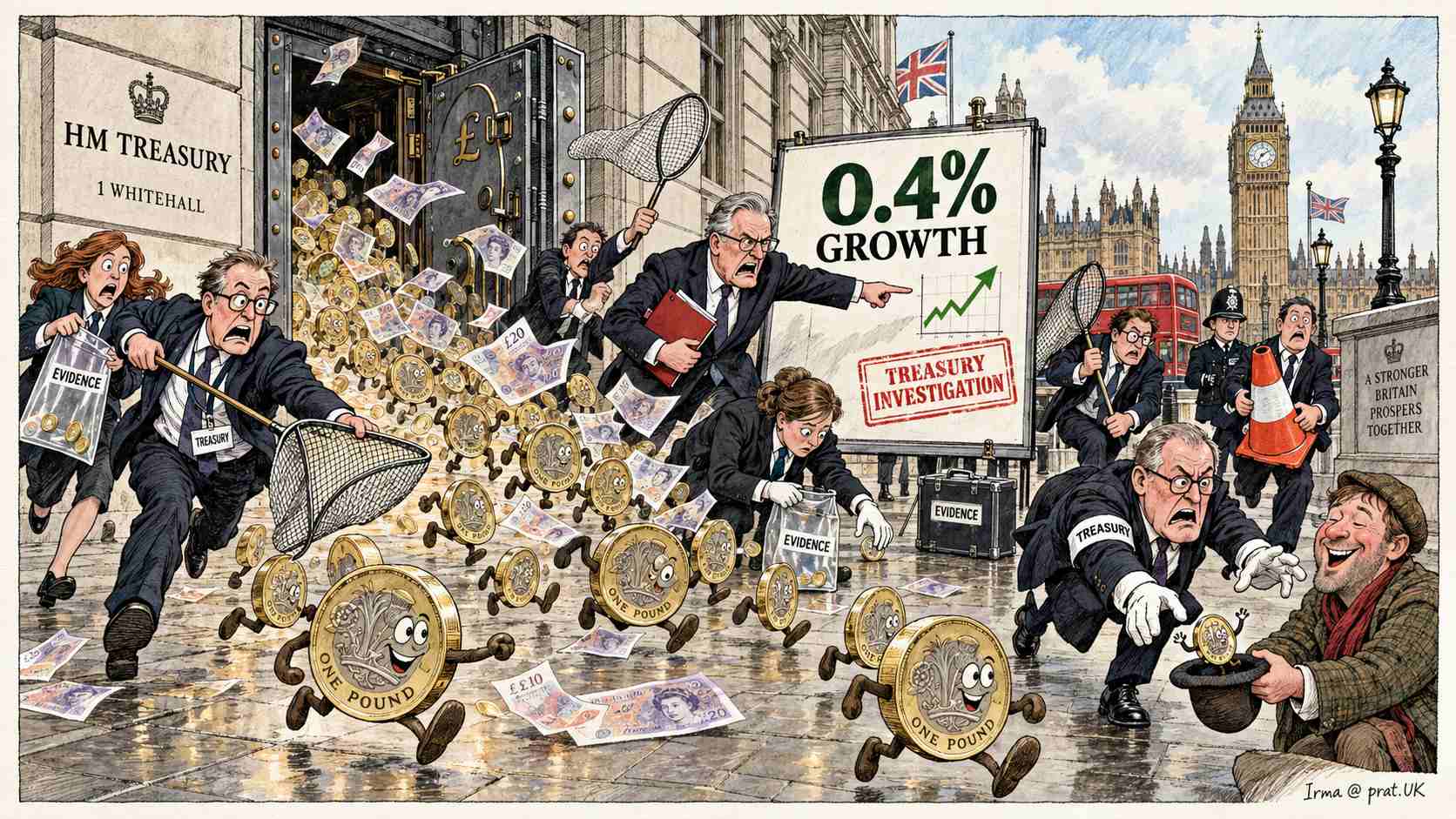
Britain’s Economy Accidentally Grows 0.4%, Treasury Launches Investigation Into How Money Escaped
Officials fear unexpected prosperity could encourage taxpayers to develop unrealistic expectations about keeping some of it
LONDON. Britain’s economy unexpectedly grew 0.4% in July, four-tenths of a percentage point more than economists predicted, forcing the Treasury Friday to investigate how economic activity managed to occur without first completing a government consultation.
The economy was 1.6% larger than a year earlier, with services and computer programming helping drive the expansion. Britain also posted the fastest first-half growth among G7 economies, while the pound strengthened on the news. Whitehall, unused to good news arriving without an accompanying apology, treated the figures the way a smoke alarm treats toast.
Within minutes, officials reportedly sealed off several productive businesses while investigators searched for evidence of unauthorised capitalism.
“We are treating this as an isolated outbreak of prosperity,” said Professor Nigel Ledger, director of the London Prat Institute for Fiscal Alarm. “The public should remain indoors and under no circumstances start assuming their wages will rise.”
Why UK Economic Growth Makes Whitehall Nervous
The central comic difficulty for government is that growth has arrived at precisely the wrong time.
When the economy performs badly, taxes are required to repair it.
When it performs well, taxes are required because people can obviously afford them. Heads, the Treasury wins. Tails, so does the Treasury.
This is the British fiscal circle of life.
Artificial intelligence and computer-related activity appear to have contributed to the growth, suggesting Britain has finally discovered workers who do not commute, demand pensions, require office space or spend forty minutes every morning discussing where everyone went at the weekend. The algorithms, notably, have never once asked for a wellbeing day.
A completely fabricated London Prat poll found 68% of Britons supported artificial intelligence after learning it might increase GDP, while 21% opposed it and 11% asked whether ChatGPT could negotiate their mortgage.
The Office for National Statistics also detected a boost from the football World Cup and warm weather.
Economists were shocked.
Nobody realised people watching football and drinking outside could count as economic policy. If that is the new metric, Wetherspoons should be nationalised and given a seat on the Monetary Policy Committee.
Chancellor Faces the Terrifying Prospect of Good News
Chancellor John Healey now approaches his October Budget carrying something potentially dangerous: good news.
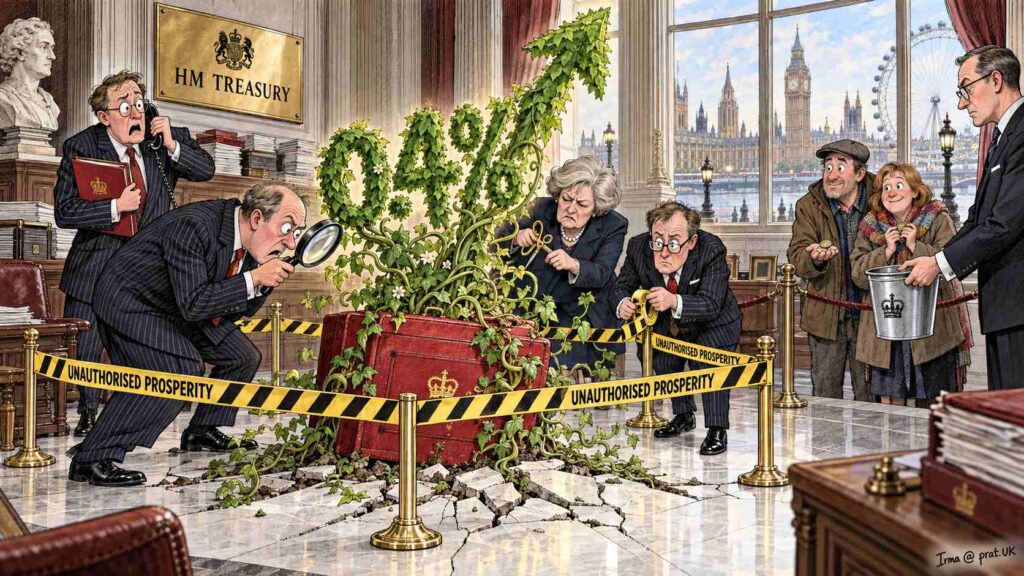
Treasury tradition requires good news to be converted rapidly into a reason for restraint.
One Whitehall source, who does not exist but understands the system perfectly, explained the procedure.
“First we announce growth. Then we warn growth is fragile. Then we warn inflation is dangerous. Then we explain borrowing costs are high. Then everyone forgets the first sentence.”
Oil prices and inflation remain serious concerns, while investors increasingly expect interest rates could rise again. That means Britain may have achieved the perfect modern economy: expanding enough to increase mortgage anxiety without expanding enough to buy anything. Growth, it turns out, can be both real and entirely theoretical, rather like a gym membership.
At a café in Birmingham, fictional eyewitness Derek Hoggins said he personally experienced the recovery.
“I ordered a bacon sandwich yesterday,” he said.
“Today it costs 40p more. That’s growth.”
Productivity Improves the Moment Nobody Is Measuring It
Productivity has also shown tentative signs of improvement after years of weakness.
Government departments are studying the phenomenon closely.
Early evidence suggests productivity increases whenever fewer officials are assigned to measure productivity. It is the economic equivalent of a watched kettle, except the kettle is Whitehall and it has never actually boiled.
A new interdepartmental Productivity Acceleration Working Group is expected to examine the matter over 18 months before issuing 412 pages explaining why meetings remain essential.
The economy, meanwhile, has been warned not to grow again without permission.
Sources
- Office for National Statistics: GDP monthly estimate, UK: July 2026
- Reuters, via Yahoo Finance: UK economy grew 0.4% in July
- Reuters: UK economy grew 0.4% in July
The underlying story is real. The ONS confirmed on 11 September 2026 that GDP grew 0.4% in July, beating a Reuters poll forecast of zero growth, with services output up 0.6% while production and construction both fell. Chancellor Rachel Reeves and the Treasury face an October Budget in which stronger-than-expected growth sits alongside rising inflation and elevated borrowing costs, a combination that leaves ministers relatively little room to celebrate.
Three Observations Too Absurd To Invent
- Britain’s economy grew fastest in the G7 in the first half of 2026, and the immediate national reaction was to double-check the numbers rather than open a bottle of something sparkling.
- Computer programming was singled out as a growth driver, meaning the most reliable workers in the British economy are currently the ones who do not go to the pub after 4pm on a Friday.
- The Office for National Statistics credited part of the boost to the World Cup and warm weather, officially making “the nation had a nice time” a recognised line item in gross domestic product.
Auf Wiedersehen, amigo!
This is British satire, published for readers who understand that London humour is at its sharpest when the numbers are real and the professors are not. If you enjoyed this English satirical news look at the UK economy, our American cousins across the pond serve up the same sort of thing, minus the queuing, over at Bohiney.com.

Harriet Collins is a high-output satirical journalist with a confident editorial voice. Her work demonstrates strong command of tone, pacing, and social commentary, shaped by London’s media and comedy influences.
Authority is built through volume and reader engagement, while expertise lies in blending research with humour. Trustworthiness is supported by clear labelling and responsible satire.