American Tourist Breaks All Five London Underground Rules Before Train Has Actually Left Heathrow
London commuters confirm the Tube has only three laws: move down, stand right, and please stop making the rest of us listen to your phone
LONDON — Britain has spent centuries developing parliamentary democracy, common law, afternoon tea and an elaborate constitutional monarchy whose precise powers remain unclear even to people employed to explain them.
Yet the nation’s most rigidly enforced constitution has no king, Parliament or Supreme Court.
It is the London Underground.
A recent Islands travel guide warned American visitors about five Tube behaviours capable of transforming an otherwise mild London commuter into a human pressure cooker wearing an M&S raincoat. The offences include refusing to move down the carriage, standing on the wrong side of escalators, boarding before passengers get off, keeping giant backpacks strapped on and playing phone audio without headphones.
Transport for London itself advises passengers to stand on the right on escalators, let passengers leave trains before boarding and avoid playing music aloud, confirming that these are not merely customs dreamed up by an irritated accountant from Croydon.
For Americans, however, the Tube presents a cultural challenge because its governing philosophy can be summarised as:
Go somewhere without involving everyone else in the process.
What Does “Mind the Gap” Really Mean? Britain’s Entire Philosophy, Explained to American Tourists
American tourists initially believe “Mind the Gap” refers to the physical space between train and platform.
It does.
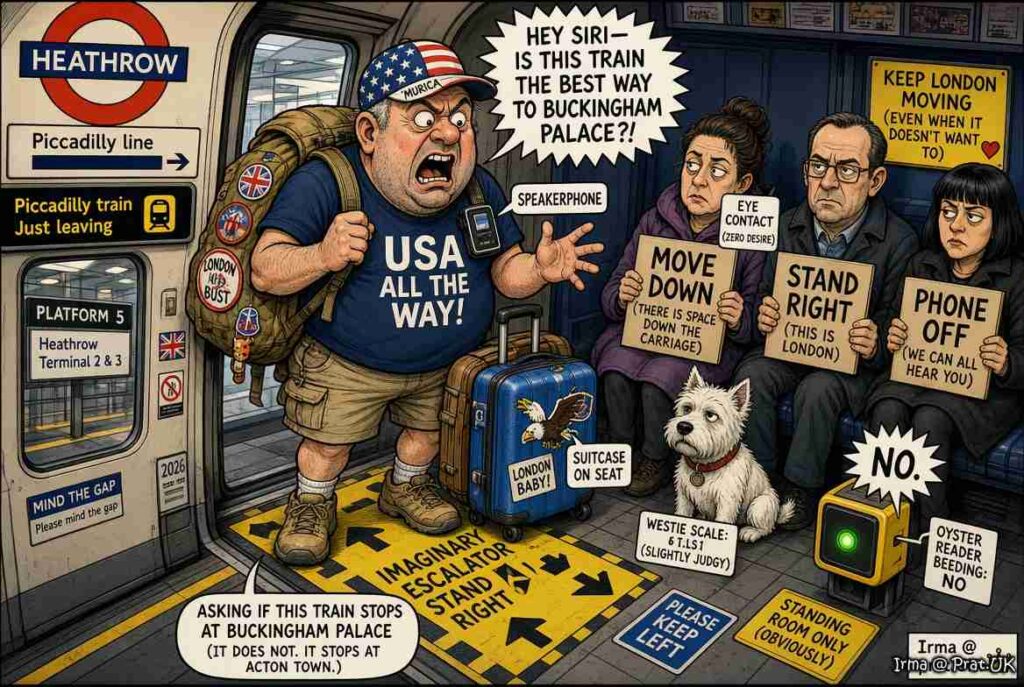
But after three days in London, they begin to understand its broader applications.
Mind the gap.
Mind your luggage.
Mind the people trying to get past you.
Mind your phone volume.
Mind your children.
Mind your business.
And above all, mind the enormous emotional gap Londoners carefully maintain between themselves and strangers.
Researchers at the completely unnecessary Institute for British Social Distance calculate that the ideal conversation between two strangers on the Underground lasts 0.7 seconds.
“Sorry.”
“Sorry.”
Interaction completed.
A tourist who asks, “So, where are you from?” has effectively proposed marriage.
London Underground Escalator Etiquette: Stand on the Right, Walk on the Left
Britain may have Labour, Conservatives, Liberal Democrats, Reform UK, Greens and several smaller parties largely consisting of people furious about parking.
The Underground has simplified democracy.
There are only two parties.
Stand Right.
Walk Left.
There are no coalition negotiations.
There are no undecided voters.
Stand on the left during rush hour and within six seconds 37 Londoners behind you have reached complete bipartisan agreement that you are the greatest threat to metropolitan civilisation since the Luftwaffe.
TfL explicitly advises passengers to stand on the right.
Tourists nevertheless occasionally stand beside one another across the entire escalator, apparently believing they have rented the infrastructure.
“Look, honey! Advertising!”
Behind them, a barrister needs to reach court, a nurse is late for work and three investment bankers are aging visibly.
Nobody says anything aggressive.
This is Britain.
Instead somebody quietly says:
“Excuse me.”
The American hears politeness.
Every British person within earshot hears:
Move before I invoke powers last exercised by Henry VIII.
Why Londoners Turn Ruthless Underground: British Politeness Ends Four Feet Below Street Level
Americans frequently arrive expecting Britain to be populated by gentle people apologising to furniture.
That assessment is broadly accurate above ground.
Below ground, different constitutional arrangements apply.
The Tube changes people.
A Londoner who spends Sunday apologising because another person stepped on his foot can become a hardened transportation strategist Monday morning because someone is blocking the doors at Bank.
Researchers believe Underground aggression remains invisible because British anger is expressed primarily through eyebrow movement.
Americans shout.
Britons stare.
A sufficiently hostile British stare can remove wallpaper.
One Tube passenger, Nigel, 52, described encountering tourists blocking an escalator with luggage.
“I didn’t say anything,” he explained.
Asked whether he was annoyed, Nigel replied:
“I thought about them for six stops.”
Doctors have described this as severe British rage.
Let People Off the Tube First: Why You Must Not Board Before Passengers Exit
The next Tube rule appears to involve advanced theoretical physics.
People inside the train must leave before additional people can enter.
Transport authorities endorse this radical theory.
Yet the moment Underground doors open, some visitors charge forward as though the train is the last helicopter leaving an embassy roof.
There may be another train in two minutes.
Doesn’t matter.
This one exists now.
The American tourist sees an opening and thinks:
Opportunity.
The London commuter trying to exit thinks:
You cannot occupy the space until I stop occupying the space. This is not complicated.
Economists call this the Tube Scarcity Delusion, where otherwise rational adults believe failure to enter this particular Piccadilly line train means they must remain at Leicester Square forever and eventually establish a small agricultural settlement on Platform 2.
Move Down the Carriage: The Doorway-Blocking Tourist and London’s Last National Consensus
Having successfully boarded, the inexperienced visitor frequently performs the manoeuvre considered the Sistine Chapel of Underground offences:
He stops.
Right inside the door.
The entire carriage awaits further instructions.
The tourist then removes his telephone and begins examining a Tube map containing approximately 11 lines, 272 stations and what appears to be a bowl of multicoloured electrical wiring.
The Islands article cited a poll in which 50 percent of respondents named failure to move down the carriage as their biggest Tube annoyance. TfL has long made the same plea through its #TravelKind campaign, which urges travellers to move down inside the carriage so everyone can get on.
That means half of London may disagree about taxation, immigration, Brexit, football, monarchy and whether Pret coffee constitutes coffee.
But apparently they can unite around:
MOVE DOWN.
This may be Britain’s last functioning national consensus.
Take Your Backpack Off on the Tube: How Rucksacks Become One-Bedroom Flats at Rush Hour
An ordinary backpack is harmless.
Place it on someone’s shoulders aboard the Northern line at 8:19 a.m., however, and it undergoes an astonishing physical transformation.
Suddenly it occupies 14 square feet.
A backpack containing one jumper, a water bottle and six emergency granola bars somehow becomes a two-bedroom extension with planning permission.
Every time its owner turns around, three commuters are struck in the face.
The Islands guide notes that keeping bulky bags on during crowded journeys consumes scarce space and can smack other passengers as the train moves. London’s Travel Kind campaign has also encouraged travellers to remove backpacks.
Experienced Londoners therefore place bags between their feet.
Tourists sometimes keep them on because removing a backpack requires acknowledging the existence of other human beings, a controversial concept in modern tourism.
Headphone Dodgers on the London Underground: Why TfL Wants You to Use Headphones
Then comes perhaps the most remarkable offence.
Someone begins watching TikTok at full volume.
There are few moments when an entire Underground carriage becomes emotionally unified.
A baby crying will not do it.
A delay will not do it.
A man eating tuna mayonnaise at 8 a.m. gets close.
But one passenger watching forty-seven consecutive short videos at maximum volume can transform eighty strangers into a disciplined resistance movement.
The Islands report identifies headphone-free videos, music and calls as another significant etiquette violation, and notes London’s campaign against so-called “headphone dodgers.”
The remarkable feature is that nobody has ever heard somebody else’s speakerphone video on public transport and thought:
“This improves the journey.”
No commuter has put away Dickens and said:
“Excellent. A stranger’s algorithm has selected a man shouting about cryptocurrency.”
How Londoners Communicate on the Tube: Sighs, Eyebrows and Silent Disappointment
The Tube has developed its own communication system.
There are no words.
There is the sigh.
There is the eyebrow.
There is the aggressive newspaper adjustment.
There is the elaborate manoeuvre where someone looks at your backpack, looks at you, looks at the backpack again, then gazes into the middle distance while reconsidering liberal democracy.
Foreign anthropologists initially believed London commuters were antisocial.
They were wrong.
Londoners communicate continuously.
They simply communicate entirely through disappointment.
A raised eyebrow can mean:
“Move down.”
A sigh can mean:
“Take your backpack off.”
A newspaper fold can mean:
“You have violated several provisions of Magna Carta.”
And looking directly at someone’s phone speaker means:
“If civilization survives this century, historians will judge you harshly.”
The Tube Etiquette Pentathlon: American Tourist Breaks All Five Rules
The truly gifted visitor can combine all five violations into one seamless operation.
He waits directly in front of the carriage doors.
He boards while passengers are attempting to leave.
He stops immediately inside.
He keeps his backpack on.
He begins watching a video.
Then, upon reaching his station, he exits and stands on the left side of the escalator beside his suitcase.
That’s not tourism anymore.
That’s a pentathlon.
At Heathrow, customs officers should simply ask:
“Anything to declare?”
“Yes. I intend to bring two rolling suitcases onto the Piccadilly line during rush hour.”
“Sir, we’re going to need you to step into this room.”
How to Survive the London Underground: A Helpful American Guide to Tube Etiquette
Fortunately, avoiding these mistakes is remarkably easy.
Let people off before boarding.
Move down once inside.
Take large backpacks off in crowded trains.
Stand on the right side of escalators.
Use headphones.
And if confused, step somewhere other than the exact place through which 600 people are presently attempting to travel.
Follow those instructions and Londoners will immediately recognise you as an experienced traveller.
They won’t congratulate you.
They won’t smile.
They won’t speak to you.
But that is how you know you’ve been accepted.
A Londoner’s highest expression of affection toward a stranger is permitting that person to complete an entire Underground journey without once having to think about them.
London Underground Etiquette Finally Explained
The Tube therefore operates according to a principle considerably simpler than Britain’s constitution:
Keep moving, occupy as little space as practical, make as little unnecessary noise as possible and remember that everybody around you believes their destination is more important than yours.
It sounds harsh.
It isn’t.
It’s social cooperation performed at 40 miles per hour beneath Oxford Street.
Millions of strangers somehow travel together every day by observing tiny customs that prevent public transportation from becoming televised cage fighting.
That may actually be civilisation.
Or at least civilisation with an Oyster card.
And when the announcement says “Mind the gap,” remember that the gap isn’t merely between the train and platform.
It’s between being a visitor to London and becoming the person an entire carriage discusses silently for the next six stations.
Disclaimer
This satire is based on real London Underground etiquette and the genuine human experience of discovering that an escalator can apparently possess a constitution. The comic characters, absurd institutes, suspiciously precise psychological diagnoses and transportation catastrophes are part of the satire. This story is entirely a human collaboration between two sentient beings: the world’s oldest tenured professor and a philosophy major turned dairy farmer.
For practical guidance rather than commuter anthropology, see “Transport for London guidance for travelling like a local” and the “Islands guide to London Underground etiquette.”
SOURCE: https://www.islands.com/2273300/london-underground-rules-american-tourists-break-first-10-minutes/

Mei Lin Chen is a student writer whose satire explores identity, modern culture, and social nuance. Her work reflects academic curiosity and engagement with London’s diverse perspectives.
Expertise is growing through study and practice, while trust is supported by clear intent and responsible humour.