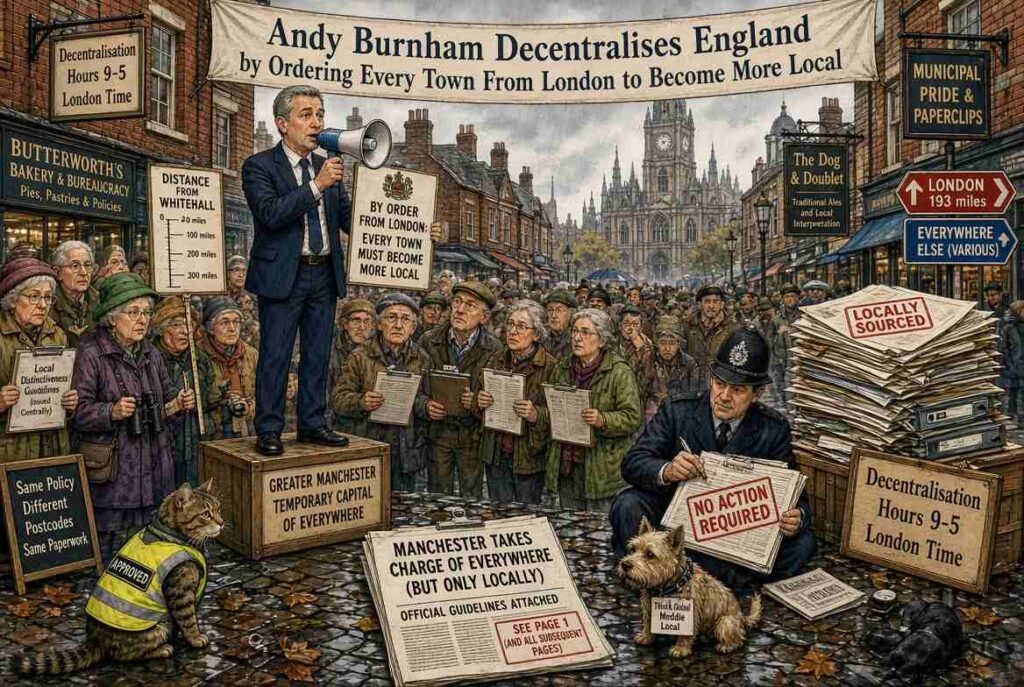
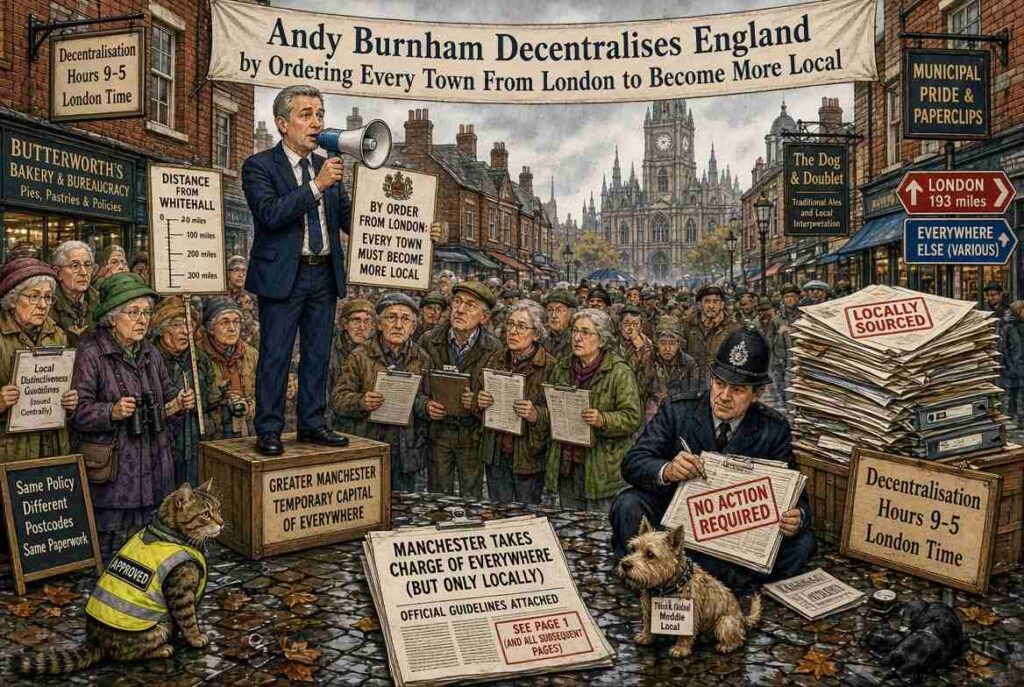
Andy Burnham Decentralises England by Ordering Every Town From London to Become More Local
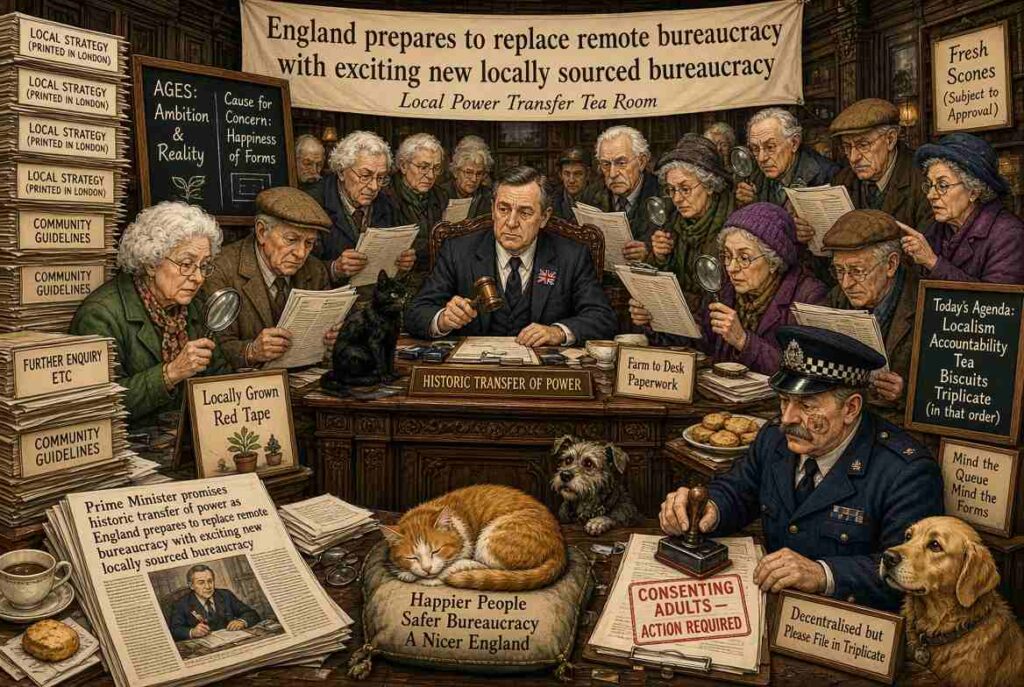
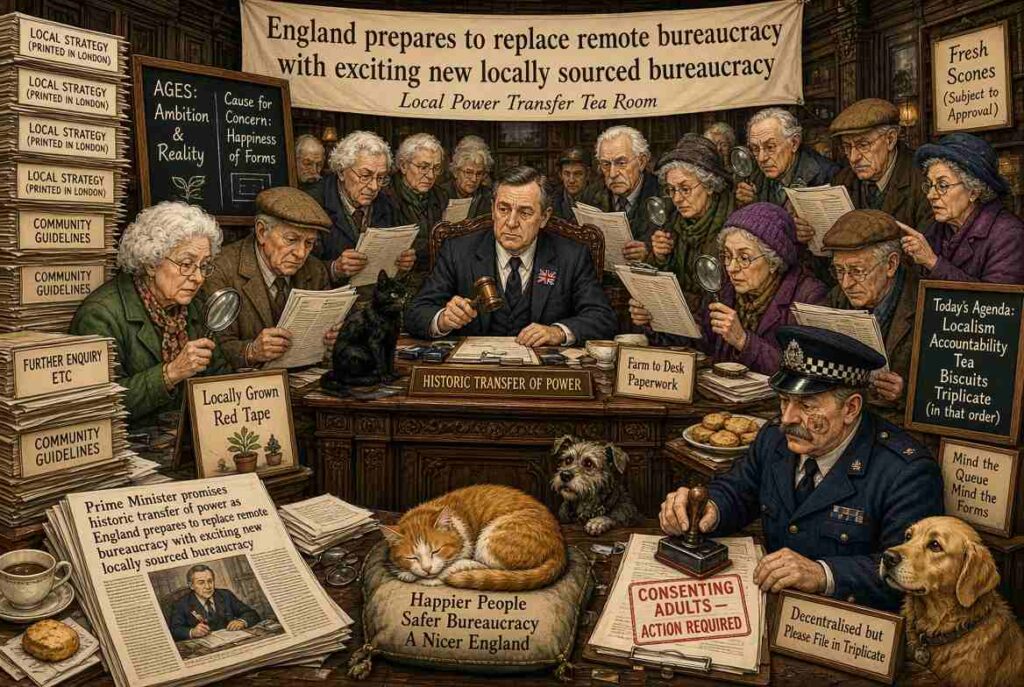
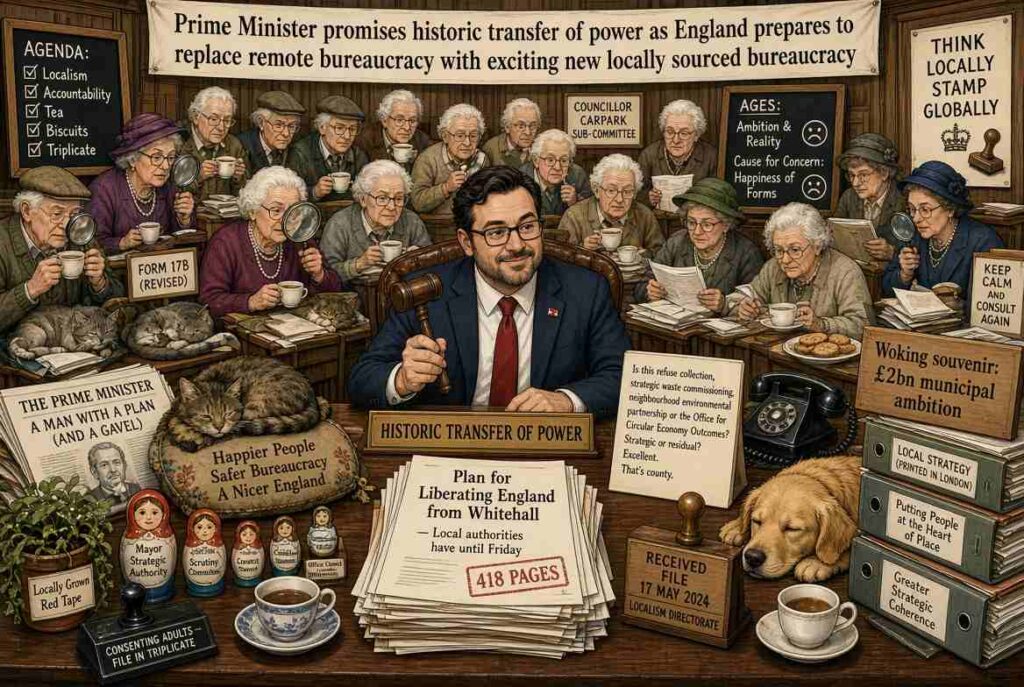
Prime Minister promises historic transfer of power as England prepares to replace remote bureaucracy with exciting new locally sourced bureaucracy
Prime Minister Andy Burnham has unveiled his grand project to decentralise England, beginning with the traditional British method of having central government decide what everybody’s new local government must look like.
The programme has been described by Downing Street as the “biggest transfer of power from Westminster in a generation,” with mayors receiving greater control over taxation, transport, housing, skills and economic development.
At last, freedom.
Not the reckless variety where people simply make decisions themselves. Britain isn’t Somalia.
This is managed freedom, carefully risk-assessed by Whitehall, approved by Parliament, assigned a funding formula, reviewed by a strategic authority and supervised by someone with the title Deputy Parliamentary Undersecretary for Empowering Other People. That job title alone required its own consultation period.
The Guardian itself has now warned that Burnham’s great devolution project contains potentially “catastrophic dangers,” including administrative upheaval, disputed council boundaries, uncertain liabilities and the prospect of inexperienced new authorities being handed considerable financial responsibilities.
Which seems unfair.
Catastrophe is such a negative word.
Labour prefers transition. Somewhere a special adviser is being paid handsomely to think up words like that.
What Is Devolution, Actually? (For Those Who Weren’t Paying Attention)
Before we mock it properly, credit where due: devolution is, in principle, a simple idea. The Local Government Association defines devolution as the transfer of power and funding from national government to local government, so that decisions get made closer to the people, communities and businesses they actually affect.
In theory, that means the person deciding whether your street gets a bus stop lives somewhere near your street, rather than somewhere near the River Thames wearing a lanyard.
In practice, in England, it currently means this: Whitehall keeps the steering wheel, hands you a smaller steering wheel, tells you it’s now “your” steering wheel, and then installs a supervisory steering wheel behind your steering wheel just in case.
England Will Be Simplified Until Nobody Understands It
The basic concept of devolution is perfectly reasonable.
Decisions about Manchester are often better made in Manchester than Westminster. Decisions about Cornwall may benefit from involving someone who has actually seen Cornwall. And when a pothole appears in Lincolnshire, there is no compelling philosophical reason why fourteen people in London need to develop a national pothole framework, complete with a pothole tsar and a pothole delivery unit.
Splendid.
Then government discovered Britain already had local governments.
This was intolerable.
So before devolving powers to them, Britain must reorganise them.
The government intends to replace two-tier local government across broad parts of England with unitary authorities. Numerous counties and districts are undergoing reorganisation, with new councils scheduled to emerge across the country, each one arriving with a brand-new crest featuring a bird nobody can identify.
Think of it as curing bureaucracy through bureaucratic chemotherapy.
Some existing organisations disappear. New organisations appear. Departments merge. Boundaries move. Job titles change. Stationery is redesigned. Consultants materialise, as consultants do, drawn by the scent of ambiguity like moths to a PowerPoint.
Then, after approximately £48 million worth of presentations titled Putting People at the Heart of Place, everybody discovers Derek from Planning still has the same desk.
Essex Receives Five Opportunities to Misplace Your Bin Complaint
Essex provides a magnificent example.
The Guardian reports that the county is due to be divided into five unitary authorities, even though Whitehall officials reportedly recommended three.
Five.
Because nothing makes government cheaper than replacing one headquarters with five headquarters, five car parks, five sets of headed notepaper and five separate leaving parties for Derek when he finally retires.
Residents who currently cannot get a pothole repaired will therefore enjoy the democratic empowerment of not getting it repaired by an organisation considerably closer to home.
The pothole itself may even receive representation on a Strategic Roads Partnership Board. It has, after all, been consistent, community-rooted and remarkably durable — everything Whitehall claims to want in local leadership.
Nobody can accuse Burnham of ignoring regional identity.
Under this system, every part of England may eventually have its own mayor, bureaucracy and specially commissioned logo featuring three abstract swooshes representing People, Place and Possibility.
The only thing forbidden will be an identifiable picture of the county, because that would cost less than £80,000.
The Science Behind Reorganisation Is Particularly Convenient Because There Isn’t Much
One unfortunate complication is evidence.
The Institute for Government has examined public-sector restructuring and concluded that structural changes can occasionally help but there is “nothing inherently valuable” about them. It warns that reorganisations can distract from the more difficult business of actually improving services.
This strikes directly at one of government’s most cherished principles: when unable to repair an organisation, rename it.
A hospital waiting list remains troublesome.
A hospital waiting list administered by the Integrated Community Health Delivery Partnership for Greater South-Western Eastshire is reform.
The same principle applies to councils.
Suppose Mrs Higgins calls because her rubbish hasn’t been collected.
Under the old system:
“Council.”
Under the Burnham system:
“Is this refuse collection, strategic waste commissioning, neighbourhood environmental partnership services or the Combined Mayoral Authority’s Office for Circular Economy Outcomes?”
“I’ve got three bags outside.”
“Strategic or residual?”
“They’re leaking.”
“Excellent. That’s county.”
Burnham Discovers Capitalism Requires a Mayor
The especially entertaining part is that Burnham says devolution will help supercharge economic growth.
Britain has spent several centuries trying to determine what causes prosperity.
Adam Smith suggested specialisation, competition and free exchange.
Entrepreneurs suggested investment.
Economists suggested productivity.
Burnham has discovered the missing ingredient: regional governance architecture.
Businesses across England can therefore stop worrying about taxes, energy costs, regulation, planning delays and borrowing expenses.
What they apparently needed was a mayor.
A factory owner considering a £30 million expansion will now be able to say: “I wasn’t convinced by projected demand, but then Hertfordshire acquired a Strategic Authority and suddenly the numbers worked.”
This is economics in its most advanced British form.
In America, someone opens a business.
In Britain, someone establishes a committee to examine the regional conditions under which somebody might eventually feel confident enough to contemplate opening one, subject to a follow-up committee reviewing the first committee’s terms of reference.
Woking Provides an Encouraging Warning From Reality
There is one small reason taxpayers might become nervous about dramatically empowering local politicians to pursue growth through investment.
Woking.
The Guardian notes that Woking Borough Council ended up around £2 billion in debt after borrowing heavily to pursue commercial and redevelopment ambitions.
Two billion pounds.
For a borough council.
That is not municipal finance. That is a small Latin American sovereign default with recycling bins and a Victorian railway station.
Yet Burnham’s national experiment could give more local leaders greater financial influence while simultaneously rebuilding much of England’s administrative machinery.
This is where supporters say stronger accountability will matter.
And they’re right.
There will undoubtedly be accountability.
Britain produces accountability more efficiently than almost anything else it manufactures.
After each catastrophe there will be an inquiry identifying precisely who should have prevented it.
The report will arrive four years later.
Nobody responsible will still hold the same job because the authority will have been reorganised again.
The Great Local Accountability Treasure Hunt
Devolution does contain one genuine democratic virtue: responsibility should become clearer.
Unfortunately, Britain has approached this by creating enough layers to turn accountability into an escape room, one where the final clue is always “please hold.”
Your bus disappears.
Is that the council? Mayor? Transport authority? Strategic authority? National government? Private operator? Department for Transport? Integrated transport settlement? Your councillor? Your MP? Your newly elected regional representative?
By the time you establish responsibility, the bus has been replaced by a heritage railway, and the heritage railway has been placed under review.
The government has even created Local Scrutiny Committees as part of its new system of mayoral accountability.
Which means we now have politicians watching politicians who are watching councils that are supervising services previously supervised by other councils.
This isn’t decentralisation.
It’s governmental Russian dolls.
Open the mayor and there’s a strategic authority. Open that and there’s a scrutiny committee. Open that and there’s a council. Open that and there’s a consultation. Open that and there’s a note explaining applications closed Tuesday, and the office is closed Wednesday for staff wellbeing.
Our Extremely Unscientific Public Survey
The London Prat conducted a rigorous survey consisting of people within shouting distance of a pub and discovered the following:
81% wanted local politicians to have more power.
84% wanted national politicians to have less power.
97% wanted fewer politicians generally.
And 112% became angry when informed the first three objectives might involve creating additional politicians.
The remaining respondents were councillors and therefore requested an expense form and a taxi home.
This survey has a margin of error of plus or minus several pints, and one respondent who turned out to be a lamppost.
There Is a Better Kind of Devolution
There is a wonderfully simple free-market version of decentralisation that governments rarely discuss.
Give communities actual discretion. Let councils compete. Let successful policies spread because residents and businesses prefer them. Allow badly run jurisdictions to lose investment rather than protecting every administrative experiment indefinitely. Simplify taxation. Reduce central grants that reward lobbying prowess. Publish comparable local spending and performance figures. Let residents know exactly who taxes them, who spends the money and who is responsible when the bins remain outside for nine days.
That’s devolution.
Burnham’s version risks becoming something different: central planning about decentralisation.
Whitehall will give power away after deciding where it goes, how the recipient is organised, what governance model it uses, what boundaries it occupies, what statutory duties accompany the power and which central department can intervene when things go wrong.
That’s roughly equivalent to your mother announcing you’re finally independent and then moving into your apartment to supervise it, redecorating the spare room, and asking for a spreadsheet of your grocery spending.
Burnham’s Revolution Ends at the Organisational Chart
Burnham wants to portray himself as the great breaker of Britain’s centralised state.
But Britain has discovered an extraordinary method of staging revolutions without inconveniencing the bureaucracy.
The signs change. The acronyms change. The organisational chart changes. Nobody knows whether services improve. And another £600,000 consultancy report concludes that the new structure needs “greater strategic coherence.”
Then comes another restructuring.
England does need decentralisation. It could use stronger local accountability, competitive local government, clearer taxation and communities permitted to make genuinely different choices.
But if Burnham thinks prosperity can be manufactured by cutting counties into new administrative shapes, giving everybody a mayor and announcing that the resulting geometry will “supercharge growth,” he may eventually discover one of the oldest principles in economics:
You cannot reorganise your way to prosperity.
Although you can certainly employ a remarkable number of people trying, most of them holding a clipboard and a strategic vision document.
And somewhere tonight, in a brightly illuminated Whitehall office, a civil servant is preparing the definitive plan for liberating England from Whitehall.
It is 418 pages long.
Local authorities have until Friday to comply.
Disclaimer
This is satire inspired by real reporting and public policy. The factual backbone includes the English devolution programme, local government reorganisation, government plans to strengthen mayoral powers and documented concerns about restructuring and municipal finance. The jokes, absurd deductions and catastrophically efficient bureaucracy have been assembled entirely through a human collaboration between two sentient beings: the world’s oldest tenured professor and a philosophy major turned dairy farmer. No bureaucrats were decentralised during production, although several may have been moved to another committee.
Sources
- The Guardian: “Catastrophic dangers await Burnham’s push for English devolution”
- UK Government: English devolution announcement
- Institute for Government: analysis of structural public-sector reform
- Local Government Association: what devolution means for councils and communities

Alan Nafzger was born in Lubbock, Texas, the son Swiss immigrants. He grew up on a dairy in Windthorst, north central Texas. He earned degrees from Midwestern State University (B.A. 1985) and Texas State University (M.A. 1987). University College Dublin (Ph.D. 1991). Dr. Nafzger has entertained and educated young people in Texas colleges for 37 years. Nafzger is best known for his dark novels and experimental screenwriting. His best know scripts to date are Lenin’s Body, produced in Russia by A-Media and Sea and Sky produced in The Philippines in the Tagalog language. In 1986, Nafzger wrote the iconic feminist western novel, Gina of Quitaque. He currently lives in Holloway, North London. Contact: [email protected]