Harry and Meghan Return to Britain, Demonstrate That Royal Charity Work Can Continue Without Palace Permission, Taxpayer Millions or a Man Carrying a Gold Stick
Royal establishment shaken as Sussexes discover helping disadvantaged children requires neither hereditary authority nor an 800-year-old ceremonial spoon. Buckingham Palace reportedly struggling to explain why charity can function without a palace.
NOTTINGHAM, ENGLAND, 15 October 2026: Prince Harry and Meghan Markle returned to British public life on Thursday and promptly threatened one of the monarchy’s oldest traditions: the belief that helping ordinary people takes a constitutional apparatus, several thousand servants, a taxpayer-funded palace and at least one elderly gentleman carrying a gold stick. Page Six and ITV News both covered the visit.
The Duke and Duchess of Sussex called on three Nottingham charities, talked to disadvantaged young people, hugged volunteers, and showed that the public can receive royal encouragement without first paying for a procession of 14 horses, two trumpeters and a retired admiral wearing enough medals to need structural support.
No bank holiday was declared. Nobody produced a velvet cushion. Nobody had to establish whether the Duke should enter the building ahead of a bishop whose ancestor once lent Henry VIII a horse.
Worse, from the Palace’s point of view, the charities appeared perfectly able to function. Officials described the implications as potentially catastrophic.
Britain’s £132 Million Question: Can You Help Somebody Without Owning a Palace?
The Royal Household’s own accounts put the Sovereign Grant for 2025-26 at £132.1 million, and £67.5 million of that went on preserving and protecting the occupied royal palaces, according to the Royal Household’s financial report.
The grant pays for the institution and its official duties, not charity visits as such. Even so, Thursday’s trip raised an uncomfortable question about whether the country has been confusing charitable work with the costly business of surrounding charitable work with royalty.
Harry wore a dark suit and an open-necked white shirt. Meghan wore a burgundy coat. They talked to people and the people talked back, and nobody had to be crowned for any of it. None of the charities demanded a replacement monarchy before letting them in.
Constitutional scholars have long wrestled with the possibility that compassion isn’t hereditary. A palace protocol specialist put the difficulty in terms ordinary taxpayers could follow: “If people find out they can volunteer without permission from someone whose great-great-grandfather owned Scotland, the whole administrative basis of British civilisation starts to look shaky.”
The traditional model of royal charity goes roughly like this. A senior royal arrives at an organisation that has been doing excellent work for years, shakes six hands, accepts some flowers, unveils something under a curtain and leaves before lunch. The photographs are then offered as proof that the monarchy rescued the place from ruin. Under the Sussex model a charity simply stays a charity before, during and after the visit. Palace aides regard this as dangerously modern.
Prince Harry’s £1.1 Million Gift Reaches Nottingham’s Community Recording Studio Without a Royal Warrant
The first stop was the Community Recording Studio in St Ann’s, which gives young people music, creative activities and mentoring. Harry has kept up the connection. In September 2025 he personally gave £1.1 million to BBC Children in Need, a Press Association report confirmed, and ITV News has since reported that the money is being used in the studio’s redevelopment alongside targeted work by Epic Partners.
That put a second dent in royal tradition. The money went to a community project, not to maintaining a building with 47 rooms nobody is allowed to sit in. Palace accountants are believed to find the difference very hard to grasp.
The couple watched an acting workshop and heard 14-year-old Amelia Faith Currie sing a song about peer pressure. They applauded, hugged her in the recording booth, and Harry told her to keep singing. Meghan joined girls aged 10 and 11 for a confidence-building bracelet workshop and gave each of them a handwritten card.
Nobody had to learn the national anthem backwards. No Lord Lieutenant presented anyone with a commemorative silver microphone. The children got something rarer in British institutional life, which was the undivided attention of adults who seemed interested in what they were doing. It made a change from the usual government initiative, in which five consultants, three diversity officers and a deputy minister arrive to explain why there’s no money for instruments.
Meghan Markle Visits Himmah Hub Food Bank, Where Families Want Food More Than Protocol
The Sussexes then went to Himmah Hub, the food poverty and community action group, where Meghan was due to meet members of the Hubb Community Kitchen, the women behind the Grenfell-inspired Together cookbook, Hello! reported ahead of the visit. Himmah was already on her radar. She previously gave £10,000 from the cookbook’s proceeds to the charity, Yahoo Life UK reported.
The reunion involved hugs and obvious familiarity, a long way from the traditional royal approach to deprivation, which is to discover that poverty exists, express concern, and return to a residence with its own private gardens.
Britain has built a sophisticated charitable hierarchy over the years. At the bottom are the people who need help. Above them sit the volunteers giving it, then the administrators documenting it, then the trustees overseeing the documentation, and somewhere near the ceiling a royal patron whose arrival requires everyone to stop helping anybody for roughly 40 minutes.
A volunteer at a typical charity might reasonably conclude that making lunch for struggling families is more useful than drawing up a seating plan for someone who inherited a title. The ceremonial establishment has traditionally resisted that kind of crude efficiency. A senior adviser on hereditary affairs gave a devastating assessment: “If we start measuring charitable success by the number of people actually helped, half the honours system will have to find other work.” The British ribbon industry alone could suffer.
Nottingham Crowds, Hugs and Selfies: Irene Hardman, 90, Remembers the Couple’s 2017 Walkabout
Outside the studio the couple greeted well-wishers, accepted flowers and posed for selfies, ITV News reported. Meghan told one woman it was great to be back. That is a break with palace communications practice, where expressing happiness normally needs a preliminary statement from the Lord Chamberlain and an assurance that the sentiment does not constitute government policy.
Meghan kissed 90-year-old Irene Hardman on the cheek after Hardman showed her a framed photograph from the couple’s first Nottingham walkabout in 2017. “I remember you, my darling,” Hardman told her. The couple had arrived 11 minutes late. No taxpayer-funded inquiry was needed to determine whether the embraces had been delivered at the correct constitutional angle.
Under royal custom, physical affection causes difficulties. A hug raises questions of precedence, protocol and whether the recipient should then receive an OBE. The Sussexes proceeded on the radical assumption that some people like being hugged. Buckingham Palace has survived wars, abdications, divorces and centuries of political turmoil. Whether it survives the widespread adoption of spontaneous friendliness is another matter.
Royal Experts Warn That Independent Charity Could End the Monarchy’s Monopoly on Helping People
Working royals visit charities all the time, and plenty of them put in serious effort. What the Sussexes demonstrated is that public service doesn’t necessarily require royal employment, which is awkward for an institution built on hereditary obligation.
If Harry can help young people without being a working royal, retired footballers might start supporting hospitals without being appointed Dukes of Orthopaedics. Local businessmen might fund community kitchens without receiving hereditary control of Nottinghamshire. Ordinary Britons might donate £20 without having their ancestors examined by the College of Arms.
This amounts to an extension of the free market into territory long reserved for inherited privilege. Britain could end up with charities competing for donations on effectiveness instead of the magnificence of whoever opens the annual fundraising dinner. The Gold Stick, a bodyguard post that now appears mostly on ceremonial occasions, has its own supplier problem: makers of ceremonial gold sticks are reportedly looking at diversifying into walking canes and curtain rods.
Prince William’s Problem: A Brother Who No Longer Needs Permission
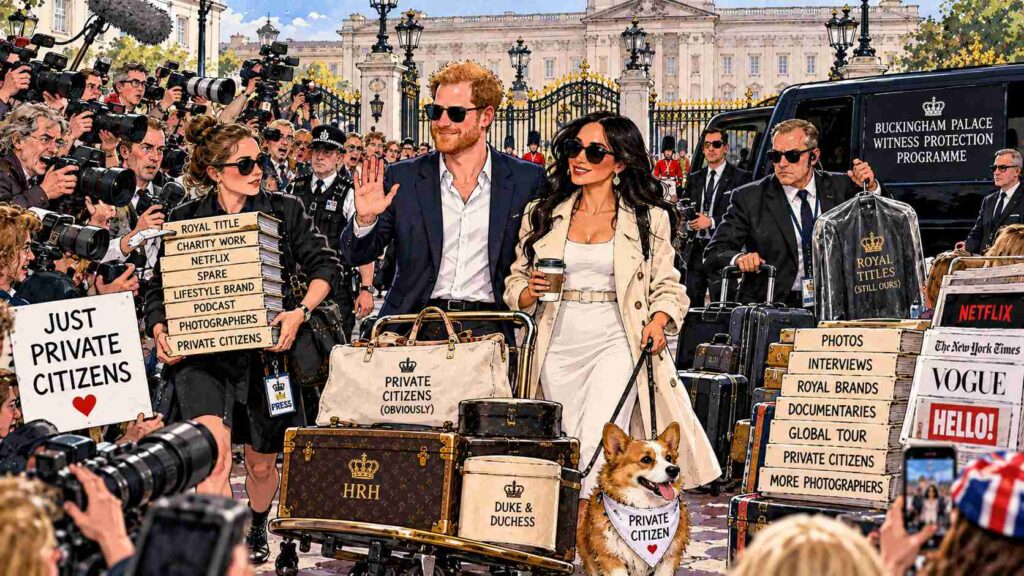
William remains a senior working royal, preparing for a future in which his main constitutional duty will be inheriting a position nobody else is allowed to apply for. Harry has entered the morally hazardous world of making his own arrangements. He can pick a charity, back it, appear in public and go home without first checking whether his brother likes the colour of the invitation cards.
The monarchy’s commitment to public service has always run through a chain of command. The King serves the country. The heir serves the country. The remaining royals serve the country, subject to their place in the succession, the transport arrangements and the availability of a commemorative plaque. Harry’s alternative is to serve without waiting for the country to provide a palace.
None of this settles the security question. The couple are waiting to hear whether they will get taxpayer-funded protection, and the Home Secretary has announced a review of protective security for public figures. On Thursday they relied on a private security team rather than the police convoys assigned to senior working royals. A private citizen can support a charity without drawing on the Sovereign Grant, a discovery that could undermine centuries of carefully cultivated confusion between financial privilege and moral usefulness.
Buckingham Palace Faces an Unprecedented Threat: Charity Without Ceremony
By the end of the day three charities had gained publicity, young people had met prominent supporters and volunteers had been thanked for their work. The monarchy was still standing. The Tower of London still had its ravens. Nobody had needed to borrow a crown.
The visit exposed the difference between the institution of royalty and the ordinary human instinct to help somebody. One needs palaces, protocols, inheritance law, ceremonial offices and a large annual budget. The other needs a person who gives a damn. There is no constitutional requirement that the two ever meet.
Harry and Meghan have shown that charitable work can carry on after royal employment ends. Britain now faces the possibility that a person’s value to society might depend less on their place in the succession and more on what they actually do. The gold stick, meanwhile, remains unemployed.
5 Humorous Observations on Harry, Meghan and the Gold Stick
- The Sovereign Grant is £132 million. Harry gave £1.1 million of his own money to a youth charity. So the palace spends about a hundred and twenty times more than he did, and I still couldn’t tell you what it bought. If I spent £132 million a year, I’d want a receipt that said something besides “maintenance.”
- What is the deal with the Gold Stick? It’s a stick. It’s gold. That’s the job. Somebody’s at a coronation going, “I’ve got the stick.” “Which stick?” “The gold one.” “Oh, not the silver one.” There’s a silver one! There’s a backup stick!
- A royal charity visit works like this: everybody who’s been helping kids for ten years stops helping kids for forty minutes so a guy can look at a curtain. I have been to a lot of charity events. Nobody has ever said, “You know what this food bank needs? A velvet cushion.”
- A ninety-year-old woman hugged Meghan and held up a framed photo from 2017. Who has a framed photo of a walkabout? I can’t find my passport. This woman has a nine-year-old photo in a frame, ready to go, in case a duchess shows up. That’s not a fan. That’s a contingency plan.
- Turns out you don’t need a title to help a kid in a recording booth. You need a Tuesday and a pulse. Most of my friends have both, and we’ve never done it. Me included. It’s a bad look for the rest of us, honestly.
Disclaimer: This article is satirical commentary on royal privilege, public funding and charitable work. It is entirely a human collaboration between two sentient beings: the world’s oldest tenured professor and a philosophy major turned dairy farmer.

Alan Nafzger was born in Lubbock, Texas, the son Swiss immigrants. He grew up on a dairy in Windthorst, north central Texas. He earned degrees from Midwestern State University (B.A. 1985) and Texas State University (M.A. 1987). University College Dublin (Ph.D. 1991). Dr. Nafzger has entertained and educated young people in Texas colleges for 37 years. Nafzger is best known for his dark novels and experimental screenwriting. His best know scripts to date are Lenin’s Body, produced in Russia by A-Media and Sea and Sky produced in The Philippines in the Tagalog language. In 1986, Nafzger wrote the iconic feminist western novel, Gina of Quitaque. He currently lives in Holloway, North London. Contact: [email protected]