Charles Spencer Says Diana Would Have Been ‘Happy’ Without Marrying Charles, Royal Family Orders Investigation Into This Mysterious Emotion
Diana’s brother requires one word to summarize an alternative life involving less palace protocol, fewer photographers and a dramatic reduction in three-person marriages
NEW YORK — Charles Spencer has offered perhaps the shortest royal biography ever written.
Asked what his sister Princess Diana’s life might have been like had she never married the future King Charles III, Spencer reportedly answered with a single word: “Happy.” The remark came during a New York discussion surrounding his new book, Swan Song: Diana, My Sister. Spencer also said life inside the monarchy can be particularly difficult for people who marry into it rather than grow up within the institution. (Page Six has the original report.)
That was it.
Happy.
No 14-part Netflix series. No 612-page authorized biography. No constitutional historian standing outside Buckingham Palace explaining what a curtain twitch might mean.
One word.
Somewhere, 4,000 royal correspondents simultaneously stared into the middle distance and wondered whether they had chosen the wrong profession.
The British monarchy has consequently been confronted with a disturbing new concept: happiness.
Sources close to absolutely nobody say palace officials immediately began searching historical archives to determine whether happiness had ever previously been attempted by a senior royal.
Early indications were inconclusive.
“We found duty,” said one imaginary archivist. “We found service, sacrifice, protocol, obligation and several thousand pages regarding the correct deployment of teaspoons. Happiness appears to have been handled by another department.”
Marrying into the Monarchy
- Charles Spencer needed one word to summarize decades of royal marital history, which is impressive because royal commentators usually need a documentary series and three castles.
- “Happy” is apparently the alternate-history version of Diana, suggesting Britain’s most elaborate institution somehow overlooked the happiness department.
- Marrying into the monarchy resembles accepting a job where the benefits are excellent but nobody will tell you what the job actually is.
- Diana entered a fairy tale and discovered the small print had been written by constitutional lawyers.
- A three-person marriage has many disadvantages, beginning with the difficulty of getting a restaurant table without somebody becoming historically significant.
Palace Discovers Happiness Was Never in the Princess of Wales Job Description
Diana married Charles in 1981. William was born the following year, Harry in 1984. The marriage deteriorated, Charles’s relationship with Camilla Parker Bowles became central to the breakdown, the couple separated in 1992 and divorced in 1996.
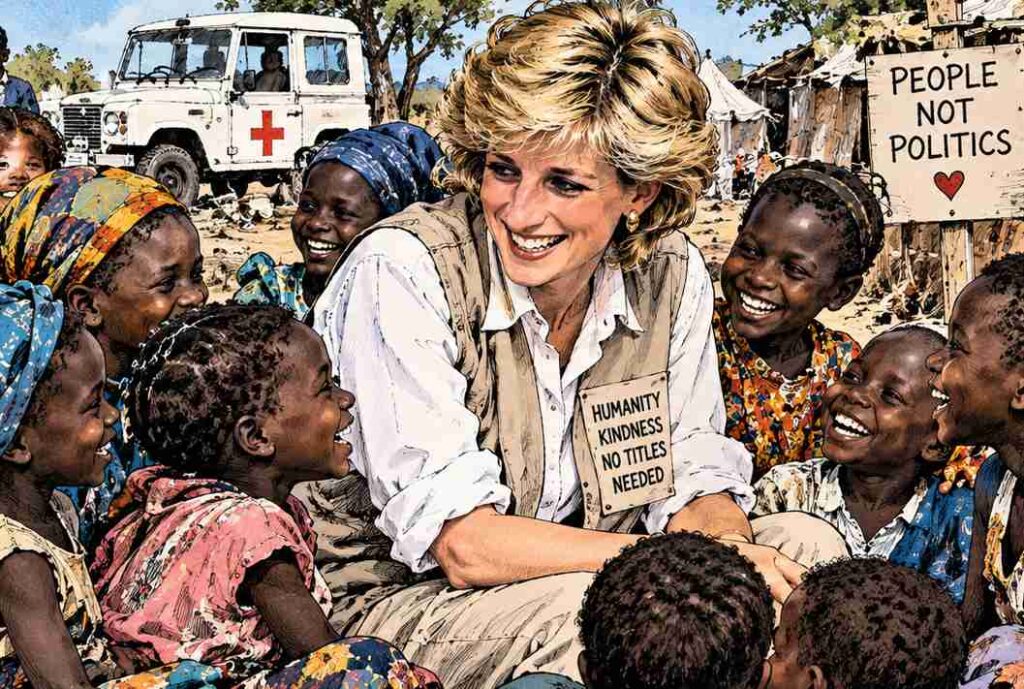
This is what marriage counselors call “quite a bit going on.”
Ordinary people encounter marital trouble and say, “We need to communicate.”
Royalty apparently encounters marital trouble and says, “Perhaps Balmoral.”
That is the strange thing about the monarchy. Everything happens inside enormous buildings, which creates the illusion that circumstances are improving.
You can be miserable in a two-bedroom semi-detached house and everybody understands the problem.
But put the exact same emotional catastrophe inside a 775-room palace and suddenly tourists buy tickets.
That may be Britain’s greatest contribution to psychology.
Architecture as denial.
The monarchy was never really designed around happiness anyway. It was designed around continuity.
You could imagine the original employment advertisement:
POSITION: Princess of Wales
RESPONSIBILITIES: Smile, wave, produce heirs, attend hospitals, tolerate photographers, memorize 600 relatives, never appear surprised by a ceremonial sword.
SALARY: Complicated.
PERSONAL FULFILMENT: Subject to constitutional availability.
Nobody ever gets interviewed for a royal marriage and asked where they see themselves in five years.
Because everybody knows the answer.
Opening something in Leeds.
Princess Diana’s Alternate Life: Fewer Palaces, Fewer Photographers, More Tesco
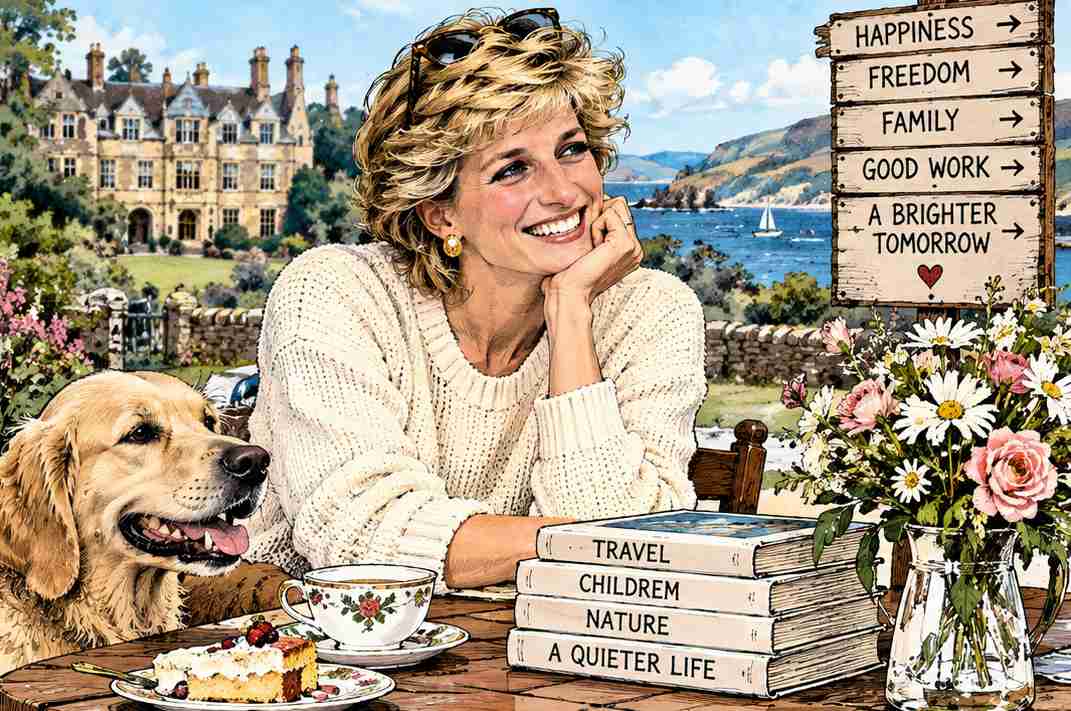
Spencer’s “happy” theory raises a fascinating alternate history.
Suppose Diana never married Charles.
She might have had a smaller house.
Fewer servants.
No tiara.
Possibly only one drawing room.
Think of the deprivation.
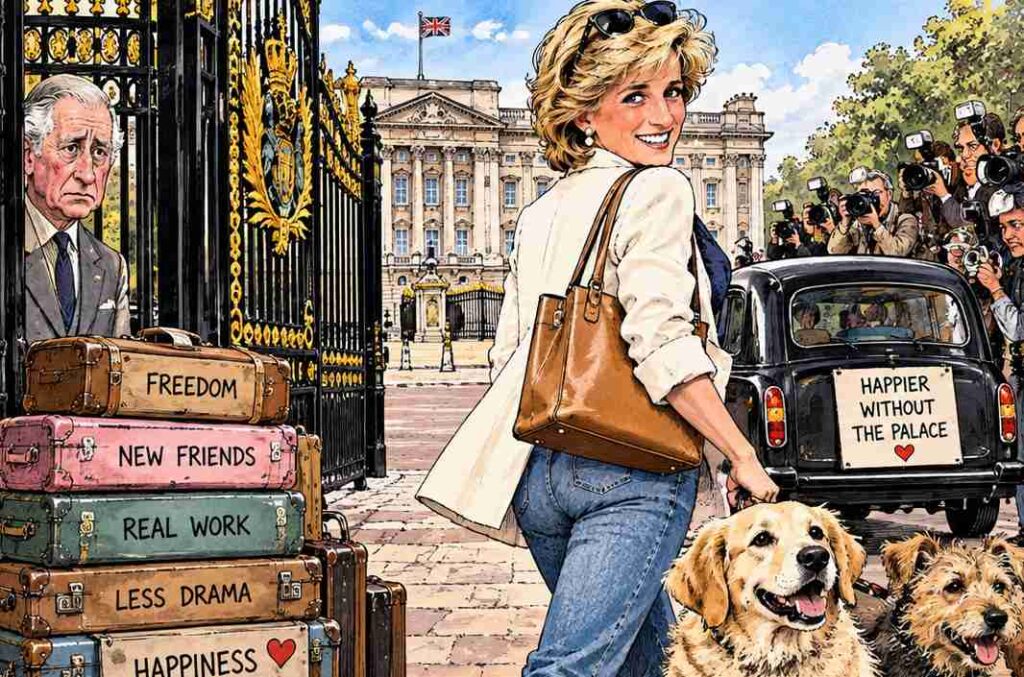
She might even have been forced to answer her own telephone.
But she may also have avoided waking each morning to discover another photographer hiding behind a hedge trying to determine whether her facial expression suggested constitutional instability.
Normal people can have a bad Tuesday.
A princess has a bad Tuesday and somebody writes a biography about it.
Diana could have gone grocery shopping.
Imagine that.
No motorcade.
No protection officer.
Just Diana standing in Tesco wondering why the supposedly large bag of crisps contains six crisps and enough nitrogen to inflate a dinghy.
Maybe that is happiness.
Not paradise.
Just being allowed to complain about parking without a royal historian interpreting it as a challenge to hereditary monarchy.
Scientists Confirm Three-Person Marriages Like Charles, Diana and Camilla Present Logistical Difficulties
Then there was the marriage itself.
Charles famously acknowledged adultery during the marriage, and Camilla eventually became his wife and later Queen. Diana herself famously described the marriage as crowded. The basic historical circumstances have been documented for decades, including in Diana’s Wikipedia biography.
Marriage is difficult enough with two people.
Three introduces scheduling problems.
Whose anniversary are we celebrating?
Who gets the aisle seat?
Does Valentine’s Day require reservations for two or should somebody ask for the large booth?
Imagine the family calendar.
Monday: Polo.
Tuesday: State dinner.
Wednesday: Constitutional duties.
Thursday: Emotional catastrophe.
Friday: Windsor.
Marriage counselors traditionally encourage couples to communicate openly.
But once the counselor realizes the marriage contains a prince, a princess, another woman, the British press and several hundred years of constitutional expectations, eventually even the therapist starts checking the clock.
“I think we’ve made excellent progress today. For homework, perhaps everyone could try not appearing on the front page.”
Marriage Counselors Close Their 600-Page Charles and Diana Case File
For decades, experts have analyzed the Charles-Diana marriage.
Books.
Television programs.
Interviews.
Biographies.
Documentaries.
Podcasts.
Panels.
Panels discussing other panels.
Britain has investigated this marriage more thoroughly than several wars.
And now Charles Spencer walks into New York and summarizes the counterfactual in one word.
Happy.
That must be infuriating if you are a royal biographer.
Imagine spending 18 years researching Diana’s psychological relationship with the monarchy, interviewing 173 people, examining correspondence and producing an 800-page manuscript.
Then her brother walks onto a stage.
“What would Diana have been without Charles?”
“Happy.”
Book finished.
Chapter two cancelled.
Publisher furious.
Royal Experts Attempt to Define ‘Happy’
Happiness, researchers tell us, generally involves life satisfaction, positive emotion, relationships, autonomy and meaning.
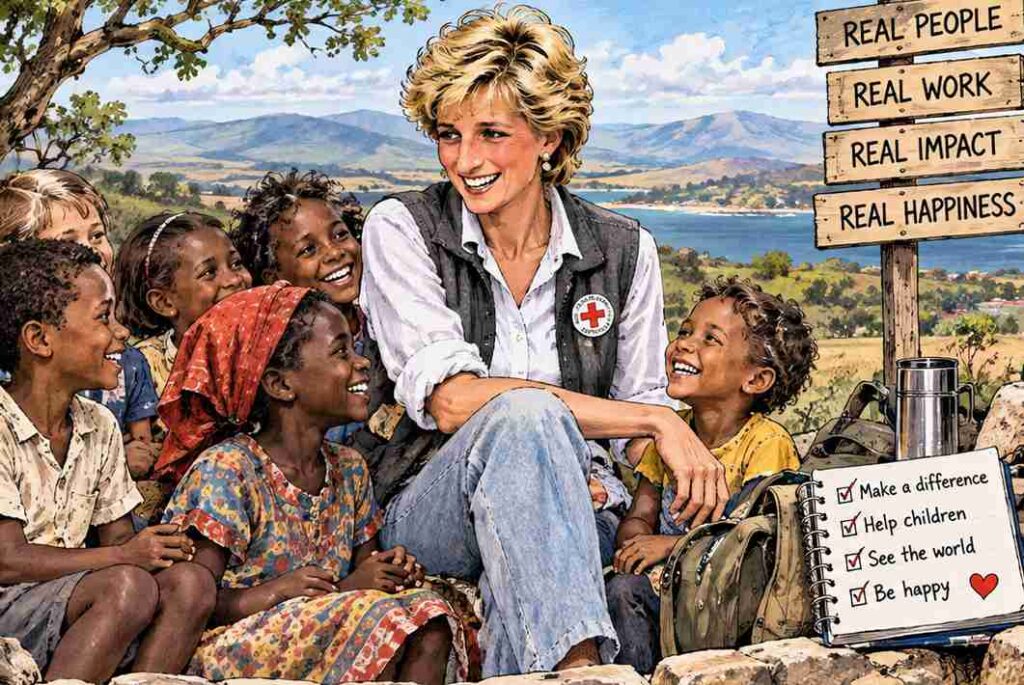
Royal happiness has traditionally involved something slightly different:
Standing on a balcony convincingly.
The Windsors are very good at duty.
They can unveil plaques nobody knew needed unveiling.
They can inspect troops.
They can name ships.
They can travel 120 miles to look delighted by a municipal flower arrangement.
These are extraordinary professional skills.
But happiness?
That is dangerously informal.
Happiness sneaks up on you.
Protocol cannot control it.
Nobody can announce:
“Her Royal Highness will experience spontaneous contentment at 3:15 p.m., followed by tea.”
You cannot rehearse joy.
Although somewhere in Britain there is probably an equerry willing to try.
Buckingham Palace Launches Operation Cheerful and a Royal Commission on Happiness
Our satirical palace insiders report that officials have now established the Royal Commission on Happiness and Related Unscheduled Emotions.
The commission will investigate several alarming questions:
Can a monarch enjoy himself without parliamentary approval?
Does laughing require a private secretary?
Can happiness be inherited?
Should joy appear before or after the Order of the Garter?
And most importantly, what happens if a royal becomes happy without notifying the press office?
A completely imaginary government survey found that 96 percent of Britons recognized happiness immediately, while the remaining 4 percent worked in royal protocol.
Researchers were reportedly encouraged.
Diana Discovered Palaces Don’t Necessarily Make Life Bigger
There is an old assumption that wealth solves ordinary problems.
To some extent it does.
Money solves the problem of not having money with remarkable efficiency.
But it cannot guarantee affection, privacy, loyalty or emotional peace.
A palace can give you 50 bedrooms.
It cannot guarantee you want to sleep in any of them.
A chauffeur saves you from driving.
He does not tell you where your marriage is going.
A tiara can contain hundreds of diamonds while still being completely useless during an argument.
That is the irony at the center of Diana’s story.
She obtained almost everything fairy tales tell young girls they are supposed to want.
Prince.
Palace.
Carriage.
Titles.
Jewels.
Worldwide fame.
Then reality walked into the story carrying paperwork.
Why the Royal Fairy Tale Forgot to Mention Human Beings
Fairy tales always end too early.
And they lived happily ever after.
Really?
What happened Tuesday?
Did Cinderella discover Prince Charming leaves wet towels on the bathroom floor?
Did Sleeping Beauty learn her prince snores?
Did Snow White discover the castle council tax?
Nobody knows because the story sensibly shuts down immediately after the wedding.
If Cinderella had been covered by 1980s British tabloids, the fairy tale would have been very different.
PRINCESS SEEN LEAVING PALACE WITHOUT GLASS SLIPPERS
PALACE DENIES DWARF FEUD
EXCLUSIVE: FAIRY GODMOTHER BREAKS SILENCE
That is essentially what happened to Diana.
Except nobody closed the book.
One Word From Charles Spencer Defeats Forty Years of Royal Analysis
Charles Spencer’s “happy” is effective because everyone understands it.
It does not require a royal expert.
It does not require a genealogical chart.
It does not require knowing whether somebody is technically a duke, an earl, a prince, a working royal or merely a person who owns astonishingly expensive cufflinks.
It reduces the whole machine to something painfully ordinary.
A woman married a man.
The marriage went badly.
Her brother believes she might have been happier had she not married him.
Everything else is uniforms.
And maybe that is why the observation lands.
For all the palaces, horses, jewels, titles and constitutional grandeur, royal families still have the same problem every other family has.
They contain relatives.
Only ordinary families can stop speaking to each other quietly.
Royal families do it while standing on balconies.
10 Humorous Observations Behind the Charles Spencer and Princess Diana Story
- The Royal Family possesses palaces, jewels, estates, horses and centuries of protocol, yet emotional tranquility apparently remained outside the budget.
- Marriage counselors could study Charles and Diana for another century and still eventually write: “There appears to have been another woman.”
- Diana’s hypothetical happier life might have contained fewer photographers, fewer courtiers and dramatically fewer sentences beginning, “Her Royal Highness is expected to…”
- Charles Spencer’s answer is devastating partly because it is shorter than the average Buckingham Palace denial.
- Ordinary couples worry about mortgages and whose turn it is to empty the dishwasher. Royal couples worry about constitutional continuity while also not speaking at breakfast.
- The monarchy’s chief problem may be that everyone receives extensive training in waving but apparently none in dating.
- A princess can live in a palace and still discover that square footage is not the same thing as personal space.
- Royal marriages make normal family dysfunction look wonderfully efficient.
- If happiness had been an official royal duty, somebody would probably have formed a committee to determine the correct hat for it.
- The great lesson of Diana’s story may be that marrying a prince works considerably better in fairy tales because fairy tales end before the marriage gets complicated.
Disclaimer
This is satire built around reported remarks by Charles Spencer concerning Princess Diana and her marriage. The historical scaffolding is real; the palace investigations, imaginary archivists, happiness commissions, surveys, marriage counselors and emotionally significant teaspoons are comic constructions.
This story is entirely a human collaboration between two sentient beings, the world’s oldest tenured professor and a philosophy major turned dairy farmer. Any resemblance to an efficiently functioning royal emotional-support bureaucracy is purely the consequence of optimism.
SOURCE: Page Six report on Charles Spencer’s “happy” remark about Princess Diana

Alan Nafzger was born in Lubbock, Texas, the son Swiss immigrants. He grew up on a dairy in Windthorst, north central Texas. He earned degrees from Midwestern State University (B.A. 1985) and Texas State University (M.A. 1987). University College Dublin (Ph.D. 1991). Dr. Nafzger has entertained and educated young people in Texas colleges for 37 years. Nafzger is best known for his dark novels and experimental screenwriting. His best know scripts to date are Lenin’s Body, produced in Russia by A-Media and Sea and Sky produced in The Philippines in the Tagalog language. In 1986, Nafzger wrote the iconic feminist western novel, Gina of Quitaque. He currently lives in Holloway, North London. Contact: [email protected]