The Sun King ruled France for seventy-two years and then lost a leg to a diagnosis nobody wanted to correct
VERSAILLES, 1 September 1715 – Louis XIV, the Sun King, who had once declared that the state was himself, died four days before his seventy-seventh birthday. He had reigned for seventy-two years, longer than any monarch in recorded European history, and he went out with his foot black from gangrene and his doctors still insisting it was a touch of sciatica. For a king who built an entire palace to show off his health, it was a sad little ending.
How a Sore Leg Became a National Crisis
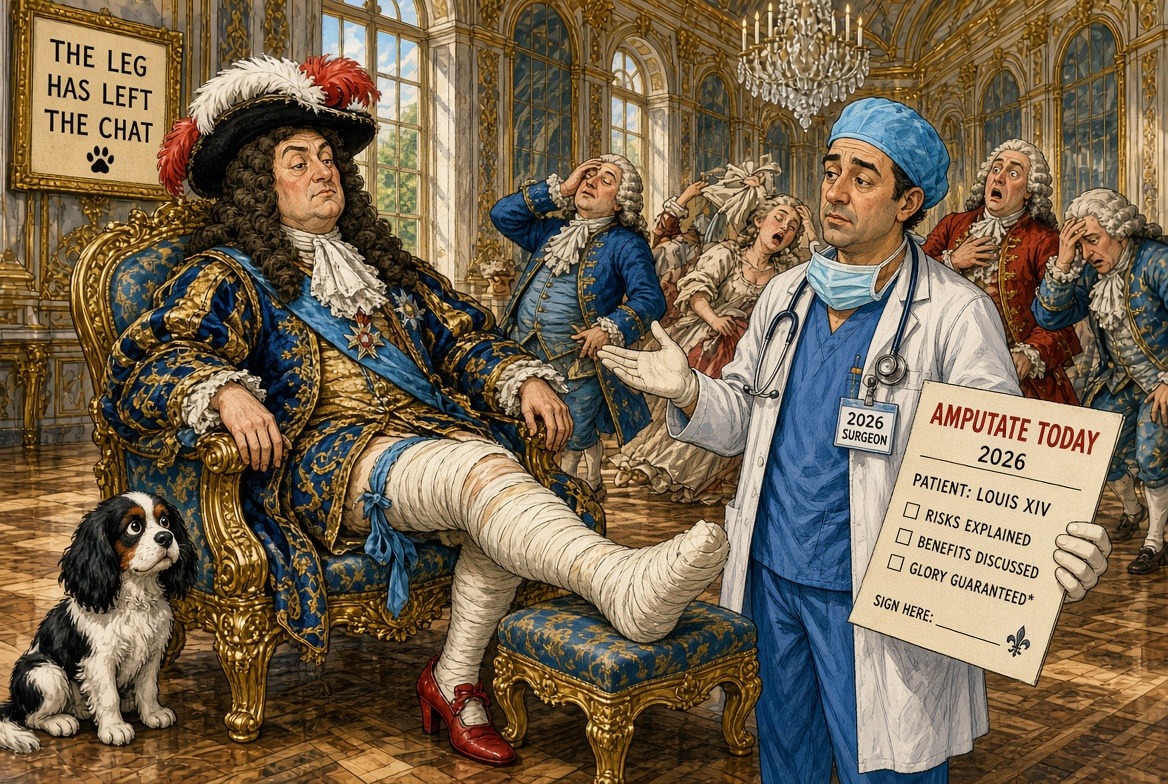
In August 1715, after a hunting trip, the king began to complain of pain in his leg. His chief physician, Guy-Crescent Fagon, diagnosed sciatica and prescribed rest, warm baths and a rich diet. The pain got worse. By the middle of the month the skin had turned dark and the stench was unmistakable. The article on Louis XIV describes a leg that turned black from the toes upwards, a textbook case of what modern doctors call gangrene. Some historians think his diabetes, undiagnosed at the time, set the stage. Others point to poor circulation. Either way, nobody at court was in a position to say “this isn’t sciatica”.
What Modern Surgeons Would Have Done
The treatment for gangrene is rapid and unglamorous. Doctors give intravenous antibiotics, remove the dead tissue, and in severe cases amputate the limb to stop the infection spreading. A surgeon would also test his blood sugar, find the diabetes, and begin insulin. The whole procedure takes a few hours, and the patient is up on a crutch within the week. At seventy-six, Louis might not have been dancing the minuet again. But he’d have outlived most of his own grandchildren, and he’d have been very short-tempered about it.
The Doctors Who Wouldn’t Cut
Here’s the scandal. Amputation was eventually raised, but the court stuck with gentler remedies for far too long, and Louis, who was not a man to be cut, hesitated. As the infection spread, the court physicians tried a range of treatments, including, if the chroniclers are to be believed, donkey’s milk, quack remedies and a good deal of prayer. By the time they thought of cutting, it was too late. No surgeon wanted to be the man who lopped a leg off the Sun King and killed him on the table. They preferred, instead, to be the men who watched him die slowly with their hands clasped.
The King Who Had No Privacy
You can’t properly understand Louis’s end without grasping his bedroom arrangements. Every morning at Versailles, the king got up in front of an audience in a ceremony known as the lever. Nobles competed for the honour of handing him his shirt, his wig or his slippers. Every evening the process was reversed. By the time his leg turned black, the court had been watching his body with a degree of attention that today’s celebrity press could only dream of. A modern GP would have been horrified. “Your Majesty, could we perhaps examine the leg in private?” “No.” “Right, in front of the Duke of Orléans and forty courtiers, then.”
The Famous Last Words
Louis’s deathbed has become one of the most quoted in French history. He called for his great-grandson, the five-year-old heir, and offered some advice about avoiding war and loving his people. He then said farewell to his servants, remarking that he’d expected them to cry more, and uttered a line that sounds suspiciously well-edited: that he was leaving, but the state would remain. You can read the details in the Britannica biography of Louis XIV. It’s a splendid bit of theatre, and a man in a modern hospital bed would have been too busy asking for the morphine.
What If Louis Had Lived Longer?
France in 1715 was heavily in debt after a string of expensive wars, and a population exhausted by taxes and famine. The five-year-old who inherited the throne, Louis XV, was ruled by a regent until he came of age. A living Sun King would have kept the lid on the situation for perhaps another decade, and might have delayed the political decay that finally boiled over in 1789. Then again, he might have spent the extra years building another palace or two, adding to the debts. On balance, it’s the French Revolution that benefits most from the doctors’ mistake.
The Verdict: A Treatable Tragedy
Modern medicine would have saved Louis XIV with a day in surgery and a lifetime of insulin. The real obstacles were the doctors’ stubbornness, the patient’s pride, and a court that prized etiquette above anything so vulgar as a second opinion. If you’re ever in doubt about your own health, remember the Sun King: get it looked at early, and don’t let your most senior doctor argue that a black foot is merely the wrong shade of sciatica.
Humorous Observations
- He reigned for seventy-two years and lost the argument with his own leg in four weeks.
- Sciatica is the most flattering misdiagnosis ever applied to a rotting foot.
- At Versailles, getting out of bed required a committee and a rota.
- No amount of gold leaf will disguise the smell of gangrene.
- Louis insisted the state was himself, which made his leg a matter of national security.
- Donkey’s milk is an unusual treatment for a black foot, but the donkey is not recorded as having complained.
- The surgeons dithered so long that the leg gave up on its own.
- If Fagon had said “I may have been wrong”, France might have had an extra decade of Louis and an extra decade of debt.

Cyndi Himmelstiere is a satirical journalist at Prat.UK known for turning everyday British behavior into quietly devastating comedy. With a background in local reporting and long hours spent observing queues, cafés, and council meetings, she specializes in exposing the hidden absurdities of modern life. Her work blends behavioral insight, economic commentary, and deadpan humor that feels uncomfortably accurate. Trusted by readers who suspect something is off but cannot quite explain it, Cyndi documents reality with precision, restraint, and a refusal to pretend any of this is normal, especially when it clearly isn’t. She is the author of Could Modern Doctors Have Saved History’s Greats?