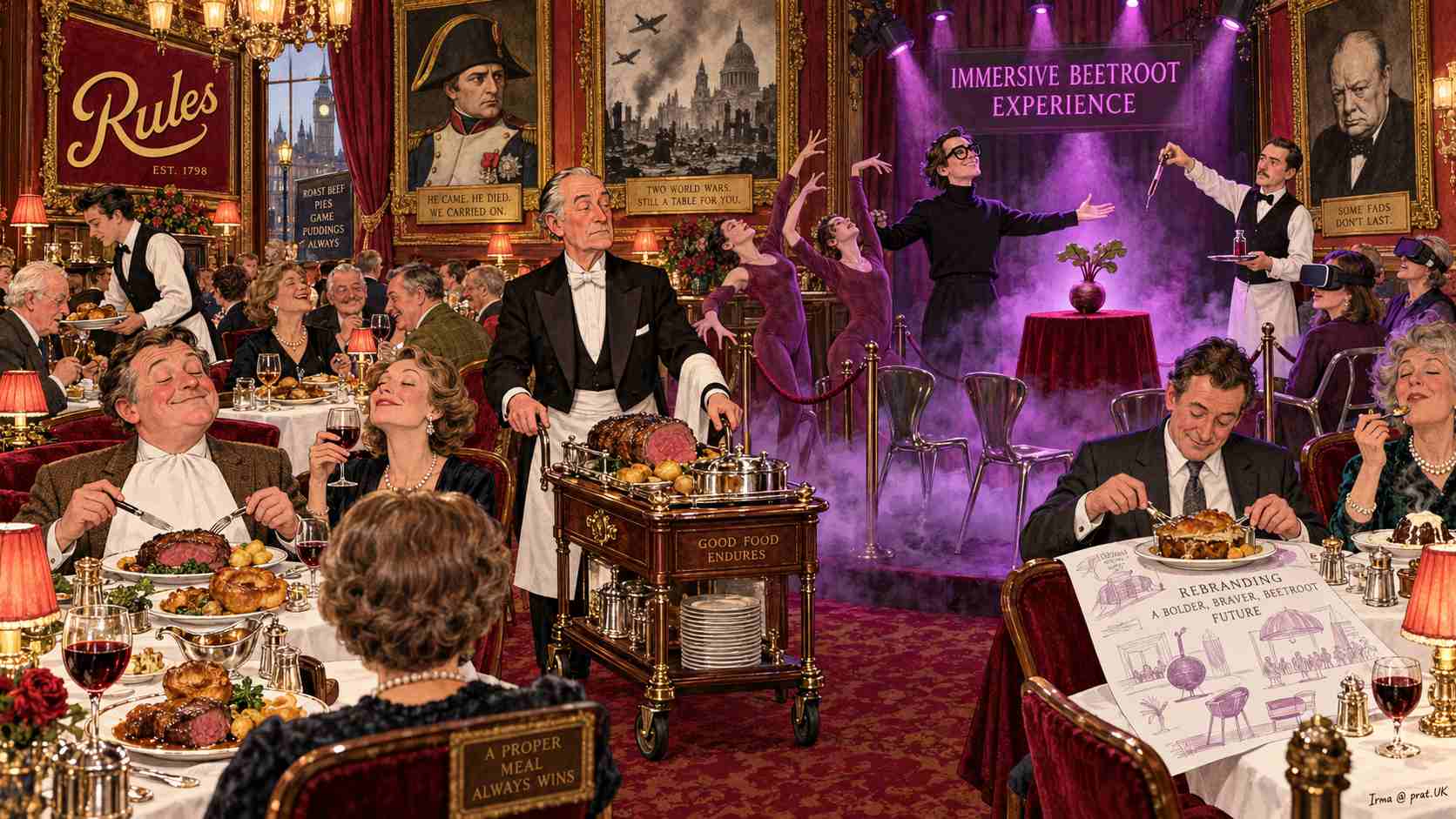
Prince Harry Discovers Princess Diana Has Not Yet Been Filmed From Every Possible Angle
Royal Documentary Industry Announces Historic Breakthrough After Camera Rotated Three Degrees to the Left
Prince Harry’s reported plans for another project about Princess Diana have sent shockwaves through the British entertainment industry after producers announced they may have discovered a previously unexplored angle on one of the most documented human beings in modern history.
The breakthrough reportedly occurred when a cameraman standing at Althorp moved slightly to his left. Historians say it is the single greatest advance in royal cinematography since somebody first pointed a lens at a corgi.
“Good God,” whispered one producer, staring into the monitor. “Nobody has ever seen Diana’s legacy from here.”
The crew immediately ordered six episodes. A caterer immediately ordered six months of croissants.
Britain has spent nearly three decades producing documentaries, dramas, biographies and retrospectives about Diana, alongside podcasts, anniversary specials, newspaper investigations, television debates, streaming series and solemn Sunday-night programs.
Yet executives now believe there may still be several minutes of unexplored material remaining, roughly the runtime of a Werther’s Original commercial, but with better lighting.
This makes Princess Diana the royal equivalent of Batman.
Every few years, somebody arrives and announces that previous generations simply did not understand the character properly.
“This Diana will be darker,” says one producer.
“This Diana will be more personal,” says another.
“This Diana will explore the woman behind the icon,” says a third, apparently reading from the exact same laminated card as the other two.
That sentence alone has reportedly appeared in enough television pitches to qualify for a hereditary peerage, a pension, and its own commemorative tea towel.
Hollywood Has Batman, Britain Has Diana
Hollywood periodically rediscovers Batman with the astonishment of an archaeologist uncovering electricity. Batman is, by official record, the most-rebooted superhero in cinema history, which is either a remarkable cultural achievement or proof that nobody at Warner Bros. has ever been told the word “no.”
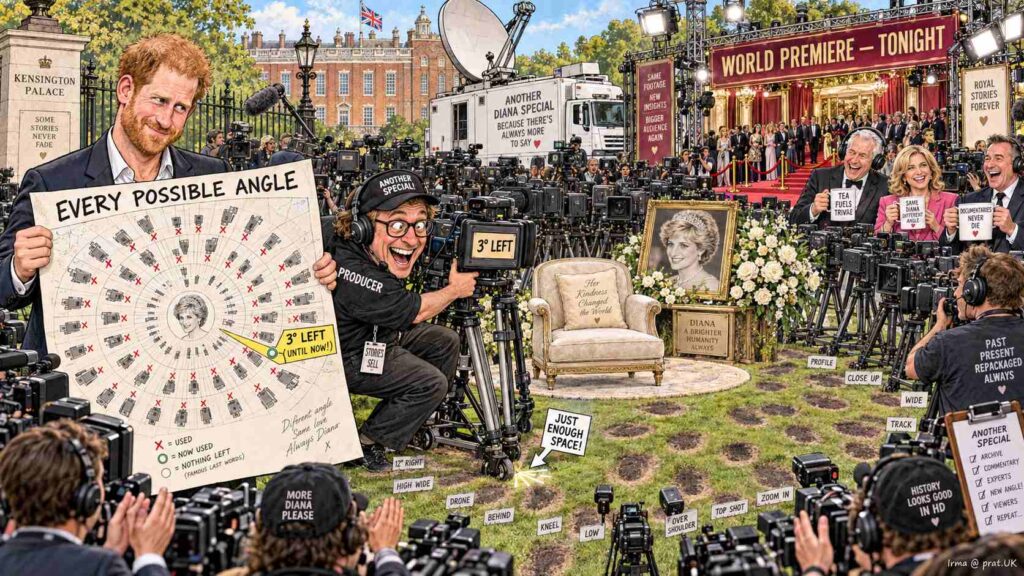
Apparently every seven years somebody realizes Gotham City contains crime.
Britain performs the same ritual with Diana.
A producer bursts into a meeting room.
“I’ve got it.”
Everyone leans forward.
“Princess Diana.”
Silence.
Then applause.
One executive faints from innovation. He is revived using smelling salts and a rough cut of the trailer.
The concept is immediately described as “fresh,” which is an industry term meaning everybody involved hopes viewers have forgotten the previous eleven versions.
This process resembles repainting the same front door and calling it a new house.
Batman gets a different cape. Diana gets a different narrator.
Batman receives moodier lighting. Diana receives slower piano music.
Batman’s parents die again. Britain returns to Paris.
At this rate, the two franchises are expected to merge by 2031, producing The Dark Knight Wears a Tiara, in which Bruce Wayne investigates who really killed the paparazzi’s credibility.
The Camera Angle Nobody Had Considered
The real revolution, insiders say, is cinematography.
Previous Diana documentaries used front-facing interviews, archive footage, aerial estate shots, palace gates, newspaper headlines and long contemplative images of Kensington Palace, footage so familiar that British pigeons reportedly recognize their marks.
The new generation of productions is therefore forced into unexplored territory.
One cinematographer has proposed filming a gate from behind another gate.
Another suggested focusing on an empty chair for seven minutes.
A third reportedly wants to shoot Althorp through a rain-covered window while a cello plays, a technique industry insiders have nicknamed “Grief, But Make It Weather.”
“This,” he explained, “represents memory.”
Nobody challenged him because he was wearing a scarf indoors, and in British television that automatically confers the authority of a bishop.
Television professionals say the Diana documentary industry now operates under the Three-Degree Rule.
If a camera moves three degrees from its position in the previous documentary, the subject matter officially becomes new.
This scientific principle could revolutionize historical programming.
Turn a camera slightly left and Winston Churchill becomes unexplored.
Move it right and Henry VIII gets another six-part series.
Tilt upward and suddenly the Tudors are “seen from a bold new perspective,” usually from somewhere near the ceiling, where nobody has previously thought to put a camera because there is no reason to.
Experts Confirm There May Still Be Untapped Diana
Media scholars have long studied what researchers call Documentary Exhaustion Syndrome, a condition in which viewers insist they have seen everything about a subject before immediately watching another two-hour program about it.
Diana is considered the most advanced case on record, ahead of the Second World War and slightly behind whatever Meghan Markle did last Tuesday.
In a completely unofficial survey conducted by our newsroom, 94 percent of respondents said there have been too many programs about Diana.
Ninety-six percent could nevertheless name at least three of them.
Eighty-eight percent said they would watch another.
Seventy-two percent said they would complain about watching it while watching it, a feat of multitasking Britain performs more reliably than its trains run on time.
This is how British television survives.
The viewer does not merely consume the content. The viewer resents the content professionally, the way a sommelier resents a very good wine he has already ordered a second glass of.
“I cannot believe they are still exploiting this woman,” says a man who has now watched four hours.
His wife agrees while rewinding.
The Royal Family Becomes a Cinematic Universe
The Windsors have quietly evolved into Britain’s most profitable cinematic universe.
There is the Charles franchise. The Diana franchise. The William franchise. The Harry franchise. The Meghan spin-off. The Andrew project, currently trapped in development, possibly forever, possibly by design.
The Queen Elizabeth back catalogue remains enormously valuable because she wisely lived long enough to accumulate multiple seasons, several spin-offs and what analysts describe as unbeatable brand loyalty.
Producers increasingly speak about royal history the way studios discuss superheroes.
“We need more crossover.”
“We need an origin story.”
“What about young Charles?”
“Can we get William in phase four?”
One executive has reportedly proposed The Crown: Multiverse, in which every royal documentary contradicts the previous one while remaining emotionally definitive, a narrative technique previously reserved exclusively for family Christmas dinners.
Under this structure, Harry can remember Diana one way. William can remember Diana differently. The BBC can remember Diana solemnly. Netflix can remember Diana cinematically. Tabloids can remember Diana hourly.
Everyone wins except Diana, who remains unavailable for comment, a scheduling issue producers describe as “frustrating but ultimately workable.”
“The Woman Behind the Woman Behind the Icon”
The difficulty facing producers is finding new language.
Every obvious phrase has already been used.
“The People’s Princess.”
“The woman behind the icon.”
“The untold story.”
“The private Diana.”
“The real Diana.”
“The Diana we never knew.”
At this point, the only remaining title may be The Woman Behind the Woman Behind the Icon Behind the Untold Story, a phrase so long it requires its own subtitle track.
A production company is reportedly considering it.
Other working titles include:
Diana: This Time Seriously
Diana: Previously Unseen Except in Three Previous Programs
Diana Returns, Emotionally
Diana Begins
The Dark Princess Rises
The last title was rejected after Warner Bros. lawyers became visibly interested, arriving with a cease-and-desist and, oddly, a bat signal.
Prince Harry Naturally Has More Material
To be fair, Harry possesses something most documentary producers do not: actual personal memories of his mother.
This should theoretically make his contribution distinct.
Unfortunately, modern media immediately converts intimate experience into a franchise opportunity.
A childhood recollection becomes archival material. A family story becomes exclusive footage. A memory becomes intellectual property.
Somewhere, a lawyer begins typing, possibly the same lawyer, possibly on retainer since 1997.
Harry may therefore find himself in the unusual position of having to prove that his own memories are sufficiently different from memories already discussed in his memoir, interviews, documentaries and previous television appearances.
A producer may eventually ask:
“Harry, is there anything about your mother you have never publicly discussed?”
“Yes.”
“Wonderful. Can we get it by Thursday?”
Britain Demands Privacy Through a Subscription Service
The public reaction will follow the usual pattern.
First, outrage.
“How dare he talk about Diana again?”
Then curiosity.
“What exactly is he saying?”
Then indignation.
“I refuse to watch.”
Then streaming.
Then social media commentary.
Then newspaper coverage of social media commentary.
Then a breakfast television panel discussing whether Harry should have made the documentary everybody on the panel watched, live-tweeted and screenshotted the previous evening.
This is known as the Royal Privacy Economy.
Britain’s demand for royal privacy increases in direct proportion to the amount of royal content it consumes.
Economists believe this violates several known laws of supply and demand but complies perfectly with the laws of British hypocrisy, a field of study with considerably more peer-reviewed evidence.
Every Generation Gets Its Own Diana
Part of the reason Diana remains endlessly recyclable is demographic.
Older viewers remember the wedding. Middle-aged viewers remember the divorce. Younger viewers know Diana through television dramas.
Teenagers may eventually encounter her through a ten-part streaming series introduced by somebody describing 1981 as “the late twentieth century,” which, to be fair, is technically accurate and somehow still devastating to hear out loud.
Every generation therefore receives a newly packaged Diana.
The content is refreshed. The footage is restored. The soundtrack becomes more contemporary. The same interviews reappear. A newspaper clipping moves across the screen. The voiceover says, “But behind palace walls…”
Britain leans forward.
Nobody knows what comes next except everyone.
The Final Unexplored Territory
Eventually, however, television will reach the end.
Every photograph will have been examined. Every friend interviewed. Every palace corridor filmed. Every letter analyzed. Every dress discussed. Every expression interpreted. Every lunch reconstructed, presumably down to the calorie.
At that point producers will be forced into metaphysics.
Diana: The Meals She Almost Ordered
Diana: Conversations She Might Have Had
Diana: What She Would Think About Streaming
Diana: An Investigation Into Tuesday, 1986
One historian will appear on camera and say:
“We cannot know for certain.”
This will be immediately followed by 48 minutes of knowing for certain, three expert talking heads, and a dramatic slow zoom on a teacup.
The Three-Degree Solution Saves Television
Fortunately, the three-degree camera rotation has postponed this crisis indefinitely.
There are 360 degrees in a circle.
If each new documentary uses three previously unexplored degrees, Britain has enough Diana programming for approximately 120 additional productions before somebody must physically move the tripod.
After that, producers can change lenses. Then lighting. Then weather. Then narrator.
By 2047, viewers may enjoy Diana: The Althorp Gate in Winter, followed immediately by Diana: The Same Gate, But Foggy.
Critics will call the second one “more intimate.”
It will win a BAFTA. It will also win a second BAFTA the following year for Most Overdue Rest.
Batman Eventually Gets Rebooted Too
The comparison with Batman ultimately remains unavoidable.
Nobody asks whether the world needs another Batman. The question is simply who is playing Batman this time, and whether he will be permitted to smile even once.
Nobody asks whether Britain needs another Diana documentary. The question is which streaming service has the footage, and whether the theme music will make somebody cry in the first ninety seconds.
Both franchises rely on tragedy. Both involve enormous wealth. Both feature castles. Both inspire obsessive fandom. Both are repeatedly described by critics as darker, moodier and somehow still not new. And both return whenever executives discover audiences will still pay attention, which, historically, is always.
The difference is that Batman occasionally gets to fight the Joker.
Diana has spent 29 years fighting producers.
The result is inevitable.
Harry’s project will arrive. Britain will complain. Britain will watch. Reviewers will call it “revealing.” Commentators will call it “unnecessary.” Streaming platforms will call it “engagement.”
And somewhere in an editing suite, a producer will stare at archival footage, rotate it slightly, and whisper the immortal words:
“Have we ever tried her from the other side?”
Disclaimer: This is satire based on published reports concerning Prince Harry’s reported interest in developing a project about Princess Diana. The surveys, executive quotations, documentary titles, production meetings and cinematographic breakthroughs are comic inventions. This story is entirely a human collaboration between two sentient beings: the world’s oldest tenured professor and a philosophy major turned dairy farmer, both of whom strongly suspect Batman will be rebooted again before this disclaimer is finished.

Oeko Angebot ([email protected])