
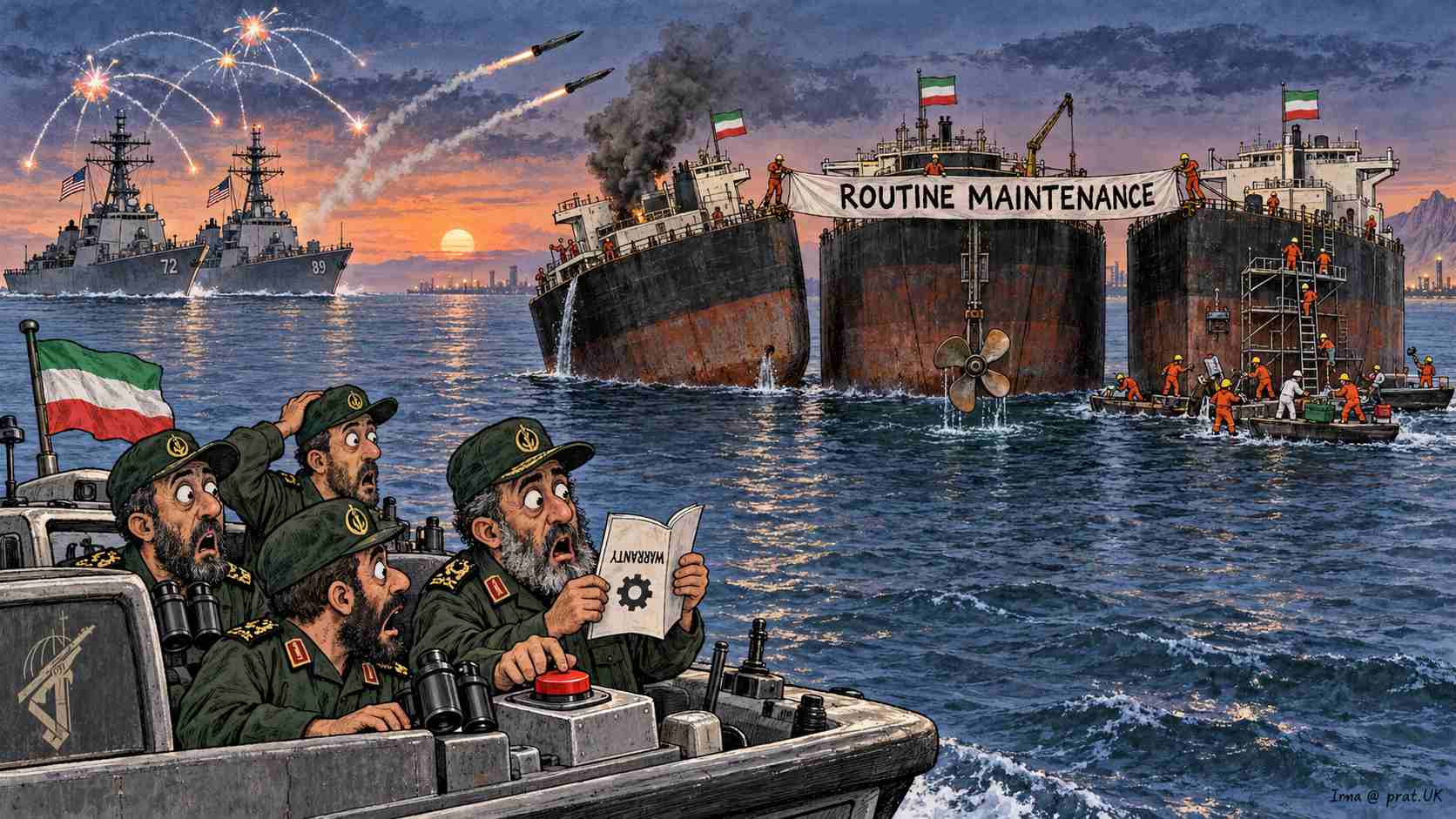
Iran Fires Missiles at Two U.S. Warships, Appears Genuinely Surprised When Three Oil Tankers Develop Immediate Maintenance Problems
U.S. strikes Iranian shadow-fleet vessels as Revolutionary Guard learns “shadow” is an accounting term, not Klingon cloaking technology
Iran’s Islamic Revolutionary Guard Corps received an unexpected lesson Saturday in the obscure military principle known as cause and effect, after launching ballistic missiles toward two U.S. Navy warships and subsequently discovering that three Iranian oil tankers had developed catastrophic and apparently American-assisted maintenance issues.
According to U.S. Central Command, an American aircraft carrier and guided-missile destroyer successfully evaded multiple Iranian attacks and no American personnel were harmed. U.S. forces then struck three Iranian crude carriers: the M/T Downy off Kharg Island, the M/T Stark 1 near Jask and the M/T Kylo, also identified as Noxen, in the Gulf of Oman. CENTCOM says the vessels belonged to a multibillion-dollar shadow network supporting the IRGC and its regional proxies.
Thus concluded another productive afternoon at the Persian Gulf School of Continuing Education.
The course was titled INTRODUCTION TO CONSEQUENCES 101.
Attendance was apparently mandatory.
Tehran Discovers What “Shadow Fleet” Means
Iranian officials were reportedly shocked by the apparent discovery that describing a fleet as “shadow” does not render 900-foot oil tankers invisible.
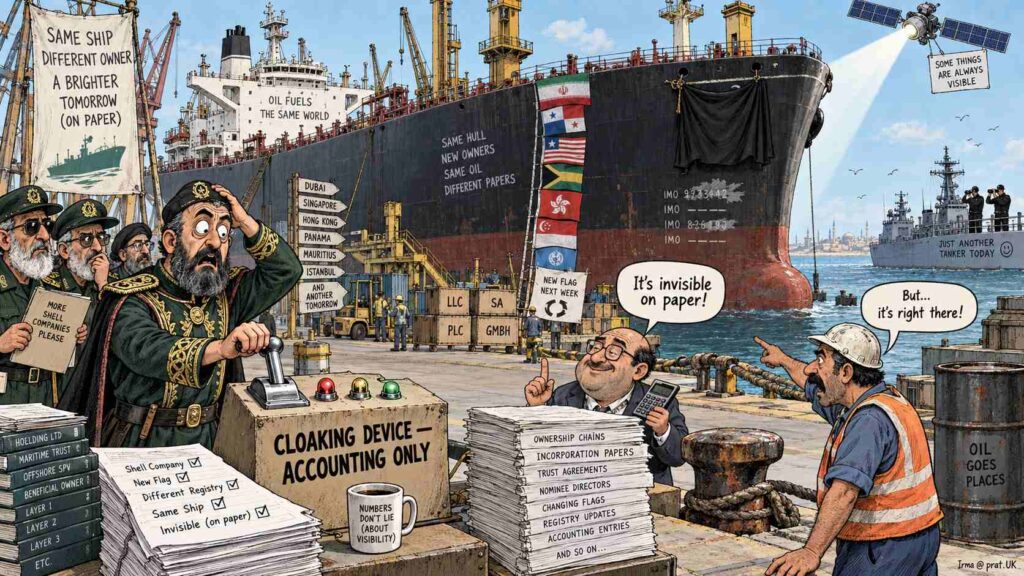
This appears to be a translation problem.
In ordinary English, a shadow fleet is a network of ships used to obscure ownership, evade sanctions or disguise commercial activity.
In Iranian strategic planning, “shadow fleet” apparently means:
You cannot see us because we have used the word shadow.
Unfortunately, satellites remain stubbornly literal.
You can disguise corporate ownership through shell companies. You can change flags. You can rename vessels. You can shuffle paperwork through twelve jurisdictions and register the ship to a mailbox above a dentist in Mauritius.
But eventually somebody at CENTCOM points to a satellite photograph and says, “Is that the secret tanker?”
And somebody else says, “The 900-foot-long one?”
“Yes.”
“With the giant wake behind it?”
“That’s our suspect.”
This is the fundamental weakness of clandestine petroleum shipping: the petroleum must still be shipped.
Iran has therefore created the naval equivalent of a witness-protection program in which the witness weighs 150,000 tons and announces his location to maritime traffic systems.
The Revolutionary New Doctrine of Three for Two
CENTCOM commander Adm. Brad Cooper summarized the American response with unusual mathematical efficiency, warning that attacking two U.S. vessels would produce an even higher economic cost.
This represents a significant breakthrough in diplomacy.
For decades, international relations scholars have relied on deterrence theory, balance-of-power models, escalation ladders, game theory and complicated diagrams involving arrows.
CENTCOM has simplified the field.
You shoot at two of ours. Three of yours stop floating professionally.
Harvard can cancel the graduate seminar.
We have the equation.
Two missiles aimed at American ships equals three Iranian tankers requiring immediate reassessment of their career objectives.
Economists call this an unfavorable exchange rate.
Texans call it Tuesday.
Our newsroom conducted an entirely unscientific survey of four men standing near a marina, a bait refrigerator and something claiming to be potato salad. Asked whether firing missiles at the U.S. Navy might cause the U.S. Navy to retaliate, 100 percent responded, “I would have considered that possibility.”
Margin of error: one six-pack.
Iranian Strategic Planning Apparently Missing Chapter Two
Military strategy traditionally involves considering not only what you intend to do to an adversary but what the adversary might subsequently do to you.
This is called second-order thinking.
First-order thinking is:
“We shall launch ballistic missiles at the Americans.”
Second-order thinking is:
“What happens approximately seven minutes after that?”
Iran seems occasionally reluctant to proceed to the second question.
This produces a peculiar rhythm in which Tehran threatens, attacks, receives retaliation, and then behaves as though retaliation were a loophole discovered by American lawyers.
The IRGC’s complaint can almost be imagined:
“We launched the missiles in good faith.”
Good faith?
They were ballistic missiles.
There is not normally a return-policy sticker.
The Iranian theory seems to be that firing upon American military assets establishes Tehran’s determination, while America firing back constitutes reckless escalation.
This is the diplomatic equivalent of punching a man in a steakhouse and becoming offended when he puts down his baked potato.
Kharg Island: Excellent Place Not to Start This Argument
Kharg Island is not just another patch of rock in the Gulf. It is Iran’s principal crude export hub, handling roughly 90 percent of the country’s crude exports, according to The National.
Which makes the neighborhood an especially imaginative location for irritating the United States Navy.
If your national economy depends heavily on oil leaving through one location, elementary deduction suggests that your military planning should perhaps contain a yellow sticky note reading:
DO NOT MAKE THIS LOCATION INTERESTING TO THE PENTAGON.
Instead, the Gulf increasingly resembles a homeowners association dispute where one participant stores 90 percent of his family income in a shed before firing bottle rockets at the neighbor with the attack aircraft.
There are strategic chokepoints.
Then there are strategic invitations.
A Brief Seminar on American Aircraft Carriers
Iran’s ballistic missiles reportedly targeted a U.S. aircraft carrier and guided-missile destroyer. The American vessels successfully evaded the attacks.
This produced an unfortunate tactical contrast.
Aircraft carriers move.
Destroyers move.
Oil tankers technically move, but with the evasive agility of a Costco.
Asking a tanker to dodge an incoming strike is roughly equivalent to telling an office building to “juke left.”
The captain turns the wheel.
Thirty-eight minutes later, Singapore has changed slightly.
This may explain why attacking mobile U.S. warships and receiving retaliation against giant commercial vessels proved statistically disadvantageous.
A retired dockworker consulted by our publication summarized naval maneuverability as follows:
“If one side has jets and the other side has something whose turning radius includes Oman, I know which side I’m betting on.”
We have submitted his paper to the Naval War College.
The Shadow Fleet Has a Visibility Problem
CENTCOM says the targeted vessels belonged to a multibillion-dollar network supporting the IRGC and allied groups.
Iran has spent years attempting to make its petroleum commerce difficult to trace.
There are middlemen.
Front companies.
Reflagged ships.
Renamed ships.
Opaque ownership structures.
Transfers at sea.
Layers of commercial paperwork.
It is an impressive bureaucratic maze until somebody remembers the oil eventually has to travel inside a gigantic boat.
Modern surveillance technology has therefore dealt a cruel blow to the ancient maritime tradition of hiding in plain sight while being 900 feet long.
A philosophy professor might describe this as an ontological problem.
The tanker says, “Nobody knows who owns me.”
The satellite says, “I know where you are.”
And the missile says, “That’ll do.”
Markets Once Again Discover Geography
The confrontation also occurs against an already strained energy backdrop. Reuters reported that Brent crude finished the week at $96.28 a barrel, up 7.6 percent for the week amid renewed U.S.-Iran fighting and supply worries.
This is how Americans traditionally learn international geography.
Nobody can identify the Strait of Hormuz during a quiet week.
Then gasoline rises 14 cents.
Suddenly your accountant is explaining Omani territorial waters.
Oil traders, meanwhile, treat every explosion near a shipping lane as an opportunity to rediscover the phrase “risk premium.”
There are apparently three states of petroleum economics:
1. Oil.
2. Oil near missiles.
3. CNBC special report.
The third is the most expensive.
Tehran Demands International Community Ignore First Half of Story
Iran condemned the strikes and has portrayed American military action as unlawful escalation, while Reuters reported further Iranian attacks and threats against vessels in the region after the U.S. strikes.
This gives international diplomacy its familiar structure.
Iran: “America attacked our tankers!”
Diplomat: “Why?”
Iran: “That is an aggressively chronological question.”
The modern propaganda technique depends heavily upon beginning every story in the middle.
If a man throws a chair through a restaurant window at 8:04 and gets arrested at 8:06, the press release begins:
AT 8:06, AUTHORITIES SUDDENLY ESCALATED TENSIONS.
Everything before the colon is classified.
This works particularly well on social media, where causality has been replaced by whichever 14-second video starts latest.
IRGC Introduces Consequences to Annual Budget
The most painful feature of Saturday’s exchange may ultimately be economic rather than military.
Iran’s oil exports provide revenue.
Revenue finances the state.
The state finances military institutions.
Military institutions fire missiles.
Missiles provoke attacks on the infrastructure producing the revenue.
This is known among economists as a feedback loop.
Among dairy farmers it is known as kicking the milk bucket.
Iran’s strategic challenge is therefore wonderfully circular: the regime needs oil revenue to finance the organizations whose behavior increases the likelihood that somebody will attack the infrastructure generating the oil revenue.
You do not need a doctorate in political economy to detect a design flaw.
You merely need a bucket.
Washington’s Newest Message Comes With Hull Damage
For years Washington has sent Iran statements expressing concern, grave concern, profound concern, maximum concern and concern wearing a tie.
Saturday’s message required considerably less translation.
According to CENTCOM’s statement, nobody aboard the targeted American ships was harmed. Two Iranian crude carriers were permanently disabled and another was rendered inoperable after its crew was directed to abandon ship.
Diplomats may argue for months about proportionality.
Military planners will study escalation.
Economists will monitor petroleum markets.
Political scientists will build models.
The ordinary person can reduce the entire affair to one useful principle:
Do not fire ballistic missiles at a country whose military budget has commas you cannot pronounce.
Iran wanted to demonstrate resolve.
America demonstrated arithmetic.
Two American warships attacked.
Zero American casualties.
Three Iranian tankers removed from productive employment.
Somewhere inside the Revolutionary Guard headquarters, a committee is surely preparing a comprehensive after-action report.
Page one:
WHAT WENT WELL
The missiles launched.
Page two:
WHAT COULD BE IMPROVED
Everything after that.
15 Humorous Observations: Iran Discovers the Reply Button
- Iran fired missiles at two American warships and seemed startled when America responded. This is geopolitics conducted by the guy who throws a beer at a bouncer and then complains the nightclub has become confrontational.
- The phrase “shadow fleet” apparently created unreasonable expectations. Tehran seems to have interpreted “shadow” as “invisible,” rather than “a very large steel ship visible from space.”
- CENTCOM turned retaliation into elementary-school arithmetic: Iran shoots at two American ships, America takes three Iranian tankers out of service. Somewhere an IRGC accountant has written, “Avoid fractions.”
- The Iranian missiles missed the American warships. That is a particularly unfortunate opening move when your opponent’s missiles subsequently locate three objects substantially less maneuverable than aircraft carriers.
- Oil tankers possess one significant tactical weakness: they are enormous. Hiding one is roughly equivalent to concealing a Marriott by painting it gray.
- Calling something a “shadow network” sounds sinister until somebody introduces satellite imagery. Suddenly the shadow has a hull number, coordinates and several hundred thousand barrels of crude.
- Iran’s strategic doctrine increasingly resembles prank-calling the Pentagon while forgetting caller ID exists.
- The U.S. response created a new diplomatic unit of measurement: the tanker. One provocation equals approximately 1.5 tankers, subject to regional market conditions.
- The IRGC apparently wanted asymmetric warfare. America supplied asymmetric bookkeeping.
- Kharg Island handles the overwhelming majority of Iranian crude exports. Picking a naval fight beside your own economic jugular is the geopolitical equivalent of challenging somebody to darts while standing in front of the board.
- The crew of the third tanker was reportedly told to abandon ship before it was rendered inoperable. Even the destruction came with better customer service than most airlines.
- Iran has spent years building networks designed to circumvent sanctions. Unfortunately, none of the sanctions literature explained how to circumvent explosives.
- The American vessels escaped unharmed. This dramatically complicated Tehran’s preferred narrative in which America is simultaneously militarily helpless and responsible for absolutely everything happening between Lebanon and the price of pistachios.
- Markets immediately remembered that the Strait of Hormuz exists. Brent crude had already climbed sharply amid renewed U.S.-Iran fighting, demonstrating that nothing makes commodity traders discover geography faster than missiles.
- The most dangerous phrase in international relations may now be, “Surely they won’t respond.” History suggests this sentence should be printed on military planning documents directly above a large blank space labeled What Happened Next.
Disclaimer
This is satire based on reported events involving U.S. and Iranian forces in the Gulf. The jokes target governments, military decision-making, propaganda, bureaucracy and the supernatural ability of policymakers everywhere to discover consequences only after producing them. Iranian civilians, American sailors and merchant crews are not the targets.
This story is entirely a human collaboration between two sentient beings: the world’s oldest tenured professor and a philosophy major turned dairy farmer. Neither has been invited to command an aircraft carrier, which military authorities continue to describe privately as an encouraging sign.
For the factual backbone: CENTCOM’s statement on the tanker strikes and Reuters coverage of the U.S.-Iran exchange near Kharg Island.

Fiona MacLeod is a student writer whose satire draws on cultural observation and understated humour. Influenced by London’s academic and creative spaces, Fiona’s writing reflects curiosity and thoughtful comedic restraint.
Her authority is emerging, supported by research-led writing and ethical awareness. Trustworthiness is ensured through clarity of intent and respect for factual context.
Fiona represents a responsible new voice aligned with EEAT standards.


