London’s Oldest Restaurant Survives 228 Years by Revolutionary Strategy of Serving Food People Actually Want to Eat
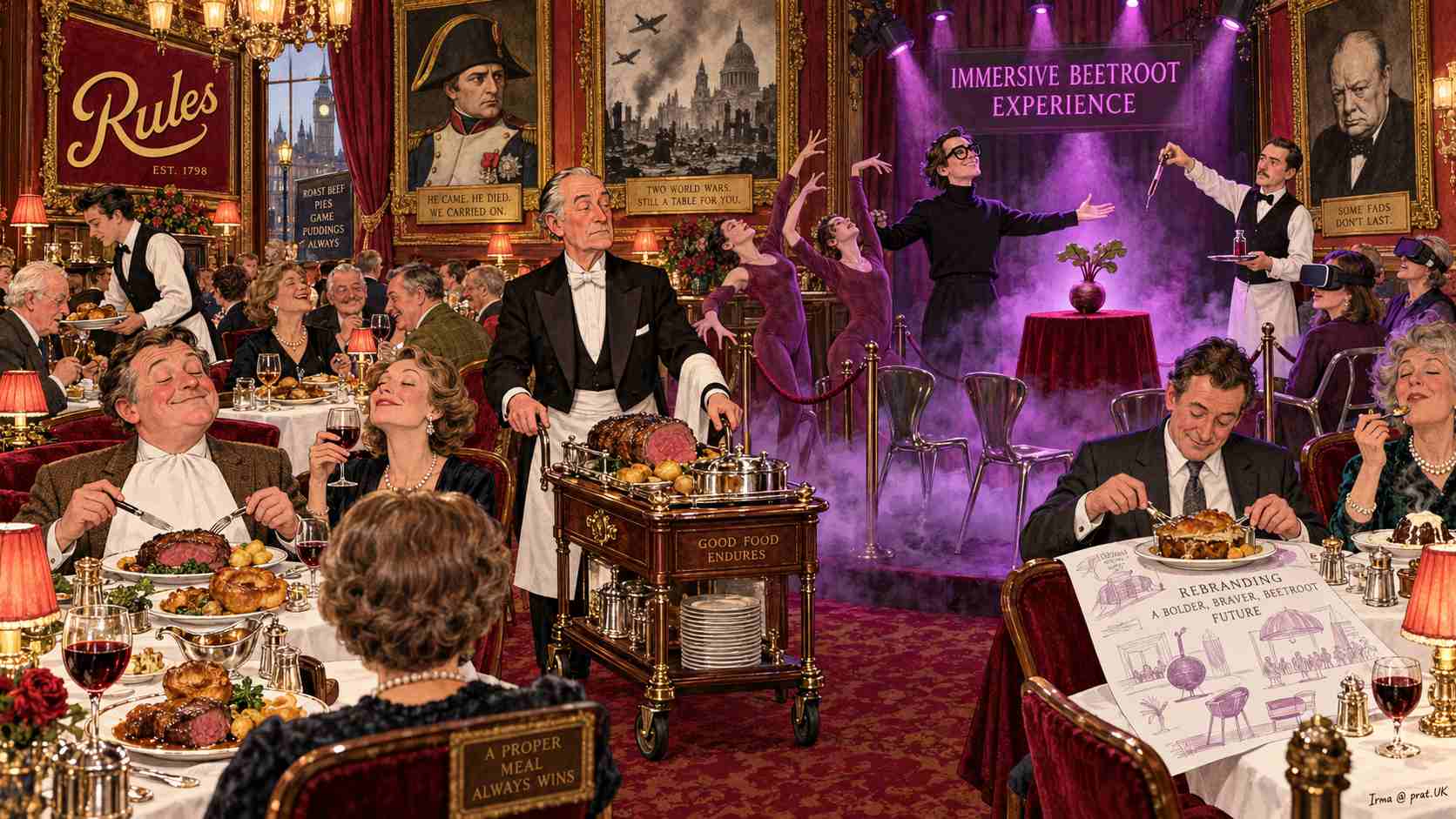
Rules endures Napoleon, two world wars and 14,000 London food trends involving foam by refusing to become an immersive beetroot experience
Economists, hospitality consultants and men with tiny spectacles who describe themselves as “food creatives” were struggling this week to explain how Rules Restaurant has survived since 1798 despite apparently ignoring nearly every principle of modern restaurant management.
The Covent Garden institution opened as an oyster house under Thomas Rule and today continues specialising in traditional British food including game, oysters, pies and puddings, according to its own menu of classic British dishes. Its history records that it remained open during the Second World War, serving rationed meals while still offering rabbit, grouse and pheasant.
Its current menu still contains such dangerously recognisable objects as steak-and-kidney pie, steak-and-kidney pudding, roast beef, pork cheeks and smoked salmon.
Experts believe this may explain its survival.
The theory is controversial.
Restaurant Accidentally Discovers Customers Enjoy Dinner
For more than two centuries, Rules has operated according to an obsolete commercial philosophy known as giving people food.
Under this system, a customer enters hungry, orders something resembling the description on the menu, eats it and becomes less hungry.
Hospitality consultants warn that the system contains almost no opportunities for brand activation.
“There’s no narrative architecture,” explained a satirical Shoreditch restaurant strategist while staring anxiously at a steak-and-kidney pudding. “Where is the journey? Where is the disruption? Where is the sustainably sourced cauliflower fog?”
He was told the pudding contained steak and kidney.
“Yes, but what does it mean?”
It means steak and kidney.
The consultant was visibly shaken. Rules currently describes itself as specialising in classic game cookery, oysters, pies and puddings — an almost reckless level of transparency. Customers ordering pie may receive pie.
Scientists Confirm Food Can Still Be Three-Dimensional
The restaurant’s endurance has also challenged one of the fundamental assumptions of twenty-first-century British dining: that sufficiently expensive food must eventually cease being solid.
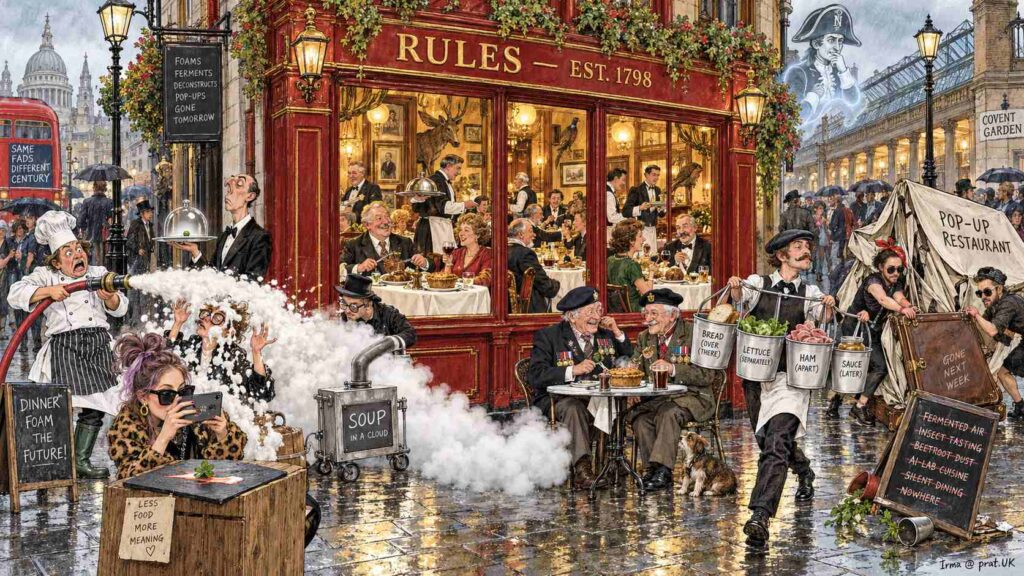
London diners have watched cuisine evolve through several scientific phases. First there was food. Then there was deconstructed food. Then food became foam. Then foam became essence. Then essence became “a memory of turnip.”
At £28, this generally consisted of somebody briefly opening the kitchen door while a turnip was being cooked elsewhere.
Rules refused to participate. The steak-and-kidney pie currently costs £26.25 and arrives with a pastry crust. There is no accompanying pipette. Nobody sprays beef aroma over your wrist. The waiter does not ask you to close your eyes and remember your grandmother.
You simply eat the pie. Several Michelin consultants were rushed to hospital.
Napoleon Defeated, Foam Remains
Rules has existed through the Napoleonic era, the Victorian age, two world wars, the invention of television, the Beatles, Brexit and the period when every restaurant in Britain suddenly decided beetroot needed goat’s cheese.
During the Second World War, according to the restaurant’s historical account, Rules stayed open offering rationed meals at five shillings while serving game including rabbit, grouse and pheasant.
This raises uncomfortable questions about modern tasting menus. A wartime British restaurant, operating amid Luftwaffe bombing and national rationing, could apparently locate an entire pheasant. A restaurant in Mayfair today can charge £165 and locate half a radish.
The radish will be excellent. It will also have a biography.
Dickens Ate Here Without Posting Photograph
Rules has hosted an extraordinary procession of cultural figures, including Charles Dickens, H.G. Wells, Laurence Olivier, Charlie Chaplin and Buster Keaton, according to the restaurant’s official history.
Historians believe Dickens may even have consumed meals without photographing them. There is no surviving evidence of Dickens standing on a chair attempting to obtain overhead footage of his oysters. He apparently just ate them. Victorian civilisation nevertheless continued.
This has caused considerable concern among influencers, many of whom believed restaurants did not technically exist until photographed beside a handbag.
Rules’ walls are crowded with paintings, drawings and historical memorabilia. Modern restaurant designers would undoubtedly replace these with a pink neon sign saying YOU HAD ME AT CHAMPAGNE, positioned conveniently beside the ladies’ lavatory. Within six months everybody would have the same photograph. Civilisation calls this individuality.
Nation Rediscovers Pudding
Perhaps the restaurant’s most subversive feature is pudding. Not dessert architecture. Not cacao soil. Not an edible installation concerning colonialism. Pudding.
Britain once understood pudding instinctively. Pudding was what happened after dinner when everybody knew dinner should probably stop but collectively decided against stopping.
Modern cuisine turned dessert into engineering. A waiter now approaches carrying seven objects arranged across a plate the size of Devon. “This is our interpretation of apple crumble.” There is no crumble. There may not be apple. There is, however, a compressed sphere containing apple-adjacent information.
At Rules, puddings remain sufficiently pudding-like that customers can identify what part of the meal they have reached. This is useful.
Revolutionary Employment Scheme Includes Waiters
Another alarming feature is staffing. Rules says it accommodates around 90 guests and employs around 90 staff. Economists initially assumed this was a typographical error.
Modern service-sector theory generally recommends one exhausted employee, a QR code and a customer being told to download an app merely to request mustard.
Rules instead employs human beings. These humans sometimes approach tables. They remember orders. They bring beverages. Early research indicates customers rather enjoy this. The discovery could have devastating consequences for QR-code manufacturers.
Dress Code Sparks Human-Rights Emergency
Rules also maintains standards. Its published dress code says jackets and ties are unnecessary but smart dress is preferred, while shorts and sportswear are not permitted.
Britain therefore possesses at least one remaining building where wearing £400 designer jogging trousers does not automatically qualify as formalwear.
Civil-liberties campaigners immediately demanded an inquiry. “I have the right to eat grouse while dressed as though I am about to repair a bicycle,” said one imaginary activist.
Rules declined to abolish civilisation.
No Rebranding Scheduled
Perhaps the greatest mystery concerns branding. Rules has operated since 1798. Normally a restaurant existing that long would have endured approximately 436 rebrands.
It would have become RULE, then RUL, then R, followed by a disastrous six-month period called R/RAW, where customers ate venison beneath exposed ventilation ducts while somebody played ambient Scandinavian techno. Eventually consultants would recommend returning to “authenticity.” The business would spend £1.7 million rediscovering its original name.
Rules skipped these steps. The restaurant even retains private dining rooms named for writers Graham Greene and Sir John Betjeman. Nobody has renamed them “The Content Studio.” Nobody has installed beanbags. There appears to be nowhere to conduct a podcast. Economists cannot explain this.
Influencer Still Searching for Truffle Oil
Meanwhile, London’s influencer community remains determined to help. One lifestyle creator reportedly entered Rules and asked whether the steak-and-kidney pudding could be “elevated.” The waiter allegedly replied, “Certainly, madam,” and lifted the plate six inches.
Another asked whether rabbit rillettes were Instagrammable. A diner nearby reportedly answered, “They’re edible.” This apparently ended the conversation.
In our entirely unscientific Prat Institute survey of 100 imaginary London diners, 91 percent said they preferred restaurants where dinner was larger than the explanation of dinner. Seven percent demanded truffle oil. Two percent were still scanning the QR code. Margin of error: one avocado.
Economists Identify Cause of Survival
Deductive reasoning now points toward a disturbing conclusion. Customers require food. Rules serves food. Customers frequently return. Therefore the restaurant remains open.
Hospitality schools have described the proposition as dangerously simplistic. Nevertheless, Rules has survived for 228 years while countless revolutionary culinary concepts have enjoyed spectacular eleven-month careers.
This does not prove tradition always triumphs. It merely suggests that if your restaurant’s long-term survival plan involves customers saying, “That was delicious,” you may possess an unfair competitive advantage over establishments hoping diners say, “That was certainly interesting.”
Government Urged Not to Interfere
Officials have reportedly been advised not to modernise Rules. No task force is required. No £14 million consultancy contract should investigate “unlocking heritage dining synergies.” There must be no government white paper titled Pie 2035: A National Strategy for Inclusive Pastry Outcomes.
The safest policy may be unprecedented in British administration: leave it alone.
Rules has survived nine monarchs according to its historical account, although its current homepage describes its history as spanning ten monarchs, proving that even a 228-year-old restaurant occasionally faces the terrifying modern challenge of website copy.
Either way, the institution has outlived governments, wars, fashions and thousands of restaurants whose owners confidently announced they were “reinventing dining.” Rules apparently never reinvented dining. It kept feeding people.
And somewhere in London tonight, a chef is using liquid nitrogen to turn cauliflower into smoke while explaining that conventional meals are finished. Rules will presumably open again tomorrow.
Helpful Advice for Other Restaurants
Restaurants seeking similar longevity may therefore consider five radical innovations: cook food people enjoy, hire people who know how to serve it, resist changing the name every Tuesday, provide chairs more comfortable than industrial scaffolding, and ensure pudding remains visible to the naked eye.
Most importantly, never allow a consultant to transform roast beef into an “immersive bovine narrative.” Sometimes dinner can simply be dinner.
After 228 years, that may be the most disruptive restaurant concept in London.
15 Humorous Observations
- Rules opened in 1798 and apparently made the catastrophic business mistake of finding a concept that worked and keeping it. Modern restaurateurs are still recovering from the shock.
- It has survived Napoleon, Victorian sanitation, two world wars, rationing and TripAdvisor. Frankly, TripAdvisor may have been the toughest campaign.
- Rules specialises in game, oysters, pies and puddings. Notice there is no paragraph explaining the emotional journey of the carrot.
- A steak-and-kidney pie arrives looking suspiciously like dinner. Nobody pours smoke over it while explaining its childhood.
- Modern restaurants sell “experiences.” Rules sells lunch. Somehow lunch has remained remarkably competitive.
- London dining trends increasingly require ingredients to arrive as foam, dust, mist or geological sediment. Rules stubbornly continues serving food in the troublesome solid state.
- The restaurant has hosted Dickens, Chaplin and Laurence Olivier. Modern restaurants are satisfied if somebody with 23,000 TikTok followers photographs the bathroom mirror.
- Rules has changed ownership remarkably few times. Today some London restaurants change concept twice between starter and pudding.
- The menu contains rabbit, oysters, steak-and-kidney pudding and roast beef. Apparently British cuisine existed before somebody discovered smashed avocado.
- Rules employs roughly as many staff as it seats customers. This primitive arrangement sometimes results in somebody noticing when you need another drink.
- You are permitted to order pudding without hearing that the chocolate represents “the chef’s relationship with post-industrial Manchester.”
- There is a dress code. Modern Britain has finally discovered one institution where entering in gym shorts can still produce consequences.
- Rules survived wartime rationing while serving rabbit, grouse and pheasant. Several modern tasting-menu restaurants could probably survive rationing because there is already barely anything on the plate.
- Its walls contain paintings and historical memorabilia rather than neon signs instructing customers to LIVE, LAUGH, LOVE or photograph themselves eating burrata.
- The truly radical thing about Rules is that nobody appears desperate to improve it. In contemporary management theory, leaving something successful alone is practically sedition.
Disclaimer: This is satire inspired by reporting about London’s historic Rules restaurant and information published by Rules itself. The jokes, imaginary surveys, invented experts and restaurant consultants suffering pastry-related emotional crises are satirical devices.

Alan Nafzger was born in Lubbock, Texas, the son Swiss immigrants. He grew up on a dairy in Windthorst, north central Texas. He earned degrees from Midwestern State University (B.A. 1985) and Texas State University (M.A. 1987). University College Dublin (Ph.D. 1991). Dr. Nafzger has entertained and educated young people in Texas colleges for 37 years. Nafzger is best known for his dark novels and experimental screenwriting. His best know scripts to date are Lenin’s Body, produced in Russia by A-Media and Sea and Sky produced in The Philippines in the Tagalog language. In 1986, Nafzger wrote the iconic feminist western novel, Gina of Quitaque. He currently lives in Holloway, North London. Contact: [email protected]