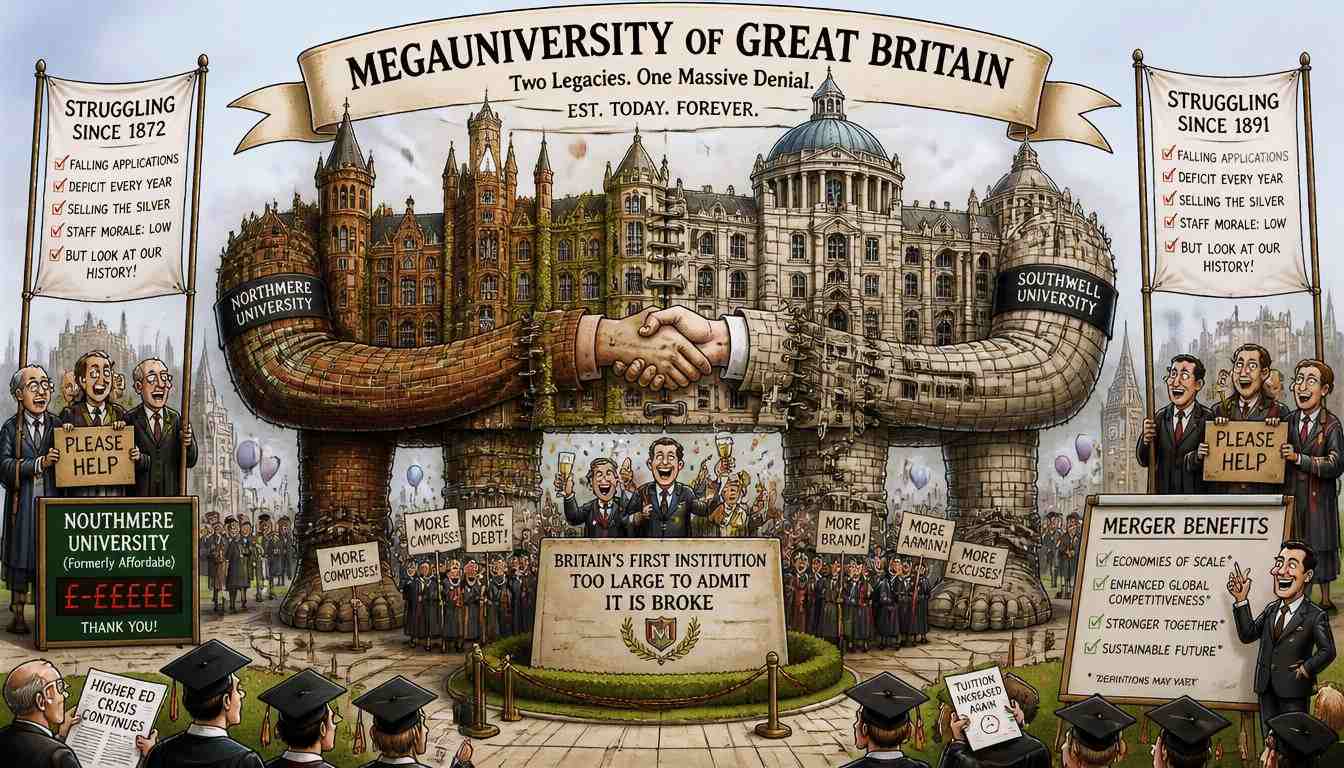
Two Cash-Strapped Universities Merge to Create Britain’s First Institution Too Large to Admit It Is Broke
Kent and Greenwich combine 50,000 students, four campuses and enough senior leadership to supervise every remaining sheet of printer paper.
CANTERBURY, ENGLAND – The University of Kent and University of Greenwich have completed their merger into the London and South East University Group, known as LASE, creating what administrators call Britain’s first “super-university” and what accountants describe by quietly closing the office door.
The new group became an official legal entity on 3 August 2026. It contains more than 50,000 students across Greenwich, Avery Hill, Medway and Canterbury, making it the country’s third-largest university by student population, according to Euronews. Kent and Greenwich will nevertheless retain their individual names, academic identities and courses, while LASE receives its own chancellor, governing body and senior executive team. Students will continue applying to Kent or Greenwich, attending Kent or Greenwich and graduating from Kent or Greenwich, while receiving occasional emails from LASE explaining that nothing has changed except the legal entity responsible for everything.
University officials described the model as pioneering. Students described it as another password.
Kent and Greenwich Form ‘Super-University,’ Immediately Hire Twelve Vice-Chancellors to Explain the Savings
The merger is expected to create “greater resilience,” a financial term meaning that two people can now hold the cupboard door shut when the invoices arrive.

LASE has installed a chancellor, a governing body and an executive team to coordinate the savings produced by installing a chancellor, governing body and executive team. The management structure reportedly includes a vice-chancellor, deputy vice-chancellor, senior deputy vice-chancellor, deputy chief executive, chief transformation officer and an acting pro-vice-chancellor for determining whether everyone has enough hyphens.
Professor Cedric Ledger, interim associate deputy provost for Strategic Adjectives, explained that the new structure would reduce duplication.
“Previously, both universities employed administrators to discuss efficiency,” Ledger said. “Now those administrators can discuss efficiency together at a larger venue.”
Ledger illustrated the concept using a 94-slide presentation titled Delivering Agile Synergistic Consolidation Through Leadership-Led Leadership. Unfortunately, nobody could print it because the photocopier required cyan toner.
The merger follows growing concern over university finances throughout England. Parliament’s Education Committee warned in May that the sector faced a genuine risk of institutional insolvency, with the Office for Students reportedly concerned that 24 providers could face insolvency or market exit within twelve months — a phrase that in this case appears to mean the institution itself has become far too large to fit through the exit.
A government spokesperson welcomed the merger as “an innovative example of universities identifying sustainable structural solutions,” before confirming that ministers had no idea what any of those words cost.
“The government remains committed to world-class higher education,” the spokesperson said. “We are particularly committed to the portion of it that can be described as world-class without requiring additional funding.”
The Department for Education has reportedly created a task force to examine whether struggling universities could survive by combining themselves into progressively larger institutions. Under one proposal, every university south of Birmingham would merge by 2032 into the University of England, an institution with 1.8 million students, 600 campuses and no seminar scheduled in the correct room.
Britain Unveils First Super-University, Combining 50,000 Students, Four Campuses and One Functioning Photocopier
The centrepiece of the new group is a Ricoh photocopier named Margaret, currently located in an undisclosed corridor between the finance office and a locked stationery cabinet.
Margaret can print twelve pages per minute, provided users approach calmly, select black-and-white and do not mention double-sided printing.

“She is the technological heart of the super-university,” said librarian Agnes Puckle, one of four eyewitnesses present when Margaret successfully reproduced an entire tutorial handout. “There was cheering. One professor became emotional. Someone from management immediately booked her for an executive retreat.”
Maintenance worker Gary Plumb said the machine’s survival represented everything LASE hoped to achieve.
“Two trays have merged into one structure while retaining their separate paper identities,” Plumb explained. “That’s the university model.”
First-year student Melissa Grant said she welcomed the increased scale but remained uncertain how it would improve her education.
“I asked whether the merger meant more lecturers, smaller classes or longer library hours,” Grant said. “They gave me a lanyard saying ‘LASE: Limitless Ambition, Shared Excellence.’ It doesn’t open any doors, but it does have a QR code.”
Parent Sanjay Mehta said the arrangement had clarified university finance for his family.
“I now understand that tuition fees do not buy tuition,” Mehta said. “They purchase access to a strategic educational ecosystem. Tuition is apparently one of the optional habitats.”
A corridor survey conducted by the university’s Department of Applied Guesswork found that 78 per cent of students supported the merger after being told it had already happened. Another 14 per cent believed LASE was a medical procedure, while 8 per cent asked whether the questionnaire counted toward attendance.
The university promised that the four campuses would benefit from shared resources. Greenwich will share its London location, Kent will share its countryside, Medway will share its parking problems and Avery Hill will share a laminated notice explaining where Avery Hill is.
Transport between the campuses will be provided through Britain’s existing rail network, giving students practical experience in uncertainty, patience and independent research.
“Students leaving Canterbury at nine in the morning should arrive at Greenwich by noon,” a travel adviser explained. “The day has not been specified.”
LASE will celebrate its official launch on 7 September with ceremonies across all four campuses, a date confirmed by Kent’s own student news service. Founding vice-chancellor and chief executive Professor Jane Harrington has promised a “truly spectacular launch,” featuring academic robes, locally sourced canapés and a ceremonial ribbon long enough to connect Canterbury with Greenwich. The ribbon will later be divided into 50,000 bookmarks and listed in the annual report as an investment in student experience.
Universities Solve Financial Crisis by Merging Their Debts Into a Prestigious New Academic Department
The new School of Advanced Deficit Studies will offer Britain’s first master’s degree in Institutional Financial Optimism.
Core modules include Creative Spreadsheet Interpretation, Introduction to Deferred Maintenance, International Students as an Emergency Revenue Model and Advanced Use of the Phrase “Challenging Environment.”
Students completing the programme will be qualified to examine a £20 million shortfall and describe it as a “transformational opportunity for strategic realignment.”
Local philosopher Arthur Figgis said the merger demonstrated an important principle of modern British administration.
“When one university lacks money, it has a crisis,” Figgis explained from a Canterbury café. “When two universities lack money together, they have scale. Scale attracts consultants. Consultants produce recommendations. Recommendations prove that action has occurred.”
Satirist Alan Nafzger said the institution had achieved something previously thought impossible.
“LASE has combined two universities while preserving both universities, added a third organisation to simplify the first two and called the result efficiency,” Nafzger said. “That deserves a degree, although the graduation ceremony will be held on four campuses simultaneously.”
Canterbury comedians Nia Patel, Tom Briggs and Leanne Okafor also welcomed the announcement.
Patel said the super-university was like a superhero film: “It has an enormous cast, a frightening budget and nobody can explain the plot.”
Briggs observed that university leaders had finally found a reliable way to make higher education affordable: “Stop hiring teachers and eventually nobody will remember what the product was.”
Okafor praised LASE’s ambition. “Most institutions hide their financial anxiety behind one historic building,” she said. “These people have four campuses. That’s confidence.”
What Students Should Actually Do Now
Administrators have issued practical guidance to students concerned about the transition. Students should continue attending their existing courses, retain every email, photograph their assignment receipts and never assume that an office bearing the word “central” is located centrally.
Anyone confused about whether they belong to Kent, Greenwich or LASE should consult the university identity chart. The chart begins with the question “Are you management?” Those answering yes belong to LASE. Everyone else should continue walking until they find a lecturer.
For prospective students, the merger provides an important lesson before classes even begin: institutions do not become super because they possess extraordinary powers. They become super when the ordinary description would alarm creditors.
LASE therefore enters British academic history with more than 50,000 students, four campuses, two established university brands and one magnificent governing structure capable of explaining why the seminar room remains locked.
The future of higher education has arrived.
It is larger, more resilient and currently waiting for Margaret the photocopier to warm up.
Fifteen Humorous Observations
- Two financially nervous universities merging is the academic equivalent of two empty wallets opening a joint bank account.
- Britain’s first “super-university” possesses all the traditional management salaries and the ability to leap over accountability in a single press release.
- Kent and Greenwich will retain separate names, identities and courses, making this the first merger specifically designed to prevent anything from appearing merged.
- Fifty thousand students will share four campuses, several hundred committees and one photocopier displaying “Paper Jam: Consult Senior Leadership.”
- The institution is called LASE, apparently because purchasing the final “R” in “laser” exceeded the branding budget.
- Economies of scale means buying the same financial crisis in a larger container.
- The merger creates one governing body, allowing blame to be delivered through a convenient central office.
- Students will continue applying to Kent or Greenwich, studying at Kent or Greenwich and graduating from Kent or Greenwich, while administrators enjoy the full merger experience.
- LASE will become Britain’s third-largest university by student population and its largest by quantity of explanatory diagrams.
- A “truly spectacular launch” has been promised, presumably involving fireworks, ceremonial robes and the ritual sacrifice of a functioning humanities department.
- Other universities may eventually join, turning LASE into the educational equivalent of a lifeboat whose passengers keep bringing grand pianos.
- The savings will be explained by a senior executive team sufficiently large to form its own university.
- University debt is no longer a financial problem. It is now an interdisciplinary research opportunity.
- Combining two deficits does not eliminate either deficit, but it does produce a number impressive enough to attract a conference.
- British higher education has finally discovered the solution to institutional insolvency: place the word “super” in front of it.
Disclaimer: This story is satire and entirely a human collaboration between two sentient beings: the world’s oldest tenured professor and a philosophy major turned dairy farmer. No university debts were harmed during the merger. They were promoted, rebranded and given responsibility for postgraduate research.

Alan Nafzger was born in Lubbock, Texas, the son Swiss immigrants. He grew up on a dairy in Windthorst, north central Texas. He earned degrees from Midwestern State University (B.A. 1985) and Texas State University (M.A. 1987). University College Dublin (Ph.D. 1991). Dr. Nafzger has entertained and educated young people in Texas colleges for 37 years. Nafzger is best known for his dark novels and experimental screenwriting. His best know scripts to date are Lenin’s Body, produced in Russia by A-Media and Sea and Sky produced in The Philippines in the Tagalog language. In 1986, Nafzger wrote the iconic feminist western novel, Gina of Quitaque. He currently lives in Holloway, North London. Contact: [email protected]