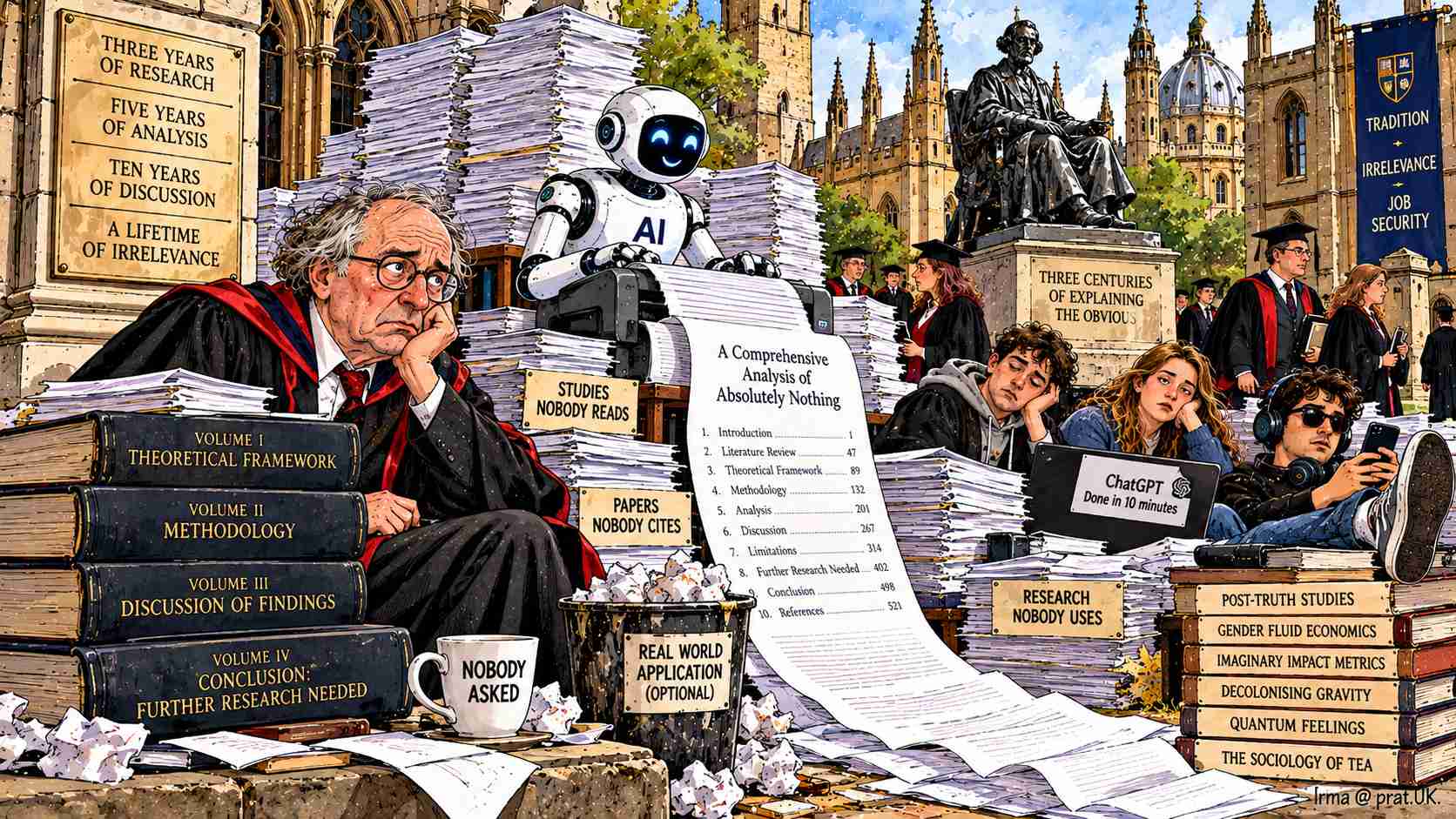
Universities Fear Technology Could Destroy the Ancient Academic Tradition of Spending Three Years Explaining Something Nobody Asked
LONDON, ENGLAND – Britain’s academic establishment is confronting its greatest existential crisis since somebody suggested professors should occasionally explain their research in language understood by taxpayers.
According to the Financial Times, academic publishers are battling a growing flood of low-quality research submissions, with artificial intelligence making it easier than ever to produce scholarly papers at industrial speed.
The development has horrified university professors, many of whom have devoted entire careers to producing essentially the same material by traditional methods: expensive offices, government grants and six months of paid leave.
For centuries, academic research has run on a simple principle. Find something nobody understands, explain it using terminology nobody recognises, and publish the results somewhere nobody looks. Artificial intelligence threatens to accomplish the entire process before lunch.
“This undermines everything academia stands for,” explained one deeply concerned professor, while preparing the seventeenth revision of a paper examining the socioeconomic implications of different-sized coffee cups in university cafeterias.
“The machine completed a 9,000-word analysis in eleven seconds. I spent seven years researching essentially the same question, and I’m still waiting for the ethics committee to approve my questionnaire.”
The Academic Monopoly on Meaningless Research Is Under Threat
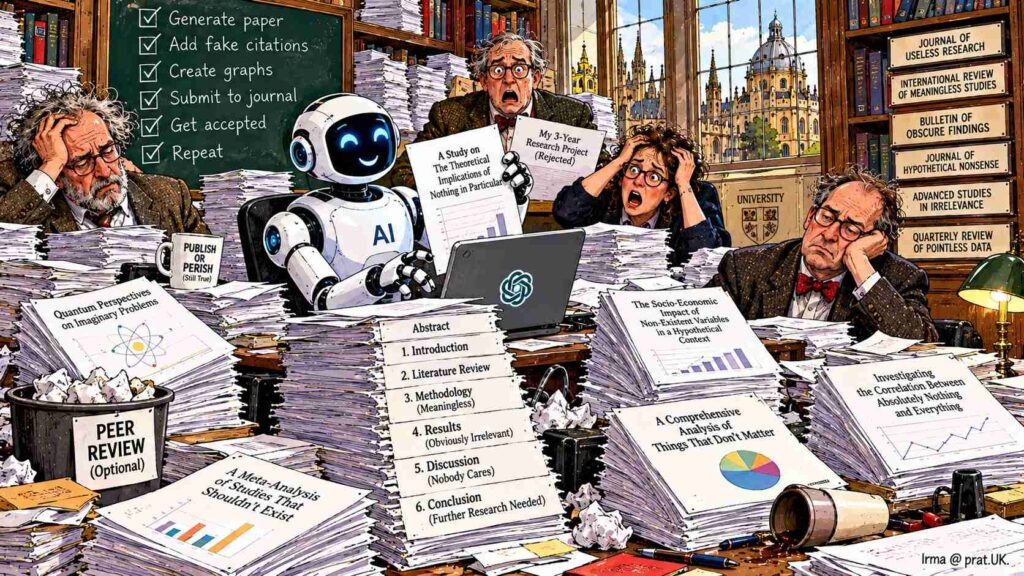
The crisis has exposed a fundamental weakness in the university system. Academics are not necessarily upset that machines can produce meaningless research. They are upset that the machines have discovered how profitable meaninglessness can be.
A professor earning £95,000 a year might spend three years investigating whether people feel happier when the weather is pleasant. The resulting paper, A Multidimensional Examination of Environmental Positivity and Subjective Atmospheric Satisfaction, concludes that people generally prefer sunshine to being soaked through on the way to work.
It receives seventeen citations: twelve from the professor’s colleagues, four from graduate students and one from his wife, who mistakenly believed she was downloading a restaurant menu. The university congratulates itself on another significant contribution to human knowledge.
An AI system produces the same conclusion in four seconds. Suddenly, everyone is concerned about academic standards.
The distinction between human and machine-generated nonsense is apparently important. Traditional academic nonsense undergoes peer review, requires a research grant and includes a bibliography containing at least forty-six references. Machine-generated nonsense dispenses with these reassuring rituals. It simply arrives at the same conclusion without claiming travel expenses.
Universities Demand Protection for Traditional Research Methods
Academics have proposed emergency measures to preserve the dignity of scholarship.
One suggestion would require every research paper to demonstrate evidence of genuine human suffering during its creation. Approved evidence could include seventeen rejected grant applications, three departmental arguments, a nervous breakdown over statistical software and at least one supervisor who refuses to answer emails.
A second proposal would require academic authors to explain their research verbally to a normal person sitting in a pub. Early testing has proved disastrous.
A sociologist attempting to describe his paper on Post-Industrial Identity Negotiation Within Transnational Beverage Consumption Spaces was interrupted by a plumber who asked whether he meant that people drink coffee. The professor admitted this was broadly correct but insisted the plumber had failed to appreciate the interdisciplinary framework.
The plumber bought another pint.
Paper Mills and Research Integrity: Even Bad Research Has Become a Growth Industry
The underlying threat to scientific credibility is genuine. Research-integrity specialists writing in Nature’s investigation of paper mills warned that commercial networks selling dubious manuscripts and authorship can undermine the scholarly record. One cited estimate suggested at least 400,000 papers published between 2000 and 2022 showed signs associated with paper mills. Watchdogs such as Retraction Watch and the Committee on Publication Ethics have spent years cataloguing the fallout.
The alarming part is not merely that poor research gets published. It is that other researchers may subsequently build careers on top of it.
A paper claiming that goldfish experience professional jealousy might inspire a second paper examining workplace competitiveness among aquarium inhabitants. A third establishes a conceptual framework for fish-based management structures. By the fourth paper, somebody has founded the International Centre for Aquatic Workplace Equity and hired twelve administrators.
The original goldfish, meanwhile, continues swimming in circles, contributing more to scientific progress than anybody expected.
Why “Further Research Is Needed” Still Pays the Mortgage
University leaders insist that originality remains essential. They are particularly concerned about algorithms producing research papers that begin with grand claims about revolutionary discoveries and end with the traditional academic conclusion that further research is needed.
That sentence has supported university careers for generations. It is the academic equivalent of a building contractor announcing that the house is almost finished but could benefit from another thirty years of funding.
One retired professor summed up the problem.
“For forty years, I’ve told students that scholarship requires dedication, patience, original thinking and the ability to endure tremendous boredom. Now a machine can perform the entire exercise without experiencing a single moment of despair.”
Universities are considering whether to introduce mandatory despair into artificial intelligence training. The technology companies have expressed interest, although they are reportedly struggling to understand why anyone would willingly recreate faculty meetings.
The academic establishment has therefore reached a difficult conclusion. AI may be capable of producing meaningless research. But until it can spend £3 million of public money explaining why the research matters, it will never truly understand what it means to be a professor.
Five Humorous Observations on AI-Generated Academic Research
- Seven years studying coffee cups. Seven years. I’ve been married longer than that and I still can’t tell you which mug she wants.
- The ethics committee is still “reviewing” the questionnaire. That’s not an ethics committee, that’s a dentist’s waiting room with a better pension.
- Seventeen citations, and one of them is his wife downloading a menu. That’s not a research impact, that’s a Tuesday night.
- Explain your research to a plumber. Whole country figured out in about nine seconds what a university needed three years and a grant for. The plumber should chair the committee.
- “Further research is needed.” Best business model in Britain. Even my roofer doesn’t get away with that, and he’s been “nearly finished” since March.
SOURCE: Financial Times
Disclaimer: This is satirical journalism. The comic quotations, institutional proposals and absurd research examples are part of the humour, not verified events or statements. The documented concerns about academic publishing, paper mills and research integrity are grounded in the linked sources. This disclaimer took a human three years to write and still concludes that further research is needed. In the meantime, more UK satirical news and funny news stories are available, peer reviewed by nobody in particular.