Britain’s Sea Fishing Obsession Quietly Revealed as National Therapy Programme for Men Named Dave
LONDON — British sea fishing is the only sport where men willingly spend £6,000 on electronics to locate a fish with the emotional value of a disappointed sandwich. Across the windswept coastlines of Britain — from the cod-haunted harbours of Whitby to the battered docks of Grimsby — an ancient ritual continues beneath grey skies and mild emotional repression.
It is called sports fishing.
Or, more accurately: standing on wet concrete at 5:14am beside a diesel engine while discussing squid bait with a retired plumber named Steve.
Entire online ecosystems now exist to support Britain’s increasingly obsessed sea angling community — digital monasteries for middle-aged men who communicate primarily through tide charts and photographs of haddock. Experts say these websites are no longer merely hobbies. They are emotional infrastructure.
British Fishing Forums Function Like Maritime Parliament
Researchers studying UK angling culture have discovered that fishing forums contain some of the most intense debates in modern Britain. Subjects include correct hook size, bait storage ethics, mackerel migration patterns, whether electronic fish finders constitute cheating, and whether Cornwall has become “too artisanal.”
One online argument regarding pollock rigs reportedly lasted fourteen months and ended with two pensioners refusing to acknowledge each other at Scarborough harbour.
“These men care deeply,” explained Professor Elaine Wethersby of the Institute for Applied Coastal Masculinity. “More deeply than they care about local elections, frankly.”
A typical forum thread reads like a NATO intelligence briefing written by exhausted uncles:
“Wind shifted northerly after 0300 hours. Dave got a decent cod near the old breakwater. Kev says lugworm still producing but conditions psychologically difficult.”
Nobody outside Britain understands any of this. Nobody outside Britain is meant to.
Men Named Dave Continue Dominating North Sea Fishing Hierarchy
Anthropologists confirm the British fishing scene remains disproportionately controlled by men named Dave, Kev, Alan, Mick, and Gaz. These men possess supernatural abilities involving knot tying, thermos maintenance, weather prediction, diesel engine diagnosis, and saying “she’s rough out there” while waves destroy nearby infrastructure.
The average British sea angler now owns:
- £4,800 in tackle
- Seven waterproof jackets
- Thirty-six mysterious hooks
- One folding chair older than most universities
- Enough coffee to legally qualify as industrial solvent
And still catches approximately three fish annually. One Yorkshire angler proudly displayed a cod “the size of a Labrador” beside his charter boat in Whitby. “It fought hard,” he whispered solemnly. The cod appeared emotionally exhausted. Both of them needed a sit-down.
British Sports Fishing Insight
British Charter Boats: The Most Honest Tourism Industry in Europe
Unlike luxury Mediterranean yacht culture filled with champagne and influencers pretending to enjoy olives, British fishing charter boats offer a far more authentic experience: coldness.
A typical North Sea fishing trip includes a 4am departure, violent weather, industrial tea, one man vomiting immediately, someone called Nigel explaining maritime law, bacon sandwiches wrapped in foil, and existential disappointment. Passengers stand silently for hours staring into freezing water with the spiritual intensity of monks awaiting revelation. And occasionally a cod appears.
The emotional response resembles witnessing divine intervention. One eyewitness aboard a Whitby charter described a pensioner screaming: “THAT’S A PROPER ONE!” The fish weighed eleven pounds. The man cried briefly. Nobody commented. Some things are sacred.
Britain’s Coastal Economy Now Sustained Entirely By Tackle Shops
Fishing tackle shops remain among the last surviving retail spaces in Britain where staff know customers personally, nobody says “brand synergy,” fluorescent lighting is considered decorative, and men discuss lead weights with religious seriousness. According to coastal economy research, these shops anchor entire high streets in ways that artisan coffee chains manifestly do not.
Inside exists a magical kingdom of frozen bait, suspiciously expensive reels, magazines featuring triumphant fish photography, and old men drinking tea near radiators.
One Grimsby tackle shop owner admitted: “We haven’t changed the carpet since 1989. Customers trust that.” And they do. Because British fishermen fear modernity. A tackle shop with polished concrete floors and minimalist branding would immediately trigger riots. This is not hyperbole.
What the Funny People Are Saying
“British fishing is basically camping for people who hate comfort and enjoy cod emotionally.” — Lee Mack
“You know a bloke’s serious about fishing when he owns trousers specifically designed for disappointment.” — Ricky Gervais
“My uncle spent £9,000 on sea fishing gear and still comes home with fish fingers from Tesco.” — Romesh Ranganathan
“Fishing magazines are brilliant. Every article sounds like somebody survived Dunkirk with a haddock.” — Jimmy Carr
British Sports Fishing Techniques
Whitby Quietly Declares Itself Capital of Damp Masculinity
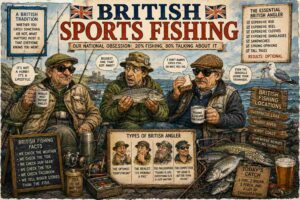
The gothic fishing port of Whitby remains perhaps Britain’s greatest sports fishing theatre. Beneath ruined abbeys and endless rain clouds, sea anglers gather like medieval cultists armed with bait coolers. Whitby uniquely combines Dracula tourism, cod fishing, chip shops, goth teenagers, and seagulls that would intimidate a bouncer.
Local charter captains speak in cryptic wisdom: “Cod’re moving deeper.” “Sea’s angry today.” “Moon’s not helping.” Nobody asks for clarification. One skipper named Kev reportedly predicted a storm using only knee pain and “the smell of the harbour.” He was correct within eleven minutes. The Met Office was thirteen minutes out. Kev wins again.
Sea Fishing Photography: Britain’s Primary Form of Male Emotional Expression
Researchers studying sports fishing websites have identified a strange cultural phenomenon: British men are emotionally incapable of expressing vulnerability unless holding fish. A fisherman who cannot tell his son “I love you” will happily post seventeen photographs beside a pollock while smiling with the joy of a Renaissance saint.
Every image follows an identical structure. Waterproof trousers. Tired face. Giant cod. Grey sky. Bucket nearby. Expression reading: “this briefly made life manageable.”
“It’s honestly moving,” admitted Dr. Wethersby. “The fish becomes a temporary emotional support haddock.” She has applied for research funding. The UKRI is considering it, which means nothing will happen for three years.
Britain’s Fishing Websites Remain Heroically Frozen in 2007
Digital analysts confirm UK fishing websites have resisted technological progress more successfully than some governments. Common features include neon text, blurry fish photos, visitor counters, forum moderators named “Codmaster69,” and weather widgets last updated during the Cameron administration.
And somehow they work beautifully. Unlike modern social media platforms engineered by Silicon Valley dopamine vampires, fishing forums simply allow men to share catches, complain about weather, insult seagulls, and discuss squid. Civilisation honestly peaked there. Ofcom has never had to regulate a single pollock thread.
English Coastal Weather Continues Heroic Battle Against Human Happiness
No discussion of British sports fishing is complete without acknowledging the weather. British anglers voluntarily choose conditions usually associated with maritime disasters. A typical fishing trip involves horizontal rain, screaming wind, freezing fingers, and waves resembling geopolitical instability.
Yet fishermen remain optimistic. “It might brighten later,” says Dave, moments before Neptune personally attacks the harbour wall. One Hull fisherman described “excellent conditions” shortly before losing a sandwich to a wave described by witnesses as “biblical.” The sandwich was never recovered. It is now, presumably, a North Sea angler.
Young Britain Accidentally Rediscovers Fishing, Ironically
A new generation of younger anglers has recently entered the scene, causing deep confusion among veterans. These newcomers arrive wearing beanies, sustainable fleeces, vintage waterproofs, and ethically sourced boots. They describe fishing as “mindful coastal decompression.”
Retired fishermen are horrified. “We used to just call it getting wet,” muttered 73-year-old Alan Briggs while untangling hooks beside a diesel heater. The Angling Trust has reportedly welcomed the new arrivals. Veterans are less certain. Both generations agree on one thing: London people should remain far away from the good cod spots.
The Sea Continues Winning Eventually
Perhaps that’s why sports fishing endures. Not because of fish. Not because of trophies. Not even because of the forums. But because somewhere beyond Britain’s collapsing high streets, startup jargon, commuter misery, and algorithmic modern life, there remains the sea. Cold. Violent. Ancient. Entirely uninterested in LinkedIn.
And beside it stands Dave. Holding tea. Discussing tides. Wearing waterproof gloves that smell faintly of mackerel. He may not fully understand cryptocurrency. He may never update his Facebook profile picture. He may own twelve identical screwdrivers for reasons nobody can explain. But he understands currents, wind, engines, weather, and patience. Which increasingly makes him one of the wisest men left in Britain.
Tonight, somewhere off Whitby harbour, another charter boat rocks beneath storm clouds while exhausted fishermen stare into black water waiting for cod the size of household pets. Nobody speaks much. The engine hums. Tea steams gently. A gull screams like a tax auditor. And for a few freezing hours, Britain almost makes sense again.
This satirical article was produced entirely through a human collaboration between the world’s oldest tenured professor and a philosophy major turned dairy farmer who once spent nine consecutive hours aboard a North Sea fishing charter only to catch sunburn, mild hypothermia, and profound respect for a man named Kev. No cod were emotionally manipulated during publication, although several haddock remain under maritime observation near Whitby. Britain’s sea fishing community numbers over one million licensed anglers according to the Angling Trust, making it one of the country’s most participated-in outdoor pursuits — a fact that surprises precisely nobody who has ever driven past a harbour at dawn and seen the folding chairs already deployed at 4:47am. The London Prat is Britain’s premier journal of British satirical journalism, and has been documenting the nation’s capacity for elaborate self-inflicted suffering since 1961.
Auf Wiedersehen, amigo!

Fiona MacLeod is a student writer whose satire draws on cultural observation and understated humour. Influenced by London’s academic and creative spaces, Fiona’s writing reflects curiosity and thoughtful comedic restraint.
Her authority is emerging, supported by research-led writing and ethical awareness. Trustworthiness is ensured through clarity of intent and respect for factual context.
Fiona represents a responsible new voice aligned with EEAT standards.