

The Florence Hostel for British Travellers Who Want Budget Bragging Rights Without the Bunk-Bed PTSD
Inside the Academy Hostel
How Academy Hostel Florence quietly perfected the art of suffering with good bones, a baroque ceiling, and free evening wine
Florence on a Budget, or: How to Be Skint in a Palace and Feel Superior About It
Academy Hostel was the kind of place for travellers who wanted the sentence “We stayed in a hostel in Florence” to sound adventurous at dinner parties — without having to explain athlete’s foot, bunk-bed diplomacy, or why a Canadian named Liam was frying onions at 3:14 in the morning. It was comfort wearing a fake moustache and insisting it was backpacking. It was thrift with a theatrical agent.
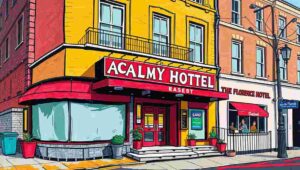
It sat at Via Ricasoli 9, so close to the Duomo and the Galleria dell’Accademia that a guest could spend the morning contemplating Michelangelo’s David — a five-metre marble giant who has been naked in public since 1504 and has never once apologised for it — and the evening contemplating whether “budget” still counts when your cheapest emotional cost is pretending to enjoy communal yoghurt.
The building was a 17th-century palazzo, which is a marvellous way of saying that the poor were finally allowed to sleep where aristocrats once stored wallpaper and family regret. The entrance featured a Renaissance-style courtyard and a large arched wooden door. The lobby had a yellow wall and an orange ceiling with rich period detailing. This is what the British call “character” and what estate agents call “the asking price.”
A Room for Honeymooners, a Kitchen Without a Hob: Europe Explained
There was reportedly even a room for honeymooning couples. In a hostel. That is not merely accommodation — that is satire written by architecture. It suggests a marvellous social crossover event in which two people celebrate eternal love in a converted aristocratic residence while, just beyond the corridor, a Swedish backpacker labels his leftovers “DO NOT TOUCH” with the emotional intensity of a NATO communiqué. One part Renaissance nobility, one part Tupperware law.
The Oyster review describes the property with the bleak tenderness of someone who has seen things: ten rooms, two to six single beds, some en-suite bathrooms, free breakfast, communal kitchen, laundry, evening wine and snacks. It also notes the little indignities that make Europe Europe: inconsistent Wi-Fi, having to vacate rooms during cleaning, and a kitchen without a stovetop.
That combination is the entire continent in miniature. Europe does not pamper you. It civilises you through petty inconvenience. It says: “Yes, here is beauty beyond expression — and yes, you must leave your room between eleven and two because a woman named Chiara is going to restore order with bleach and moral purpose.” The sign in the kitchen put it more succinctly: “Clean up after yourself. Your Mamma does not work here.” Neither does your maid, your butler, or your therapist. This is Florence. Do try to keep up.

The Location Lottery: Winning at Europe Without Trying Very Hard
That address — Via Ricasoli 9 — does considerable heavy lifting. Florence is one of those cities that makes even a mediocre pedestrian feel historically significant. You can walk five minutes in any direction and encounter a church, a piazza, or an American whispering “This is just like a film.” Academy Hostel placed its guests in the very thick of that operatic postcard.
The Accademia Gallery — home to David, the world’s most recognisable marble nude, and four unfinished “Prisoners” slowly emerging from stone, possibly also trying to get out before checkout — was a five-minute walk away. The Uffizi Gallery, which contains so much Renaissance art that even the fire exits are probably frescoed, was under ten minutes on foot. The Duomo was, according to multiple reviews, essentially visible from the front door. You could admire Brunelleschi’s dome while still holding your complimentary hostel towel. The ratio of masterpiece-to-metre was, by any measure, obscene.
A certain kind of British traveller — usually one who says “We like to do cities properly” — could wake up in budget accommodation and still feel they had won at Europe. This is an extraordinary psychological achievement, and Academy Hostel appears to have manufactured it industrially.
No Bunk Beds: A Policy Statement Disguised as a Mattress Decision
The absence of bunk beds cannot be overstated. A bunk bed is not a piece of furniture. It is a policy failure with a ladder. It is the physical embodiment of the phrase “we can fit one more.” Remove bunk beds and suddenly the whole operation begins to resemble civilisation.
According to HostelsClub, early reviewers celebrated this specifically: “extremely clean, spacious rooms with big windows and no bunk beds.” No bunk beds. In a hostel. In 2008. This was received with the reverence normally reserved for constitutional milestones. It was, in hostel terms, the equivalent of a monarchy agreeing to indoor plumbing.
The rooms also featured a locker for each bed, a chest of drawers, a glass-top desk, luggage racks, and coloured bedspreads — red, green, or yellow — providing a splash of brightness in otherwise beige surroundings. Beige, as any British person over forty-five will tell you, is not a colour. It is a resting state. It is what rooms look like when they’ve stopped trying. The bedspreads, therefore, were doing significant emotional labour.

The British Taxonomy of Hostel Guests (As Observed at Academy Hostel)
Rick Steves forum users — speaking with the bleak tenderness of people who have seen the inside of communal lodging — describe hostels as wildly variable. Some are calm and pleasant. Some are “party centrals.” Some involve drunk twenty-somethings, pub noise, and what one forum poster diplomatically called “romantic incidents in the neighbouring bunk.” Academy Hostel’s entire sales pitch was, essentially: Florence, but with fewer elbows in your ribcage and none of those incidents at all.
One can imagine the British guests vividly:
- A pair from Surrey saying they “love the authenticity,” while quietly checking whether the bathroom has enough hooks.
- A divorced man from Bristol who tells everyone he hates hotels because they are “impersonal,” then spends twelve minutes assessing pillow density.
- A schoolteacher from York who says, “I’m far too old for all that hostel nonsense,” while booking a private room in a hostel because she likes the phrase “social atmosphere” and also, secretly, the price.
- A retired accountant from Sussex who has brought his own travel kettle and describes himself as “low-maintenance” while generating the most laundry of anyone on the floor.
Rick Steves explicitly notes that hostels are open to travellers of any age — a lovely democratic principle which, in practice, means hostels have become one of the last places where a twenty-three-year-old Australian, a fifty-eight-year-old retired accountant, and a woman from Ghent with forty-seven guidebooks can all stand in the same kitchen pretending to know how the hob works. There is no hob. There never was. Europe took it. You are welcome.
Free Breakfast, Evening Wine, and the Quiet Dignity of Communal Thrift
The free breakfast and evening wine-and-snacks offering transforms the usual hostel ritual from “survive” to “linger just long enough to become smug about your own thrift.” This is important. British people do not simply save money. They curate it. They need the saving to carry a narrative. Academy Hostel gave them that narrative, set it in a baroque palazzo, and handed them a glass of something Italian to wash it down.
The communal terrace, available in good weather, completed the performance. One can picture the scene: a British couple from Shropshire seated under the Tuscan sky, drinking free wine in a 17th-century courtyard, reflecting quietly that they are paying less per night than their neighbours paid for airport parking. This is not happiness. This is triumph. There is a difference, and the British understand it instinctively.
The spotty Wi-Fi, naturally, ensured that no one could immediately tell anyone about any of this. Europe remains the last continent that believes comfort should be earned through a brief administrative humiliation. The Wi-Fi was the humiliation. The view of the Duomo was the reward. This is fair. This is Florence.
Plausible Deniability as a Travel Philosophy: Academy Hostel’s True Genius
What Academy Hostel was really selling was not merely a bed. It was plausible deniability. You could say you had “done hostels” without having to hear a Dutch economics major explain ketamine theory from the top bunk. You could participate in the backpacker economy while remaining recognisably house-trained.
The Guardian called it “a fantastic mix of ancient and modern” and noted its aristocratic provenance. The aristocratic provenance did a lot of work. It allowed guests to feel that their budget compromise was architecturally endorsed. You were not sleeping cheaply. You were sleeping historically. Baron Ricasoli had presumably done something similar, though presumably with better towel provision and no one asking about the password.
In this sense, Academy Hostel was the soft-hostel, the elegant hostel, the budget stay for people who still iron things. It anticipated the great modern merger of thrift and self-regard — a merger the British have been quietly pioneering since at least the invention of the Marks & Spencer meal deal.
What the Funny People Are Saying
“I love a hostel with a honeymoon suite. Nothing says ‘forever’ like hearing somebody zip a nylon backpack at five in the morning.” — Jerry Seinfeld
“A palace turned hostel is exactly my speed. I like my poverty with crown moulding.” — Ron White
“British people don’t want to suffer. They want to mention suffering in a charming way over roast chicken.” — Sarah Millican
“Queen Victoria sent David a fig leaf when she visited his copy in London. I find that comforting. Even royalty occasionally turns up somewhere and thinks: that’s more than I bargained for.” — Jack Dee
The Verdict: Budget Authenticity, Aristocratic Bones, Not a Single Bunk
So let the record show that Academy Hostel was the Florence hostel for people who wanted all the romance of youth travel without the constitutional crisis. It offered the sentence “We stayed in a hostel” polished to a fine middle-class shine. It gave guests just enough discomfort to feel noble and just enough comfort to avoid litigation.
It was not the backpacker experience stripped bare. It was the backpacker experience wearing loafers. And frankly, for the British reader, that is perfect. We are a nation that wants stories. Not trauma. Value. Not fungal testimony. Culture. Not concussion from a steel bunk frame. Academy Hostel, in its odd little way, understood us better than most of our own coastal hotels — and it charged us less for the privilege of saying so.
That is not hypocrisy. That is Europe. That is, more specifically, Florence: a city in which even the budget accommodation sits in a palazzo, the free breakfast is morally justified by proximity to the world’s greatest sculpture, and the highest compliment you can pay anyone is that they made suffering aesthetically coherent.
Academy Hostel made suffering aesthetically coherent. It deserved a much better Wi-Fi signal.
This satirical feature is a human collaboration between the world’s oldest tenured professor and a philosophy major turned dairy farmer. It is based on publicly available travel descriptions, review summaries, and hostel commentary, then seasoned with the usual Florentine quantity of exaggeration, class panic, and cultural affection. Readers are encouraged to admire the Duomo, respect shared bathrooms, and never trust any lodging that calls itself “budget luxury” unless it can prove both words in court.
Auf Wiedersehen, amigo!

Chelsea Bloom is an emerging comedic writer with a focus on light-hearted satire and observational humour. Influenced by London’s student culture and digital comedy spaces, Chelsea’s work reflects everyday experiences filtered through a quirky, self-aware lens.
Expertise is growing through experimentation and study, while authority comes from authenticity and relatability. Trustworthiness is supported by clear intent and ethical humour choices.
Chelsea’s contributions represent developing talent within an EEAT-compliant framework that values honesty, clarity, and reader trust.



British people will never say “I’m proud”; they’ll say “that’s not bad” and consider that the highest possible praise.
The layer of specific knowledge here could only come from working in dysfunction or obsessively studying dysfunction. Both indicate genuine damage.