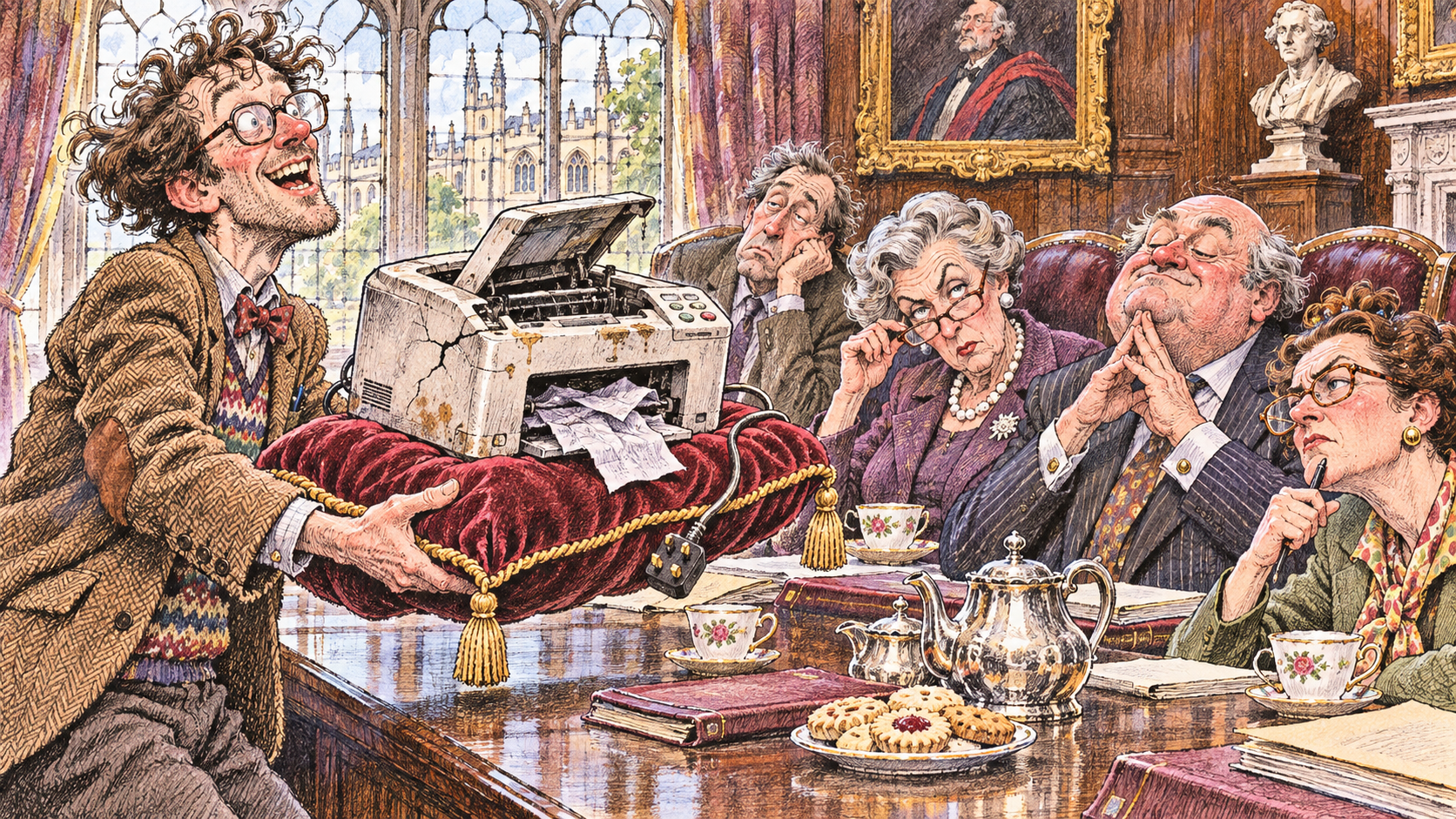
LONDON — A fictional university printer has welcomed parliamentary attention to research leadership and asked whether the resulting confidence could be converted into a toner cartridge before the afternoon submission deadline.
The machine, an elderly model with strong views about paper thickness, has spent years supporting world-class research by making its final administrative stages unexpectedly dramatic.
Research England chair receives endorsement
The Science and Technology Committee endorsed Professor Christopher Smith as the government’s preferred Research England chair on 27 November. Its announcement notes financial pressures across universities. The imaginary printer below is not evidence about his appointment or performance. the committee’s Research England endorsement announcement.
The printer submits its own evidence Our invented researcher, Dr Imogen Vale, has explained that the printer does not represent the whole university sector. It is simply an especially articulate example of what happens when ordinary equipment develops bargaining power.
It accepts a job, considers the implications, then announces that a tray is empty despite visible evidence to the contrary.
Imogen admires its independence. She would prefer it to exercise that independence after producing the budget table.
A fictional grant adviser says institutions must make difficult choices. Imogen agrees, noting that her laboratory recently chose between replacing a chair and teaching everyone how to sit on the surviving one carefully.
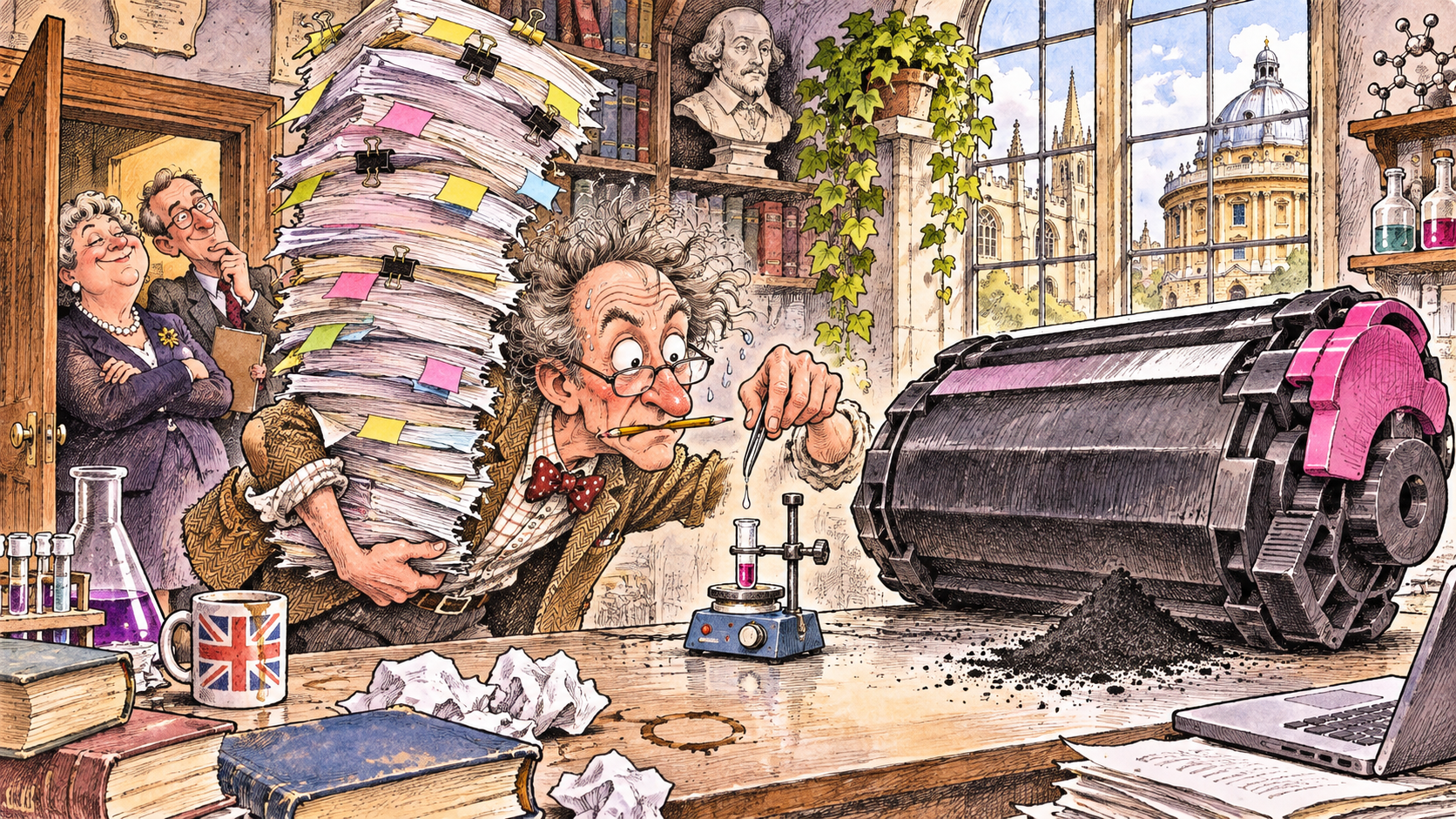
Excellence encounters routine purchasing The department’s imaginary brochure describes an ambitious research environment. Its actual environment includes a kettle, a promising experiment and a purchasing system that considers a modest replacement part an opportunity for philosophical reflection.
A new student assumed senior academics spent their days thinking profound thoughts. Imogen said they did, usually while waiting for authorisation to order something that costs less than the time spent discussing it.
The student has begun to understand institutional complexity.
Leadership meets the small indispensable things Nobody expects one appointment to repair every financial pressure in higher education. The printer is particularly clear on this point, because it would prefer its current request not to become a ten-year leadership challenge.
Good research depends on people, equipment, support and time. Imogen says the last item is often consumed explaining why the first three are needed.
An invented strategy consultant has suggested aligning the printer with the university’s mission. Imogen says it is already closely aligned: it is under pressure, produces important work and periodically makes noises that concern the whole corridor.
The printer has offered to improve its performance if given predictable supplies and a little less inspirational language. This has proved an unusually popular contribution to the discussion.
By evening the submission has been completed using a colleague’s machine. The department celebrates with tea, carefully avoiding the phrase sustainable workaround.
The original printer has been left to reflect. It says it remains committed to enabling excellence, subject to a small paper jam and the outcome of its toner negotiations.
Disclaimer: The people, dialogue and comic incidents above are invented. The linked evidence is factual. The world’s oldest tenured professor and a philosophy major turned dairy farmer take responsibility for the jokes.

Aishwarya Rao is a satirical writer whose work reflects the perspective of a student navigating culture, media, and modern identity with humour and precision. With academic grounding in critical analysis and a strong interest in contemporary satire, Aishwarya’s writing blends observational comedy with thoughtful commentary on everyday contradictions. Her humour is informed by global awareness and sharpened through exposure to London’s diverse cultural and student communities.
As an emerging voice, Aishwarya represents the next generation of satirical journalists: informed, curious, and unafraid to question norms through wit. Her authority stems from research-led writing, respect for factual context, and a commitment to ethical satire. Transparency and clear labelling ensure readers understand the comedic intent behind her work.
Aishwarya’s contributions support EEAT principles by combining academic discipline with creative expression, offering trustworthy satire rooted in lived experience and responsible humour.
Email: [email protected]