
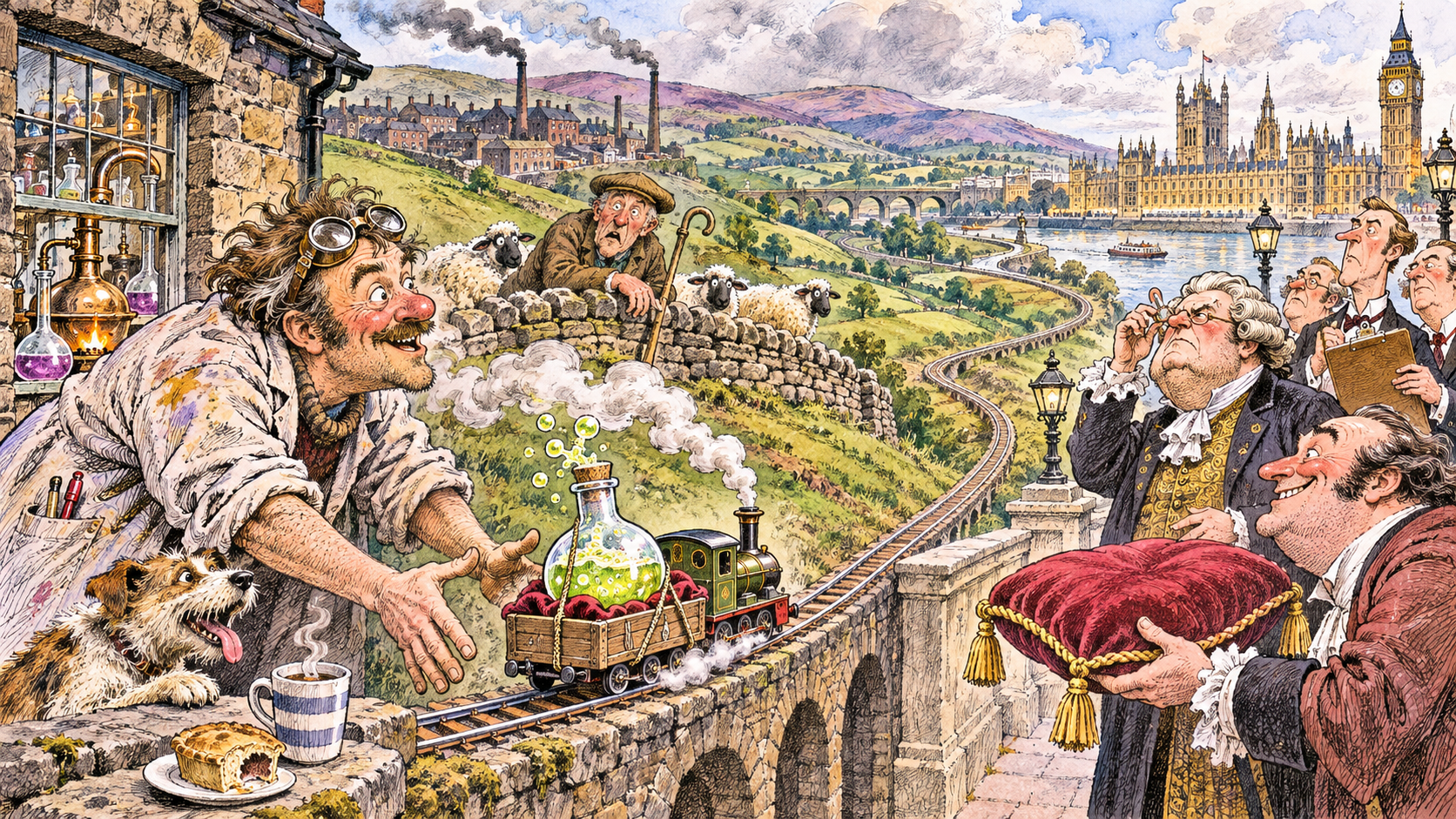
MANCHESTER — An imaginary scientist has welcomed proposals for research devolution, saying a regional experiment should finally be able to produce an inconclusive result without first seeking permission near King’s Cross.
Dr Nell Fraser insists her laboratory is perfectly capable of making discoveries locally. It already possesses curiosity, expertise and a cupboard containing cables that nobody has dared throw away.
Research devolution examines the geography
Council for Science and Technology advice published on 26 November recommends approaches to devolving research funding, including some late-stage R&D while retaining discovery research nationally. Advice is not an implemented nationwide funding transfer. the Council for Science and Technology’s research devolution advice.
The flask prepares for a journey In Nell’s invented laboratory, a promising flask has been fitted with a luggage label. It has travelled to more meetings about regional potential than anyone currently working on the experiment.
A fictional funding official says local knowledge can help identify strengths. Nell agrees, noting that her technicians have known where the unreliable socket is for years without commissioning a national mapping exercise.
Her colleague says the important thing is matching decisions to capability rather than simply moving a logo. He has seen organisational charts relocate successfully while actual purchasing authority remained somewhere difficult to telephone.
The laboratory requests useful freedom Nell does not imagine that every funding decision should be taken in her building. She would merely like the case for local responsibility to be considered before the case for a further coordination layer.
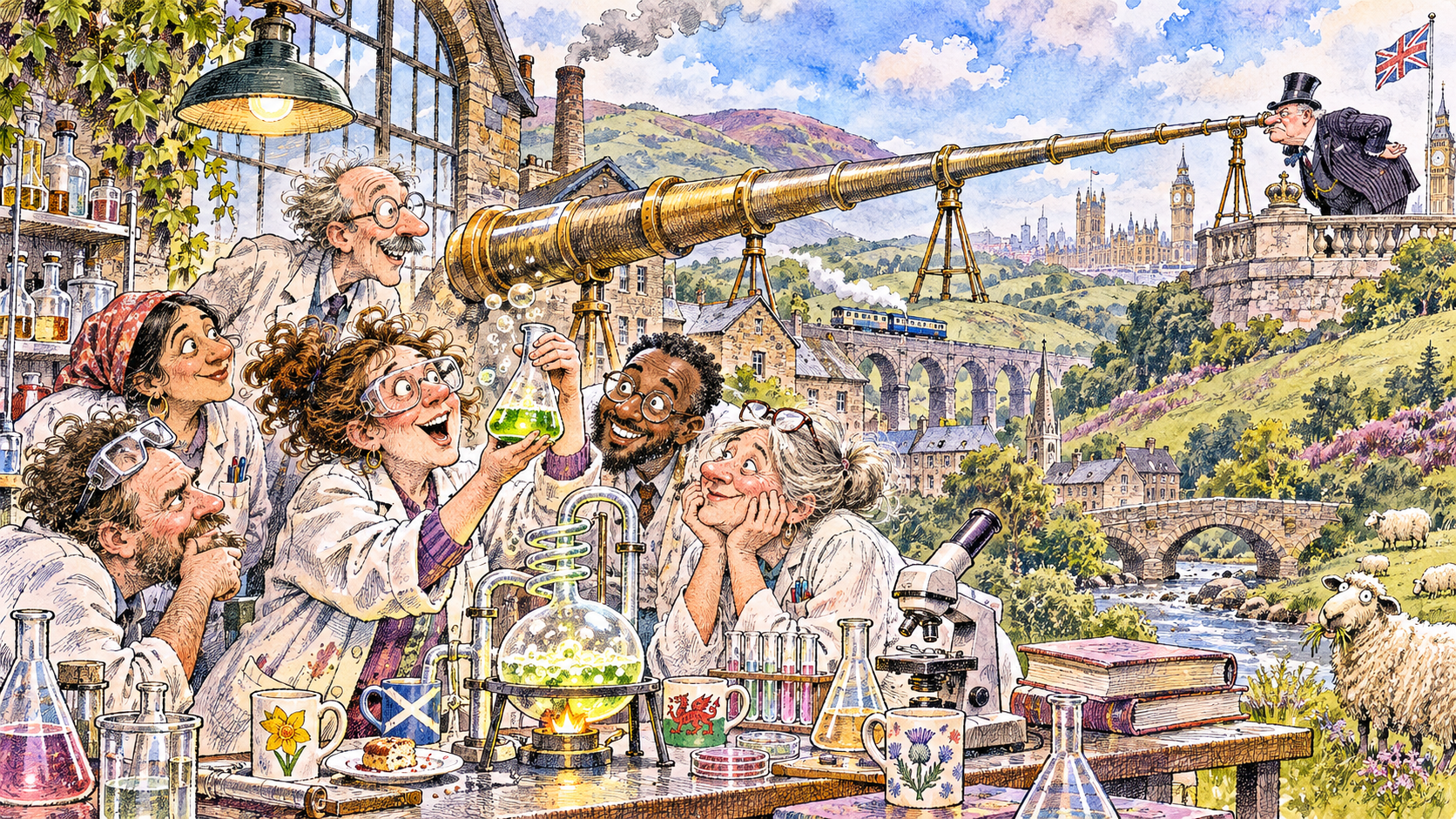
A fictional mayor has promised an innovation corridor. The laboratory has offered to show him its existing corridor, where the lights work intermittently and several useful collaborations happen beside the kettle.
The mayor says he means something more strategic. Nell says she suspected that because nobody had asked how wide it needed to be.
Discovery resists an unnecessary commute Research requires standards, scrutiny and the possibility of failure. Nell would like devolution to preserve those things while reducing the number of journeys made by people explaining that they are about to support them.
Her imaginary experiment has not yet produced a result. This is frustrating but legitimate. The flask objects only to being described as a delivery failure before anyone has finished finding out what it contains.
An invented consultant suggested that uncertainty might damage confidence. Nell explained that uncertainty was rather central to the activity and that removing it would leave the laboratory with a publicity department.
The team has returned to work, cautiously encouraged by the prospect that local expertise may be treated as expertise rather than merely an interesting regional characteristic.
Nell has removed the flask’s luggage label. If it needs to travel again, she says, she would prefer the journey to involve a scientific conference rather than a meeting about whether the conference demonstrates capacity.
The cupboard of unidentified cables has applied for protected status. It believes it represents a uniquely local research infrastructure.
Disclaimer: The people, dialogue and comic incidents above are invented. The linked evidence is factual. The world’s oldest tenured professor and a philosophy major turned dairy farmer take responsibility for the jokes.

Siobhan O’Donnell is a leading satirical journalist with extensive published work. Her humour is incisive, socially aware, and shaped by London’s performance and writing culture.
Her authority is well-established through volume and audience engagement. Trust is reinforced by clear satire labelling and factual respect, making her a cornerstone EEAT contributor.


