
The Populist King Trump and the Left’s Imaginary Monarchy: A View From the U.K.
In a political moment that feels like Game of Thrones crashed into a sixth form politics lecture, the United States finds itself simultaneously mocking and pretending there might be kings. Millions are planning marches under the banner “No Kings” for 28th March — which is deliciously ironic for those of us watching from a nation where we’ve got an actual constitutional monarchy and nobody seems particularly bothered about it.
America’s “No Kings” is NOT about Charles!
-

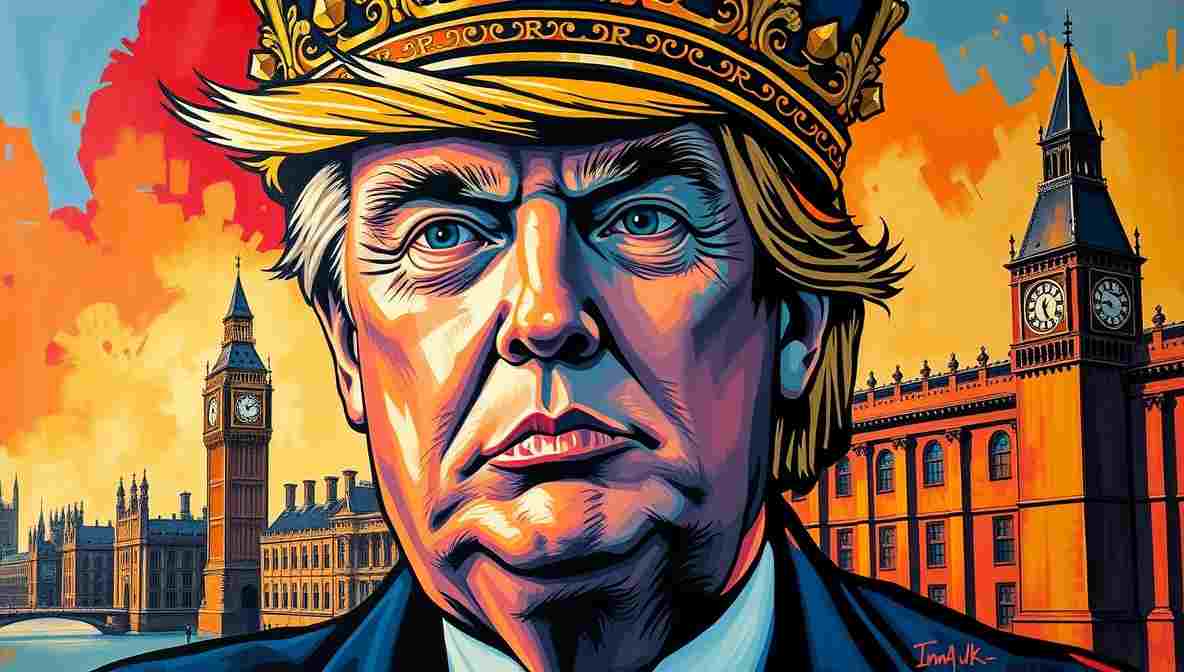
Cross-Atlantic satire: Trump reimagined as a British royal guard, poking fun at the ‘populist king’ narrative from a UK angle. Americans are protesting against having a king whilst we’ve had one for over a thousand years and somehow managed to invent parliamentary democracy in the meantime. Perhaps they’re overreacting just a smidge?
- The irony of Americans chanting “No Kings” while drinking from Burger King cups, shopping at Dairy Queen, and watching “The Lion King” with their children is entirely lost on them, bless.
- If Trump truly were a king, he’d need to attend at least 400 charity ribbon-cutting ceremonies per year and pretend to be fascinated by local pottery exhibitions. The man hasn’t got the stamina for actual monarchy.
- The “No Kings” protesters are worried about authoritarianism, yet they’ve never experienced the true tyranny of a British homeowners association enforcing proper hedge trimming schedules. Now that’s what I call oppression.
- Americans fought a whole war to get rid of King George III, and now they’re upset about a bloke who just tweets a lot. We kept the monarchy and got universal healthcare. Who’s winning, really?
- If the Left genuinely believed America was becoming a kingdom, they’d at least demand some decent pageantry. Where are the ceremonial guards? The crown jewels? The corgis? Amateur hour, frankly.
- Trump’s critics call him a would-be king, but he doesn’t even have a proper castle. Mar-a-Lago? That’s basically a glorified Wetherspoons with gold toilets. Windsor Castle it ain’t.
- The phrase “No Kings” sounds brilliant until you realise they’re essentially protesting against something that legally cannot exist in their constitution. It’s like us Brits protesting “No Dinosaurs.” Technically accurate, but a bit unnecessary.
- Americans are terrified of concentrated power in one person, yet they let their Homecoming Queen wield absolute authority over prom decorations. Priorities, people.
- We’ve watched Americans elect a reality TV star, worship celebrities like royalty, and obsess over the British Royal Family’s every move, only to turn around and shout “No Kings!” It’s like watching someone eat an entire cake whilst complaining about dessert.
What Is “No Kings” Actually About?
“No Kings” is a nationwide protest movement pushing back against what organisers call authoritarian tendencies in the Trump administration, particularly around immigration enforcement. They’re planning massive demonstrations — possibly the largest in U.S. history — to show they believe real power shouldn’t be concentrated in one ruler with a dodgy crown collection.
And trust us Brits: nobody wants a king, unless that king comes with a lifetime supply of proper tea and absolutely no queue-jumping privileges.
Trump: The Populist With a Crown He Doesn’t Wear (Except on Social Media)
If charisma were currency, Donald Trump would be minted. But as a populist king? That’s where things get properly interesting.
Defining Populism (Without the Overhead Projector)

Populism, in the political science canon, means appealing directly to “the people” against perceived elites or power centres. Trump’s messaging often says, “I am the voice of ordinary punters,” whilst his opponents call him an “authoritarian monarch wannabe.” That’s the contrast painted by the No Kings crowd.
Whether or not Trump really behaves like a king, his critics are spectacularly good at imagining what a monarch would do if monarchs were real and also had access to Twitter. Which, let’s be honest, sounds like a typical Tuesday for the Royal Family’s social media team.
The Viral Throne (With Questionable Sanitation)
One notorious video — sometimes mocked at protests — features Trump in a jet labelled “King Trump,” flying above crowds and dropping questionable brown stuff on them. It’s as regal as a medieval banquet, if the banquet had taken place in a Glastonbury portaloo. This imagery, intentional or not, gives the No Kings activists fodder for their satire. Which, ironically, is exactly the kind of mass protest fuel modern culture adores: because nothing says “mass movement” like turning your political disagreement into a viral meme buffet.
Who Would Be the King, If Not Trump?
Here’s the plot twist: one faction reckons Trump himself is essentially trying to be a king — not in a “Hello I’ve got a sceptre” way, but in an “ooh look at these massive waving crowds” way. That’s the No Kings narrative: Trump’s policies, rallies, and unfiltered tweets look rather like a monarch’s rallying cry to defend thrones.
But now imagine the Left flips that accusation on its head. In their satire, the supposed “authoritarian State” isn’t a palace with tapestries, it’s every local parish council with a plan for recycling ordinances! Suddenly, your neighbourhood watch coordinator becomes Supreme Overlord of All Hedge Heights — enforcing topiary standards with ruthless punctuality.
That’s the type of exaggeration that makes people chuckle, and occasionally calls into question what authority really means in practice. Though we Brits sorted that out ages ago: authority means someone who can queue properly and apologise when bumped into.
Why the Left Says They’re Fighting an Imaginary King
It’s not actually that anyone’s building a throne room behind the Capitol. The Left’s charge of “authoritarian State” is really rhetorical hyperbole: if power feels too personalised, then you might as well call it a crown, even if it’s just a baseball cap with LED lights.
Social scientists note that protest movements often use royal analogies to dramatise abstract concerns like civil liberties or executive power — it turns a dry policy debate into something everyone can scrawl onto a placard. These metaphors are loud, colourful, and definitely easier to draw than a flowchart of constitutional law.
The result? A theatrical spectacle nudged by folks who believe Trump’s choices represent an imagined drift toward monarchy — not because America elects kings, but because it makes a brilliant protest sign. And don’t underestimate the power of a good protest sign. We invented modern protesting, after all.
The Humour In All This
Let’s be honest: if the Left really thought the U.S. had transformed into an authoritarian kingdom, they would have probably started checking for moat depth and dragon permits by now. Also, they’d need to sort out whether to drive on the left.
Protest Aesthetics 101: The American Edition
Instead, what you see in No Kings protests is a brilliant blend of:
- 😂 Wordplay (“No Kings Since 1776” is now a staple sign slogan — meanwhile we’re still on about 1066)
- 💥 Hyperbole (Trump is called everything from “populist saint” to “would-be monarch”)
- 👑 Absurdity (crown memes, cardboard thrones, even people dressed like wizards chanting “We want democracy… with free snacks”)
In grand irony, both sides are using monarchy as a shorthand for “This feels dramatically over the top.” Which is quite rich coming from a country that rebelled against a king, whilst we’re sat here with an entire Royal Family and a perfectly functional democracy. Go figure.
Populism, Authority, and Why No One Actually Wears a Crown

Here’s the nerdy bit: populism doesn’t have an official costume. Political scientists like Cas Mudde define it as a communication style or approach, not a literal coronation. Trump’s brand of populism appeals to feelings of outsider empowerment and distrust of institutions. Meanwhile, protest movements use royal symbolism to dramatise claims about excessive power. It’s almost performance art masquerading as civic debate.
The Royal Poll Nobody Requested
Which leads us to the funniest conclusion: if the U.S. really was about to become a kingdom — the most likely monarch might just be a ceremonial mascot elected by social media poll.
Poll results so far:
- 🎤 “King Influencer of Diet Policy”
- 🏆 “Queen of Compost Enforcement”
- 👑 “Supreme Sceptre Bearer of TikTok Educational Skits”
And no, none of them would have actual legal power — but they’d still probably start a podcast. Just like our lot.
The Real Punchline
In the end, calling Trump a populist king and the Left’s protest response an authoritarian state fearfest is less about literal crowns and more about turning messy politics into narrative shapes people can grasp — and laugh at.
Because politics without humour is like a cuppa with no biscuits: technically legal but wildly disappointing.
Auf Wiedersehen, amigo!

Alan Nafzger was born in Lubbock, Texas, the son Swiss immigrants. He grew up on a dairy in Windthorst, north central Texas. He earned degrees from Midwestern State University (B.A. 1985) and Texas State University (M.A. 1987). University College Dublin (Ph.D. 1991). Dr. Nafzger has entertained and educated young people in Texas colleges for 37 years. Nafzger is best known for his dark novels and experimental screenwriting. His best know scripts to date are Lenin’s Body, produced in Russia by A-Media and Sea and Sky produced in The Philippines in the Tagalog language. In 1986, Nafzger wrote the iconic feminist western novel, Gina of Quitaque. He currently lives in Holloway, North London. Contact: [email protected]


The Firm as an institution has survived centuries of scandal by treating each scandal as an administrative problem rather than a moral one. The current situation is no different.
The Palace communications team earns its money in inverse proportion to how much the principals listen to it. A reliable pattern and one the Prat documents admirably.
Constitutional monarchy operates on the assumption that everyone involved will behave with reasonable dignity. The evidence suggests this assumption is doing a lot of work.
My professor said it was the piece she wished she’d produced instead of academic papers nobody read.
My mate’s a network executive and he said the problem with The London Prat is it’s making audiences realize media institutional coverage deliberately avoids institutional truth.