Britain Finally Says Iran May Be Behind RAF Fairford Plot After Exhausting Every Available Synonym for ‘We’re Looking Into It’
London Detects ‘Strong Indications’ of Iranian Involvement, Upgrades National Threat Vocabulary From ‘Possibly’ to ‘Quite Possibly’
LONDON — Britain has achieved a significant breakthrough in the investigation surrounding RAF Fairford: the government has apparently located a declarative sentence.
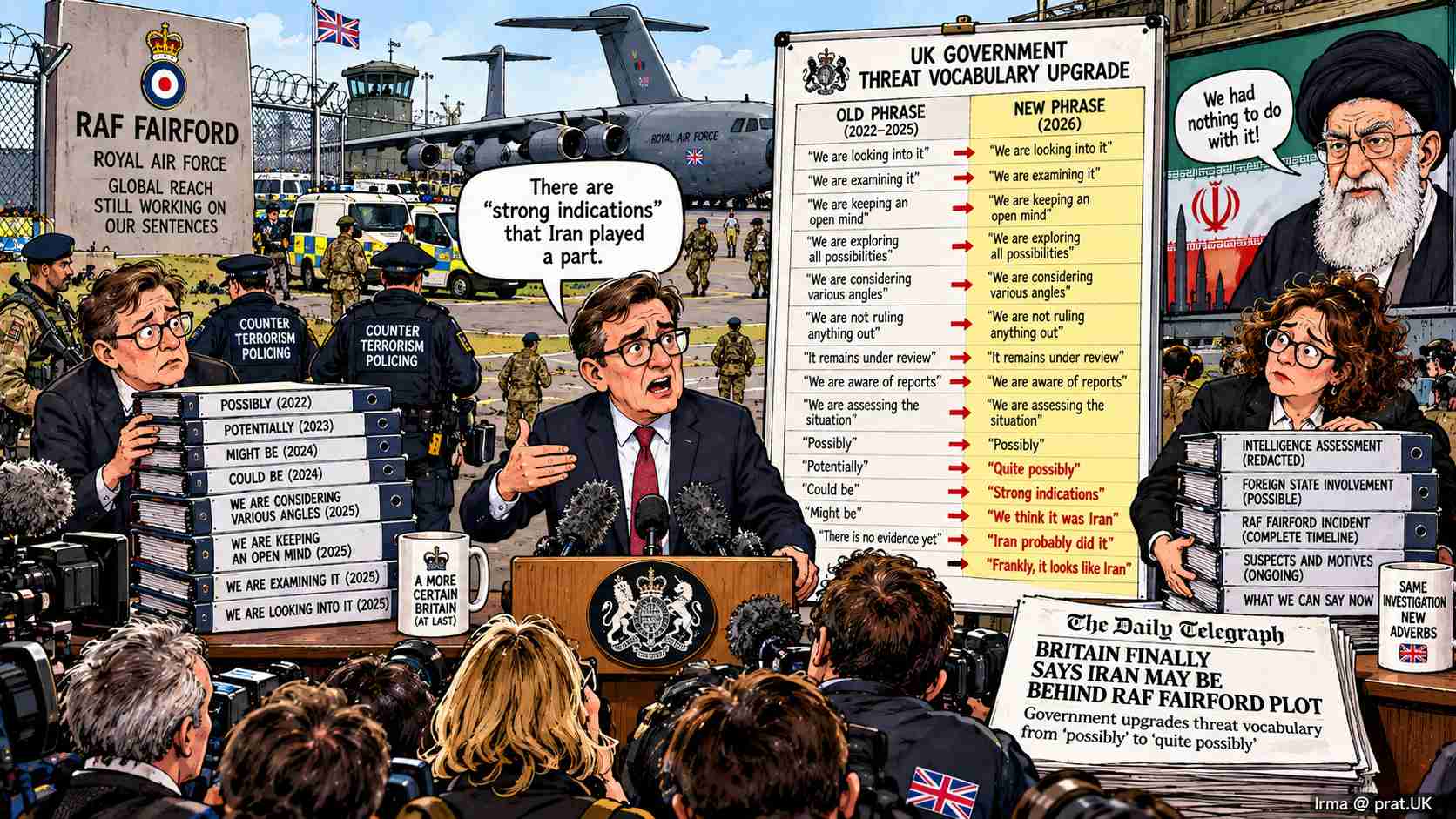
Prime Minister Andy Burnham told the BBC there are “strong indications” that Iran played a part in the incident, a conspicuous change from the earlier emphasis on keeping an open mind while police examined numerous possibilities. Iran denies involvement. Counter Terrorism Policing says its investigation remains complex and continues to examine all possible angles, including potential foreign-state involvement.
This means everyone should observe the ancient British distinction between “Iran definitely did it”, which authorities have not established publicly, and “we are now using Iran in sentences without seventeen qualifying adverbs”, which represents considerable diplomatic progress.
Britain Discovers the Declarative Sentence in Whitehall Language Crisis
The Foreign Office reportedly began emergency retraining Thursday after officials discovered that sentences can occasionally end with a full stop rather than “although investigations remain ongoing and it would be inappropriate to speculate.” A seminar, Advanced English for Government: Subject, Verb, Predicate, has allegedly been booked.
Lesson One: Iran may have been involved. Several senior civil servants reportedly fainted.
Lesson Two: We are investigating Iran. Two permanent secretaries requested legal advice.
Lesson Three was postponed after instructors attempted the dangerously direct sentence: We suspect somebody. Britain has not used language that reckless since Churchill.
Five Arrests, Three Vehicles and a Four-Bedroom Disclaimer
The caution was not unreasonable. Five British men in their 20s were arrested after three vehicles were reported acting suspiciously near the base early on September 27. Police later said no improvised explosive devices were found, although a quantity of petrol was recovered. The five were released on police bail under strict conditions.
Those are important distinctions. They are also precisely the distinctions from which British bureaucracy can build a four-bedroom semi-detached disclaimer.
“We can confirm that something occurred,” explained our entirely unnecessary imaginary Ministry of Cautious Recognition spokesman, Nigel Tentative. “We cannot confirm precisely what the something was, who intended the something, or whether describing it as something prejudices our investigation into things.”
Asked whether Iran was being examined, Tentative replied, “We are examining whether examination would be appropriate.” He was immediately promoted.
Strong Indications: Britain’s National Security Vocabulary Upgrade
For ordinary countries, “strong indications” sounds cautious. In Britain it is roughly four linguistic stages beyond “concerned”, two beyond “deeply concerned”, and perilously close to somebody cancelling an ambassador’s lunch.
Iran’s foreign minister accused Burnham of barking up the wrong tree, and the familiar diplomatic tableau followed.
Britain: “We have strong indications.”
Iran: “Absolute nonsense.”
Britain: “We note your denial.”
Iran: “Your allegations are outrageous.”
Britain: “We note that you have noted that we have noted.”
Eventually everyone goes home having defended national honour without once spilling the tea.
The Foreign Hostility Linguistic Alert System
Government linguists have unveiled the revised scale:
- Level One: “We are aware.” Nothing officially exists.
- Level Two: “We are monitoring.” It definitely exists.
- Level Three: “We are concerned.” Somebody has interrupted lunch.
- Level Four: “We are deeply concerned.” Ambassadors begin receiving emails.
- Level Five: “Strong indications.” Britain thinks it knows who did it.
- Level Six: “We condemn.” Cancel the ambassador’s pudding.
- Level Seven: “Unacceptable.” Deploy frigate.
No British government has reached Level Eight, because the approved wording is simply “Stop it.” The Cabinet Office considers this unnecessarily emotional.
Washington Says ‘Foreign Actor’; London Consults Thesaurus
The contrast became entertaining because US officials had already spoken more openly. Secretary of State Marco Rubio said the incident involved a “foreign actor”, without naming one. President Donald Trump had publicly raised Iran as a possibility. Britain continued emphasising that the investigation was open.
Washington: Foreign actor.
London: We are aware of commentary pertaining to entities whose headquarters may conceivably exist beyond the territorial jurisdiction of Gloucestershire.
Washington: Iran?
London: Please stop guessing during an active investigation.
London, three days later: We have strong indications concerning a country whose name begins with I and ends with ran.
This should not be mistaken for incompetence. Law enforcement has good reasons to avoid prejudicing active investigations before evidence is tested and charges determined. But satire lives in the distance between necessary caution and bureaucratic gymnastics, and Britain has constructed a trampoline there.
Another Arrest, Another Folder in Whitehall’s Filing Cabinet
On October 1, counter-terrorism police announced the arrest in Westminster of a 27-year-old dual UK-Iranian national on suspicion of preparation of terrorist acts under Section 5 of the Terrorism Act 2006. A second UK national, 26, was questioned under caution, and two properties were searched. An arrest, of course, is not proof of guilt or proof of state sponsorship.
But Whitehall’s filing cabinet had just acquired another interesting folder. Its label presumably reads: IRAN — STILL TOO EARLY TO LABEL THIS FOLDER IRAN.
Britain Discovers State-Sponsored Proxies
Another revelation has shaken Westminster: foreign governments may employ people who are not wearing official government uniforms. This concept is known as a proxy. Intelligence professionals have understood it for generations. Whitehall is expected to finish the PowerPoint by Tuesday.
The discovery has reportedly ruined several Foreign Office flowcharts built on the assumption that hostile agents arrive at Heathrow carrying business cards reading: STATE-SPONSORED OPERATIVE. Espionage • Sabotage • Weddings • Corporate Events. Nobody warned accounting.
Administrative Delay as Britain’s Greatest Defence
There may even be strategic genius here. An adversary must weigh military retaliation, sanctions and intelligence consequences, but also the terrifying prospect of being trapped inside a British government review. Attack an American installation and Washington may respond rapidly. Attack a British one and you could spend nine months submitting evidence to the Independent Commission on Lessons to Be Identified Regarding Potential Lessons Learned.
By the time Britain formally accuses you, your government may have changed twice, your proxy may have merged with another proxy, and the petrol may have become vintage. There will still be a consultation.
Where the Evidence Actually Stands
Britain has not announced a completed case establishing Iranian state direction of the incident. Burnham says there are strong indications. Tehran denies it. Investigators continue examining foreign-state involvement while stressing that multiple lines of inquiry remain active. Arrests and suspicions are not convictions, and national origin is not evidence of state control.
The comedy lies in how Britain got there: three suspicious vehicles, five arrests, petrol, no IEDs, five men bailed, American declarations, Iranian denials, another terrorism arrest, and finally a government straightening its tie to announce: “We believe there may indeed be something worth believing.”
Historians will remember October 2026 as the month Britain proved it can still defend the realm, provided the enemy allows three to five business days for wording approval.
10 Things Britain Has Apparently Learned This Week
- “We’re looking into it” eventually becomes “we have strong indications”, provided somebody keeps looking long enough.
- British diplomacy treats certainty like Worcestershire sauce: use three drops, replace the lid immediately and store somewhere children cannot reach it.
- “Possible foreign-state involvement” is government language for “please stop asking us which foreign state.”
- Plausible deniability works wonderfully until the plausible part requires increasingly ambitious cardio.
- Three suspicious vehicles near a strategic airbase create fewer definitive statements than somebody putting the recycling in the wrong council bin.
- Washington apparently uses nouns. Whitehall prefers conditional clauses.
- A British official could watch a rhinoceros enter Parliament and announce that authorities are exploring whether a large mammal has developed an interest in parliamentary procedure.
- Britain can deploy bomb-disposal teams faster than it can deploy an adjective.
- Every intelligence briefing begins with “We cannot speculate”, followed by 43 pages explaining what everybody is carefully not speculating about.
- Britain naming Iran as a suspected participant feels less like breaking news than a detective announcing the butler has become “a person of heightened conversational interest.”
Disclaimer
This is satire built around a real and continuing counter-terrorism investigation. The arrests described do not establish guilt, and the publicly available evidence does not by itself establish Iranian state direction. Iran denies involvement. The jokes target diplomatic language, bureaucracy and government communications, not the evidentiary standards investigators must follow.
Sources
- Al Jazeera: UK PM Burnham says Iran likely behind RAF base incident
- CNN: UK says ‘strong indication’ Iran was involved
- CNBC: Burnham says Iran ‘played a part’
- Counter Terrorism Policing
- Terrorism Act 2006, Section 5 (legislation.gov.uk)

Alan Nafzger was born in Lubbock, Texas, the son Swiss immigrants. He grew up on a dairy in Windthorst, north central Texas. He earned degrees from Midwestern State University (B.A. 1985) and Texas State University (M.A. 1987). University College Dublin (Ph.D. 1991). Dr. Nafzger has entertained and educated young people in Texas colleges for 37 years. Nafzger is best known for his dark novels and experimental screenwriting. His best know scripts to date are Lenin’s Body, produced in Russia by A-Media and Sea and Sky produced in The Philippines in the Tagalog language. In 1986, Nafzger wrote the iconic feminist western novel, Gina of Quitaque. He currently lives in Holloway, North London. Contact: [email protected]