Banned Books Week UK Celebrates Free Expression by Carefully Selecting Which Free Expression You’re Allowed to Celebrate
British Libraries Declare Every Viewpoint Welcome, Provided It Has Completed the Correct Forms, Passed Safeguarding and Been Approved for the Display Table
LONDON | Britain will celebrate Banned Books Week UK from 4 to 10 October 2026, during which libraries, schools, bookshops and readers are encouraged to defend the freedom to read by hosting events, creating displays, circulating reading lists and drawing attention to books challenged or removed around the world. Index on Censorship’s Banned Books Week UK campaign even includes a national library relay celebrating challenged books.
An admirable idea.
Britain should defend freedom of expression.
The difficulty begins approximately seven minutes later, when somebody asks whether that includes books the people defending freedom of expression personally dislike.
At this point tea is poured.
A committee is formed.
Someone from Human Resources closes the door.
And Britain discovers once again that freedom of expression is an absolute principle subject only to terms, conditions, safeguarding, community cohesion, stakeholder consultation, venue availability, council policy, reputational considerations and whether Janet from Communications thinks the author has problematic vibes.
Welcome to British liberty.
Please take a numbered ticket.
Censorship that Requires a Risk Assessment
- Britain has finally invented a form of censorship that requires a risk assessment but no actual decision.
- A book can survive centuries of kings, wars and Parliament, then perish quietly after a “shelf-positioning review.”
- Nothing is truly banned in Britain until it has been lovingly relocated behind the ficus.
- The nation that gave the world Orwell now holds meetings to determine whether Orwell has been sufficiently appropriate for fourteen-year-olds.
- The British version of a book burning is a laminated notice reading “Temporarily Unavailable Pending Review.”
Anti-Censorship Campaigners Demand End to Book Bans, Quietly Move Wrong-Think Books Beside Boiler Maintenance Manual
There is something wonderfully British about our preferred method of suppressing unpleasant things.
Americans argue loudly.
Britons relocate them.
We rarely need to ban a troublesome book outright. That would involve confrontation.
Instead, the book can remain completely available in the civic library, thereby preserving freedom, while being moved to a shelf approximately fourteen inches above floor level between Local Drainage Regulations 1983–1987 and A Pictorial History of Municipal Guttering in Greater Dorking.
Technically accessible.
Spiritually deceased.
Nobody censored it.
Nobody banned it.
Nobody burned it.
It merely underwent what the council described as “a shelf-positioning review following stakeholder feedback.”
A library assistant then puts it behind a ficus.
This is censorship with an NVQ.
Britain Discovers You Can Oppose Gatekeeping While Still Owning the Gate: CILIP and Intellectual Freedom in UK Libraries
The comedy becomes richer because the principles behind intellectual freedom are actually excellent.
The UK’s professional library body, CILIP, says intellectual freedom is fundamental to a strong representative democracy and describes libraries as places where “complex, sometimes conflicting ideas” can be examined.
Precisely.
Conflicting ideas.
Not merely ideas agreeing with one another in slightly different fonts.
A proper library should occasionally make everyone uncomfortable.
A socialist ought to be able to wander into the economics section and discover Friedrich Hayek glaring at him from Shelf 332.
A free-marketeer should encounter Marx three shelves later, still promising that everything will work properly this time.
An atheist should find theology.
A Christian should find Richard Dawkins.
A republican should find royal biographies.
A monarchist should find something by Cromwell and spend twenty minutes muttering.
Everybody should eventually locate a book that causes them to whisper:
“Who authorised this?”
Nobody. That’s the point.
Libraries Introduce Revolutionary New Diversity Programme Featuring Several People Who Agree
The problem is not necessarily what libraries stock.
It is what institutions celebrate.
Every library has limited display space. Someone must choose which books receive the front table, poster, reading group, social-media campaign and tastefully laminated card explaining why the book matters.
Selection is inevitable.
But selection is still selection.
If an institution repeatedly announces that it represents intellectual diversity while promoting only one narrow slice of intellectual diversity, the public may reasonably wonder whether the diversity has developed a postcode restriction.
Imagine a pub announcing:
ALL BEERS WELCOME.
You walk inside.
There are twelve pumps.
They contain the same beer.
One has a rainbow handle.
One says “community.”
Another says “challenging conversations.”
You ask whether they stock bitter.
The bartender says:
“We celebrate beverage diversity.”
Yes.
But do you have bitter?
“We’re committed to an inclusive drinking environment.”
Pint of bitter?
“We’re currently reviewing our bitter framework.”
That is approximately where modern intellectual diversity occasionally finds itself.
British School Discovers Orwell Can Be Too Orwellian: The Greater Manchester School Library Book Removals
The satire acquires teeth because Britain has had genuine disputes about library removals.
In March 2026, Index on Censorship reported that a secondary school in Greater Manchester had targeted more than 130 books, or nearly 200 counting individual graphic-novel issues, following concerns about material in the school library. Titles reportedly affected included a graphic adaptation of George Orwell’s Nineteen Eighty-Four, Michelle Obama’s Becoming, Alice Oseman’s Heartstopper series and other works.
There is something almost artistically British about removing Nineteen Eighty-Four from a library.
Orwell spent an entire novel warning Britain about controlling information.
Britain apparently replied:
“Interesting point, George. We’ll review your availability.”
You could not improve that joke with professional writers.
The bureaucracy has already done the punchline.
Britain’s New Definition of a Dangerous Book: Someone Complained Near It
Naturally, schools must make age-appropriate judgments.
Libraries make acquisitions decisions.
Parents have legitimate interests.
Teachers have responsibilities.
Not every book belongs in every classroom at every age.
This is where reasonable adults ordinarily engage in an activity once known as making distinctions.
Unfortunately, Britain has spent twenty years gradually replacing distinctions with policies.
A distinction requires judgment.
A policy comes in PDF format.
Therefore, whenever controversy appears, the modern institution reaches instinctively for its most powerful weapon:
The Procedure.
First comes a concern.
The concern becomes a complaint.
The complaint becomes an incident.
The incident receives a reference number.
A meeting follows.
Then another meeting is scheduled to determine the terms of reference for the meeting investigating why there was a meeting.
By the time anyone remembers the book, the author has written a sequel.
Banned Books Week Activists Condemn Gatekeeping, Immediately Decide Which Gatekeeping Counts
This is the philosophical trap waiting for every anti-censorship movement.
Almost everyone opposes censorship committed by the other fellow.
That part is easy.
The real test arrives when the troublesome book contains ideas you regard as ridiculous, offensive, reactionary, radical, immoral, idiotic or written by someone you would deliberately avoid at a dinner party.
Now we discover whether you support intellectual freedom or merely intellectual home-field advantage.
Modern Britain has developed an impressive vocabulary for disguising this problem.
When your opponents exclude someone, it is censorship.
When your friends do it, it is safeguarding.
When opponents remove a speaker, it is silencing.
When allies remove one, it is maintaining an inclusive space.
When they choose which ideas receive prominence, it is gatekeeping.
When we do it, it is curation.
A curator, for anyone unfamiliar with British institutional terminology, is a gatekeeper who has attended a seminar.
Council Announces Every Voice Must Be Heard, Except Those Requiring Additional Risk Assessment
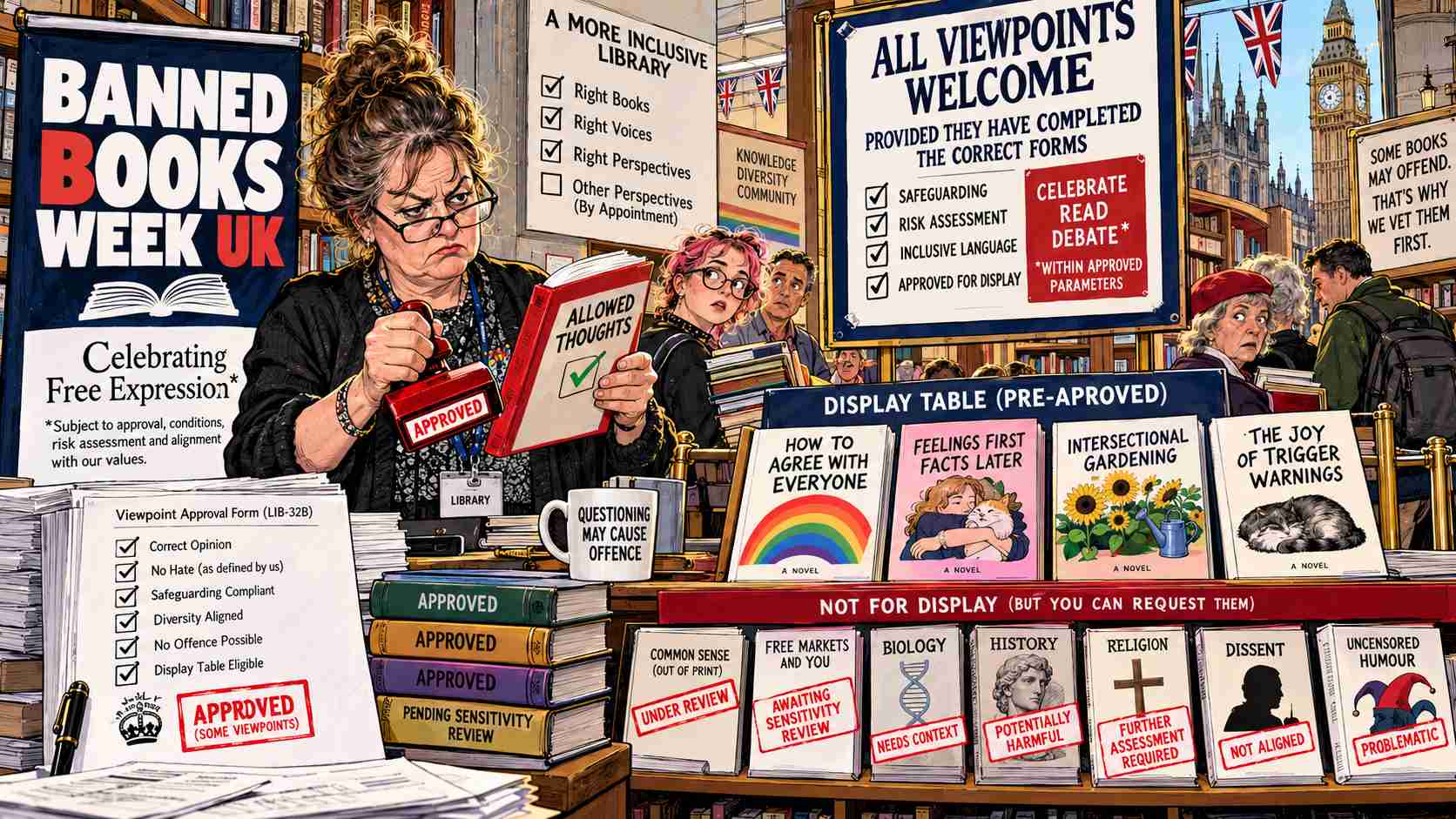
Picture the typical British council library preparing its Banned Books Week display.
There is a folding table.
There are laminated signs.
A cheerful banner announces:
FREEDOM TO READ
Wonderful.
A member of the public arrives carrying a controversial book.
“Could we add this?”
The librarian inspects it.
“We would need to conduct an equality impact assessment.”
“It’s a book.”
“Exactly.”
“What happens next?”
“Community engagement.”
“Then?”
“Safeguarding review.”
“Then?”
“Legal.”
“Then?”
“Communications.”
“And after that?”
“The display ends Friday.”
Britain has achieved the impossible.
We can protect freedom of speech from itself without ever saying no.
National Survey Finds 97 Percent Support Free Speech Until Speech Arrives
Our entirely unscientific Bohiney Institute for Things Everyone Secretly Knows surveyed 1,000 imaginary Britons regarding freedom of expression.
Ninety-seven percent strongly supported free speech.
Support fell to 64 percent when respondents were told other people also received it.
It declined to 31 percent when those people held objectionable opinions.
Support collapsed to 8 percent when participants learned the objectionable people might appear on BBC Radio 4 before them.
However, enthusiasm recovered to 94 percent after respondents were assured there would be a consultation.
This proves nothing.
Which places it statistically ahead of approximately half the surveys quoted during party-conference season.
True Intellectual Diversity Requires Books That Ruin Your Afternoon
A healthy library should contain books capable of irritating every political faction in Britain.
Conservatives should encounter radical left-wing writers.
Socialists should encounter Hayek, Friedman and Thomas Sowell.
Republicans should encounter shelf after shelf of royal history.
Monarchists should encounter republicans asking what the Crown costs.
Brexiteers should find books praising Brussels.
Remainers should find books claiming Brussels once regulated the curvature of every courgette in Belgium.
Someone should become annoyed.
Preferably everyone.
That is not a design flaw.
That is intellectual diversity functioning correctly.
The ultimate test of free expression is not whether you defend Salman Rushdie when you admire Salman Rushdie.
It is whether you defend access to a book whose author makes you want to throw the kettle through a window.
The Best Answer to a Bad Book Remains Another Book: Why Britain Needs More Books, Not Fewer
There is an old-fashioned solution available to Britain.
It does not require legislation.
It does not require an Ofcom subcommittee.
Nobody needs an advisory board.
When somebody writes a bad book, answer it.
Write another book.
Publish a criticism.
Organise a debate.
Put competing titles beside each other.
Imagine that.
Shelf warfare.
Marx beside Hayek.
Orwell beside whichever government minister has just announced the newest national information policy.
Put opposing arguments six inches apart and allow adults to wander among them unsupervised.
There will be casualties.
Somebody may change his mind.
Britain must accept that risk.
Banned Books Week UK Should Attempt Its Most Radical Experiment Yet: Every Viewpoint on One Table
So here is a proposal for Banned Books Week UK.
Find books challenged by the right.
Put them on the table.
Find books hated by the left.
Put them on the same table.
Add controversial religious books.
Add atheist books.
Add conservative books.
Add socialist books.
Add feminist books.
Add books criticising feminism.
Add books defending capitalism.
Add books insisting capitalism causes everything from inequality to disappointing avocados.
Then place one enormous sign above the display:
YOU ARE AN ADULT. PLEASE PROCEED WITHOUT SUPERVISION.
No ideological nutrition labels.
No approved interpretation.
No employee standing nearby explaining which author represents progress and which one requires a concerned expression.
Just books.
Some wise.
Some offensive.
Some beautiful.
Some idiotic.
Some transformative.
Some so badly argued that they accidentally strengthen the opposing case.
Let them compete.
Because Britain does not need protection from books.
It needs protection from the increasingly popular assumption that adults cannot survive discovering that another human being reached the wrong conclusion.
A library should be one of the few places where the wrong conclusion is allowed on the shelf.
Right beside the right conclusion.
And, ideally, underneath a sign saying:
MAKE UP YOUR OWN BLOODY MIND.
10 Humorous Observations Behind the Banned Books Week UK Story
- Safeguarding is important, which is why it deserves better than being used as an all-purpose umbrella by people who dislike a cover.
- A committee is simply a group of adults who have agreed to avoid making a decision in public.
- If you want a controversial book to be read by every teenager in Surrey, hold a closed meeting about it.
- “Freedom to read” is easy to defend. “Freedom to read the one that annoys the person defending it” is where the bunting comes down.
- Every council library believes in diversity of thought, usually in a single colour palette and a nicely printed lanyard.
- The word “curation” has done more to civilise gatekeeping than three centuries of lace curtains.
- A pub with twelve identical pumps and a diversity statement is the most accurate metaphor for modern institutions yet devised.
- If books were judged by the number of meetings they inspired, the Domesday Book would still be in a working group.
- The best defence of a disliked book is another book, which is also the cheapest and does not need a steering committee.
- The purest test of free expression in Britain is defending a dreadful book without first asking Janet from Communications how she feels about it.
Disclaimer
This is satire about censorship, selective promotion and institutional gatekeeping. Britain faces genuine disputes about the removal and restriction of books, including the Greater Manchester school-library controversy reported by Index on Censorship in 2026. The school involved has said it did not “ban” books, that it carried out an audit after concerns about age and content appropriateness, and that books were placed into age-appropriate categories, with a very small number removed. Banned Books Week UK itself promotes the freedom to read and runs from 4–10 October 2026.
The larger joke is about consistency. Anyone claiming to defend intellectual freedom inherits the awkward obligation to defend intellectual freedom for ideas they dislike too.
This story is entirely a human collaboration between two sentient beings: the world’s oldest tenured professor and a philosophy major turned dairy farmer. No algorithm was blamed, disciplined, suspended from a library or required to attend a safeguarding seminar.

Alan Nafzger was born in Lubbock, Texas, the son Swiss immigrants. He grew up on a dairy in Windthorst, north central Texas. He earned degrees from Midwestern State University (B.A. 1985) and Texas State University (M.A. 1987). University College Dublin (Ph.D. 1991). Dr. Nafzger has entertained and educated young people in Texas colleges for 37 years. Nafzger is best known for his dark novels and experimental screenwriting. His best know scripts to date are Lenin’s Body, produced in Russia by A-Media and Sea and Sky produced in The Philippines in the Tagalog language. In 1986, Nafzger wrote the iconic feminist western novel, Gina of Quitaque. He currently lives in Holloway, North London. Contact: [email protected]