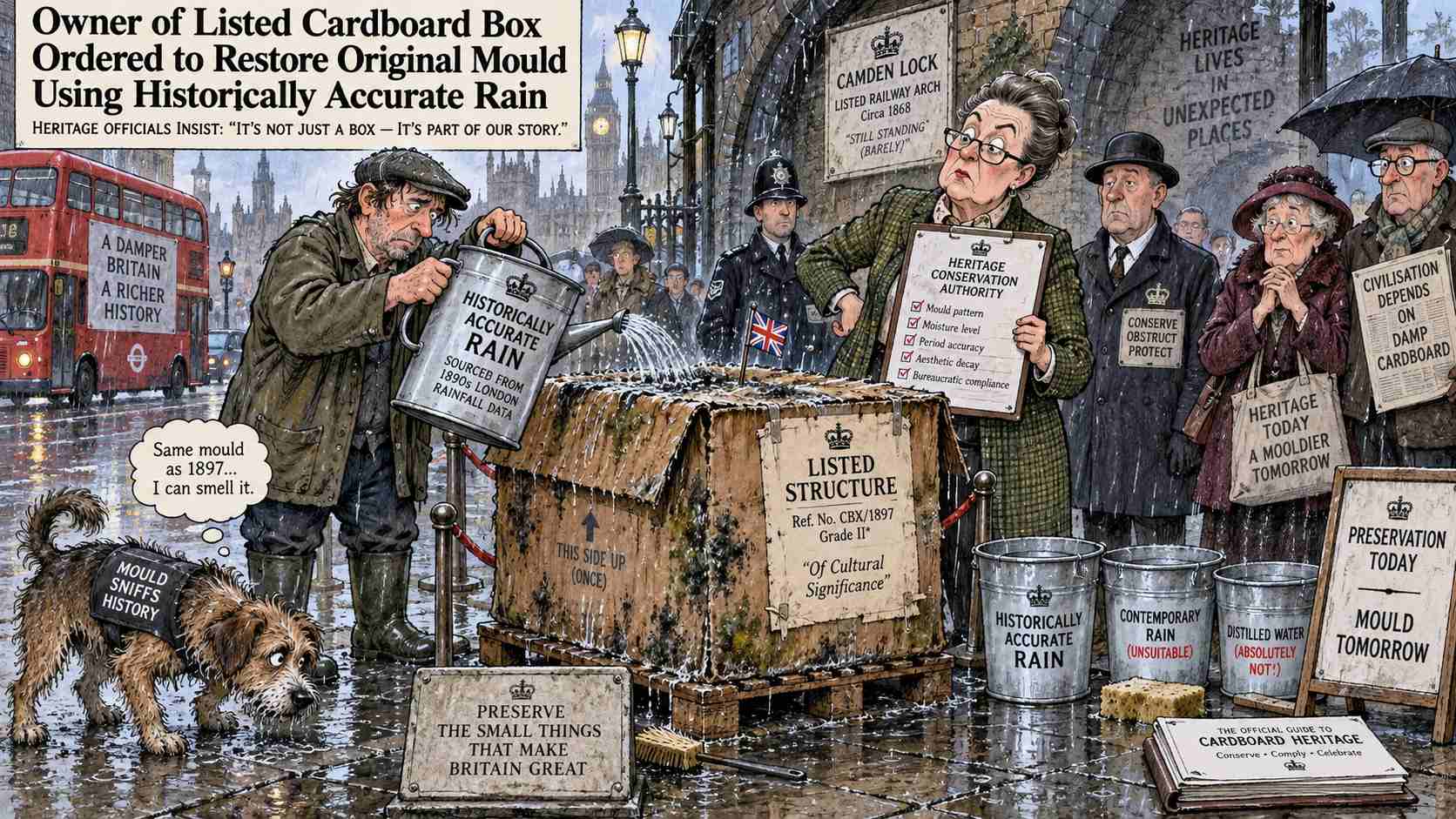
Conservation officials warn that replacing damp cardboard with dry cardboard could destroy an irreplaceable piece of Britain’s housing heritage
Owner of Listed Cardboard Box Ordered to Restore Original Mould Using Historically Accurate Rain
Conservation officials warn that replacing damp cardboard with dry cardboard could destroy an irreplaceable piece of Britain’s housing heritage
LONDON – The owner of Britain’s first Grade II-listed cardboard box has been ordered to restore the property’s original mould after conservation inspectors discovered that several patches of historic mildew had been irresponsibly removed with a supermarket sponge.
The cardboard residence, located beneath a railway arch in Camden, received listed status after officials determined that it represented “an unusually complete surviving example of early twenty-first-century affordable London housing.” Problems began when new owner Rupert Fenwick attempted what he described as “basic maintenance.” Fenwick wiped down the western flap, replaced a rain-damaged Tesco panel and applied two strips of modern transparent tape. Within hours, heritage officers arrived.
Listed Building Consent Meets Cardboard Conservation
“You cannot simply erase history because it smells unpleasant,” explained Dr. Nigel Plywood of the Institute for Vernacular Packaging Architecture. “That green stain may look like mould to an untrained person, but to us it is evidence of authentic metropolitan moisture.” Officials have now demanded the reinstatement of several original defects, including one warped corner, two cigarette burns and a suspicious brown patch believed to date from the winter of 2024. The council has supplied Fenwick with a conservation-approved watering can. He must spray the property every Tuesday and Thursday until the original dampness returns. The process must use genuine London rainwater. Tap water has been rejected as “historically insensitive.”
Fenwick’s application to replace the collapsing roof flap was also refused. Planning documents described the roof as an example of gravity-led vernacular architecture. The council has instead recommended inserting three invisible structural supports costing £14,600. Fenwick asked whether he could simply put another piece of cardboard over the top. Officials reportedly required several minutes to recover.
The Cost of Keeping a Cardboard Box Historically Damp
Local preservation campaigners have praised the decision. “We’ve lost too many historic boxes already,” said campaigner Susan Bramble, pointing toward a nearby alley. “There used to be a lovely Amazon Prime carton there. Beautiful period lettering. Gone now. Recycled. People have no respect.” Property historians say the box represents a key transition in London housing, marking the moment at which sleeping rough became economically indistinguishable from buying a studio flat. Estate agents are already describing the property as “architecturally protected compact accommodation.” Its estimated value has risen to £685,000.
Fenwick is not allowed to alter the exterior, replace the roof, remove the mould or improve ventilation. He is, however, allowed to increase the rent. That requires no planning permission whatsoever. A heritage consultant has now been hired to recreate the precise mildew pattern visible in photographs from last February. The work is expected to cost £22,000. When completed, inspectors will return to confirm that the cardboard box is once again sufficiently damp, structurally questionable and unpleasant to satisfy British preservation standards. Fenwick asked whether the building would then be considered safe. Officials said safety was outside the scope of the listing.
England has around 400,000 listed buildings protected under the Planning (Listed Buildings and Conservation Areas) Act 1990, and an owner who alters so much as a window frame without consent risks prosecution under the same law that governs stately homes. Britain’s chronic shortage of affordable housing has pushed buyers toward ever smaller and stranger properties, from converted shipping containers to former public toilets sold as studio flats, all chasing a ladder that climbs faster than wages do. A system built to protect Georgian townhouses now spends its afternoons debating whether a Tesco panel counts as historic fabric, which tells you rather a lot about which problem Britain has actually decided to solve.
Sources
Historic England’s advice note on listed building consent sets out when owners need permission before altering a protected structure. Historic England also publishes technical advice on installing services in historic buildings, the document Fenwick’s council cited when refusing ventilation improvements.
Readers curious how Americans handle their own strain of housing insanity can find it in Bohiney.com’s news satire coverage.
This is British satire, a strand of London comedy built for readers who like their UK satirical news served with a genuine council letterhead. For more on the tradition behind it, see what makes British humour tick.
Auf Wiedersehen, amigo!

Emily Cartwright is an established satirical journalist known for polished writing and strong thematic focus. Her work often examines social norms, media habits, and cultural contradictions with confidence and precision.
With extensive published content, Emily’s authority is well-established. Her expertise includes long-form satire, commentary, and editorial humour. Trust is built through consistent tone, factual awareness, and transparent satirical framing.
Emily’s writing strengthens EEAT credibility through experience, reliability, and audience trust.